MEXC Review 2026
Suitable for active crypto traders, futures traders, and those looking for a wide selection of altcoins with low fees.
- MEXC is trusted. Tested via live trading.
- MEXC №10 in the crypto exchanges list
Highlights of MEXC

MEXC is an international cryptocurrency exchange founded in 2018. The platform focuses on a wide selection of digital assets and offers spot trading, futures, crypto purchases, Earn products, and copy trading. MEXC emphasizes easy access to the crypto market, a large number of tokens, and low trading fees.
The exchange may be interesting for traders looking for a wide selection of altcoins, active crypto trading, and additional tools such as futures or trade copying.
MEXC Pros and Cons
Pros
- Low trading fees on spot and futures.
- Over 2,000 cryptocurrencies and a large selection of altcoins.
- Offers futures, P2P, Earn, copy trading, Launchpad, pre-market, and API.
- Fast sign-up and straightforward KYC verification.
- Proof of Reserves, 2FA, and other basic security tools are available.
Cons
- Weak regulation and no Tier-1 licenses.
- Opaque legal entity structure.
- Support may respond with templates, and complex issues are not resolved immediately.
MEXC reviews

MEXC
What traders talk about
No reviews yet.
Leave a review of your experience:
MEXC Broker Overview
- Foundation Year
- 2018
- Official Website
- https://www.mexc.com
- Regulated in Countries
- —
- Trading Assets
- Cryptocurrency
- Futures
- Fees (Maker/Taker)
- Spot
- 0% / 0.05%
- Futures
- 0.01% / 0.04%
- Max Leverage
- Spot
- 1x
- Futures
- 500x
- Email Support







MEXC is an international centralized cryptocurrency exchange founded in 2018. The platform was originally known as MXC, and later developed the MEXC brand for the global market. The company positions itself as a service for easy buying, selling, and trading of digital assets, emphasizing a large selection of cryptocurrencies, low fees, high liquidity, and accessibility for users from different countries. The exchange serves millions of users and offers access to thousands of trading pairs.
MEXC’s core business is cryptocurrency trading. The platform offers spot markets, futures, crypto purchases, Earn products, copy trading, as well as listings of new and popular tokens. The exchange targets both beginners who need simple access to the crypto market and active traders who value a wide selection of coins, derivatives, and additional trading tools.
MEXC Review Summary
Reliability and Regulation
MEXC is a major crypto exchange with basic security measures, but weak regulation and an opaque legal structure.
Advantages
- Proof of Reserves and 1:1 reserves.
- Operating since 2018.
- No major publicly known hacks
Disadvantages
- No Tier-1 licenses.
- Opaque legal entity structure.
Our MEXC rating is based on our broker rating methodology, where we analyze regulation, trading conditions, fees, platforms, security, the convenience of deposits and withdrawals, support, and other important parameters. This approach helps objectively compare the broker with competitors and understand which traders it suits best.
Read on to learn more about the pros, cons, reliability, and trading conditions at MEXC.
Reliability and Regulation
MEXC looks like a large, functioning crypto exchange with solid infrastructure, Proof of Reserves, stated 1:1 reserves, and standard account security tools. However, from a regulatory standpoint the platform raises questions: the exchange does not have a transparent set of licenses from reputable regulators, its legal-entity structure is not disclosed clearly enough, and the FSA Seychelles reported that MEXC Global Limited was dissolved and never held a VASP license. Therefore, MEXC can be used for active trading, but with caution: do not keep large sums on the account, enable all available security measures, and check in advance whether services are available in your country.
Licensing and Jurisdiction
| Legal Entity | Regulator |
|---|---|
| — |

MEXC is not among crypto exchanges with strong and transparent regulation. The platform operates on the international market, but does not have licenses from Tier-1 regulators such as FCA, ASIC, CySEC, MAS, or MiCAR. The exchange’s website also lacks sufficiently clear information about which legal entity serves users from different countries and which jurisdiction regulates it.
An additional risk is linked to the FSA Seychelles public statement dated May 30, 2025. The regulator said that MEXC Global Limited was registered in Seychelles as an International Business Company, but was later removed from the register and automatically dissolved. The FSA also emphasized that this company never had permission to operate as a virtual asset service provider under the VASP Act 2024. This does not automatically mean the entire MEXC exchange has stopped operating, but it reduces the transparency of its regulatory profile and requires caution from users.
Regulatory Risks
MEXC’s regulatory risks can be assessed as elevated. The main issue is the lack of clear and strong oversight by reputable financial regulators. In its user documents, MEXC indicates restrictions for a number of countries and regions and reserves the right to change service availability depending on legal and compliance factors.
For customers, this means the service terms may change: certain products may become unavailable, the account may be subject to additional checks, and fiat operations, derivatives, or withdrawals may depend on the user’s country of residence. Attempts to bypass geographic restrictions using a VPN can also lead to blocks or verification issues.
Security of Funds
The exchange offers standard security tools: two-factor authentication, an anti-phishing code, trusted device management, a withdrawal address whitelist, and additional checks in case of suspicious activity.
MEXC also publishes Proof of Reserves data and states that client assets are reserved on a 1:1 basis. This is a positive factor because users can get more information about reserves. However, Proof of Reserves does not replace a full financial audit and does not eliminate risks related to asset management, the exchange’s internal procedures, account freezes, or regulatory restrictions.
In public sources, there is no widely known incident on the scale of the largest crypto exchange hacks in which hundreds of millions or billions of dollars of user funds were stolen from MEXC. But a centralized exchange still remains a custodial service: the user hands control over assets to the platform. Therefore, MEXC can be used for active trading, but for long-term storage of large sums it is safer to use personal non-custodial wallets.
Account Opening
The account-opening process at MEXC looks fast and convenient, and the interface is not overloaded with unnecessary steps. Verification is also straightforward: there is a basic Primary KYC level for access to core functions and Advanced KYC for higher limits and expanded fiat operations. An additional plus is the Rewards Hub with tasks and bonuses for new users.
Registration
Registration on MEXC is available in several ways: via email, phone number, a Google account, or Apple ID. On the start screen, the exchange offers new users a registration bonus and a field to enter a MEXC referral code.
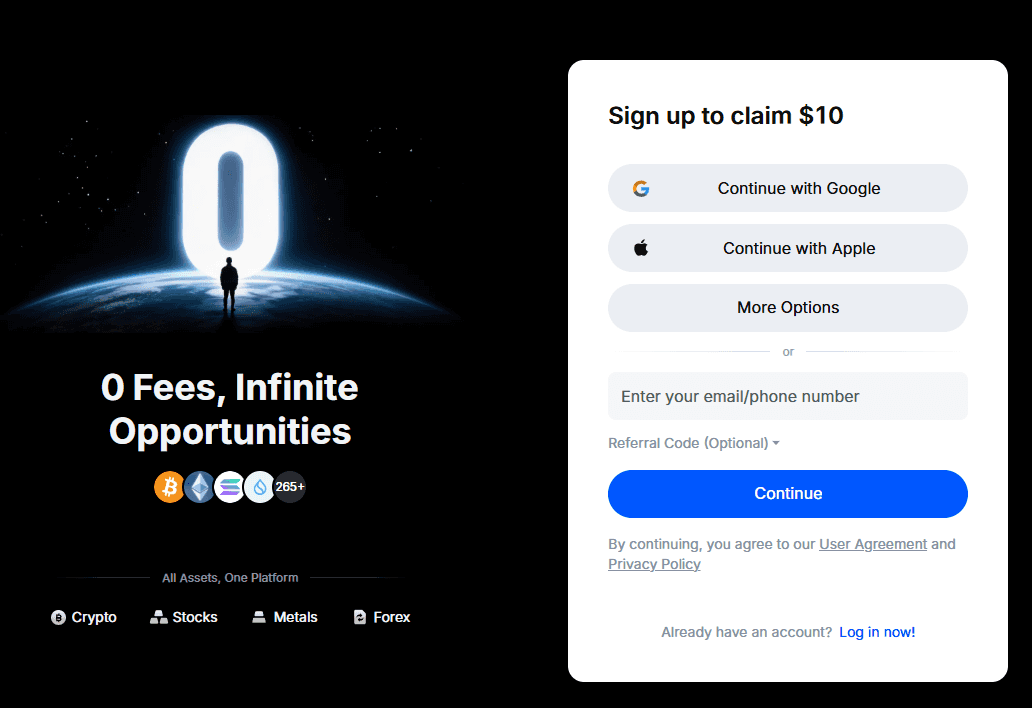
The process is standard for crypto exchanges: the user enters contact details, confirms them with a code, accepts the user agreement and privacy policy. After logging in, it is advisable to immediately enable two-factor authentication, an anti-phishing code, and other protection tools to reduce the risk of unauthorized access.
Verification
MEXC has two KYC levels: Primary KYC and Advanced KYC. Basic verification requires confirming identity using a document, while the advanced level additionally includes face recognition. You can complete verification via the web version of the platform or the mobile app.
Primary KYC gives access to the exchange’s core functions: crypto deposits, P2P, spot and futures trading, and participation in platform events. Advanced KYC is suitable for users who need higher withdrawal limits and access to expanded fiat operations.
Parameter | Primary KYC | Advanced KYC |
|---|---|---|
Requirements | Identity document | Document + face recognition |
Crypto deposit | No limits | No limits |
Crypto withdrawal | Up to 80 BTC per day | Up to 200 BTC per day |
Fiat trading | P2P | Up to 20 000 USD per day |
Spot and futures trading | Available | Available |
Participation in platform events | Available | Available |
For most users, basic verification is sufficient, but active traders and clients who plan to work with large sums or fiat operations are better off completing Advanced KYC.
Rewards Hub
MEXC has a separate Rewards Hub—a section with bonuses and promotions for new and active users. It contains tasks related to registration, completing KYC, funding the account, placing the first trade, trading on the spot and futures markets, and participating in special exchange campaigns.
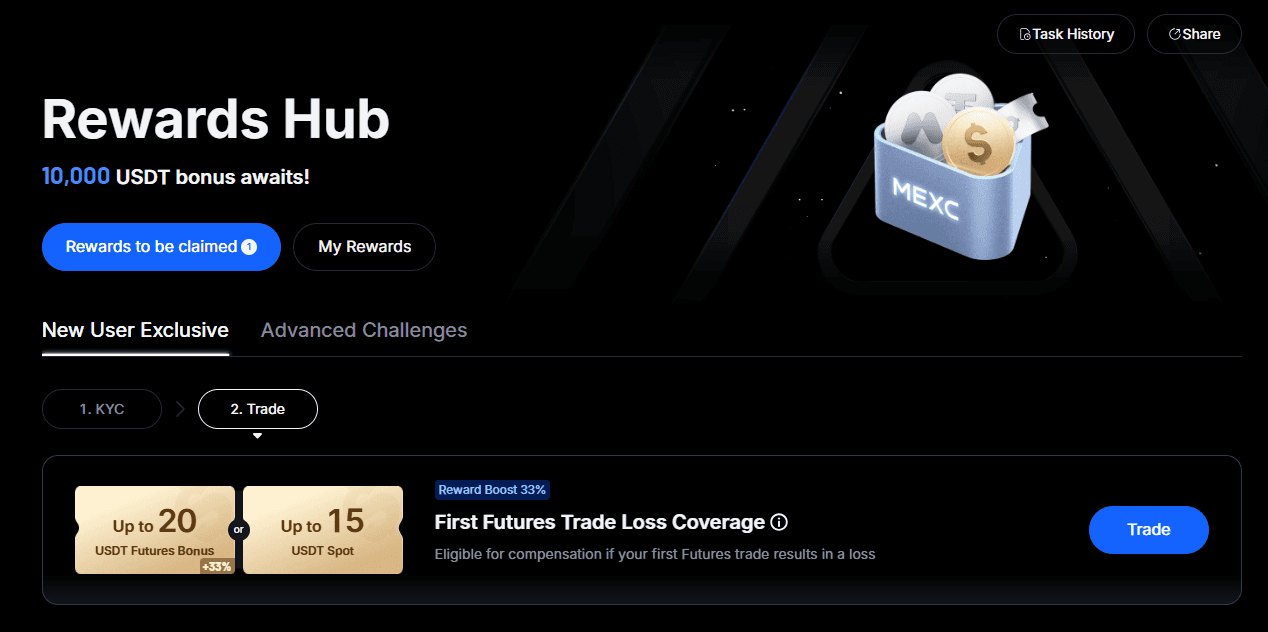
New users may be eligible for bonus rewards, but the amount and availability depend on the region, account status, verification level, and meeting the specific promotion conditions. Bonuses are usually not credited automatically, but after completing tasks—for example, completing identity verification, making a deposit, or reaching a certain trading volume.
It is important to keep in mind that MEXC bonuses often come with restrictions. They may be available only for a limited time, apply to a specific type of trading, or be provided not as freely withdrawable funds, but as trading bonuses, coupons, or fee rebates. Therefore, before joining a promotion, read the rules carefully: validity period, turnover requirements, crediting conditions, and whether profits can be withdrawn.
Account Types
MEXC does not have the classic split into accounts like Standard, ECN, or Pro as forex brokers do. Instead, the user gets a single account with access to different trading and investment sections: spot trading, futures, P2P, Earn products, premarket, copy trading, API, and other services. This format is convenient: you do not need to open separate accounts for different products, but it is important to understand the risks of each instrument individually.
Spot Trading
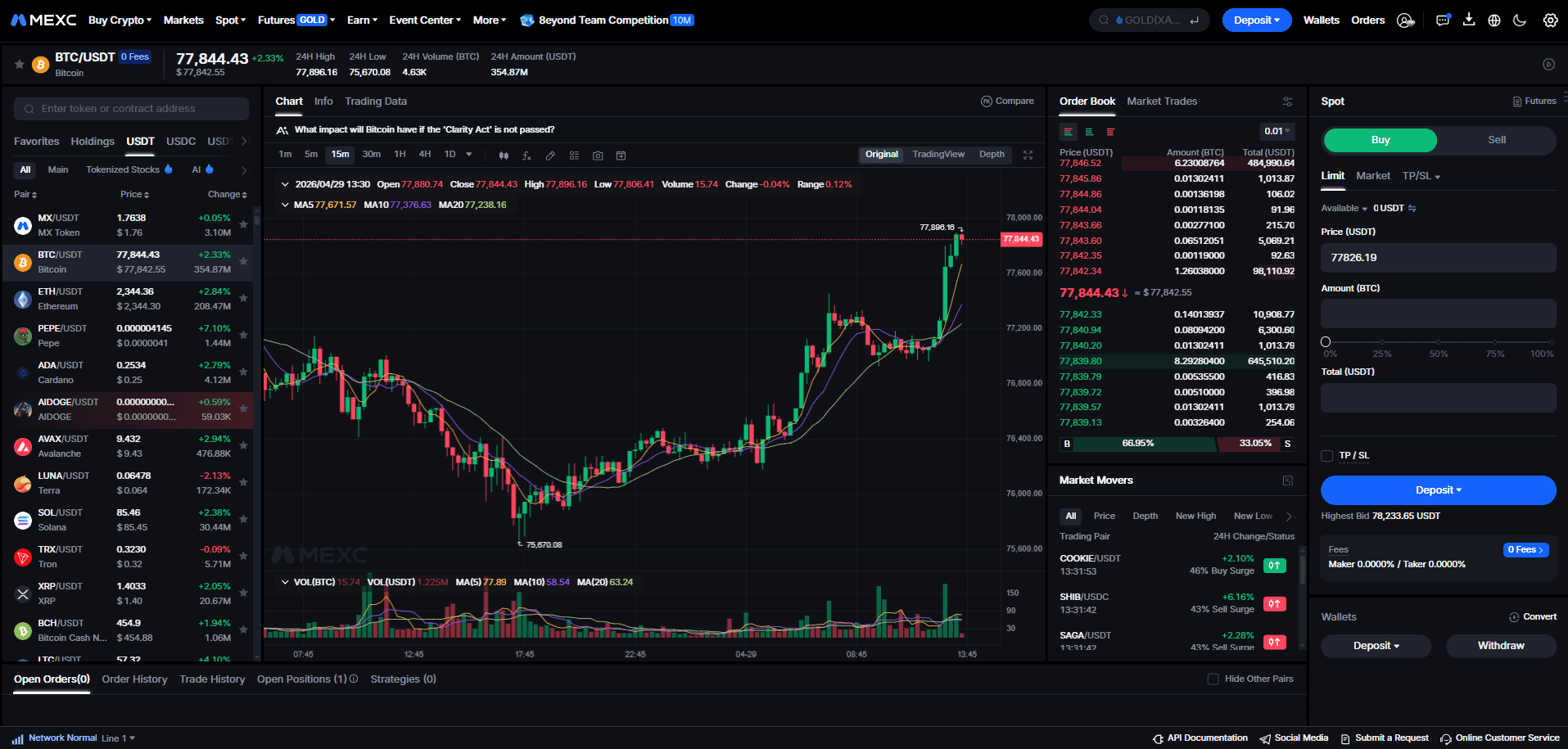
Spot trading is the basic type of operation on MEXC. The user buys and sells cryptocurrencies with the actual crediting of assets to the exchange balance. This section is suitable for exchanging popular coins, trading altcoins, and building a crypto portfolio.
MEXC strongly emphasizes the breadth of available assets: the exchange indicates access to thousands of cryptocurrencies and trading pairs. This is an advantage for users who need not only BTC, ETH, and major coins, but also new tokens. At the same time, a broad listing increases risks: lesser-known assets can be very volatile and have low liquidity.
Futures
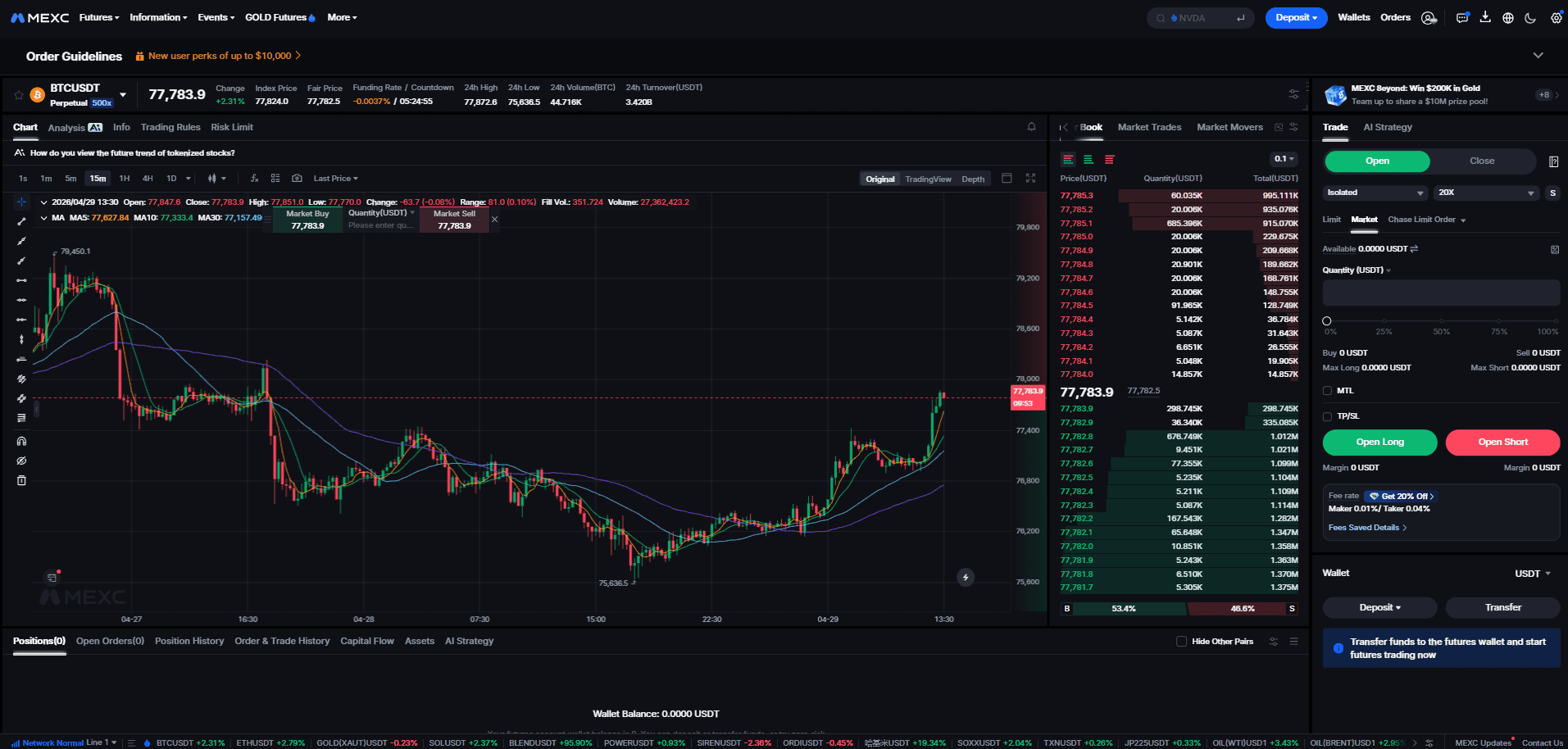
Futures trading on MEXC is aimed at more experienced traders. It allows you to open positions on price increases or decreases, use leverage, and apply different order types. Futures can be convenient for active trading and hedging, but they carry a much higher risk than spot markets.
The key feature of futures is the ability to quickly generate both profit and loss due to leverage and the high volatility of cryptocurrencies. Therefore, this section should not be considered a tool for beginners without an understanding of margin requirements, liquidation, funding fees, and risk management.
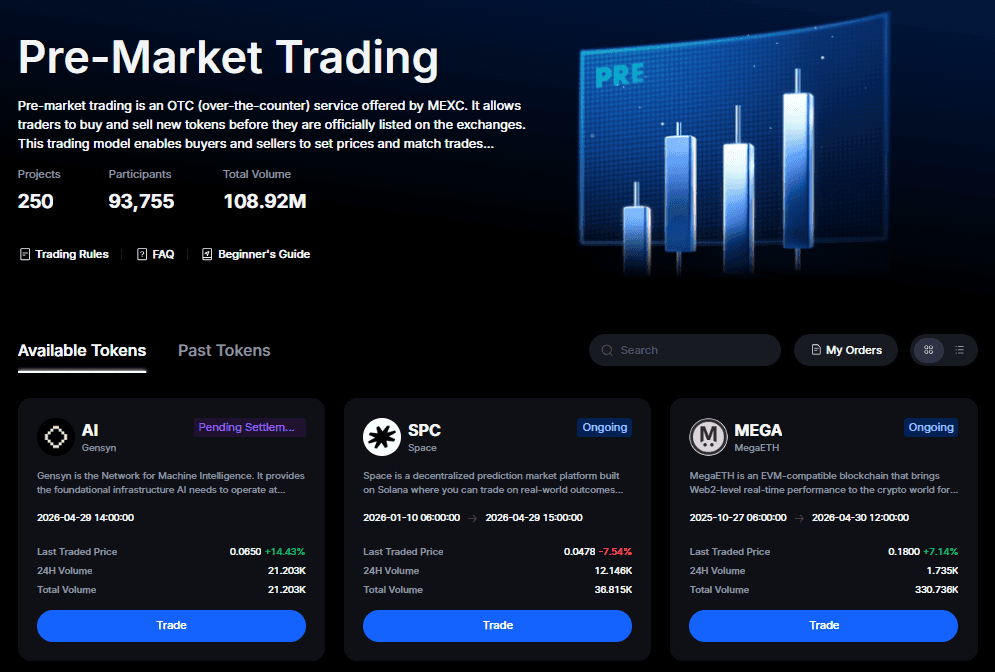
Premarket Trading
Premarket trading on MEXC allows you to buy and sell certain new tokens before their official listing on the spot market. Essentially, it is an OTC mechanism where users place orders at their desired price and wait for a match with a counterparty.
This tool may be interesting for traders who want access to promising tokens before full exchange trading begins. But premarket trading comes with higher risks: the pre-listing price can differ significantly from the market price after launch, liquidity is limited, and if delivery conditions are not met, you may lose your collateral.
Demo Trading
MEXC offers a demo mode for futures trading. It lets you test the interface, orders, and trading strategies without the risk of losing real funds. This format is useful for beginners who want to understand futures mechanics, as well as for experienced traders testing new approaches.
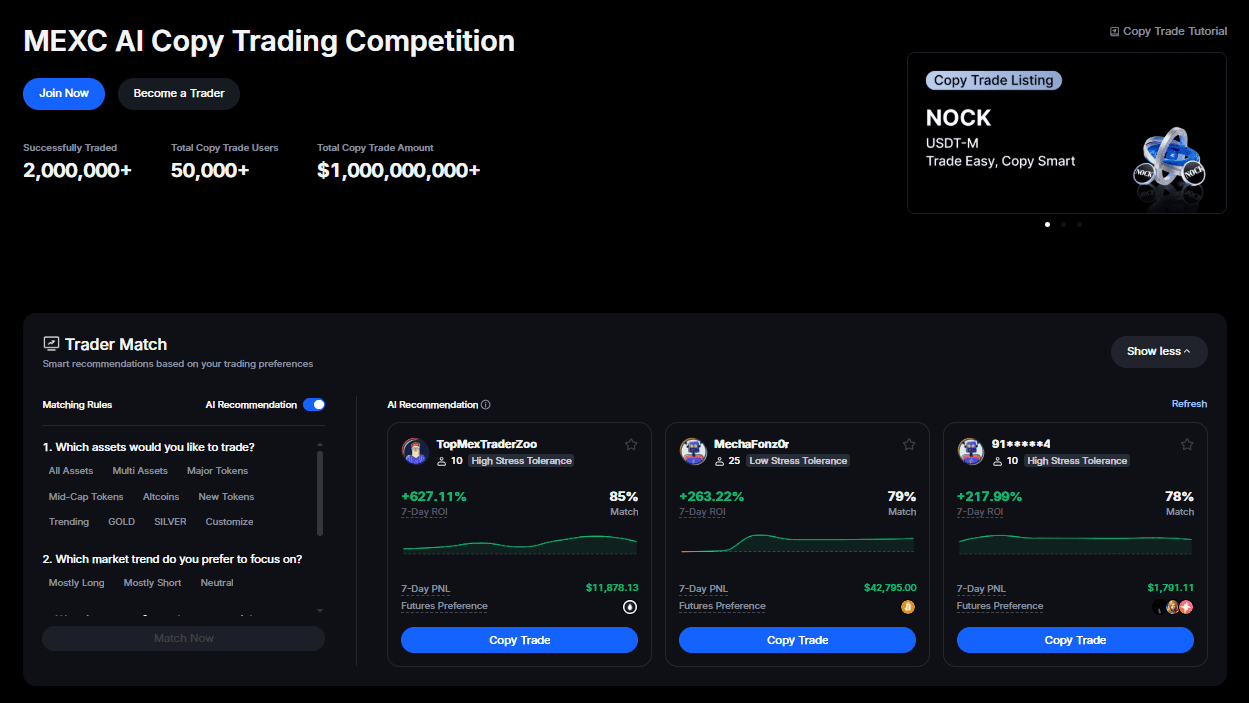
Copy Trading
Copy trading on MEXC allows you to automatically copy other traders’ trades. The user selects a trader or strategy, sets copying parameters, and can participate in the market without manually opening each trade.
This tool is convenient for those who do not want to analyze the market constantly, but it does not eliminate trading risks. A leader’s past results do not guarantee future profits, and losses are copied just like profitable trades. Therefore, when choosing a trader, it is important to look not only at returns, but also at drawdowns, trading duration, strategy style, and risk level.
API
MEXC provides an API for automated trading, market data retrieval, and integration with external trading systems. REST and WebSocket APIs are supported, as well as SDKs and examples for popular programming languages including Python, Java, Go, Node.js, and .NET.
The API is useful for algorithmic traders, market makers, trading-bot developers, and users who need strategy automation. At the same time, it is important to remember that the API connects to a live trading environment, and mistakes in code, key settings, or risk management can lead to financial losses.
MEXC AI
MEXC AI is an AI assistant within the MEXC ecosystem that helps users navigate the market, news, and trading opportunities faster. The service is positioned as a personal crypto AI helper: users can ask questions, get market insights, token analytics, trading ideas, and explanations on how to use the platform.
MEXC AI includes several modules: MEXC-AI, AI Select List, and AI News Radar. The first works as an AI advisor for market analysis and trading scenarios, AI Select List helps highlight potentially interesting assets, and AI News Radar tracks news and links it to trading pairs and market signals. The system uses public market information and platform data to produce analytical conclusions.
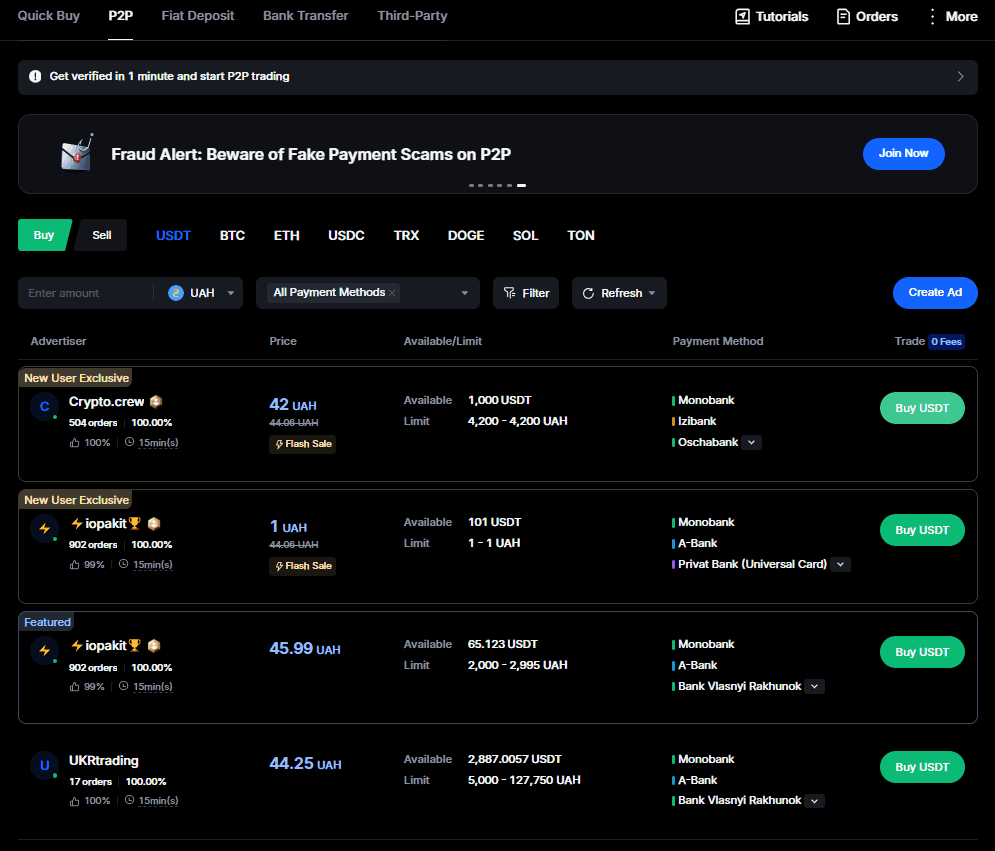
P2P
The P2P section allows users to buy and sell cryptocurrency directly with each other using available payment methods. This format is usually convenient for deposits and withdrawals via local currencies when direct bank funding or withdrawals are unavailable or inconvenient.
The main advantage of P2P is flexibility and the ability to use different payment methods. The main risks are human factors, payment disputes, fraud schemes, and restrictions by banks or payment systems. Therefore, in P2P operations it is important to choose reliable counterparties, check deal terms, and not transfer funds outside the platform’s rules.
MEXC Earn
MEXC Earn is a section for generating passive yield on crypto assets. It is suitable for users who do not want to actively trade part of their funds but want to earn additional rewards for holding or allocating crypto on the platform.
MEXC Earn offers several formats:
Product | Term | Yield | Risk level | Features |
|---|---|---|---|---|
Flexible Savings | Flexible term, funds can be withdrawn | Variable APR, depends on the asset | Low / medium | Suitable for temporarily idle assets; yield is usually lower, but liquidity is higher. |
Fixed Savings | Fixed term | Usually higher than flexible products | Medium | Funds are locked for the selected period; early withdrawal terms may be less favorable. |
On-Chain Earn | Depends on the specific product | Variable, depends on on-chain mechanics | Medium / high | Yield is generated through blockchain staking or DeFi mechanisms; there are market and protocol risks. |
Hold and Earn | No lock-up | Variable APR | Low / medium | Rewards accrue for holding certain tokens in the spot account; assets can be traded or withdrawn. |
Futures Earn | No lock-up | Up to 20% APR under certain conditions | Medium / high | Interest accrues on eligible funds in the futures account and should not interfere with regular futures trading. |
Launchpool / promo products | Limited campaign period | Depends on the promotion | High | You can receive new tokens or bonuses for allocating assets, but the terms and risks depend heavily on the project. |
New User Earn / APR Booster | Limited time | Promotional rates may be higher than standard | Medium / high | Suitable for new users, but usually has limits on amount, validity period, and participation conditions. |
The main advantage of MEXC Earn is the ability to put crypto assets to work without trading them yourself. However, such products are not risk-free: yields can change, terms depend on the specific program, and assets remain on a centralized exchange. In addition, if the price of the underlying cryptocurrency falls, the accrued reward may not offset the market loss.
MEXC Launchpad
MEXC Launchpad is a platform for participating in the launch of new tokens. Users can get access to token sales and new crypto projects at an early stage.
Launchpad is suitable for those interested in initial token offerings and who want to participate in new projects before they fully enter the market. However, such investments are high risk: new tokens can rise sharply, but they can also quickly lose liquidity and value after listing.
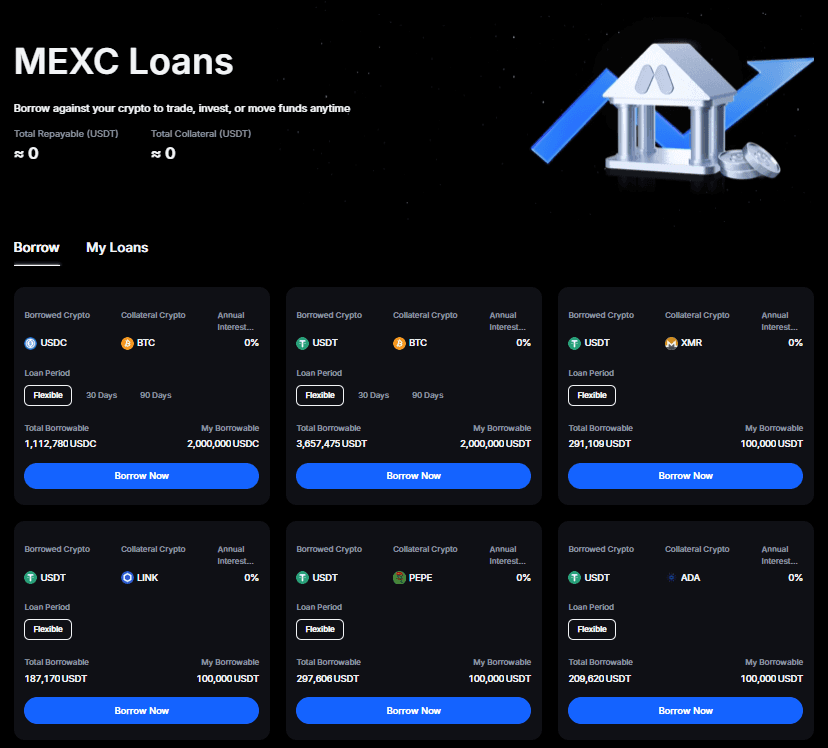
Crypto Loans
MEXC Loans is a crypto lending service that allows users to borrow funds against crypto collateral. This tool can be useful if a user does not want to sell assets but needs additional liquidity.
Crypto loans require special caution. If collateral value falls, you may need to add more collateral; otherwise, the position can be liquidated. Therefore, before using loans, it is important to understand collateral terms, interest rates, tenors, risk level, and forced-closure rules.
Commissions
MEXC fees are quite low. The exchange offers some of the most competitive conditions among crypto platforms: low spot and futures trading fees, free crypto deposits, and additional discounts when using the MX token.
Spot Fees
On the spot market, MEXC uses a Maker / Taker model. The maker fee is 0.000%, meaning limit orders that add liquidity can be filled with no trading fee. The taker fee is 0.050% and applies to orders that are executed immediately against existing orders in the order book.
Fee type | Rate |
|---|---|
Maker | 0.000% |
Taker | 0.050% |
Discount when paying with MX | 20% |
Certain pairs | Zero fees or special terms may apply |
For most users, these conditions look attractive: the taker fee is lower than the standard 0.1% found on many crypto exchanges, and maker orders effectively allow you to trade with no fee. At the same time, terms may differ for certain pairs, so before trading it is worth checking the fee card in the terminal.
Futures Fees
On futures, MEXC fees also depend on the order type and the specific trading pair. For example, for major pairs such as BTCUSDT and ETHUSDT, a 0.010% maker / 0.040% taker rate may apply, while some instruments have zero fees.
Fee type | MEXC Futures fee range |
|---|---|
Maker | 0.000%–0.010% |
Taker | 0.000%–0.040% |
Discount when paying with MX | 20% |
Certain pairs | Zero fee or special rate |
MEXC futures fees remain competitive, especially for active traders.
However, before opening a position it is important to consider not only the trading fee, but also the funding rate—periodic payments between longs and shorts on perpetual contracts. This is not a classic exchange fee, but it directly affects the total cost of holding a position.
Deposit Fees
Crypto deposits on MEXC are free on the exchange side. The user only pays the network fee when sending funds from an external wallet or another platform. After the transaction is confirmed on the blockchain, crediting depends on the selected network and the number of required confirmations.
Withdrawal Fees
The withdrawal fee on MEXC depends on the cryptocurrency and the selected network. For example, withdrawing USDT via different networks can cost differently: TRC20 can be more expensive than some alternative networks, and some networks may temporarily have zero or reduced fees.
Examples of fees and minimum withdrawal amounts:
Asset | Network | Minimum withdrawal | Withdrawal fee |
|---|---|---|---|
USDT | TRC20 | 2 USDT | 1 USDT |
USDT | ERC20 | 10 USDT | 0.5 USDT |
USDT | BEP20 | 2 USDT | 0.01 USDT |
USDT | Solana | 10 USDT | 0.23 USDT |
BTC | Bitcoin | 0.00008 BTC | 0.00002 BTC |
BTC | BEP20 | 0.00002 BTC | 0.00000025 BTC |
ETH | ERC20 | 0.002 ETH | 0.00015 ETH |
ETH | Arbitrum One | 0.001 ETH | 0.000022 ETH |
SOL | Solana | 0.02 SOL | 0.000374 SOL |
These values can change, so before withdrawing you need to check the current fee in the withdrawal window. To reduce costs, it is usually better to choose a network with a lower fee, but only if it is supported by the receiving wallet or exchange.
Deposit and Withdrawal
Deposits and withdrawals on MEXC are fairly convenient: crypto transfers, P2P, buying crypto with fiat via providers, and certain fiat operations for verified users are available. Crypto deposits are free on the exchange side, and the choice of networks helps reduce transfer costs. At the same time, its fiat infrastructure is weaker than that of the largest exchanges: available methods, fees, and processing speed depend on the country, payment channel, network, and the P2P counterparty.
Crypto Deposits
Depositing crypto is the main and most universal way to fund MEXC. For a deposit, the user selects the asset and network and receives a wallet address to which funds must be sent from an external wallet or another exchange. After the transaction is confirmed on the blockchain, the assets are credited to the MEXC balance.
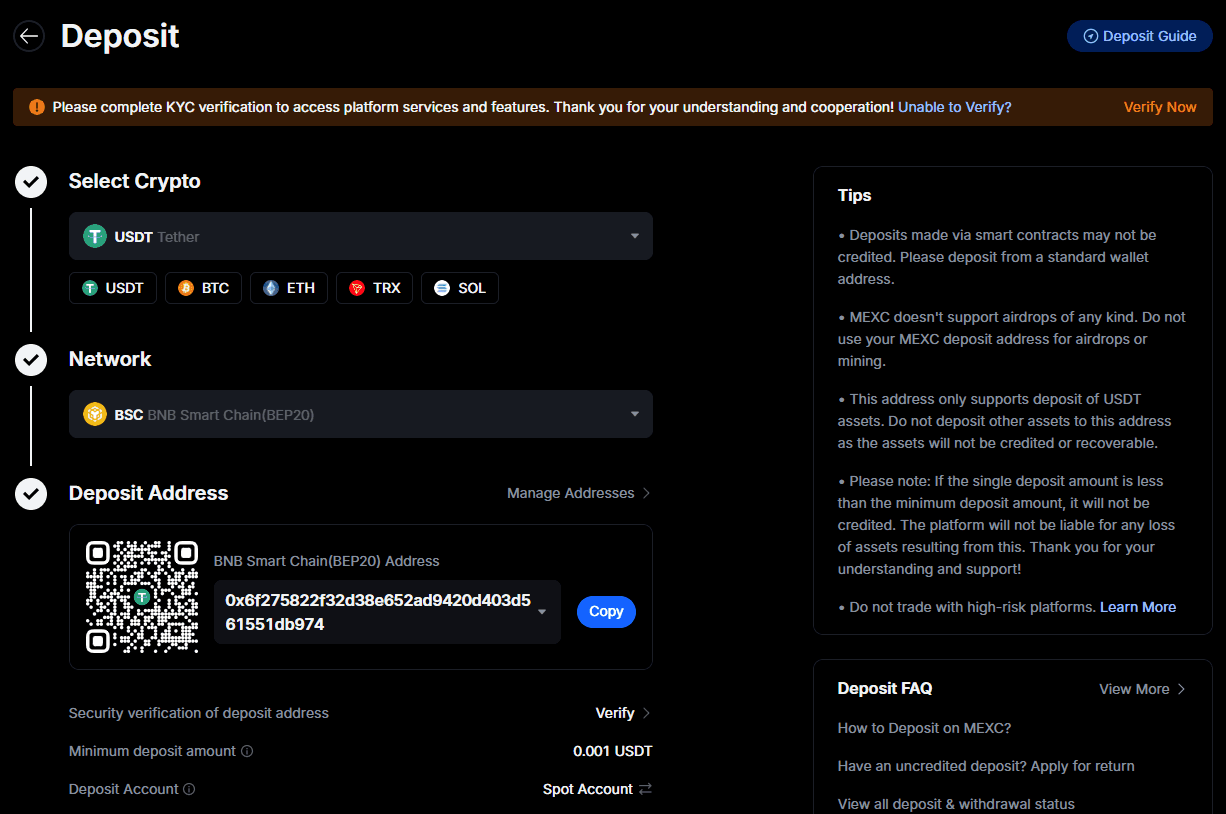
The exchange does not charge its own fee for crypto deposits. The user only pays the network fee on the sender’s side. The crediting time depends on the selected network: fast blockchains may process the transfer in a few minutes, while on congested networks the transaction may take longer.
Fiat Deposits
Fiat deposits on MEXC are not provided as a single universal banking service, but through several tools: buying crypto with a bank card or via third-party payment providers, the P2P market, and certain local methods if they are supported in the user’s country.
The simplest option is to buy crypto with fiat via the crypto purchase section. The user selects the payment currency, the cryptocurrency to buy, and the available payment method. The fee and exchange rate depend on the provider, bank, currency, and region. This method is usually convenient for beginners, but it can be more expensive than P2P or a crypto transfer.
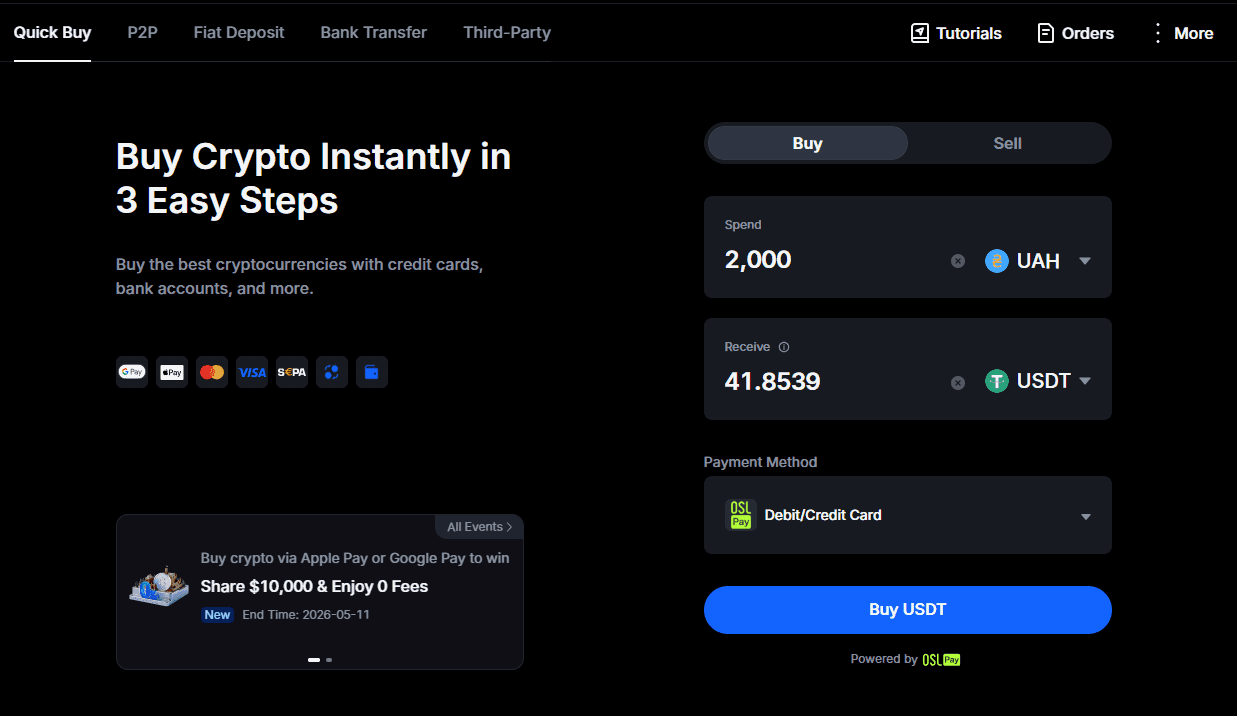
P2P on MEXC lets you buy crypto directly from other users using local currency. The exchange acts as an intermediary and holds the crypto asset until the trade is completed. This method is convenient in countries where direct banking channels are limited, but the final rate depends on the counterparty and trades require careful attention to payment terms.
Crypto Withdrawals
Withdrawing crypto from MEXC is done to an external wallet or another exchange. The user selects the asset and network, enters the recipient address and amount, and confirms the operation using account security methods. Before sending, the system shows the network fee and the minimum withdrawal amount.
The withdrawal fee depends on the coin and the selected network. For example, for USDT fees can vary significantly between TRC20, ERC20, BEP20, Solana, and other networks. Therefore, before withdrawing, it is worth comparing available networks and choosing the one that is supported by the receiving wallet and has an acceptable fee.
Withdrawal time depends on the exchange’s processing of the request and the speed of the selected blockchain. Usually, crypto transfers are processed fairly quickly, but delays are possible during network congestion, wallet maintenance, large transfers, or additional security checks.
Fiat Withdrawals
Fiat withdrawals on MEXC depend on the user’s country, currency, and available payment channels. In some cases, users can use direct fiat methods or third-party providers, but more often the universal solution remains P2P: selling crypto to another user and receiving payment to a card, bank account, or another local payment method.
Unlike crypto withdrawals, fiat operations depend more heavily on banks, payment systems, and regional restrictions. Therefore, speed, fees, and limits may differ for different users.
Limits
Limits on MEXC depend on the verification level, operation type, asset, network, and payment method. For crypto deposits, there is usually no hard upper limit on the exchange’s side, but minimum deposit amounts and network confirmation requirements apply.
For crypto withdrawals, limits depend on KYC. Primary KYC provides access to the platform’s core functions and a withdrawal limit of up to 80 BTC per day. Advanced KYC increases the withdrawal limit to 200 BTC per day and unlocks expanded options for fiat operations.
Account level | Main features | Crypto withdrawal limit | Fiat operations |
|---|---|---|---|
Primary KYC | Deposits, P2P, spot, futures, participation in events | Up to 80 BTC per day | Basic access / P2P |
Advanced KYC | Higher limits and additional fiat options | Up to 200 BTC per day | Up to 20 000 USD per day |
For P2P and fiat operations, limits may additionally depend on the payment method, country, currency, and the terms of a specific listing. Before large transfers, it is better to check current limits in your account in advance to avoid delays and additional checks.
Markets and Products
MEXC offers one of the broadest sets of crypto products among centralized exchanges. The platform focuses not only on basic crypto buying and selling, but also on active trading, early access to new tokens, passive products, P2P operations, copy trading, API, and additional services for advanced users.
Key MEXC markets and services
Let’s look at the key markets and products available on MEXC:
Asset category | Examples | Features |
|---|---|---|
Major cryptocurrencies | BTC, ETH, SOL, XRP, BNB | The most liquid assets with high demand and broad network support. |
Stablecoins | USDT, USDC and others | Used for settlements, trading, and holding funds in a less volatile form. |
DeFi tokens | Tokens of decentralized protocols | High growth potential, but also increased volatility and project risks. |
Memecoins | Popular and new meme tokens | Can rise quickly on hype, but often feature sharp drops and low fundamental resilience. |
AI and GameFi | Tokens of projects in AI, gaming, and Web3 | Depend on sector interest, project quality, and the market cycle. |
New listings | Early tokens and trending assets | Provide earlier access to new markets, but require especially thorough analysis. |
In terms of product breadth, MEXC is closer to large crypto ecosystems than to simple exchangers. The exchange covers the main use cases: buying crypto, active trading, derivatives, P2P, passive yield, early access to tokens, and automation via API. However, some products—especially futures, premarket, loans, and new tokens—are more suitable for experienced users than beginners.
Supported cryptocurrencies
MEXC places strong emphasis on the number of available assets. The exchange offers more than 2000 cryptocurrencies, including major coins, stablecoins, new altcoins, and tokens from popular market categories: DeFi, memecoins, AI, GameFi, Layer 1, and Layer 2.
Broad cryptocurrency support is one of MEXC’s biggest advantages. For traders, this means more opportunities to discover new assets, arbitrage, short-term trades, and participation in early market trends.
Trading Platforms
MEXC offers several ways to access trading: a web platform, mobile apps, and an API for automated trading. This set covers key scenarios: fast trades via a browser, account management from a smartphone, futures and spot trading, as well as connecting trading bots and external systems.
Web platform
MEXC’s web platform is available through the exchange’s official website and does not require installing a separate program.
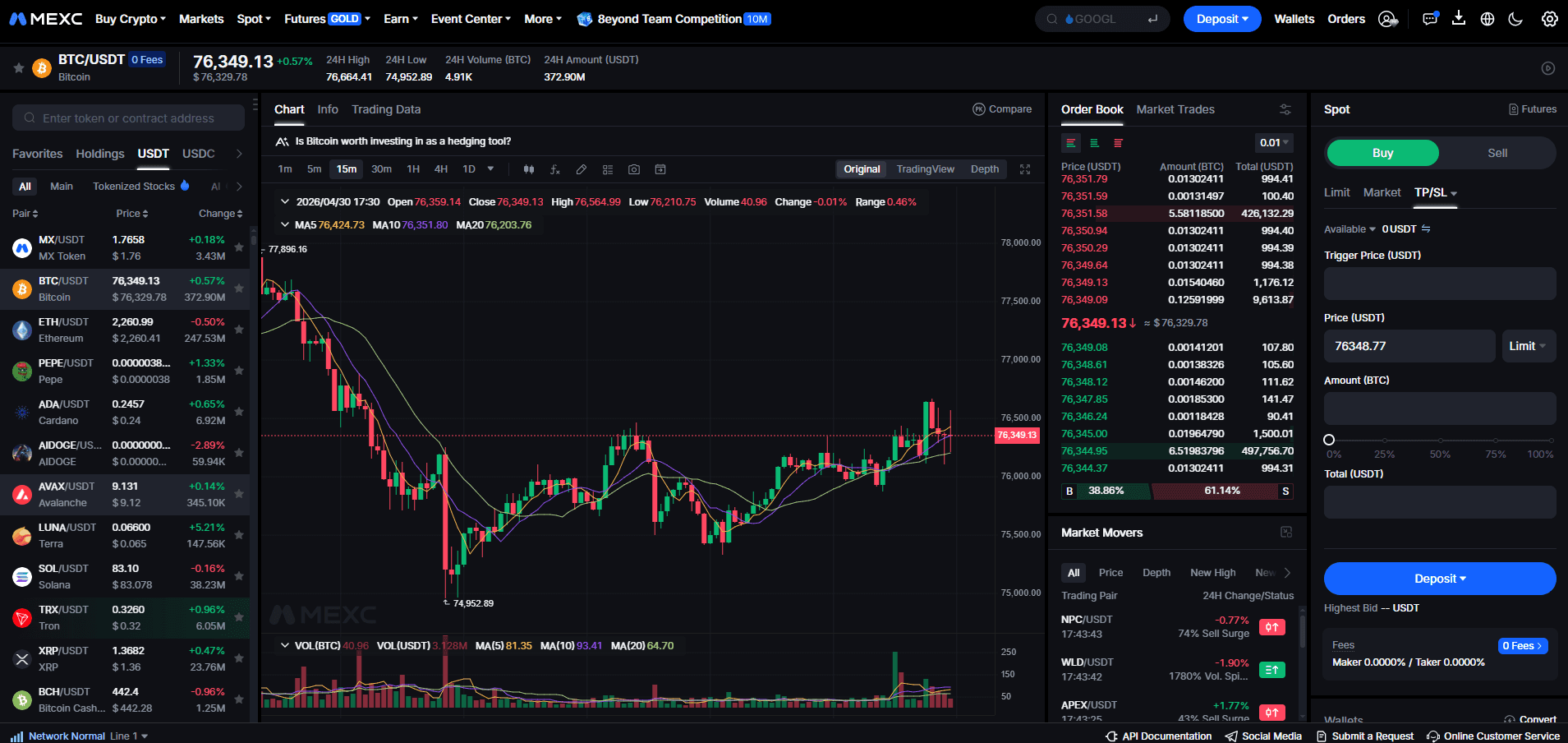
The MEXC trading terminal includes the main elements required for active trading: a price chart, order book, trades feed, order placement form, order history, and a position management panel. Users can work with market and limit orders, switch between trading pairs, choose chart display modes, and analyze price action directly within the exchange interface.
Mobile apps
MEXC offers mobile apps for iOS and Android. Through the app, you can perform most actions available in the web version: buy and sell crypto, trade spot and futures, fund the account, withdraw funds, complete KYC, use P2P, Earn, copy trading, and receive market notifications.
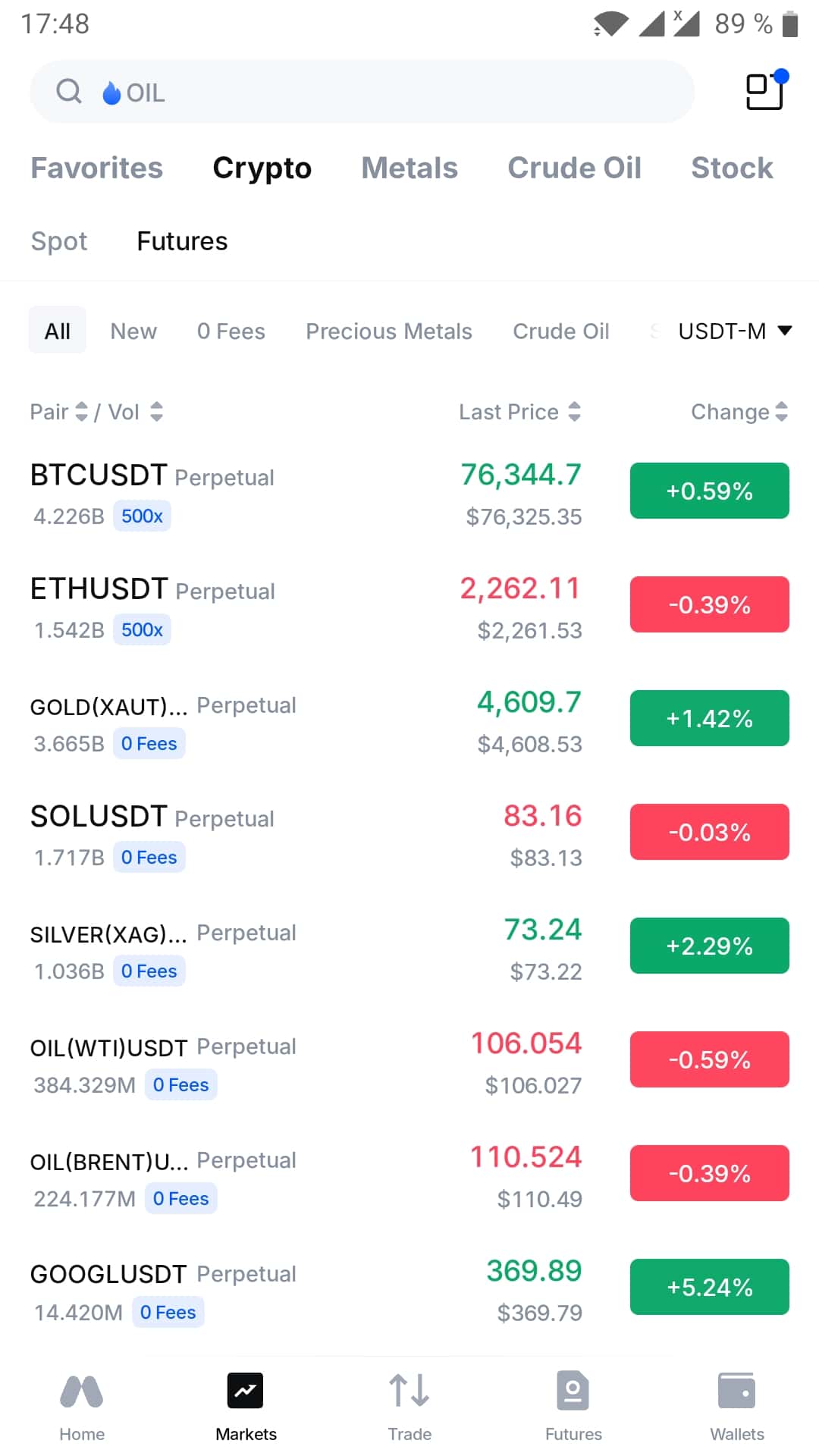
The mobile app is convenient for quick position monitoring and account management away from a computer. It provides charts, trading pair lists, favorite assets, orders, trade history, and balances across accounts. The app is also suitable for verification, as document submission and face checks are easier to complete using a smartphone camera.
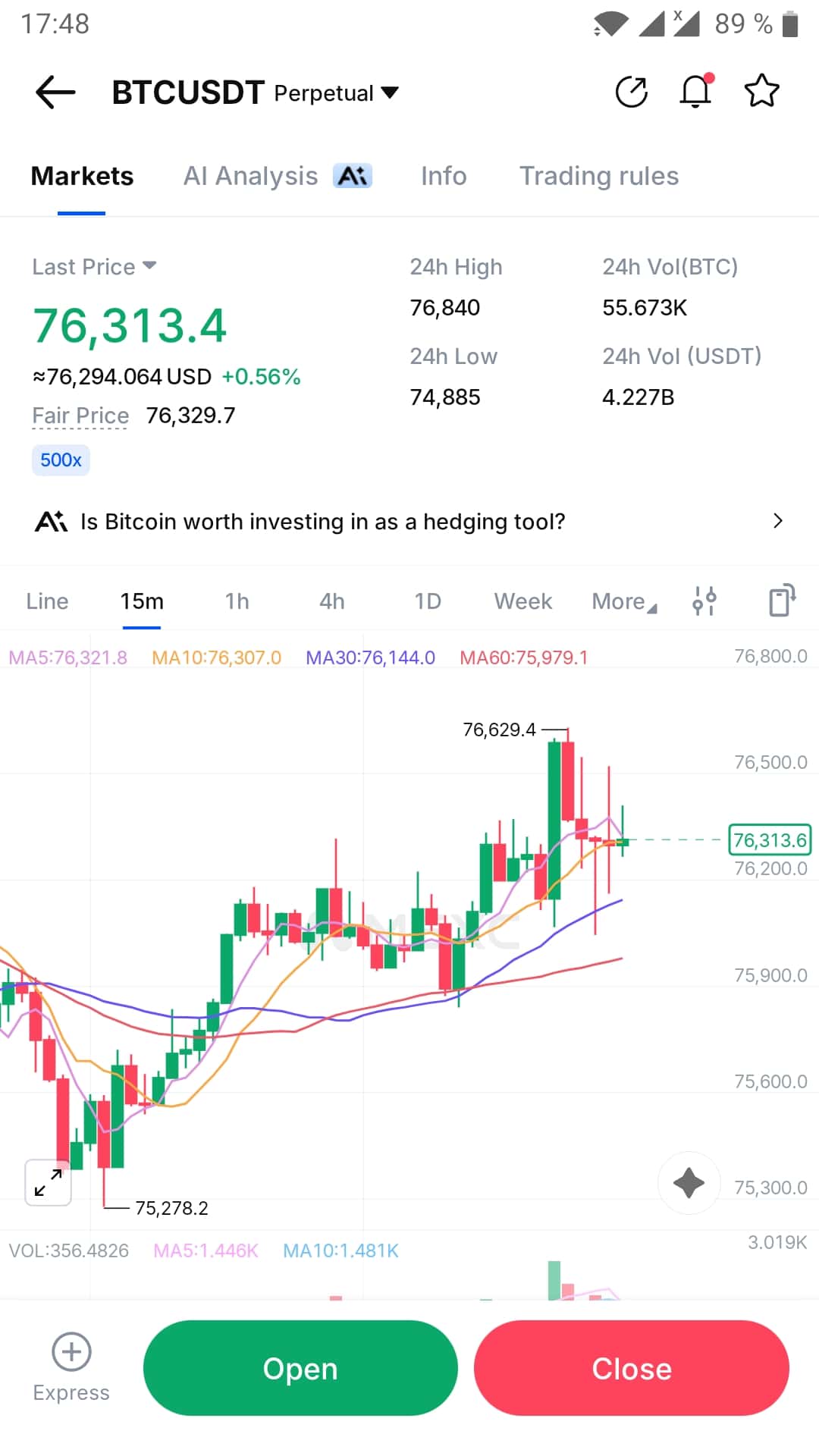
For active trading, the mobile version may be less convenient than the web platform: on a small screen it is harder to analyze charts, the order book, and multiple markets at the same time. But for market monitoring, quick trades, P2P operations, and fund management, the app looks fairly capable.
API and external platforms
MEXC provides an API for users who need trading automation or integration with external systems. Via the API, you can retrieve market data, track balances, trade history, and orders, and—depending on settings—place trading orders. This is useful for algorithmic traders, trading-bot developers, arbitrage strategies, and monitoring services.
The MEXC API supports both spot and futures markets. Typically, two main connection types are used: a REST API for requests and trading operations, and a WebSocket API for streaming data such as real-time updates of prices, order books, and trades.
Analytics
MEXC’s analytics capabilities are aimed primarily at crypto traders who need to quickly assess the market, follow news, and make trading decisions within a single ecosystem. The exchange offers charts for technical analysis, cryptocurrency price pages, a converter, a news section, a blog with educational and market materials, and additional tools such as MEXC AI.
In terms of analytics, MEXC looks stronger than a simple crypto exchanger, but weaker than platforms with full research teams and deep institutional reports. The main focus is on practical information: prices, charts, news, token overviews, asset conversion, and quick access to trading pairs.
Charts and technical analysis
In the MEXC trading interface, you have access to charts, the order book, the trades feed, trading history, and an order placement form. This makes it possible to analyze price movement, track supply and demand levels, assess liquidity, and quickly move from analysis to execution.
For spot and futures trading, different timeframes, charting tools, and basic indicators are available. This functionality suits most retail traders: you can assess trends, support and resistance levels, volumes, volatility, and the price reaction to news.
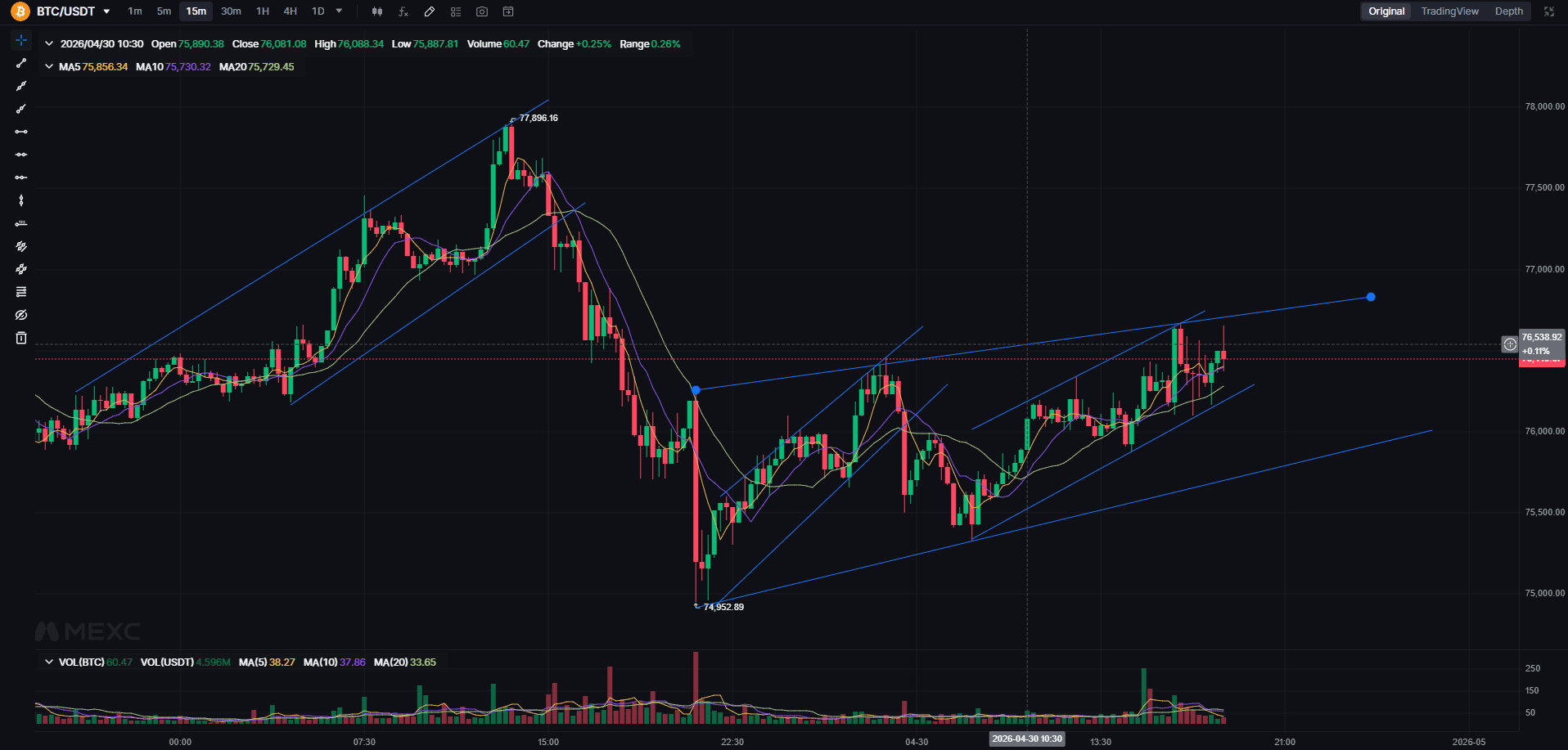
For deeper analysis, traders can complement the built-in charts with external services, for example TradingView, portfolio trackers, or their own tools via the API. This is especially relevant for those who use algorithmic strategies, arbitrage, or analyze several exchanges at once.
Crypto news
MEXC has a dedicated cryptocurrency news section. It publishes market updates, news on specific coins, industry events, and materials on BTC, ETH, SOL, XRP, DOGE, ADA, and other popular assets. Trending news selections are also available, helping you quickly understand which topics are influencing the market right now.
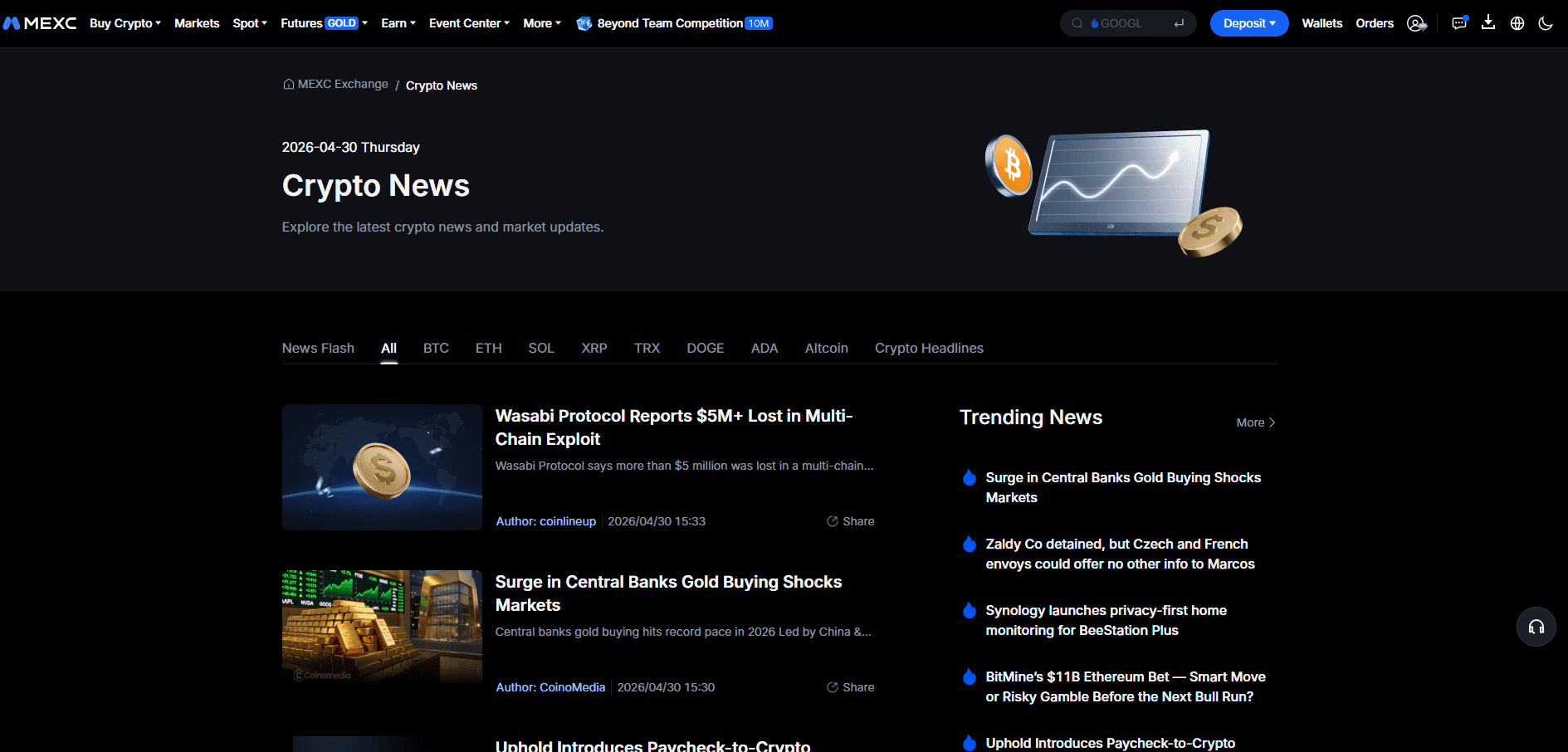
The news section is useful for active traders because cryptocurrencies often react sharply to listings, regulatory statements, hacks, protocol upgrades, macroeconomic events, and large capital flows. Having news inside the platform shortens the path from information to a trading decision.
Crypto converter
MEXC offers a crypto and fiat currency converter that lets you quickly calculate the value of one asset in another. Users can select a currency pair, for example USD/PEPE, BTC/USDT, or other combinations, enter an amount, and get a calculation at the current rate.
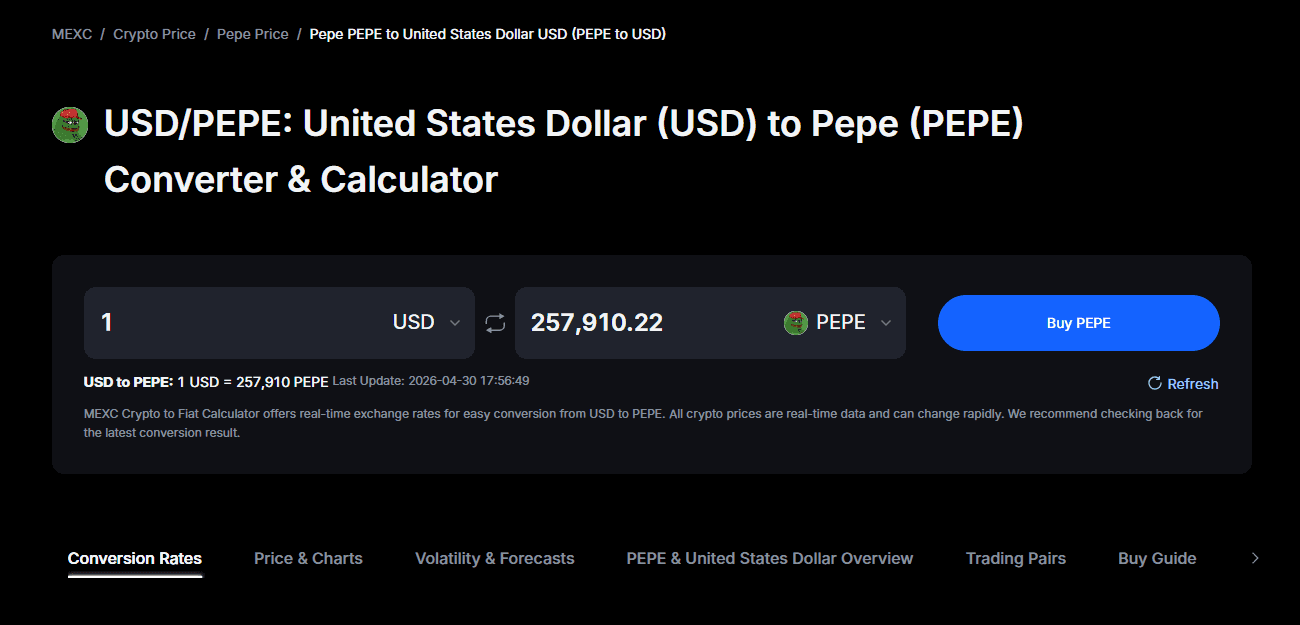
The converter is handy for basic calculations: estimating position value, converting profit or loss, comparing a token price in fiat, and preparing for a purchase.
Blog and news
The MEXC blog includes educational materials, exchange news, press releases, token reviews, market commentary, and articles on specific crypto market sectors. You can find posts about listings, fees, new products, promotions, and market trends.
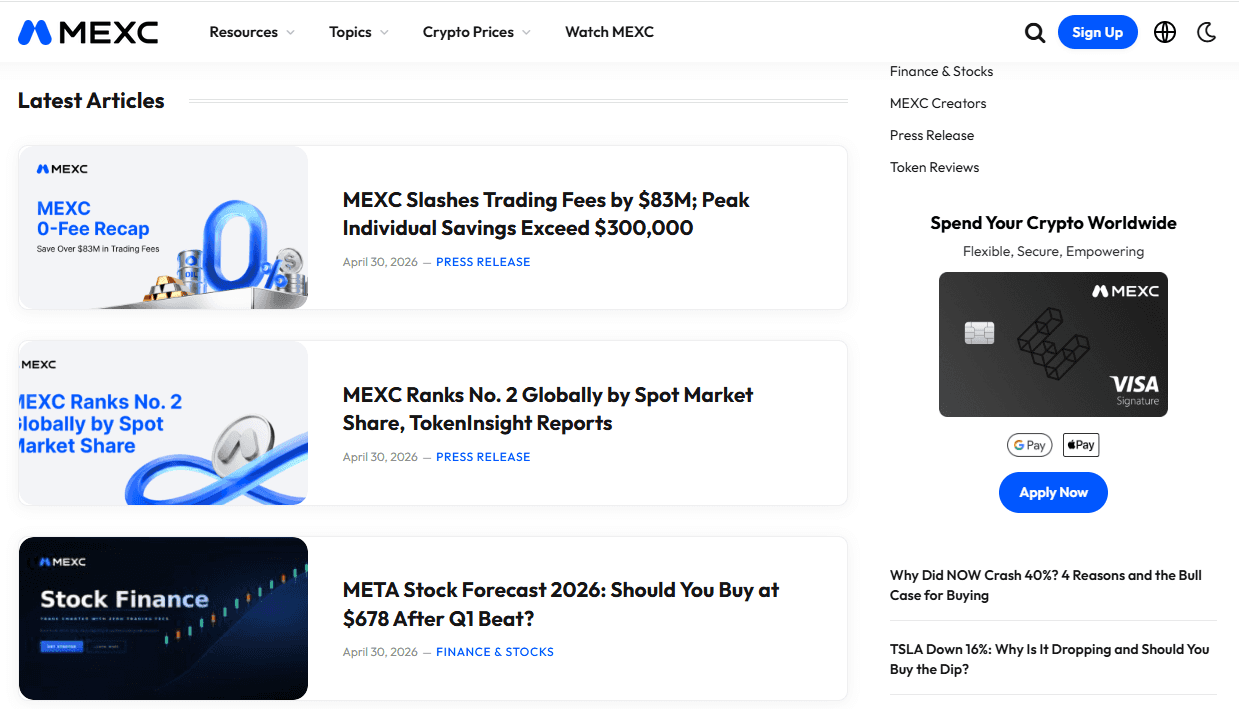
For users, it is a useful additional source of information: the blog helps you follow platform updates, new trading opportunities, changes in terms, and the listing of new assets.
Education
MEXC offers a basic educational setup for users who want to understand cryptocurrencies, trading, and the platform itself. The main learning materials are collected in the MEXC Learn section, and practical instructions on the account, verification, deposits, withdrawals, and exchange products are available in the Support Center. However, in terms of depth and structure, the educational base is weaker than Binance Academy: MEXC has fewer full courses, structured programs, and foundational educational materials on blockchain.
MEXC Learn
MEXC Learn is the exchange’s educational section that publishes articles, guides, and explanatory materials about cryptocurrencies, trading, and platform products. Here you can find beginner materials: how to buy crypto, how spot trading works, what futures are, how to use P2P, and what risks exist with crypto loans, Earn products, and new tokens.
A separate part of the materials is dedicated to MEXC products: premarket trading, Launchpad, copy trading, API, fees, bonuses, and account security. This format is useful for users who want not only to open an account but also understand how specific exchange sections work.

MEXC Learn is more like a practical knowledge base than a full academy with sequential courses. Its strong point is the applied nature of the materials: users can quickly find an explanation of a specific feature and move on to using it. But for an in-depth study of blockchain, DeFi, tokenomics, or technical analysis, it is better to also use external educational sources.
Support Center
The MEXC Support Center is a reference section with instructions on using the platform. It contains answers to practical questions: how to register, complete KYC, fund the account, withdraw crypto, set up account security, use spot trading, futures, P2P, Earn, copy trading, and other products.
Support Center materials focus more on step-by-step solutions to specific tasks than on theory. This is convenient for users who need to quickly understand the interface, find rules on fees, limits, verification, bonuses, or resolve a transaction issue.
Customer Support
MEXC support looks sufficient for typical tasks: regaining access, setting up 2FA, checking deposit status, questions about withdrawals, KYC, and using trading sections. However, as with many large crypto exchanges, resolving complex situations can take longer—for example, with an incorrect transfer network, an uncredited deposit, an account lock, or additional security checks.
Support channels
MEXC offers several ways to get help:
- Live chat — the main channel for contacting support. Available via the website and the mobile app. Users can describe the problem, get automated suggestions, or reach an agent.
- Support Center — a reference section with instructions and answers to common questions about the account, KYC, deposits, withdrawals, trading, P2P, Earn, and security.
- Self-Services — self-service tools for typical tasks: withdrawal appeals, security checks, account freezing, changing password or email, unbinding Google Authenticator, setting up an anti-phishing code, requesting the return of an uncredited deposit.
- FAQ — a database of short answers to popular questions about how the platform and individual MEXC products work.
- Announcement Center — a section with official announcements about listings, maintenance, wallet updates, changes in terms, and promotions. This is not an individual support channel, but it helps determine whether an issue is related to broader changes on the platform.
Response time
MEXC states it offers 24/7 support, which is a plus for a crypto exchange: the market runs without weekends, and questions about deposits, withdrawals, and futures can arise at any time. For simple questions, users can often get answers faster through the support center or automated self-service tools.
The response speed of a live agent can depend on support workload, the language of the request, the complexity of the issue, and the market situation. During periods of high volatility, widespread blockchain delays, or maintenance, wait times can increase. Simple questions about the interface, KYC, or account settings are usually resolved faster, while issues with transactions, risk controls, or blocked operations may require review by a specialized team.
Support competence
MEXC support should be helpful enough for typical questions related to how the platform works: registration, verification, security setup, deposits, withdrawals, trading fees, spot, futures, P2P, and Earn. Having a detailed FAQ and self-service tools reduces the load on agents and helps users resolve standard issues faster without lengthy back-and-forth.
In complex cases, support competence depends not only on the first agent but also on the exchange’s internal procedures. For example, if a deposit is not credited due to an incorrect Memo/Tag, the wrong network, or a non-standard transaction, the issue may be escalated to a financial or technical team. In such situations, it is important to immediately provide the account UID, TxID, network, amount, time of operation, and attach screenshots—this increases the chance of a quick resolution.
Conclusion
MEXC is a strong cryptocurrency exchange for active trading, especially for users who value low fees, a wide selection of coins, and access to additional tools: futures, pre-market, P2P, Earn, copy trading, Launchpad, and API. The platform is well suited to traders who are looking for new altcoins, trade frequently, and want to work within a single ecosystem without switching between different services.
FAQ
What is MEXC?
MEXC is an international centralized cryptocurrency exchange founded in 2018. The platform offers spot trading, futures, P2P, Earn products, copy trading, premarket, Launchpad, an API, and access to a large number of cryptocurrencies.
Is MEXC safe?
MEXC uses standard account protection measures: 2FA, an anti-phishing code, device management, withdrawal address whitelists, and Proof of Reserves. However, the exchange has weak regulation and an opaque legal structure, so it is not recommended to keep large sums on the platform unless necessary.
How does MEXC work?
MEXC works as a cryptocurrency exchange: users fund their account with crypto or buy crypto with fiat, after which they can trade spot or futures, use P2P, Earn, copy trading, and other services. Trades are executed within the exchange’s infrastructure, and withdrawals are made to an external crypto wallet or via available fiat methods.
How do I use MEXC?
To use MEXC, you need to register an account, set up security, complete KYC verification, and fund your account. After that, you can buy and sell crypto, trade on the spot or futures market, use P2P, Earn, Launchpad, and other exchange products.
How do I open an account on MEXC?
To open an account, go to the MEXC website or mobile app, choose registration via email, phone, Google, or Apple, confirm your contact details, and accept the platform’s terms. After registration, it is recommended to enable 2FA and complete KYC to increase limits and gain access to more features.
How do I deposit to MEXC?
To deposit, select the cryptocurrency, choose the network, and get a deposit address in your MEXC account. Then send funds from an external wallet or another exchange. It is important to select the correct network and enter Memo/Tag if it is required for the chosen asset.
How do I trade on MEXC?
To trade, fund your account, choose a market—spot or futures—open the desired trading pair, and place an order. On spot, you buy or sell actual crypto assets, while on futures you trade contracts with the option to use leverage.
How do I sell crypto on MEXC?
You can sell crypto via the spot market, P2P, or the conversion/crypto purchase section if the required method is available in your region. On spot, select a trading pair such as BTC/USDT, choose the order type, enter the amount, and confirm the sale.
How do I withdraw money from MEXC?
To withdraw crypto, select the asset and network, enter the external wallet address and amount, and confirm the operation using security methods. To withdraw fiat, you can use available fiat channels or P2P if they are supported in your country.
How do I delete an MEXC account?
Account deletion or closure is done via MEXC security settings or by contacting support. Before that, you should withdraw funds, close open orders and positions, cancel active requests, and make sure there are no pending operations on the account.