Gate Review 2026
Gate is suitable for active crypto traders, altcoin investors, and users of derivatives, bots, Web3, and TradFi instruments.
- Gate is trusted. Tested via live trading.
- Gate №2 in the crypto exchanges list
Highlights of Gate

Gate is a major international cryptocurrency exchange operating since 2013. The platform offers spot and futures trading, as well as a wide selection of cryptocurrencies and tokens, including many lesser-known altcoins.
In addition to conventional trading, Gate offers copy trading, various tools for earning income from crypto assets, and other ecosystem services. The exchange caters to both beginners and active crypto traders who value a wide selection of markets and advanced trading functionality.
Advantages and disadvantages of Gate
Pros
- A very large selection of cryptocurrencies and trading pairs.
- Advanced futures, options, and margin trading.
- Competitive fees and an attractive VIP program.
- A broad ecosystem: bots, copy trading, Earn, Web3, stocks, and CFDs.
- International regulation in several jurisdictions, including MiCA and VARA.
Cons
- The interface and large number of services may be challenging for beginners.
- Resolving complex issues through customer support can sometimes take a long time.
Gate reviews

Gate
What traders talk about
No reviews yet.
Leave a review of your experience:
General exchange overview
- Foundation Year
- 2013
- Official Website
- https://www.gate.com
- Regulated in Countries
Malta, United Arab Emirates, Bahamas, Japan, Gibraltar, Hong Kong, Australia, Cyprus
More Details- Trading Assets
- Forex
- Precious Metals
- Energy Carriers
- Soft Commodities
- Indices
- Stocks
- ETF
- Cryptocurrency
- Futures
- Options
- Fees (Maker/Taker)
- Spot
- 0.1% / 0.1%
- Futures
- 0.02% / 0.05%
- Max Leverage
- Spot
- 20x
- Futures
- 200x
- Email Support








Gate is an international digital asset company founded in 2013 by Dr. Lin Han. The trading platform initially operated under the name Bter, which was later replaced by the Gate.io brand, while today the company develops its ecosystem under the Gate brand.
Gate's main area of business is providing infrastructure for trading and managing digital assets. The company operates a centralized cryptocurrency exchange offering spot, margin, and futures trading, as well as services for earning income from cryptocurrencies. In addition to exchange services, the Gate ecosystem includes decentralized solutions, an investment arm, analytical and research products, payment services, and other Web3 tools.
Gate review summary
Reliability and Regulation
Gate has a strong international regulatory framework, including MiCA, VARA, and licenses in several other jurisdictions.
Advantages
- Regulation in several major jurisdictions.
- MiCA and VARA licenses.
- Proof of Reserves and additional measures to protect funds.
Disadvantages
- The level of protection depends on the customer's jurisdiction.
The ratings in this review are based on our cryptocurrency exchange evaluation methodology, which considers key aspects of a company's operations: reliability and regulation, trading conditions, fees, platforms, deposit and withdrawal methods, support quality, and other important criteria. This approach makes it possible to compare cryptocurrency exchanges according to consistent principles and draw more objective conclusions. Below, we examine each aspect of the Gate cryptocurrency exchange in detail—continue reading the review to learn about its strengths and weaknesses.
Reliability and regulation
Gate combines an advanced asset custody system, Proof of Reserves, a separate protection fund, and substantial international regulatory infrastructure. At the same time, cryptocurrencies held on a centralized exchange remain exposed to counterparty risk, while the degree of legal protection depends significantly on the country and the legal entity serving the user.
Licensing and jurisdiction
Gate's regulatory structure covers several regions:
| Legal Entity | Regulator |
|---|---|
| — |









Gate has a fairly extensive international regulatory structure. Instead of a single company operating worldwide, the group uses several legal entities that are licensed or registered in different jurisdictions. Among its most significant authorizations are MiCA in the European Economic Area, a VARA license in Dubai, and cryptocurrency exchange registration in Japan.
In the United States, Gate US, Inc. (NMLS ID 2272810) operates with Money Transmitter licenses and similar authorizations in several US jurisdictions. However, these licenses are issued at the individual state level and do not constitute a single federal cryptocurrency exchange license.
Asset security
Gate uses a multi-layered asset protection system. Most of the exchange's funds are stored in offline cold wallets with multisignature protection, while hot wallets use Multi-Party Computation (MPC) and multisignature technologies. The system also analyzes withdrawal risks and may restrict suspicious transactions.
The following account protection measures are available:
- two-factor authentication through Google Authenticator;
- email and SMS confirmation;
- withdrawal address whitelist;
- anti-phishing code;
- a separate password for transactions involving funds;
- IP address monitoring;
- YubiKey/Gate Ukey hardware keys.
Gate also publishes Proof of Reserves. Merkle Tree and zk-SNARK are used to demonstrate the existence of reserves, and users can independently verify that their account balance is included in the published proof. However, Proof of Reserves should be regarded specifically as evidence of reserves at a particular point in time, rather than as a full financial audit of the entire company.
An additional mechanism is Gate SAFU—a reserve fund intended to cover losses from major cyberattacks, liquidity problems, and other serious incidents. However, SAFU is not a government deposit insurance scheme and does not guarantee automatic reimbursement of every user loss.
The platform's history has not been entirely flawless. Gate's predecessor, the Bter exchange, lost approximately 7 170 BTC in February 2015 as a result of a cold wallet hack. The security infrastructure has since been substantially rebuilt, but this incident should be considered when assessing the company's historical reliability.
Account opening
Opening an account with Gate is completed entirely online and consists of two main stages: account registration and mandatory identity verification. Registration itself takes only a few minutes, but KYC must be completed to use the exchange fully. Gate requires identification, particularly before deposits and withdrawals.
Registration
A Gate account can be created on the website or in the mobile app. Registration requires a valid email address or mobile phone number. According to the exchange's own estimate, the procedure takes about three minutes.
The registration process is as follows:
- Go to the Gate website and click Register.
- Select your country or region of residence.
- Accept the user agreement and privacy policy.
- Choose registration by email or phone number.
- Enter the confirmation code you receive.
- Set a login password.
One email address or phone number can be used for only one Gate account. After registration, the exchange recommends immediately enabling two-factor authentication (2FA) for additional account protection.
It should be noted that the range of available products and even the ability to register depend on the user's country of residence. This is because Gate serves different markets through separate legal entities and complies with local regulatory restrictions.
Verification
Gate requires all users to complete the KYC (Know Your Customer) procedure. Account capabilities are significantly restricted without identity verification: according to the exchange's help center, KYC must be completed before depositing and withdrawing funds, while transactions involving digital assets, fiat currencies, and other platform services become available after verification. Users under 18 years of age cannot complete identification.
Basic verification requires a valid identity document, such as:
- passport;
- national ID card;
- driver's license.
The user specifies their country of residence, citizenship, and document type, then uploads photos of the document and completes facial recognition. The procedure can be completed directly through a browser or continued on a smartphone by scanning a QR code. If automatic facial recognition does not work, Gate also provides an alternative verification method using a photo of the user making a specified gesture.
After identity confirmation, users can additionally complete address verification. This is optional but makes it possible to increase withdrawal limits. To confirm an address, Gate may request a bank statement, utility bill, or another supporting document. In some cases, address verification may become mandatory—for example, when requesting higher limits, during an account security review, or to meet compliance requirements.
Gate estimates that directly completing the KYC procedure takes approximately 5–10 minutes. Application review usually takes from 10 minutes to 12 hours, although in some cases it may take up to one business day. Delays may be caused by poor-quality document photos, discrepancies in the submitted information, or the need for additional review.
Account types
Gate's range of services is significantly broader than the standard offering of a cryptocurrency exchange. In addition to spot trading and derivatives, the platform combines TradFi, automated and copy trading, institutional solutions, Web3, payment products, and passive-income tools. This makes Gate a functionally versatile platform, although the large number of services may make the exchange more difficult for beginners to learn.
Spot and margin trading
The spot market is the primary type of trading on Gate. Users buy and sell cryptocurrencies, with the purchased asset credited directly to their account. The exchange supports thousands of digital assets, including major cryptocurrencies, stablecoins, and a large number of lesser-known tokens.
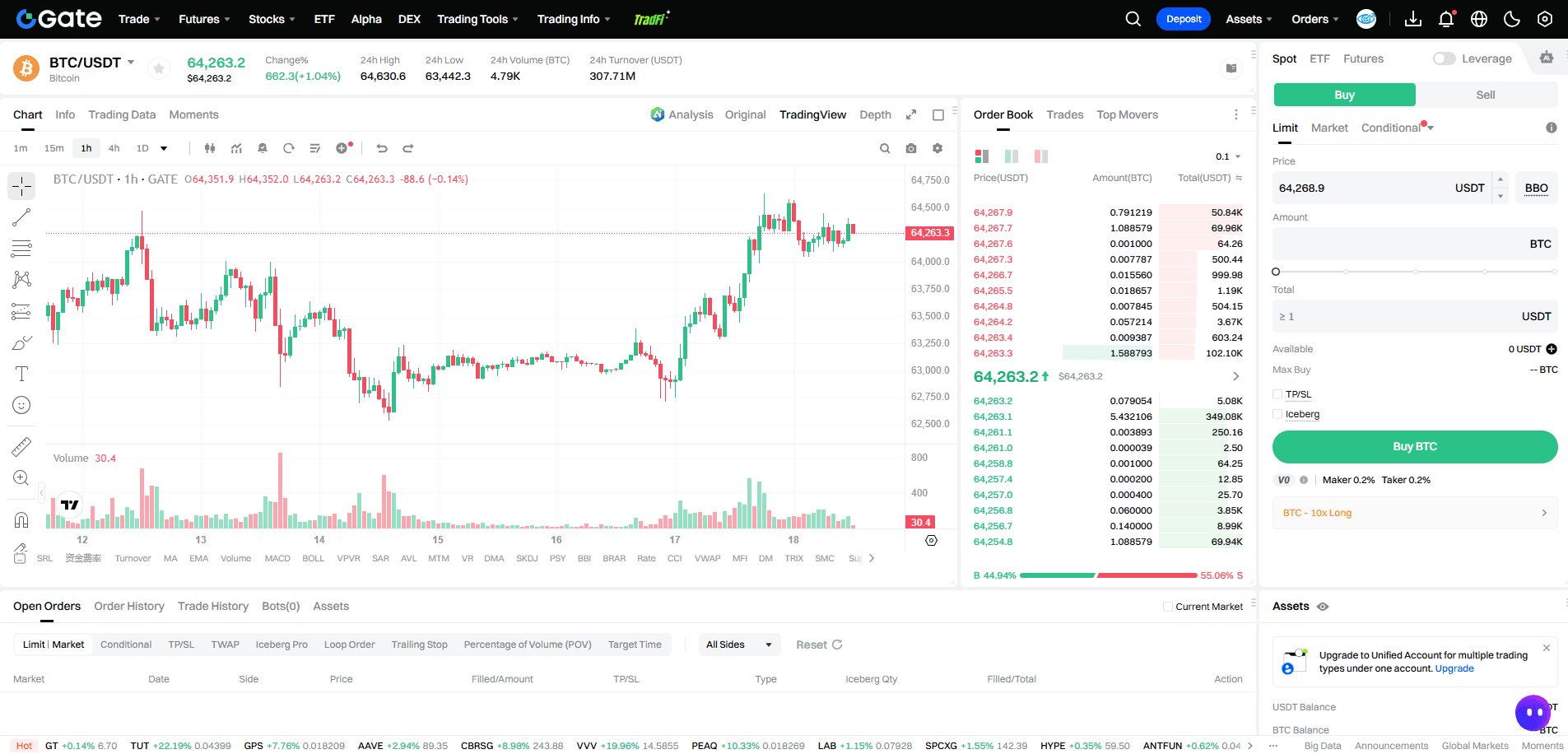
More experienced traders can use margin trading with leverage up to 20x. It allows borrowed funds to be used to increase position size. Gate supports cross margin and isolated margin: in the first case, collateral is distributed among positions, while in the second, risk is limited to the funds allocated to a specific position. Interest is charged for using borrowed assets.
Futures and options
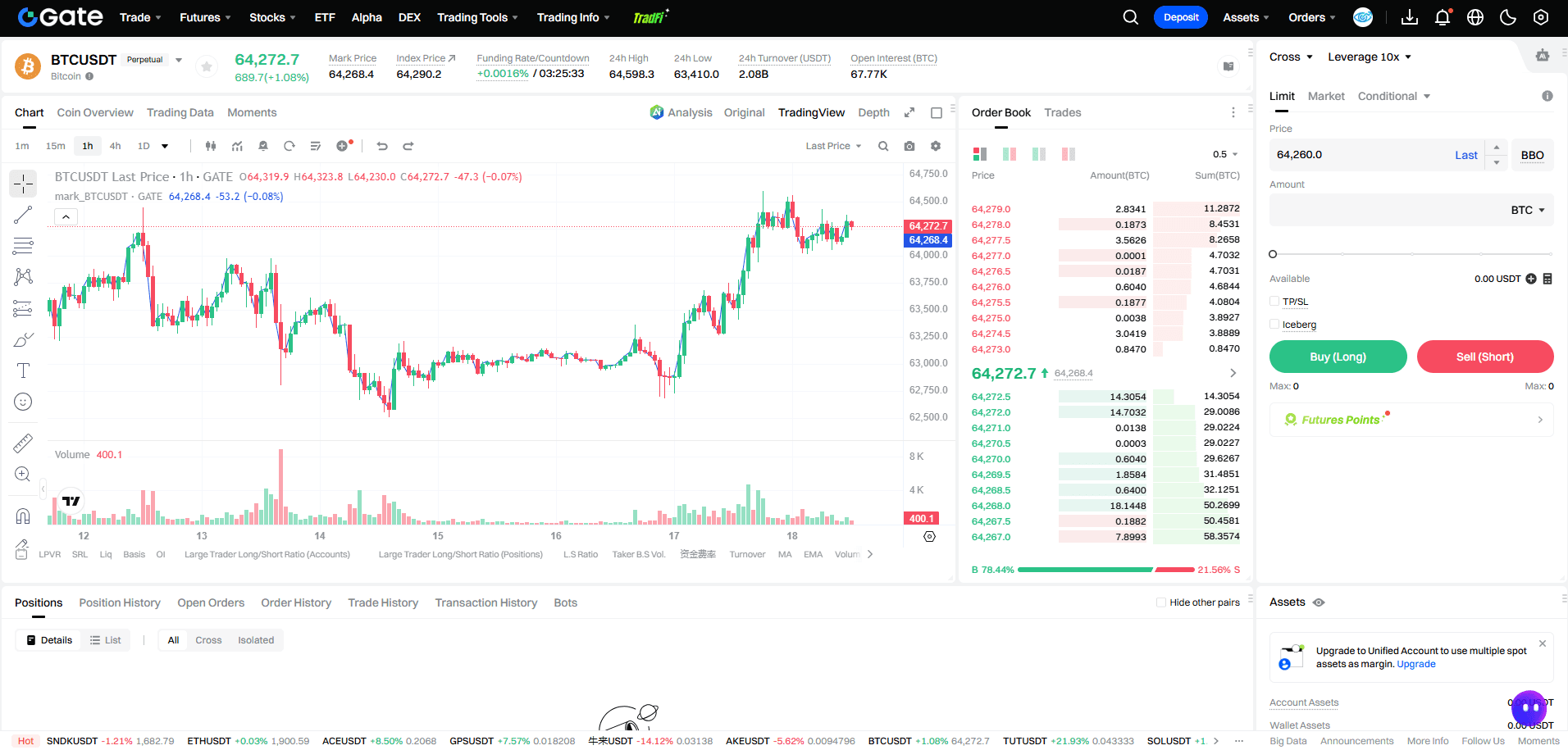
Gate offers an extensive cryptocurrency derivatives market. Users have access to USDT-M and BTC-M perpetual futures, as well as delivery futures. Futures allow users to open long and short positions and use leverage up to 200x. For new users, Gate limits maximum leverage to 20x during the first three days after opening a futures account, after which the limits may gradually increase.
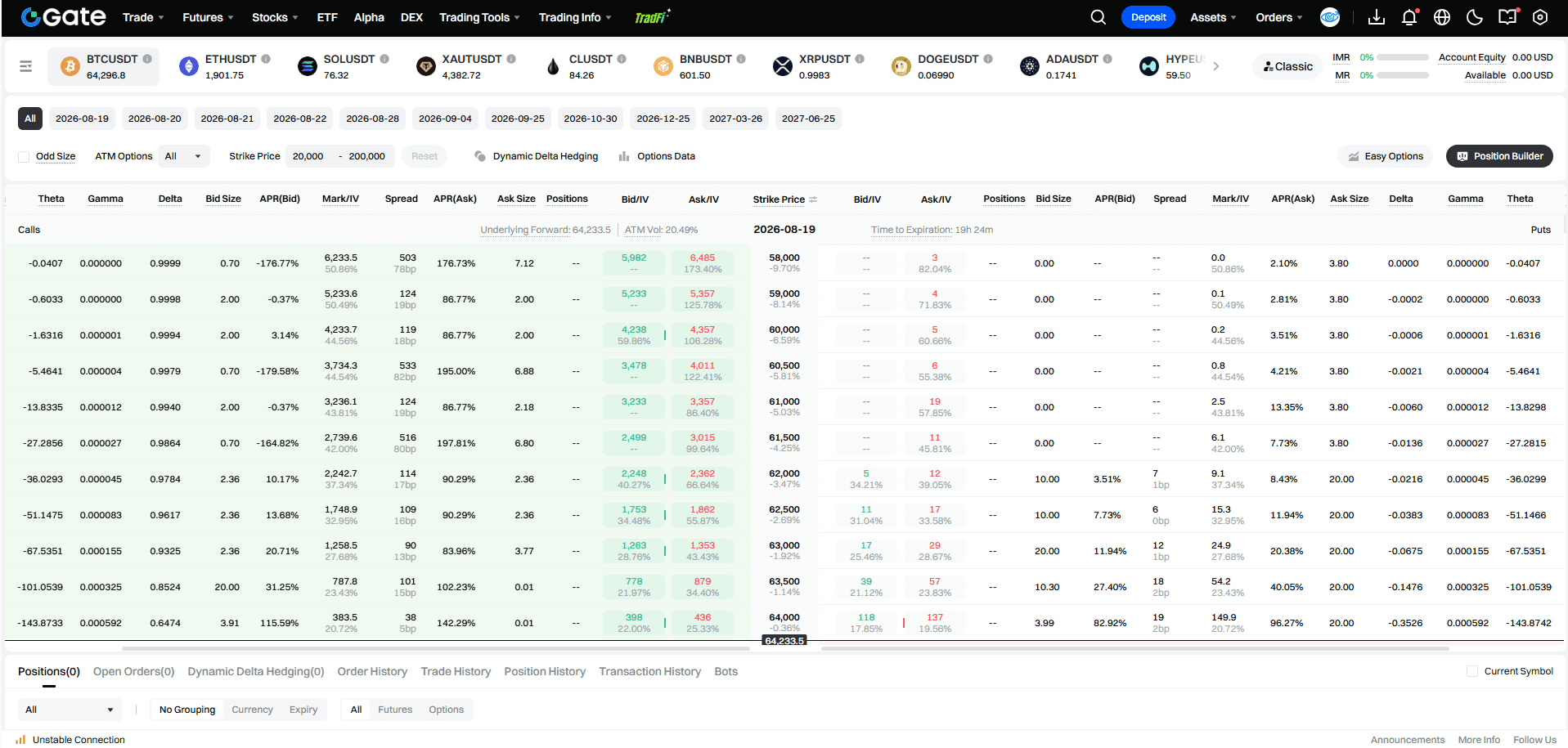
Also available separately are cryptocurrency options. Gate offers cash-settled call and put contracts. The option buyer pays a premium for the right to exercise the contract, while the seller assumes the corresponding obligations and must maintain the required margin level. Options can be used both for speculative trading and for hedging other positions.
CFDs, stocks, and ETFs
| Parameter | CFD |
|---|---|
| Account Currency | USDx |
| Minimum Deposit | $1 |
| Spread | from 0.1 pips~ 0.2 pips |
| Commission per Trade | No commission |
| Leverage | 1:1-1:500 |
| Order Execution | STP |
| Trading Platforms | Gate, MetaTrader 5 |
| Trading Assets | Commodities, Forex, Precious Metals, Energy Carriers, Soft Commodities, Indices |
| Margin Call / Stop Out | 100%50% |
| Opened Positions | — |
| Demo Account | Yes |
| Islamic Account | No |
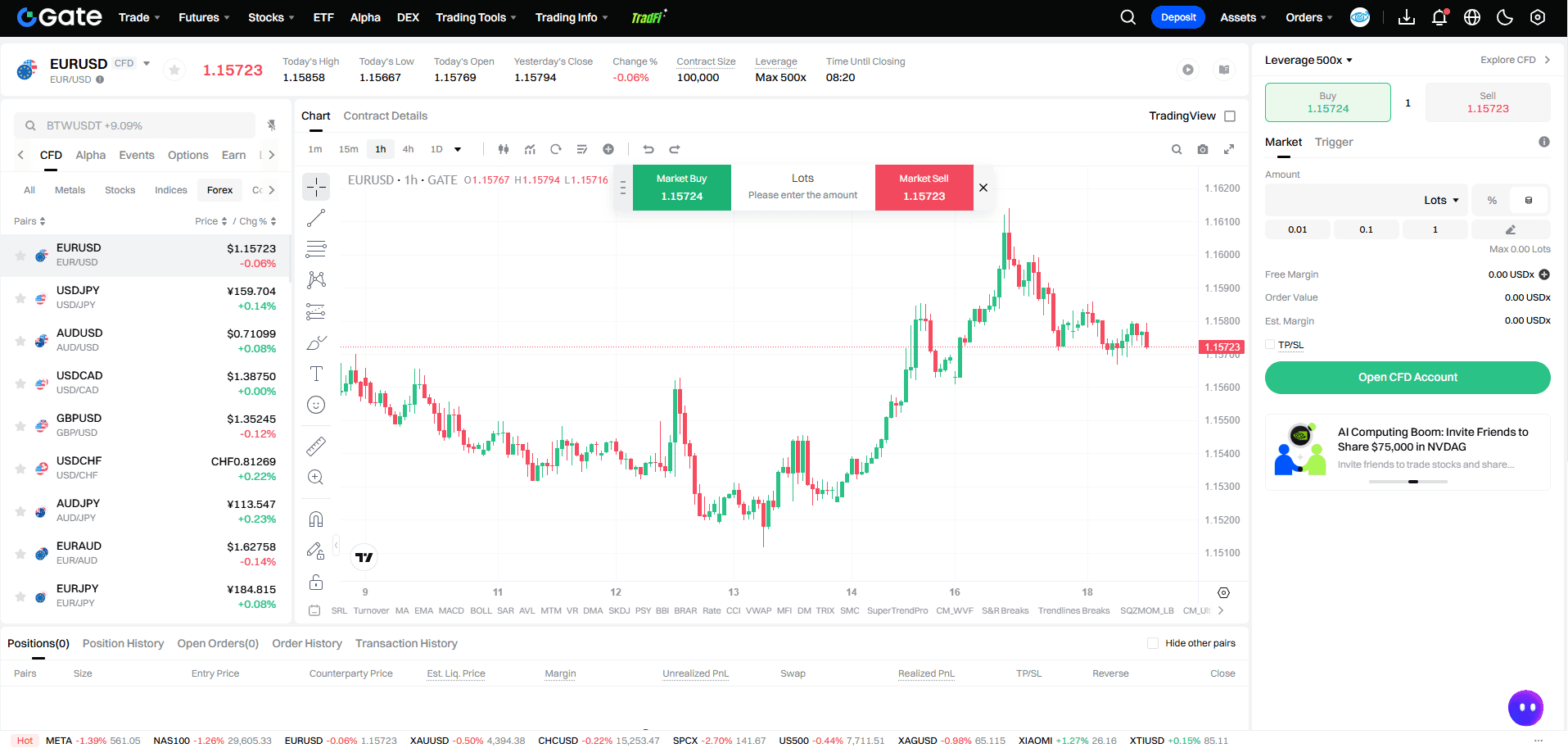
Through Gate TradFi, the exchange has expanded beyond exclusively cryptocurrency markets. Users have access to CFDs on stocks, currency pairs, gold and other metals, stock indices, and commodities with leverage up to 500x. CFDs allow users to take positions on both upward and downward movements in the underlying instrument, but this type of trading does not confer ownership of the asset itself.
In addition to derivatives, Gate offers a separate Gate Stocks service providing access to stocks and ETFs from the US, Hong Kong, and South Korean markets. Gate positions this product separately from tokenized stocks: trades involving conventional stocks are executed through brokerage infrastructure, while settlements within the platform can be made using USDT. The ecosystem also includes gStocks—tokenized instruments backed by underlying stocks.
The availability of stocks, ETFs, and CFDs depends significantly on the user's country.
Demo trading
To help users become familiar with derivatives, Gate provides Demo Trading / Testnet with virtual funds. The demo mode is primarily intended for perpetual futures and options. Its interface and main functions closely resemble real trading, but transactions do not affect the user's actual balance.
This allows users to test order types, leverage, margin modes, and trading strategies before moving to transactions with real funds.
Bots and copy trading
Gate offers one of the most extensive sets of tools for automated trading. The Bots section includes Spot Grid, Futures Grid, Spot and Futures Martingale, Infinite Grid, Smart Rebalance, spot-futures arbitrage strategies, cross-exchange arbitrage, custom strategies, and Signal Bots. Testing and the ability to copy other users' settings are available for a number of strategies.
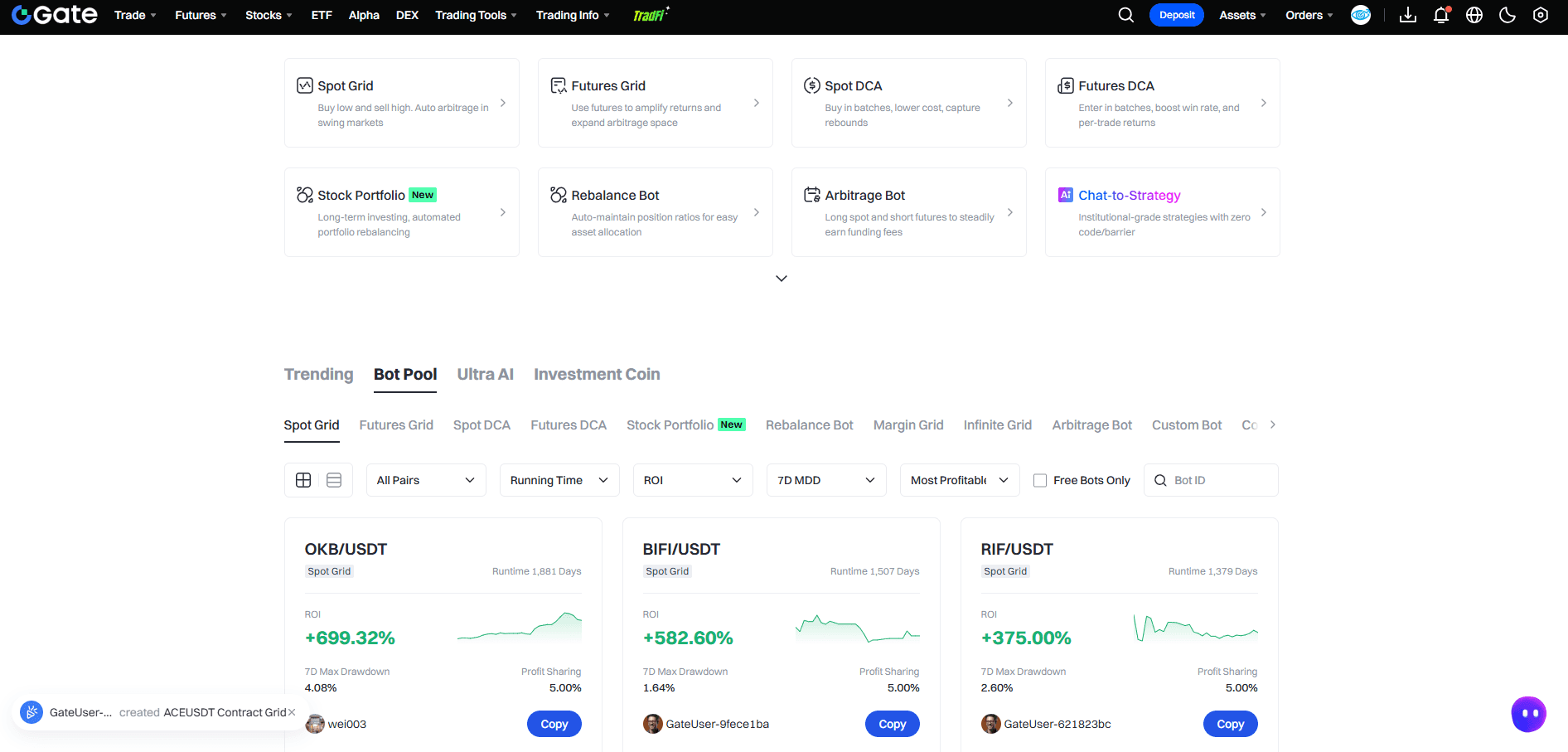
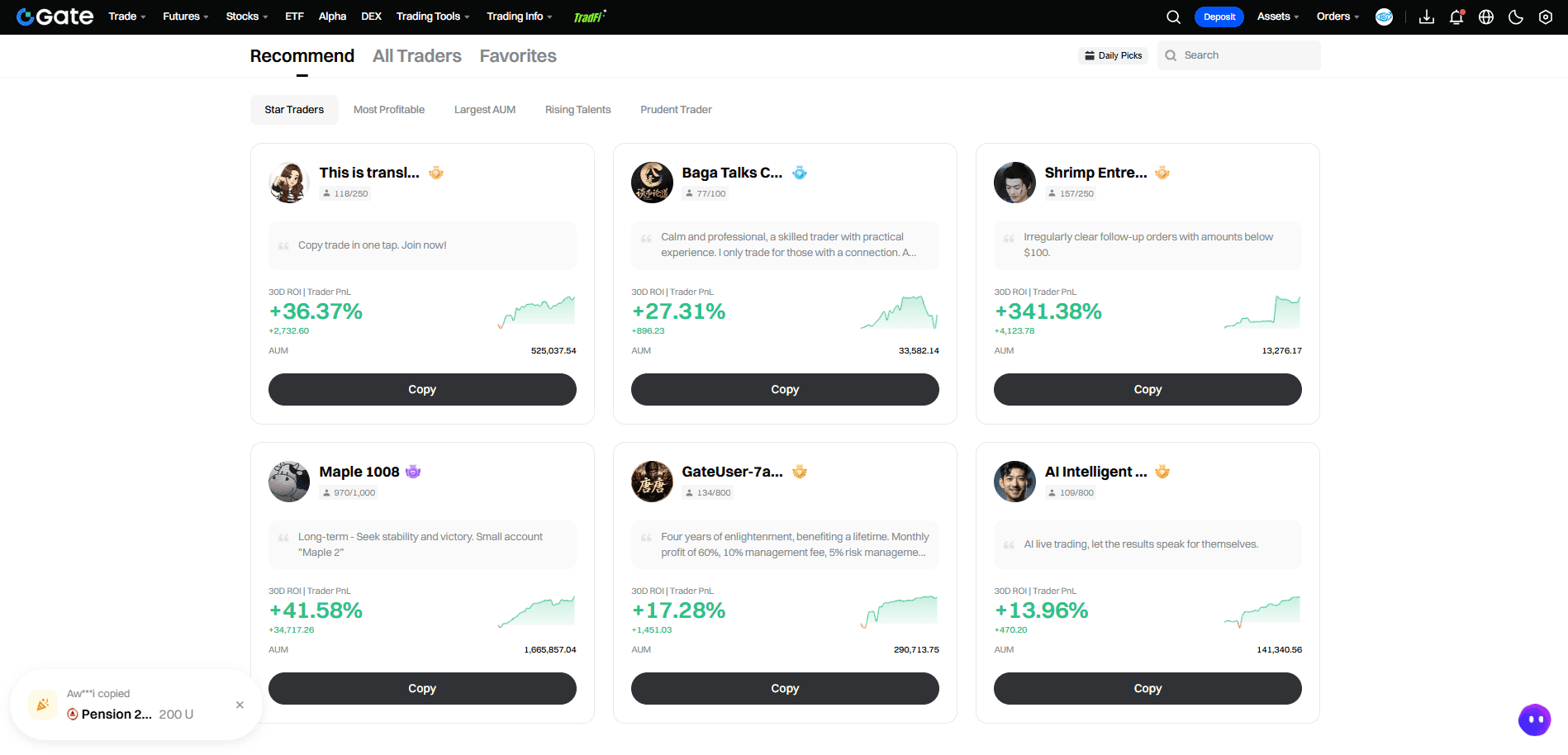
Copy trading allows users to select a lead trader and automatically replicate changes to that trader's positions. Users independently set the amount, copy mode, and risk parameters. The service is primarily built around futures trading, while within the TradFi ecosystem, Gate is also developing strategy-copying features for traditional instruments. A follower's returns may differ from the lead trader's results because of capital size, leverage, execution price, and other factors.
OTC trading
Gate OTC is intended primarily for institutional clients, companies, and high-net-worth investors who need to execute large transactions without significantly affecting the public order book.
The service supports cryptocurrency block trades and transactions between cryptocurrencies and fiat currencies. The client receives a quote for the entire transaction amount, and settlement takes place once the quote is confirmed. This format helps reduce slippage and avoid sharp price movements caused by a large order on the regular spot market.
CrossEx
Gate CrossEx is specialized infrastructure for professional traders, quantitative teams, and institutional clients. It provides access to multiple exchanges through a single account and enables centralized management of margin, positions, profits, and losses.
CrossEx supports spot trading, cross margin, and USDT-M perpetual futures. Shared cross-exchange margin and an isolated mode are available. Trading through CrossEx is conducted via an API, so the product is aimed more at algorithmic traders, market makers, and cross-exchange arbitrageurs than at typical retail traders.
Gate Alpha
Gate Alpha combines the capabilities of a centralized exchange with on-chain asset trading. Users can find a token by name or smart contract address and execute a transaction directly using funds in their Gate account, without independently going through the entire process of using separate Web3 wallets and DEXs.
To execute transactions, Gate Alpha also uses third-party liquidity and routing sources such as Jupiter, 1inch, and Li.fi. Activity in Alpha is also linked to the Alpha Points, which can be used to participate in certain airdrops and events. At the same time, early-stage on-chain tokens usually involve particularly high volatility and risk.
Gate Web3 and DEX
For users who prefer self-custody of their assets, there is Gate Web3. It is built around a non-custodial multichain wallet that can be used to store and transfer cryptocurrencies, perform Swap and Bridge transactions, connect to DApps, and interact with various blockchain networks. The ecosystem supports more than 100 blockchains.
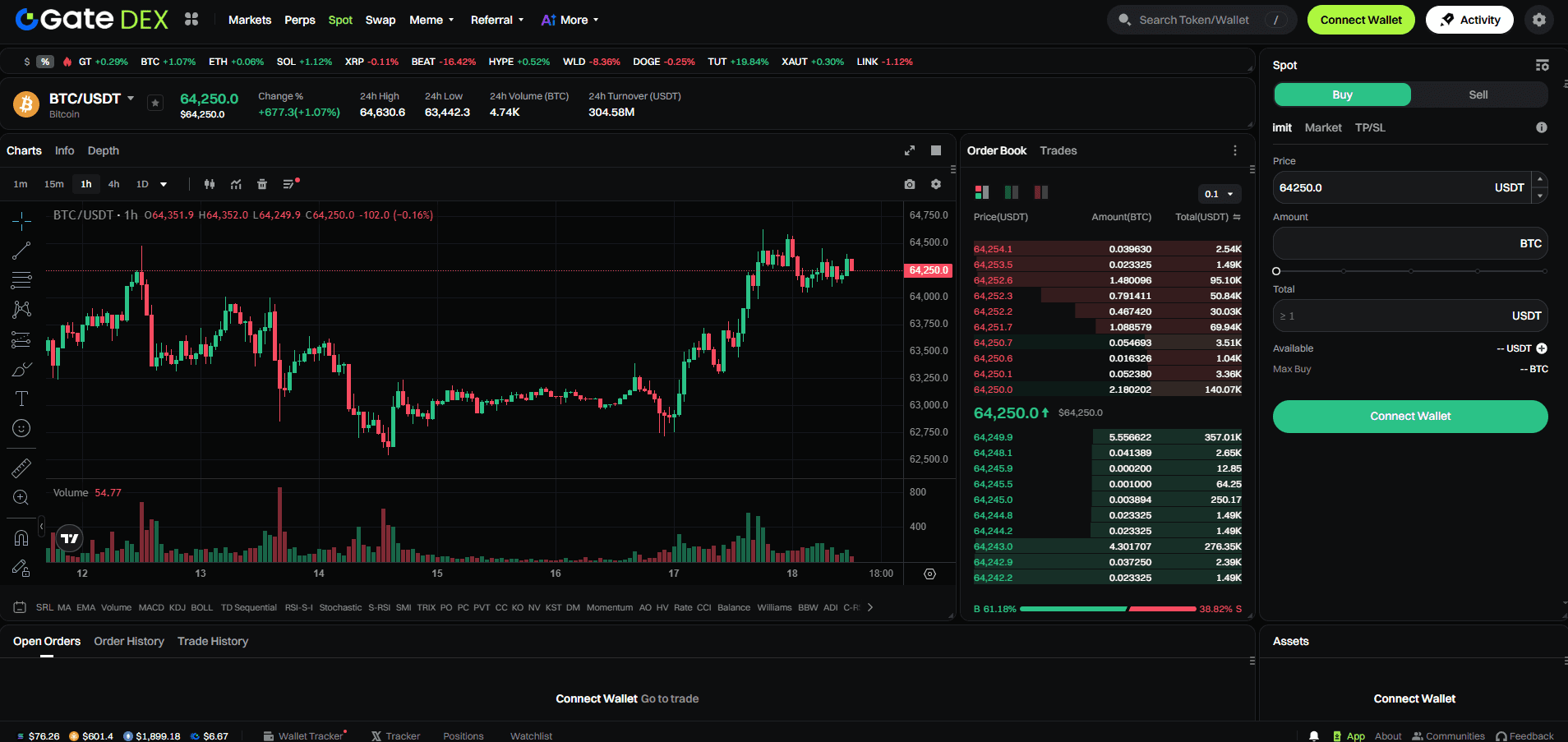
Web3 includes Gate DEX — a decentralized trading service. Unlike a centralized exchange, users retain control of their private keys and assets. Gate does not store the seed phrase or private key for such a wallet, so the owner is responsible for keeping them secure.
Buying Cryptocurrency, Convert, and P2P
For users who do not need a full-featured trading terminal, Gate offers several simplified ways to buy and exchange digital assets.
Through Buy Crypto / Quick Buy, users can buy or sell cryptocurrency using bank cards, bank transfers, and supported local payment channels. For example, SEPA transfers for EUR are available in some countries. The specific range of currencies and payment methods depends on the region.
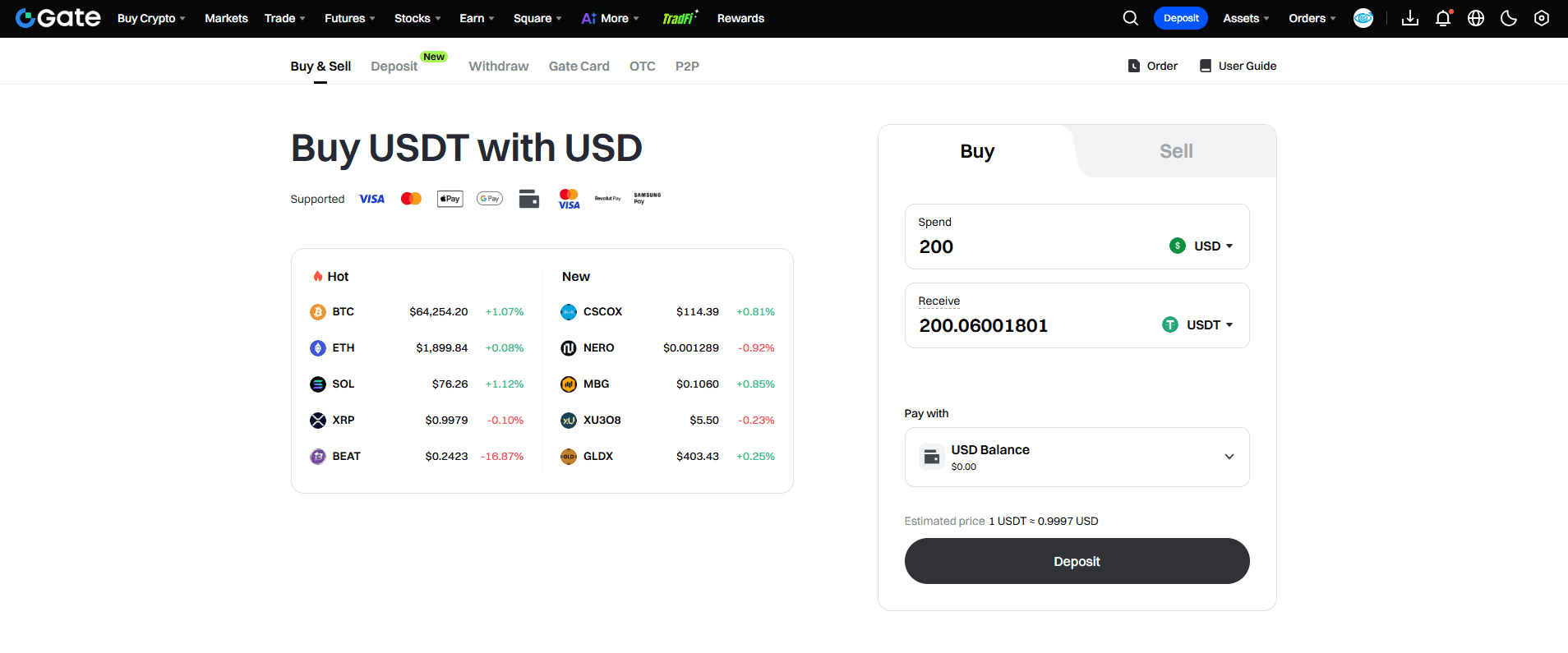
Gate Convert allows users to instantly exchange one cryptocurrency for another without using an order book or placing an order. Gate shows the user a ready-made quote and, once it is confirmed, immediately credits the received asset to the spot account. No separate trading fee is charged for Convert, although the quote itself may differ from the current spot market price.
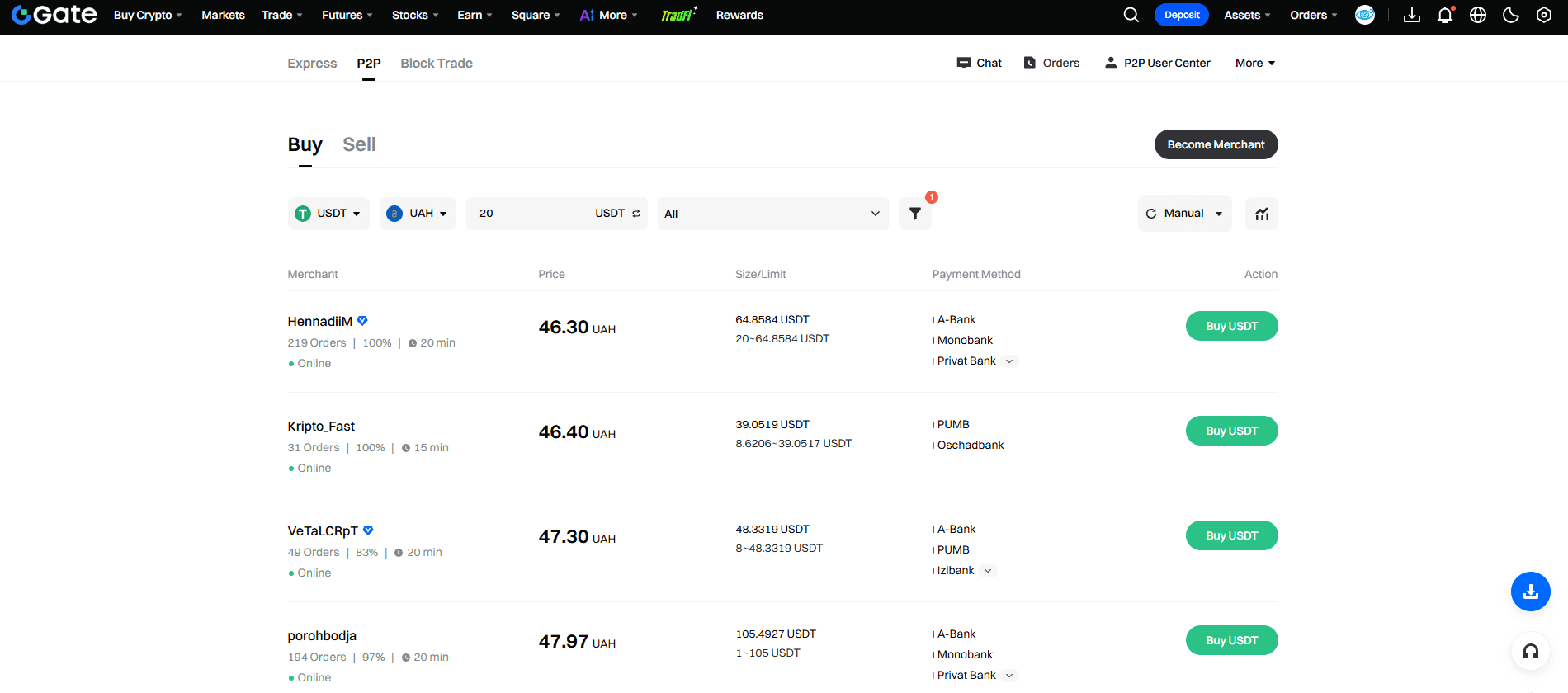
P2P is intended for the direct purchase and sale of cryptocurrency between users for fiat money. The buyer selects an offer and payment method, while Gate acts as the platform and uses a mechanism that locks the cryptocurrency until settlement between the parties is complete. Separate tools and an API are available for professional P2P merchants.
Gate Card
Gate Card allows cryptocurrency to be used for everyday payments. Depending on the country and card type, it operates through the Visa or Mastercard payment network and can be used online, in physical stores, and, for physical cards, at ATMs.
Gate offers several card options and two main spending mechanisms: directly debiting supported assets from the account and pre-funding the card with conversion into fiat currency. Certain tiers offer cashback of up to 8%, credited as points that can be exchanged for USDT or GT. Enhanced identity verification is required to apply, and the card itself is not available in every country.
Launchpool
Gate Launchpool allows users to lock supported assets to receive new tokens as part of project launches. Pools may use GT, BTC, ETH, USDT, GUSD, and other assets, while earned tokens are distributed among participants according to the terms of the specific campaign.
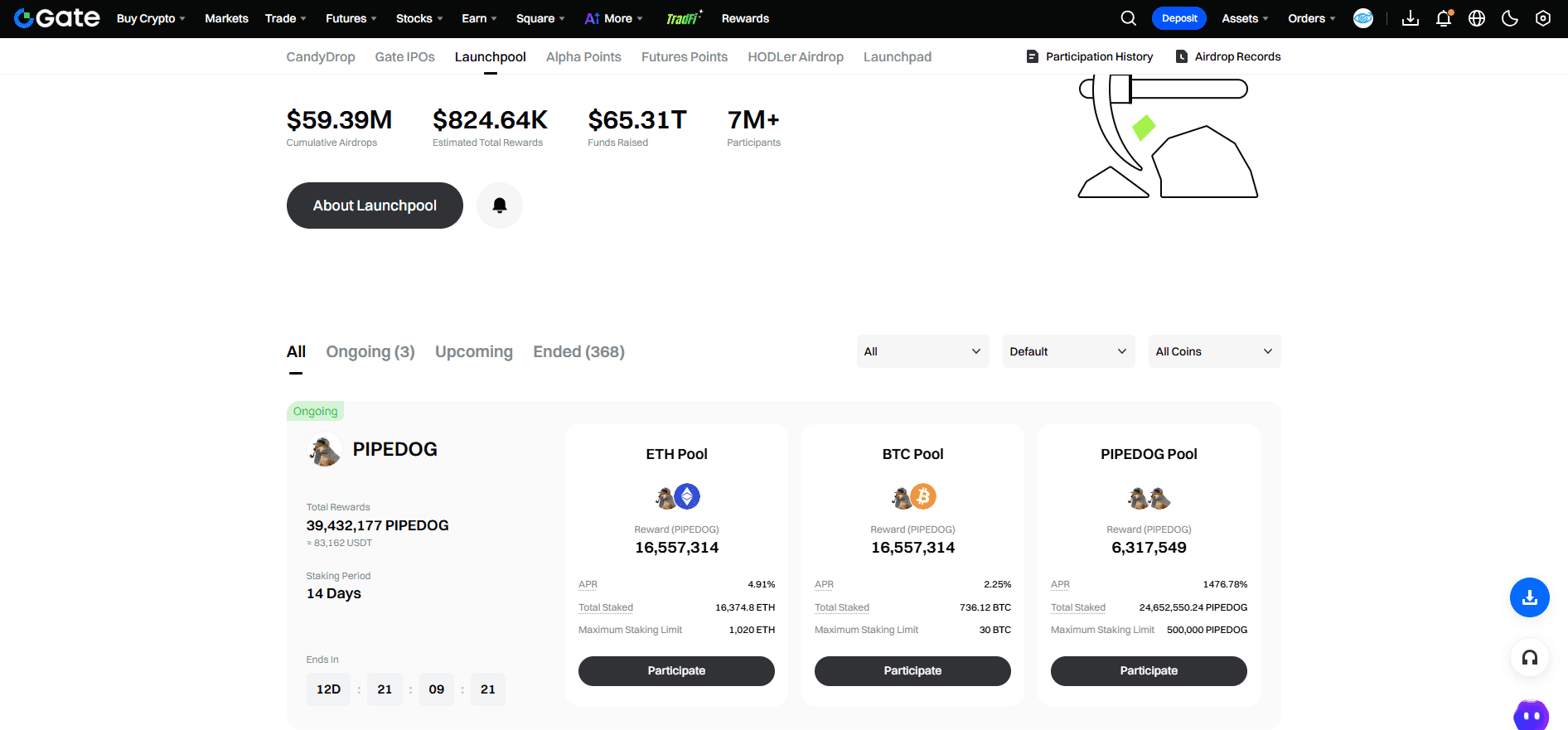
Essentially, Launchpool provides an opportunity to receive new assets without purchasing them directly, but returns, time frames, and participation requirements vary for each project.
Staking and Crypto Deposits
The Gate Earn section includes several ways to earn income from idle crypto assets. Simple Earn offers flexible and fixed-term products, while the Auto-Earn feature can automatically allocate eligible assets from the spot account or Unified Account to flexible-term products.
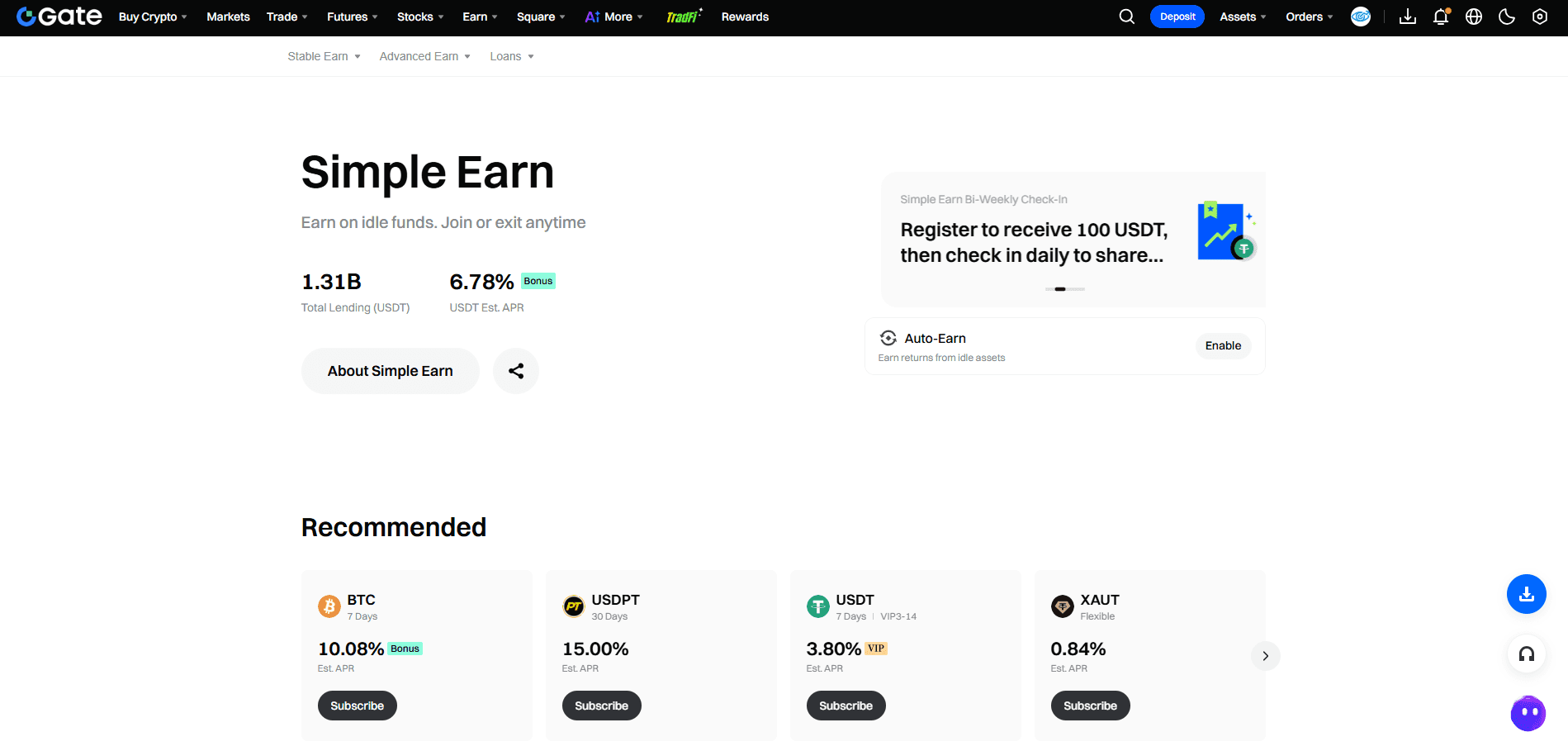
Classic Staking is also available for various cryptocurrencies, along with Soft Staking, under which users continue to hold assets in their trading accounts and retain the ability to trade or withdraw them while also receiving the distributions provided by the program.
Such products are sometimes called crypto deposits, but legally they are not bank deposits and are not covered by a government deposit insurance system. Returns, repayment periods, and risks depend on the specific product.
Airdrops and Rewards
Gate uses several free token distribution programs. In CandyDrop, users complete tasks — for example, making trades, funding their accounts, or inviting new participants — and receive Candy, which is then used to participate in token airdrops.
Other programs include HODLer Airdrop for GT holders, Alpha Points for activity in Gate Alpha, and Futures Points, which can be exchanged for rewards in specific campaigns.
A separate Rewards Hub brings together welcome offers and promotions. New users may be offered tasks for registration, KYC, their first deposit, their first trade, or reaching a specific trading volume. The amounts and terms of such bonuses change regularly, so they should be checked immediately before participation.
GUSD
GUSD is Gate's proprietary yield product, which the company positions as a flexible instrument with principal protection. It can be minted using USDT, USDC, or other supported stablecoins, used to earn daily income, used in trading, and provided as collateral.
According to Gate, the sources of yield include revenue from the company's ecosystem, RWA instruments based on treasury bonds, and other yield-bearing assets backed by stablecoins. When redeemed into the original subscription currency, Gate provides for a 1:1 exchange with no redemption fee.
Gate AI
Gate AI is a built-in AI assistant for interacting with the platform. It can answer questions about markets and Gate features, analyze current market data, search for trading ideas, and translate users' natural-language requests into specific actions within the platform.
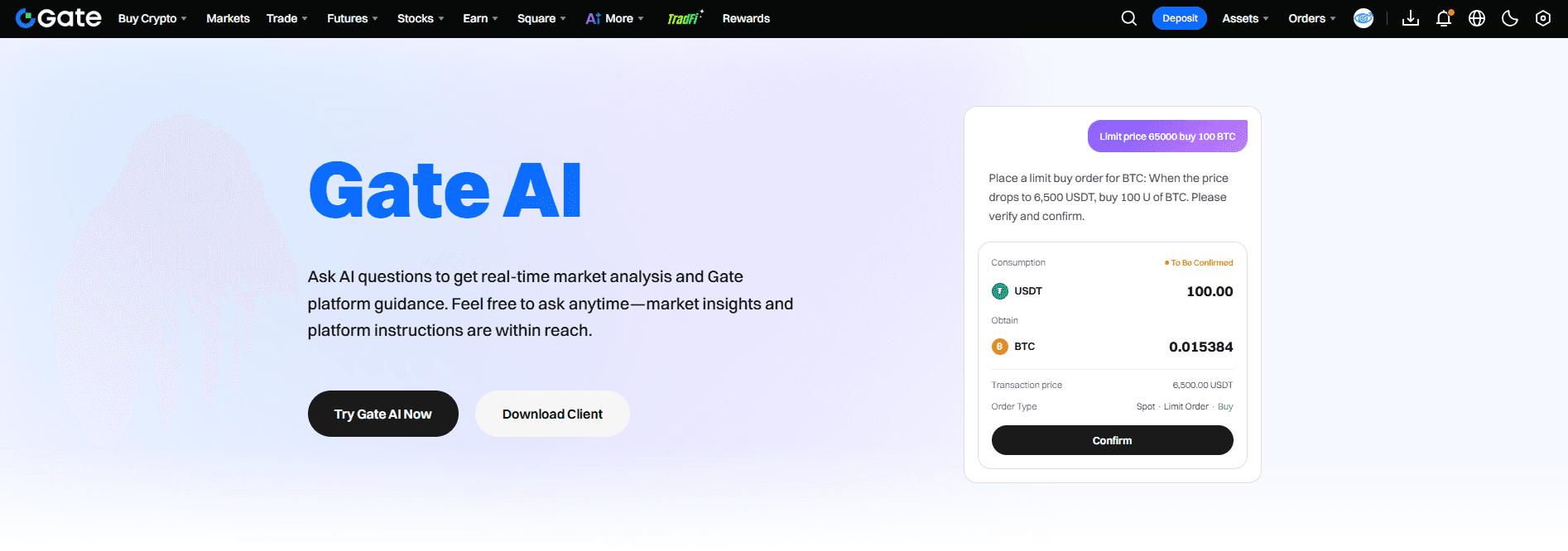
For example, a user can describe a desired trade in text, after which Gate AI will prepare the corresponding order for confirmation. The integration covers spot and futures trading, Convert, Earn products, Staking, and several other services. Gate AI should not be regarded as a fully autonomous capital management tool: the user is shown the parameters for confirmation before the order is executed.
Gate Vault
Gate Vault is a separate tool for enhanced crypto asset storage based on MPC technology. Instead of storing an entire private key in one place, it is divided into shares held by the user's device, Gate, and an independent third party. A 2-of-3 scheme is used for signing, and Gate cannot independently initiate the movement of a user's assets.
An additional feature is a 48-hour protection period for transfers: during this period, a suspicious or erroneous transaction can be frozen before the funds are finally sent to the blockchain. A recovery procedure through an independent party is also provided in case Gate's services become unavailable. At this stage, the free Gate Vault is primarily intended for users at VIP 3 and above.
Commissions
Gate's fee structure depends on the selected market and the user's activity. For cryptocurrencies, the exchange uses a VIP system: fees decrease as trading volume and account level increase. An additional discount on spot trading is available when fees are paid with the GT token. TradFi has a separate cost model, while eligible US stocks and ETFs can be traded without a Gate fee.
Spot Fees
The spot market uses the standard Maker/Taker model. For a regular user at VIP 0, the base fee is 0.10% for both maker and taker. When GT is used to pay trading fees, the VIP 0 rate is reduced to 0.09%. Fees gradually decrease as the VIP level rises.
VIP level | Standard Maker fee | Standard Taker fee | Maker fee when paying in GT | Taker fee when paying in GT |
|---|---|---|---|---|
VIP 0 | 0.10% | 0.10% | 0.09% | 0.09% |
VIP 1 | 0.099% | 0.099% | 0.089% | 0.089% |
VIP 2 | 0.098% | 0.098% | 0.088% | 0.088% |
VIP 3 | 0.097% | 0.097% | 0.087% | 0.087% |
VIP 4 | 0.095% | 0.096% | 0.086% | 0.086% |
VIP 5 | 0.090% | 0.095% | 0.081% | 0.085% |
VIP 6 | 0.085% | 0.090% | 0.076% | 0.081% |
VIP 7 | 0.080% | 0.085% | 0.070% | 0.076% |
VIP 8 | 0.075% | 0.080% | 0.060% | 0.072% |
VIP 9 | 0.070% | 0.075% | 0.050% | 0.068% |
VIP 10 | 0.040% | 0.058% | 0.040% | 0.058% |
VIP 11 | 0.030% | 0.045% | 0.030% | 0.045% |
VIP 12 | 0.020% | 0.037% | 0.020% | 0.037% |
VIP 13 | 0.010% | 0.030% | 0.010% | 0.030% |
VIP 14 | 0.008% | 0.023% | 0.008% | 0.023% |
Compared with other major exchanges, Gate's fees are competitive:
Futures fees
In the futures market, Gate also offers competitive terms: base rates of 0.02% for makers and 0.05% for takers.
Fees for trading perpetual futures also depend on the user's VIP level. As the level increases, fees gradually decrease—to 0.002% / 0.022% at VIP 14.
VIP level | Maker | Taker |
|---|---|---|
VIP 0 | 0.020% | 0.050% |
VIP 1 | 0.020% | 0.050% |
VIP 2 | 0.020% | 0.050% |
VIP 3 | 0.020% | 0.048% |
VIP 4 | 0.020% | 0.048% |
VIP 5 | 0.020% | 0.045% |
VIP 6 | 0.018% | 0.042% |
VIP 7 | 0.016% | 0.0375% |
VIP 8 | 0.014% | 0.035% |
VIP 9 | 0.012% | 0.032% |
VIP 10 | 0.010% | 0.030% |
VIP 11 | 0.008% | 0.028% |
VIP 12 | 0.006% | 0.026% |
VIP 13 | 0.005% | 0.024% |
VIP 14 | 0.002% | 0.022% |
For delivery futures, Gate lists separate rates: −0.015% for makers, meaning a rebate is provided, 0.016% for takers and 0.015% upon delivery.
In addition to the trading fee, holders of perpetual contracts must take the funding rate into account. These are periodic payments between market participants: when the rate is positive, longs pay shorts; when it is negative, the opposite applies. Gate does not retain these payments. The funding rate varies depending on the contract and market conditions.
VIP levels
Gate uses a multi-tier VIP program ranging from VIP 0 to VIP 14. The higher the level, the lower the fees on the spot and futures markets, and the more additional privileges are available to the user.
The required VIP level can be obtained by meeting one of three criteria:
- reach the specified trading volume over the past 30 days;
- maintain the required average amount of GT (GateToken) for 14 days;
- hold a sufficient value of eligible assets in the account.
In other words, it is not necessary to meet all three conditions at the same time. Gate determines the level based on the highest result the user achieves under any one of the criteria.
VIP level | 30-day trading volume | Average GT balance over 14 days | Asset value required for upgrade |
|---|---|---|---|
VIP 0 | $0 | 0 GT | $0 |
VIP 1 | $60 000 | 50 GT | $2 000 |
VIP 2 | $120 000 | 200 GT | $4 000 |
VIP 3 | $240 000 | 500 GT | $10 000 |
VIP 4 | $500 000 | 1 000 GT | $20 000 |
VIP 5 | $1 000 000 | 2 000 GT | $40 000 |
VIP 6 | $3 000 000 | 5 000 GT | $100 000 |
VIP 7 | $8 000 000 | 10 000 GT | $200 000 |
VIP 8 | $20 000 000 | 20 000 GT | $400 000 |
VIP 9 | $50 000 000 | 50 000 GT | $1 000 000 |
VIP 10 | $100 000 000 | 100 000 GT | $2 000 000 |
VIP 11 | $120 000 000 | 200 000 GT | $4 000 000 |
VIP 12 | $240 000 000 | 400 000 GT | $8 000 000 |
VIP 13 | $440 000 000 | 800 000 GT | $16 000 000 |
VIP 14 | $800 000 000 | 1 500 000 GT | $30 000 000 |
After an upgrade, the level must be maintained. If the relevant requirements are no longer met, Gate may subsequently downgrade the VIP status. The highest standard level for regular users is VIP 14; the largest clients and those focused on API trading may be moved to the institutional user category.
CFD Spreads and Swaps
For CFDs in Gate TradFi, the main trading costs are the spread and the swap for holding a position overnight. The spread depends on the specific instrument and market conditions, so there is no single fixed rate for all CFDs.
| Asset | Average spread | Swap long | Swap short |
|---|---|---|---|
| EURUSD | 0.2 pips | -7.70 pips | 1.84 pips |
| GBPUSD | 0.4 pips | -2.18 pips | -2.09 pips |
| AUDUSD | 0.2 pips | -0.90 pips | -2.32 pips |
| NZDUSD | 0.3 pips | -3.12 pips | 0.31 pips |
| USDJPY | 0.3 pips | 5.96 pips | -16.95 pips |
| USDCAD | 0.3 pips | 2.51 pips | -9.17 pips |
| USDCHF | 0.3 pips | 4.60 pips | -11.74 pips |
Separate fees starting from $0.018 per order may also apply when trading through TradFi.
Overall, the spreads we tested appear very tight, although the actual cost of a trade depends on market conditions, trading time, and how long the position is held.
Stock and ETF Fees
From July 31, 2026, Gate applies Zero-Fee Mode to eligible US stocks and ETFs. Under this model, the exchange does not charge its own trading fee for either purchases or sales, nor does it impose a minimum trading fee, account opening fee, or account maintenance fee.
However, “0% commission” does not mean there are no costs at all. Mandatory settlement, regulatory, and custody fees may be charged when trading US securities:
Fee | Amount |
|---|---|
Gate fee for trading eligible US stocks and ETFs | 0 |
Settlement Fee | $0.003 per share, maximum 0.05% of the transaction amount |
SEC Fee | $20.60 per $1 million on sales; transactions up to $500 are exempt |
FINRA TAF | $0.000195 per share on sales, maximum $9.79 per execution |
CAT Fee | $0.000003 per share on purchases and sales |
ADR Custody Fee | usually around $0.01–0.03 per share, if applicable |
Gate's zero commission applies specifically to eligible US stocks and ETFs. Securities from Hong Kong and South Korea have a separate fee model, so their fees should be checked for the specific instrument before trading.
It is also important to distinguish regular Gate Stocks shares and ETFs from gStocks — tokenized stocks. A different fee applies to gStocks: the standard rate is 0.1% of the transaction amount.
Deposit and Withdrawal Fees
On-chain cryptocurrency deposits are usually free on Gate — the exchange does not charge its own fee for crediting a supported asset. When sending funds to Gate, the user still pays the network fee or the fee charged by the third-party platform from which the transfer is made.
For cryptocurrency withdrawals, Gate charges a fee whose amount depends on the asset itself and the selected blockchain network. It is not the same for all cryptocurrencies and may change with network conditions, so the current amount is displayed directly on the withdrawal page before the transaction is confirmed.
To purchase cryptocurrency with fiat, Gate supports bank cards, P2P, and third-party payment providers. The costs of such transactions depend on the selected payment method, currency, the user's country, and the provider; the final cost is shown before the purchase is confirmed.
As a result, the cost of depositing cryptocurrency into Gate is low, but withdrawal costs must be assessed separately for each coin and network. Especially for small transfers, choosing a less expensive blockchain network can noticeably affect the total cost.
Deposit and Withdrawal
Gate offers several methods for funding an account and withdrawing funds: on-chain cryptocurrency transfers, bank cards, bank transfers, Gate Connect, and P2P. The available fiat methods depend on the user's country, currency, and available payment partners. KYC is required to deposit and withdraw funds.
Cryptocurrency Deposits
The primary way to fund a Gate account is to transfer cryptocurrency from an external wallet or another exchange. To do this, open the Deposit → Onchain section, select the coin and the appropriate network. Gate will then generate a deposit address.
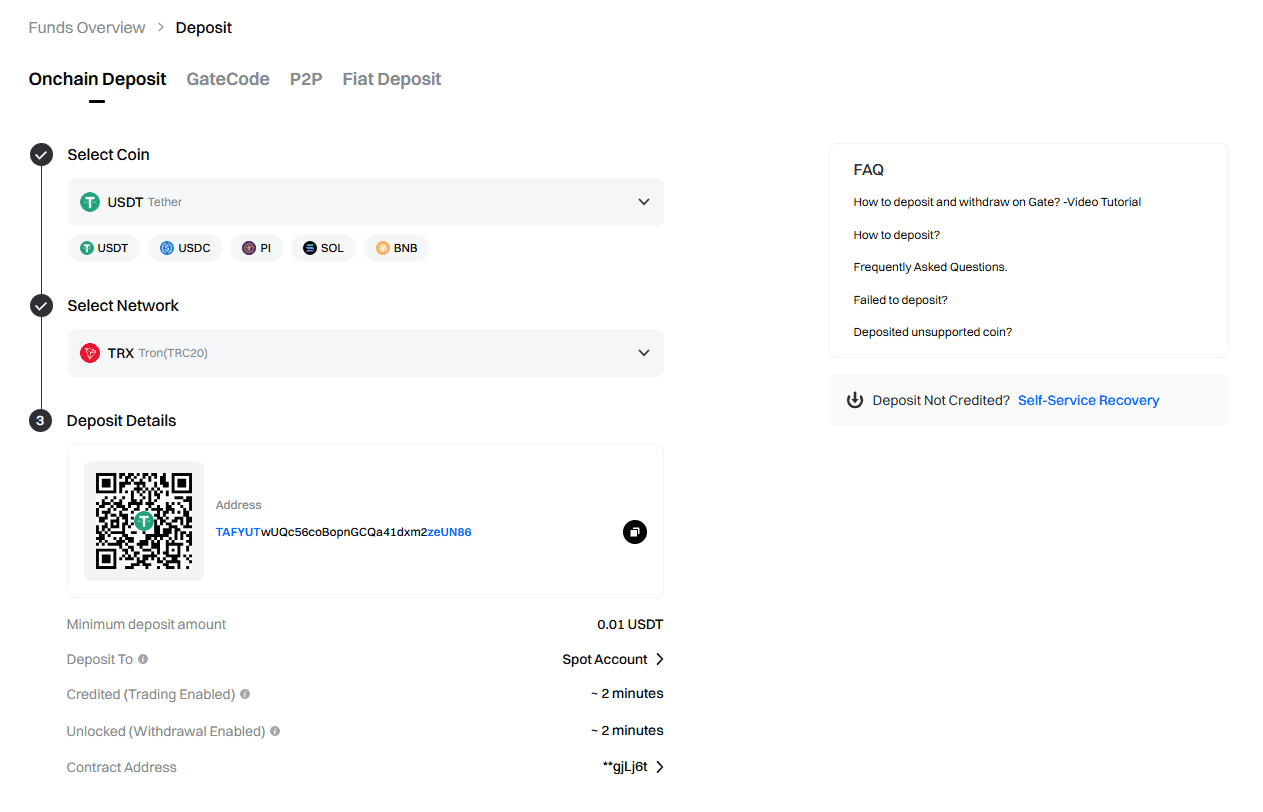
When making a transfer, it is especially important to ensure that the sending network matches the network selected on Gate. For example, several networks may be available for USDT, each with its own address, processing speed, and transaction cost. Some cryptocurrencies may also require a Memo/Tag; if it is displayed on the deposit page, it must be included when sending.
The time it takes for funds to be credited depends on the specific blockchain and the required number of confirmations. Once the required number of network confirmations has been received, the funds become available in the account.
Gate does not set a single fee for cryptocurrency deposits: for standard on-chain deposits, it is generally zero on the receiving platform's side, while the sender pays the blockchain fee. It is best to check the parameters for the specific coin and network immediately before making a transfer, as Gate displays the current terms for each asset separately.
Depositing Fiat Funds
Gate's fiat options are provided mainly through the Buy Crypto / Gate Connect service, as well as through P2P and third-party payment partners. The available methods depend on the user's country and currency. Gate indicates support for Visa, Mastercard, SEPA, and other local payment methods.
Main options:
- Bank cards. Gate Connect allows users to buy cryptocurrency with a debit or credit card. The user selects the fiat currency, cryptocurrency, and card, then confirms the payment. The purchased assets usually arrive in the spot account within 5–10 minutes.
- Bank transfer. For example, Gate supports SEPA transfers for EUR. SEPA Instant transfers may be completed within a few minutes, while standard SEPA usually takes around 1–2 business days.
- P2P. The user selects a seller, currency, and suitable payment method, then transfers the money directly to the counterparty. Gate acts as an intermediary and holds the cryptocurrency until payment is confirmed. Gate currently positions P2P as a service with zero platform fees, although the bank or payment system may charge its own fee.
- Third-party payment providers. Depending on the region, Gate may offer additional bank and card payment channels through partners.
When using a bank card or third-party channel, the actual exchange rate and fees should be checked before confirming the transaction, as they may depend on the currency, country, and payment provider.
Cryptocurrency Withdrawals
To withdraw funds, open Assets → Funds Management → Withdraw → Onchain, select the cryptocurrency and network, and enter the external wallet address. Before confirmation, Gate displays the minimum withdrawal amount and fee.
The fee is not the same for all assets. It depends on the cryptocurrency and selected network and may change depending on blockchain conditions. Gate therefore recommends checking the current cost directly on the withdrawal page.
For tokens operating on multiple networks, the choice of network can significantly affect the cost and speed of the transaction. The network selected on Gate must also be supported by the receiving wallet or exchange.
After submission, the request is processed by Gate, and the transaction is then sent to the blockchain. The overall process includes three stages: withdrawal initiation, blockchain confirmation, and crediting by the receiving platform.
Internal transfers between Gate users are also available via phone number, email, or Gate UID. Such transactions do not require a standard on-chain transaction.
Fiat Withdrawals
Gate allows users to sell cryptocurrency and receive fiat through Gate Connect. For a bank withdrawal, the user selects Sell, the cryptocurrency, the desired fiat currency, and the bank account for receiving the funds.
In particular, Gate officially lists:
- SEPA — for EUR withdrawals;
- PIX — for BRL.
After a sale via SEPA, the funds usually arrive within a few minutes or 1–2 hours, although Gate recommends contacting support if the transfer has not arrived within three business days.
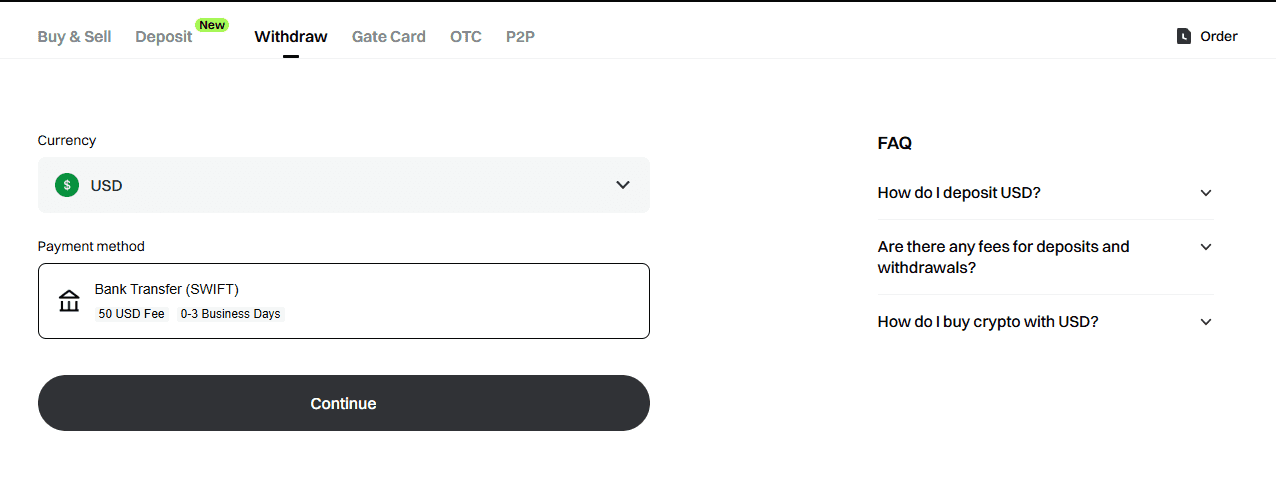
Another option is P2P. The user sells cryptocurrency to another market participant and receives payment directly to a bank account, card, or through another supported payment method. This method is particularly useful where direct bank withdrawals from Gate are unavailable.
Limits
Minimum cryptocurrency deposit and withdrawal amounts depend on the coin and network. Gate displays the relevant limits directly when the asset is selected. There is no single minimum amount for all cryptocurrencies.
The maximum daily cryptocurrency withdrawal limit depends on the account's VIP level:
VIP Level | 24-Hour Withdrawal Limit |
|---|---|
VIP 0–4 | $3 000 000 |
VIP 5–8 | $5 000 000 |
VIP 9–11 | $8 000 000 |
VIP 12 | $10 000 000 |
VIP 13 | $20 000 000 |
VIP 14 | $30 000 000 |
Gate publishes the 24-hour withdrawal limit directly in its current VIP fee schedule. Thus, even a basic VIP 0 account has a high limit of up to $3 million per day, while the limit for high-volume traders increases with their VIP status.
Additional address verification may increase the account's available limits. In some cases, Gate may also request proof of address for compliance, limit increases, or security checks.
Temporary security restrictions should also be taken into account. For example, after purchasing cryptocurrency through some fiat channels, an equivalent amount of assets may be locked from withdrawal for 24 hours.
Markets and Products
Gate stands out for its very broad selection of markets and investment products. Today, the platform goes far beyond a conventional cryptocurrency exchange: in addition to spot trading and derivatives, it offers traditional financial instruments, tokenized stocks, Web3 services, P2P, passive income products, and automated trading.
Gate's Main Markets and Services
Gate's main areas can be summarized as follows:
Category | Products and services | Description |
|---|---|---|
Spot trading | Spot | Buying and selling more than 4 900 supported digital assets. These include both the largest cryptocurrencies and a large number of new and small-cap tokens. |
Margin trading | Cross Margin, Isolated Margin | Cryptocurrency trading using borrowed funds. Cross margin and isolated margin are supported. |
Cryptocurrency derivatives | USDT-M and BTC-M Perpetual Futures | More than 600 futures trading pairs. Leverage of up to 125x is available for perpetual contracts on selected instruments. |
Delivery Futures | Delivery futures with weekly, biweekly, quarterly and other expiration periods. | |
Options | European Call and Put options with various strike prices and expiration periods. Demo trading is available. | |
Event Contracts | Short-term contracts that allow users to predict the direction of the selected asset's price movement. | |
Leveraged ETFs | Leveraged ETF Tokens | Tokens with built-in leverage, usually 3x or 5x. They trade similarly to spot assets and do not require users to manage margin themselves. |
TradFi | CFD | CFD on currency pairs, gold and other metals, stock indices, shares and commodities. |
Stocks and ETFs | US, Hong Kong and Korean Stocks | Access to real stocks and ETFs from the US, Hong Kong and South Korean markets through the Gate Stocks infrastructure. |
Tokenized assets | gStocks | Tokenized instruments backed by real equity assets. |
Stock derivatives | Stock Futures | Perpetual contracts on stocks and other traditional assets with leveraged trading available. |
Pre-listing market | Pre-Market Trading | Trading selected tokens before their official launch on Gate's spot market. |
IPO | Pre-IPOs, IPO Access | Instruments for gaining exposure to companies before or when they enter the public market. |
Simple exchange | Convert | Fast cryptocurrency conversion without using an order book. |
P2P | Gate P2P | Buying and selling cryptocurrency for fiat directly between users using an escrow mechanism. |
OTC | Gate OTC | Large over-the-counter transactions for institutional and high-net-worth clients without placing an order in the public order book. |
Automated trading | Trading Bots | Spot Grid, Futures Grid, Martingale, Smart Rebalance and other automated strategies. |
Copy trading | Copy Trading | Automatic replication of trades made by selected lead traders. |
Professional trading | CrossEx | Trading and margin management across multiple platforms through a unified infrastructure, primarily for professional and API clients. |
On-chain market | Gate Alpha | Access to new on-chain tokens directly through the Gate interface without having to use multiple DEX platforms independently. |
Web3 | Gate DEX, Gate Wallet | Non-custodial trading, Swap, Bridge and interaction with decentralized applications. |
Passive income | Simple Earn, Staking, Soft Staking | Flexible and fixed-term products for earning income from unused crypto assets. |
Structured products | Dual Investment, Smart Leverage, Quant Fund | More complex investment solutions intended primarily for experienced users. |
New token launches | Launchpool, CandyDrop, HODLer Airdrop | Receiving new tokens through staking, completing tasks, holding GT and participating in promotional campaigns. |
Crypto lending | Crypto Loan, Lending Center | Loans secured by crypto assets and other lending products. |
Payments | Gate Card | Using cryptocurrencies for everyday payments with automatic conversion of supported assets. |
Supported cryptocurrencies
The selection of cryptocurrencies is one of Gate's strongest aspects. According to current data from the exchange itself, its spot infrastructure supports more than 4 900 tokens. This significantly expands the selection compared with platforms that focus mainly on the largest cryptocurrencies.
The broad selection of cryptocurrencies makes Gate particularly interesting for users who trade not only Bitcoin and Ethereum but also seek new altcoins. The downside of this approach is that the thousands of available assets include extremely volatile and illiquid tokens. Listing on Gate is not in itself a guarantee of a project's quality, so independently assessing risks is especially important when dealing with little-known coins.
Trading platforms
Gate's range of trading platforms can be considered one of the exchange's strengths. The web version or mobile app is sufficient for beginners, while active traders have access to TradingView and a desktop client, Forex and CFD traders can use MT5, and a functional API is provided for algorithmic and institutional trading.
Web platform
Gate's main trading platform runs directly in a browser and does not require additional software to be installed. It provides access to nearly all the ecosystem's main areas: spot, margin trading, leveraged ETFs, futures, options, Gate Alpha, stocks, CFD and other TradFi instruments.
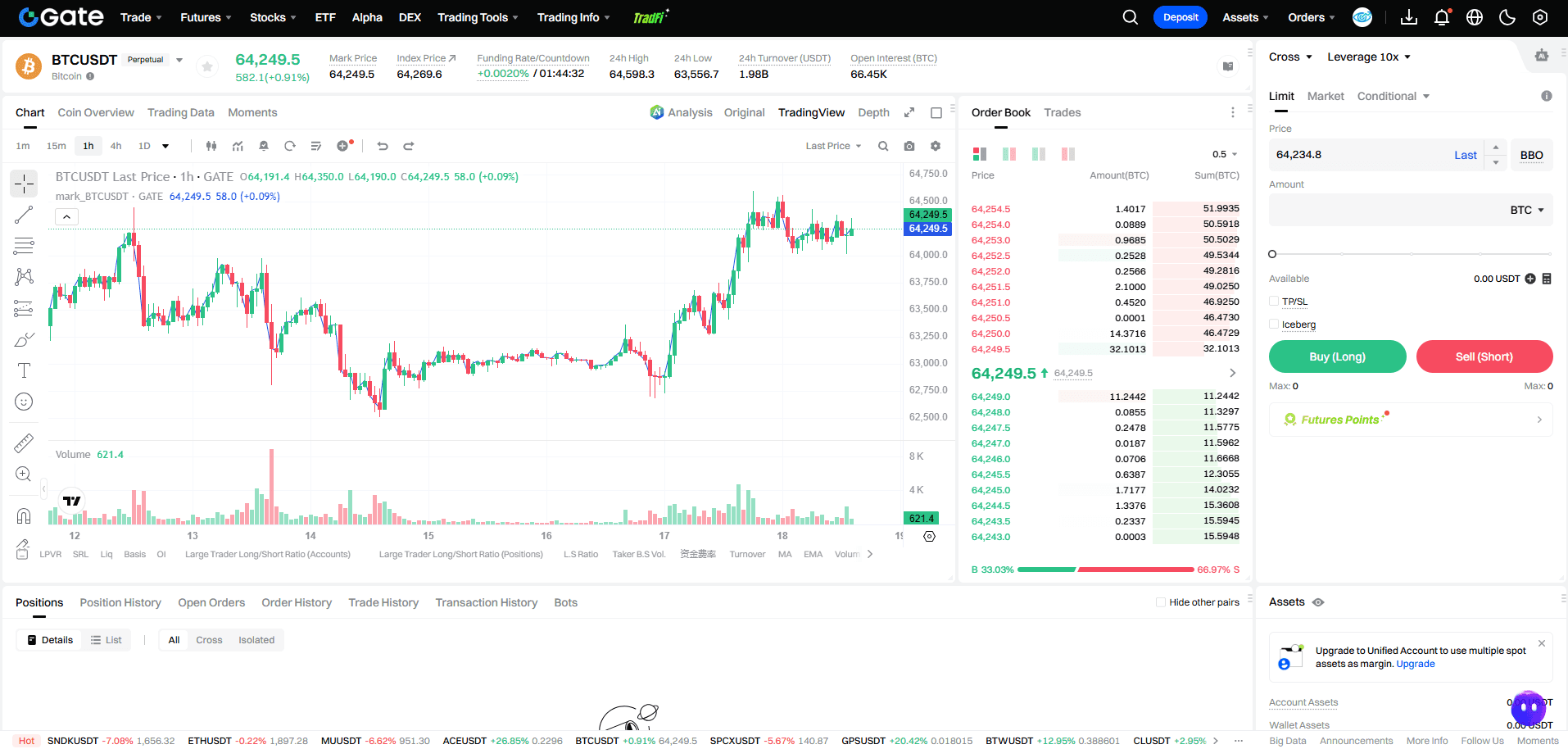
The standard trading terminal includes:
- price chart;
- order book and market depth;
- recent trade history;
- order placement form;
- open orders and positions;
- transaction history;
- balance and margin data;
- risk management tools.
On the futures market, Market and Limit orders are available, along with conditional and advanced order types. You can set Take Profit and Stop Loss for all or part of a position, use trailing mechanisms, and select the trigger price based on Last Price, Mark Price, or Index Price.
Mobile apps
The official Gate App is available for iOS and Android. On iPhone, it can be installed through the App Store, while on Android it is available through Google Play or directly as an APK from the Gate website.
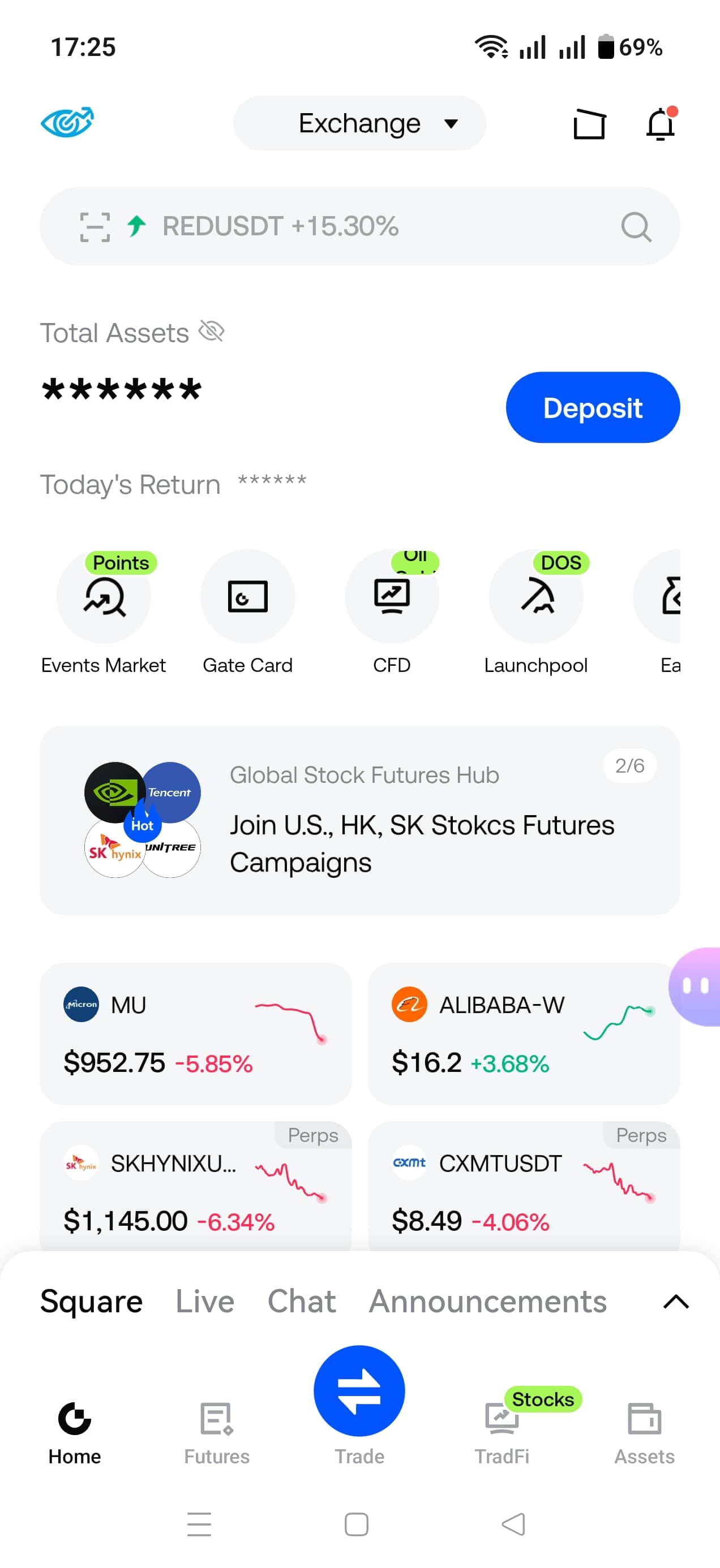
The mobile version is not limited to simply tracking a portfolio. The app provides access to:
- spot trading;
- futures and other derivatives;
- TradFi;
- buying and selling cryptocurrencies;
- investment products;
- trading bots;
- Web3;
- Earn;
- Gate AI;
- asset management and withdrawals.
Gate is effectively trying to bring most of its ecosystem into a single mobile app. It can be used not only to open positions, but also to work with Web3 assets, participate in Launchpool and airdrops, use passive income products, and manage an account.
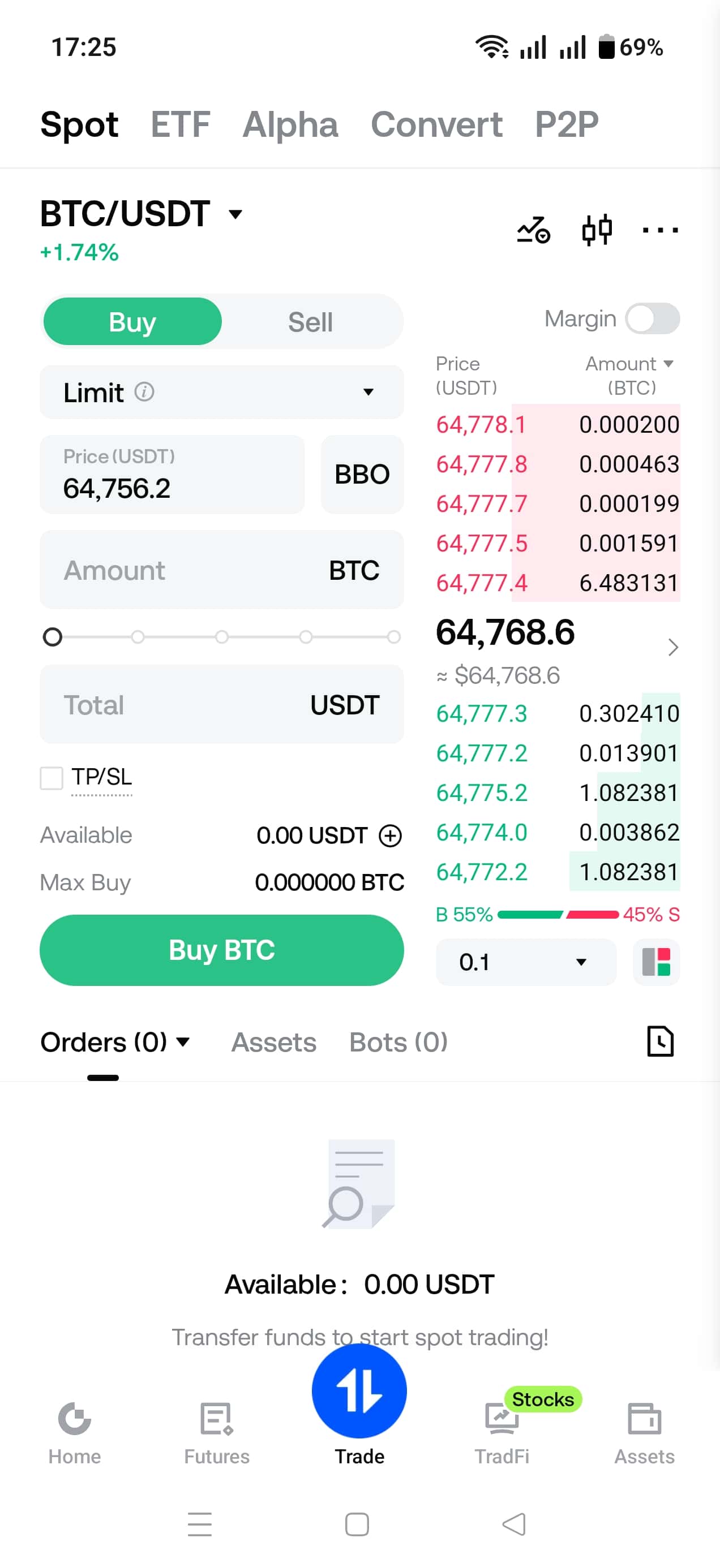
For active traders, the app is convenient because it allows them to monitor positions away from a computer and respond quickly to market changes. However, due to the large number of features, the mobile interface also takes some time to learn.
For Gate TradFi users, the mobile app has an additional advantage: information about the relevant account and transaction history is synchronized with the MetaTrader 5 system.
Desktop app
Gate has a separate Gate Desktop app for computers. Official versions are available for Windows and macOS. The installation files can be downloaded directly from the exchange's website; Windows uses a standard .exe installer, while macOS has a separate client version.
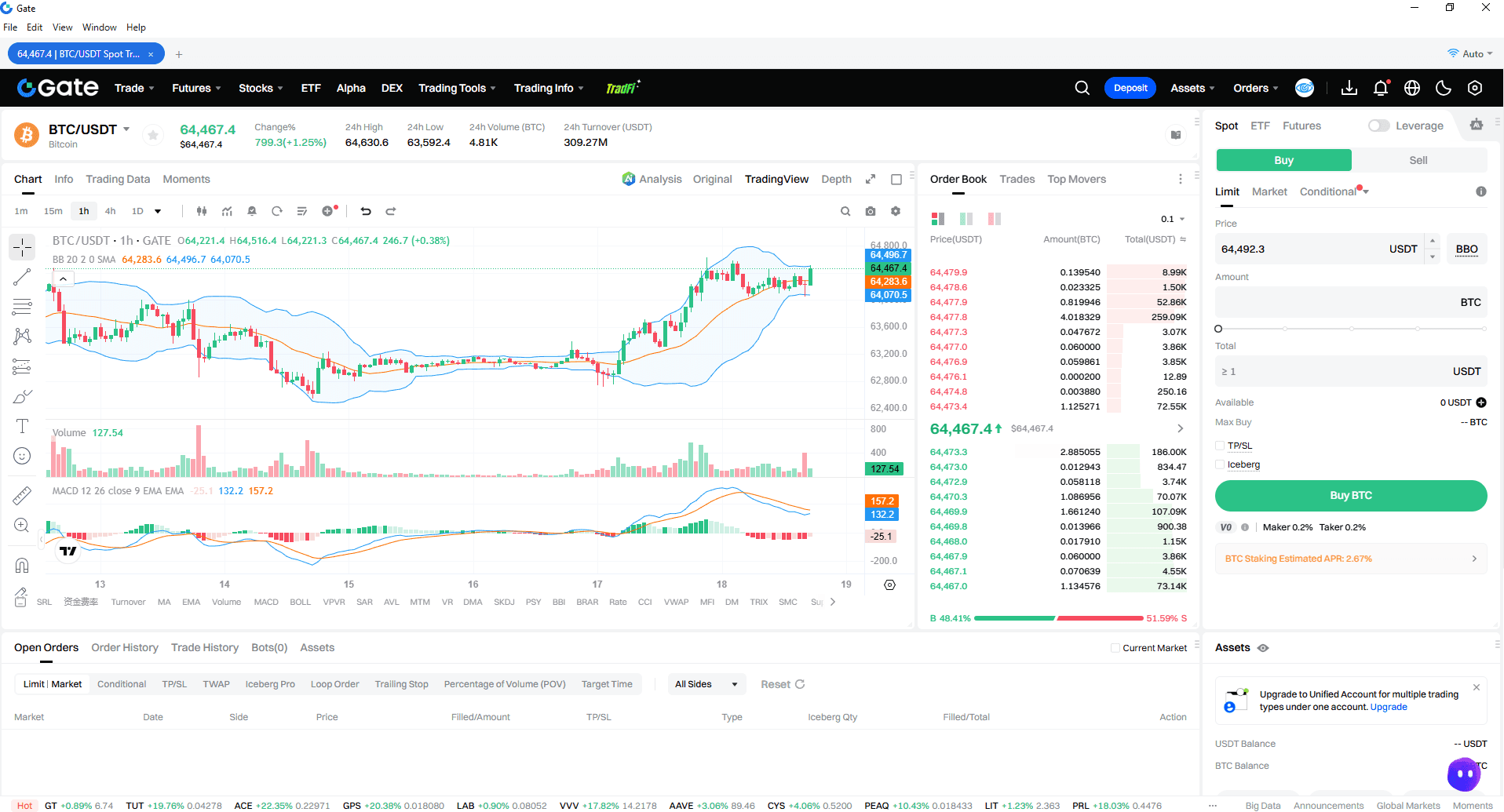
The desktop app will be convenient for traders who regularly use Gate and prefer a standalone program to a browser tab. The account remains the same, so there is no need to create a separate trading account for the desktop client.
API and external platforms
For algorithmic and professional trading, Gate provides an advanced API v4. It includes public methods for obtaining market data and private methods for managing an account and automatically placing orders. Both REST API and WebSocket are supported for receiving real-time data and updates.
Gate's API covers significantly more than just the spot market. The current documentation includes separate modules for:
- Spot and Margin;
- Perpetual Futures;
- Delivery Futures;
- Options;
- CFD;
- Stocks;
- Unified Account;
- Gate Alpha;
- CrossEx.
For example, the separate Stock API includes methods for obtaining quotes and managing orders and positions, while the Options API allows option orders to be placed and modified programmatically.
Gate also provides official SDKs for Python, Java, PHP, Go, C#, Node.js and JavaScript, simplifying the development of custom bots, trading terminals, and portfolio management systems. A separate TestNet API is available for testing integrations without using the main trading environment.
TradingView
Gate is officially integrated with TradingView, allowing users to connect their exchange account directly to the platform and trade through the TradingView interface. The integration makes it possible to use Supercharts, technical indicators, and charting tools while placing and managing orders without visiting the Gate website.
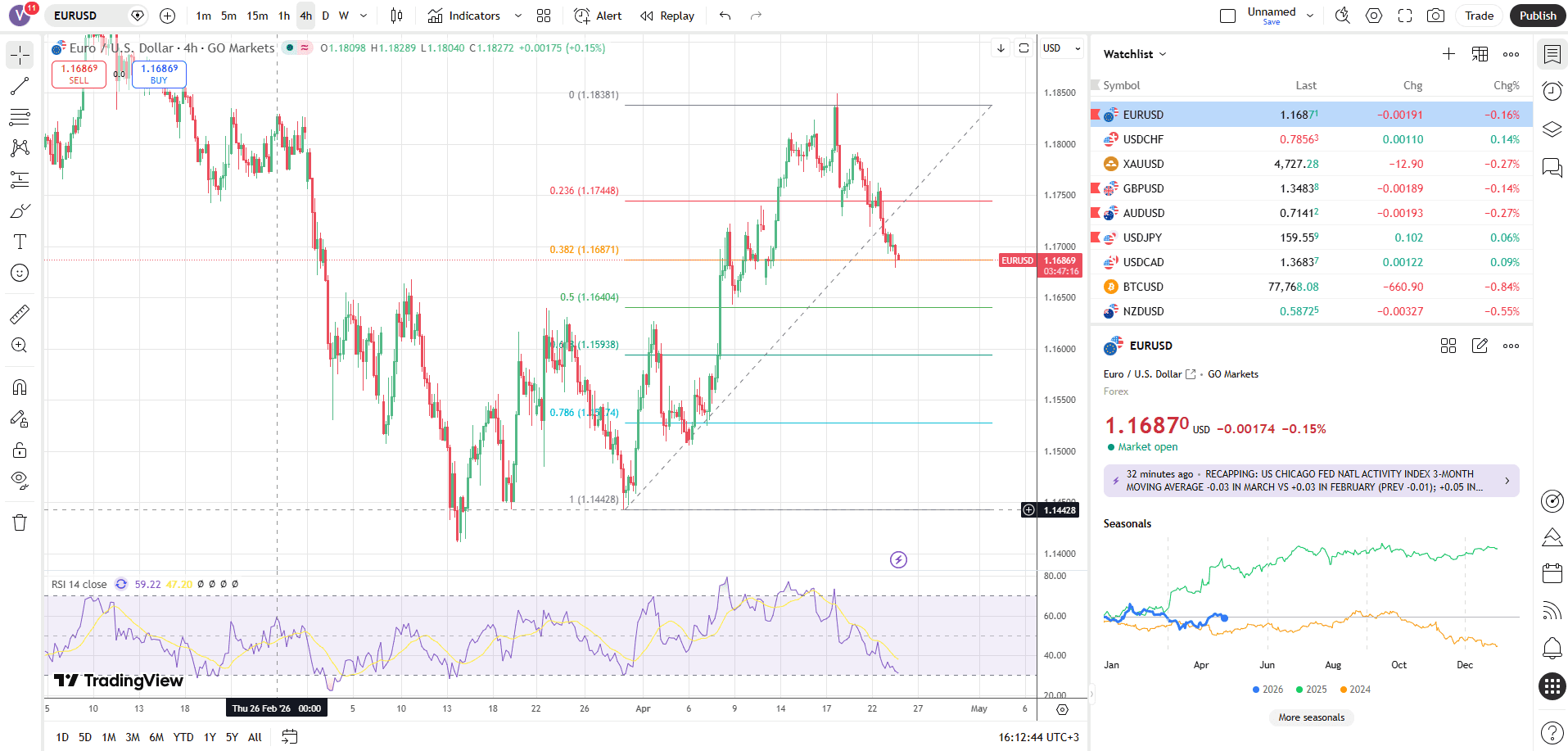
This option is particularly convenient for traders who already use TradingView for technical analysis and want to work with Gate through a familiar interface.
MetaTrader 5
MetaTrader 5 (MT5) is available for CFD trading through Gate TradFi. First, the user opens a CFD (MT5) account within their main Gate account and transfers funds to it. After activation, Gate provides the MT5 account details that can be used to log in to the MetaTrader 5 client.
The MT5 client can be downloaded from the official MetaTrader website and installed on Windows or macOS; mobile apps are also available. Balances, positions, and transaction history are synchronized between Gate and MT5. The platform provides access to advanced charts, technical indicators, and automated strategies.
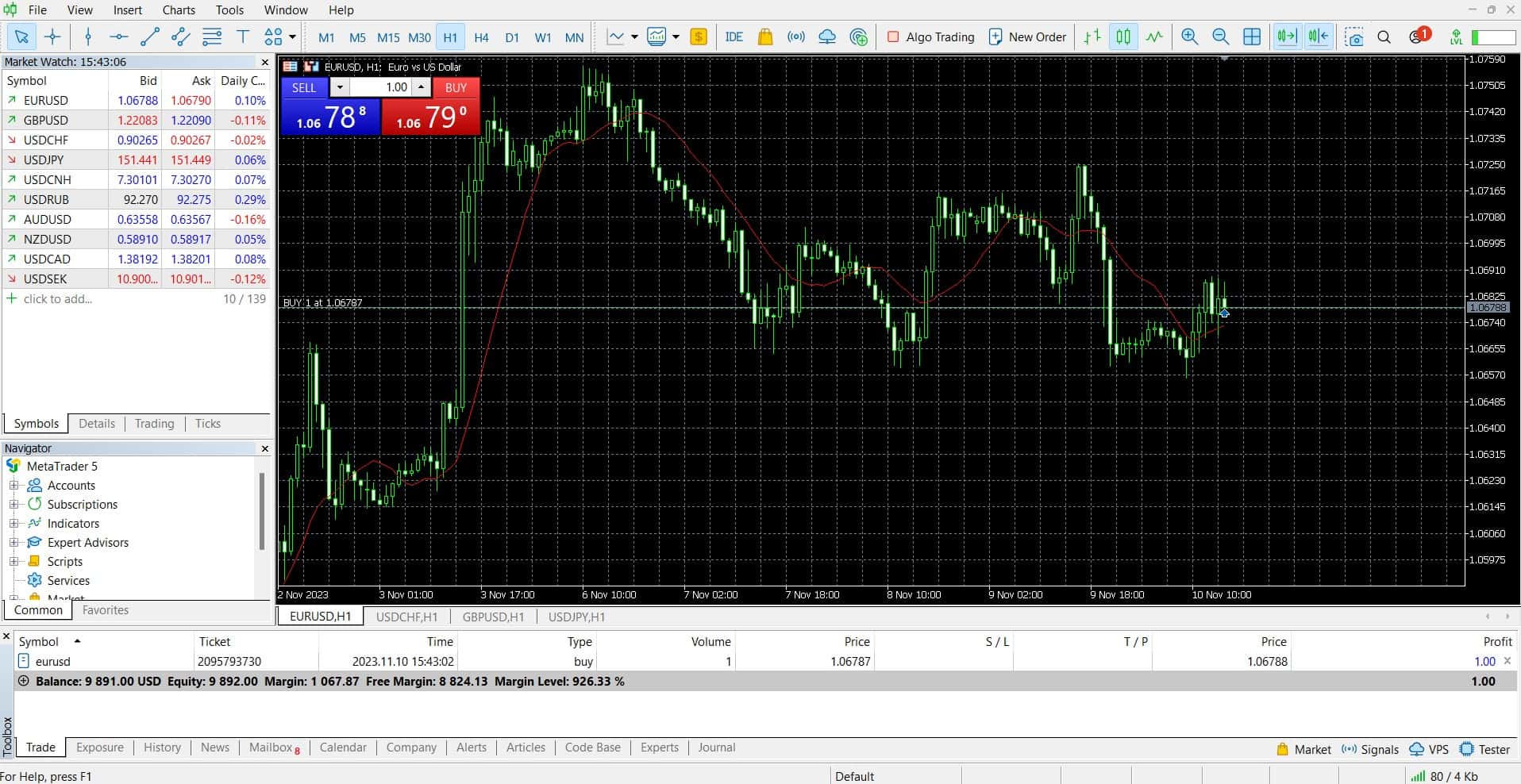
MT5 is used specifically for Gate's CFD offering, rather than as an alternative terminal for regular spot cryptocurrency trading.
Analytics
Gate has an extensive information and analytics ecosystem divided into three main areas: Gate News for timely news, Gate Blog for thematic articles, and Gate Research for more in-depth research. This separation is convenient: traders can follow current events while also accessing fundamental market reviews.
Gate News
Gate News is the platform's news section, focused on timely coverage of events in cryptocurrency and traditional financial markets. The news covers price movements, developments in crypto projects, regulation, macroeconomics, stocks, artificial intelligence, and other events that may affect the market.
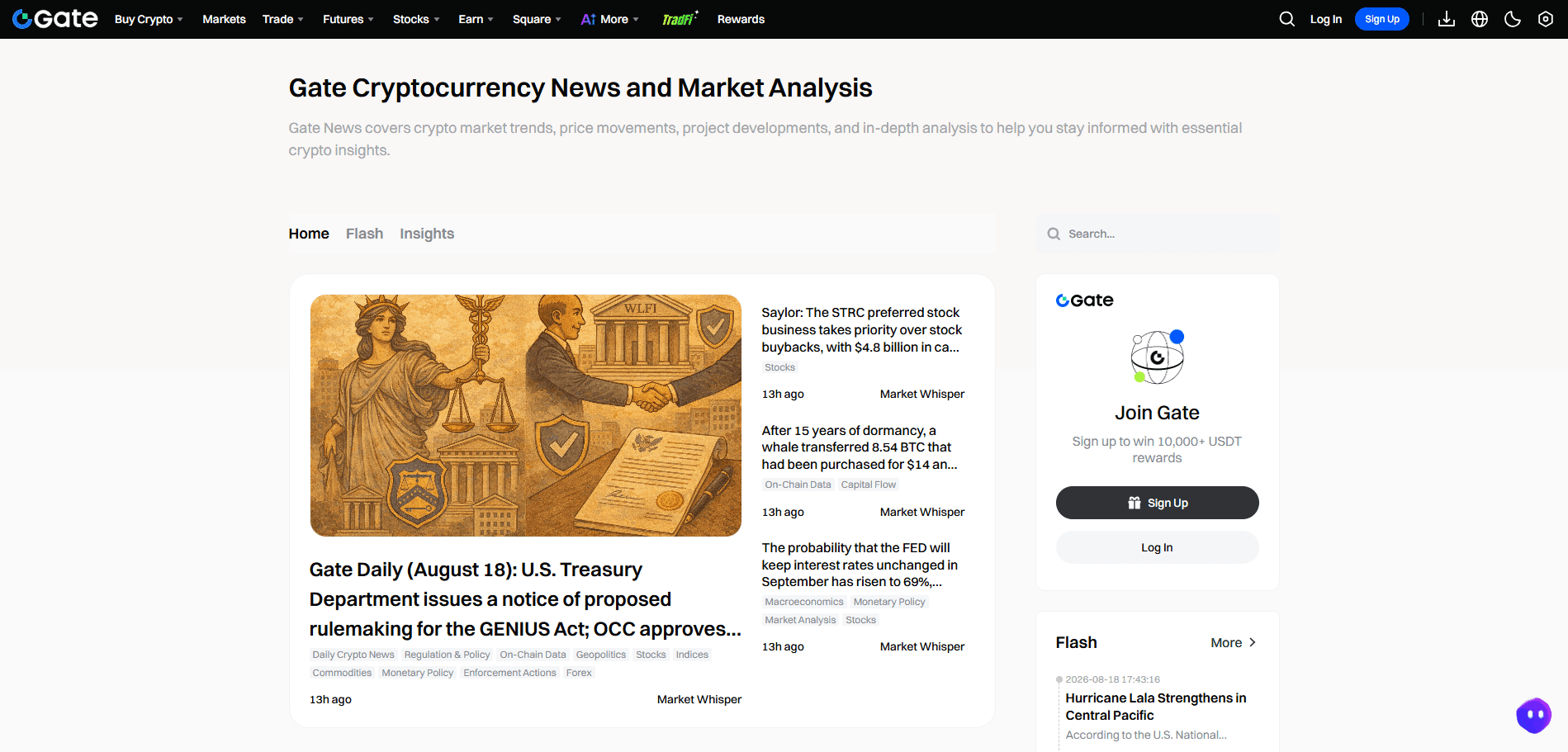
The section includes three main formats:
- Home — the general news feed;
- Flash — brief updates on events almost in real time;
- Insights — more detailed articles and analytical notes.
Gate also publishes a Daily Report that compiles the day's main events, market changes, capital flows, and significant crypto industry news. In addition to cryptocurrencies, Gate News actively covers the stock market, commodities, and macroeconomic events, so the section has become considerably broader than a typical crypto exchange news feed.
The main advantage of Gate News is its speed and large volume of content. However, when making investment decisions, it is advisable to compare the exchange's news with primary and independent sources.
Gate Blog
Gate Blog focuses more on detailed thematic articles, explanations of market processes, and news about the Gate ecosystem itself. Unlike Gate News, where timeliness is important, the content here is usually devoted to a specific topic and provides more context.

The blog is divided into several areas:
- Markets — cryptocurrencies, TradFi, macroeconomics, and market trends;
- Leadership — speeches and publications by Gate's management;
- Security — security, regulation, and industry risks;
- Ecosystem — Web3, DeFi, new projects, and products;
- Brand & Corporate — Gate corporate news;
- TradFi — traditional financial markets;
- Charity — the company's charitable initiatives.
Gate Blog complements the news feed well: it is suitable for users who need more than a brief news item and want an explanation of the reasons behind an event, the characteristics of a particular project, or the broader market context.
Gate Research
Gate Research is Gate's most in-depth analytics section. The company describes it as a blockchain and cryptocurrency research platform that includes technical analysis, market reviews, industry research, trend forecasting, and macroeconomic policy analysis.
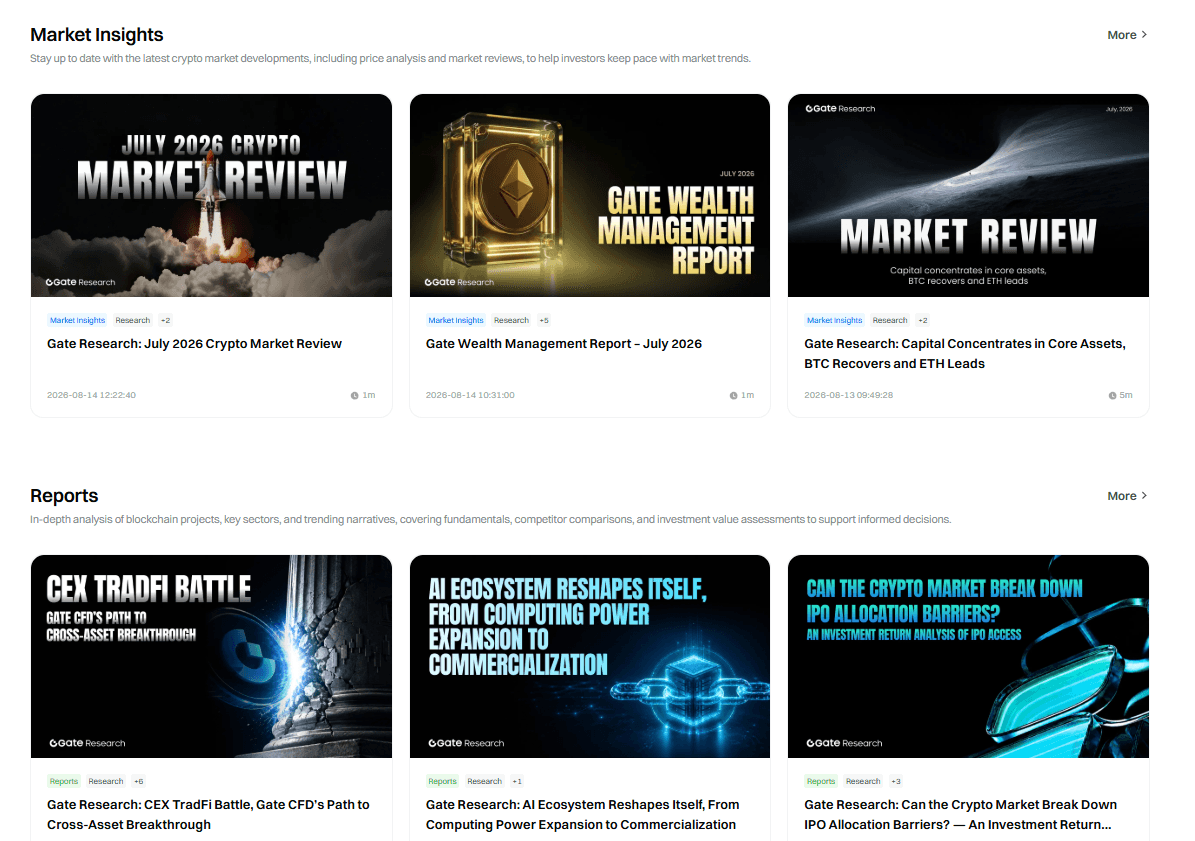
On the main page, research is primarily divided into two categories:
Section | Content |
|---|---|
Market Insights | Price analysis, crypto market reviews, capital flows, macroeconomic factors, and regular market reports |
Reports | In-depth research into individual projects, sectors, and market trends, including analysis of fundamentals, competitors, and investment models |
Gate Research publishes daily, weekly, and periodic reviews.
Weekly research may include analysis of BTC and ETH, ETF flows, liquidity, on-chain data, funding rates, open interest, options volatility, and the macroeconomic environment. Larger thematic reports examine individual market segments, from TradFi and IPOs to AI, DeFi, RWA, and blockchain ecosystems.
Some research is presented as full multi-page reports with charts, tables, statistics, and conclusions. This makes Gate Research considerably more useful than a typical corporate blog for users seeking a more fundamental view of the market.
At the same time, Gate Research remains analysis prepared by the crypto exchange itself. Gate separately warns users that they need to conduct their own research before making investment decisions, so Research materials are best used as one source of analysis, rather than as ready-made trading recommendations.
Education
Gate has a well-developed educational library suitable for users with different levels of experience. The main materials are concentrated in Gate Learn, which offers full courses and educational articles, and Gate Wiki — a large reference and encyclopedia section covering cryptocurrencies, blockchain, and trading. Both resources are free and accessible without having to open a trading position.
Gate Learn
Gate Learn is the exchange's main educational platform. Learning is delivered not only through individual articles but also through structured courses with sequential lessons. At the time of review, the catalog contained about 290 courses of varying difficulty levels.
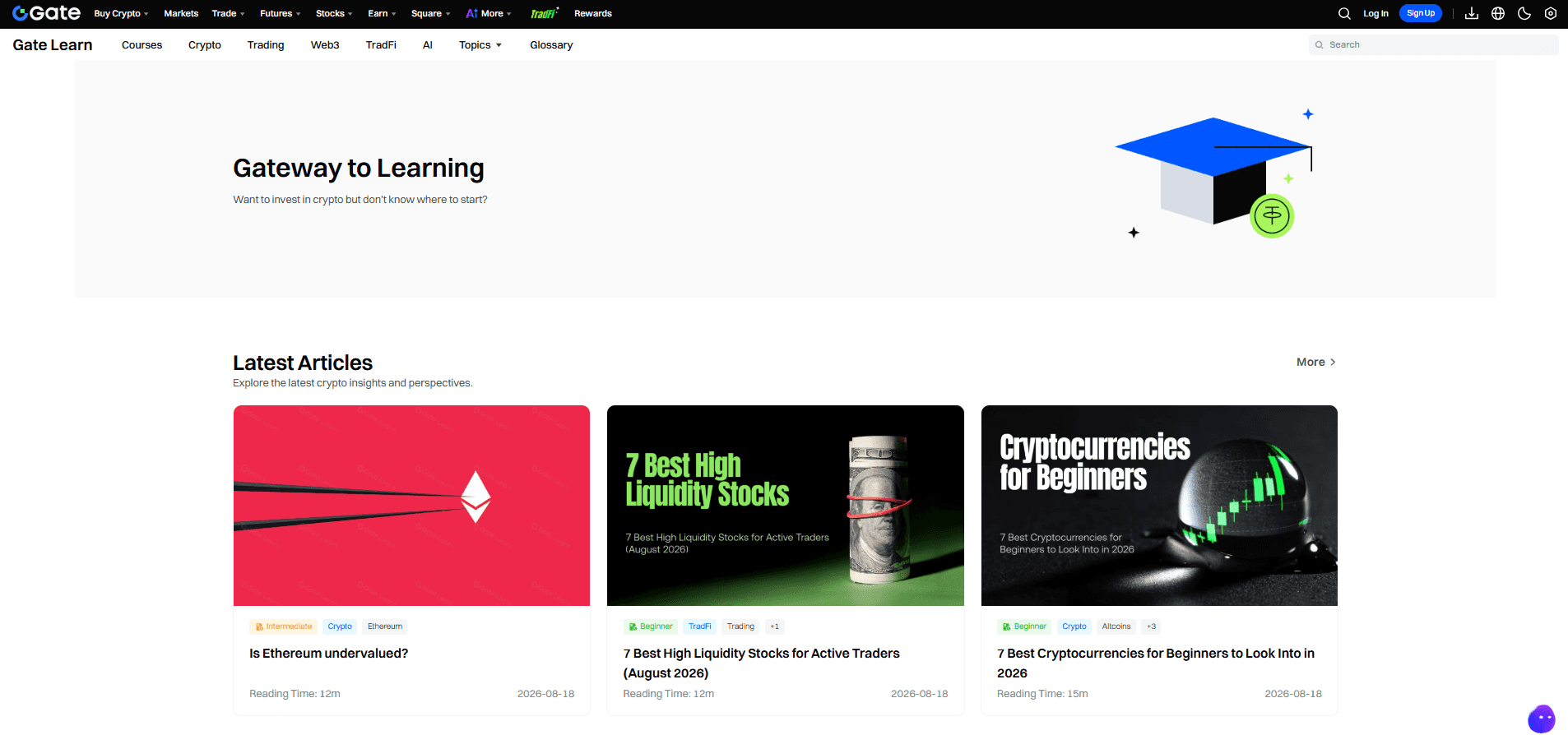
The materials are divided into five main areas:
- Crypto — cryptocurrencies, blockchain, tokenomics, and individual projects;
- Trading — trading, technical analysis, risk management, and strategies;
- Web3 — DeFi, NFT, DAO, wallets, and on-chain applications;
- TradFi — traditional markets, macroeconomics, regulation, and asset tokenization;
- AI — applications of artificial intelligence in the cryptocurrency industry.
Separate thematic filters cover Bitcoin, Ethereum, DeFi, futures, options, trading bots, ETF, RWA, stablecoins, Layer 2, security, and Gate products. Materials are available at Beginner, Intermediate and Advanced levels, allowing users to select training suited to their experience.
A full course usually consists of several sequential lessons. For example, the Proof of Reserves course explains the principles of reserves, the history of the technology, the use of zk-SNARK, and how to independently verify Gate's reserves. Other programs cover trading, DeFi, Web3, derivatives, and individual blockchain projects.
Gate Learn is available in many languages, including English, Russian, Ukrainian, Spanish, Portuguese, Japanese, Arabic, and others. This is a notable advantage over educational portals where most materials are available only in English.
In addition to courses, Gate Learn contains regular articles and a glossary, so the resource can be used both as a sequential educational program and to quickly find an explanation of a specific concept.
Gate Wiki
Gate Wiki serves a somewhat different purpose. It is more of a cryptocurrency encyclopedia and reference library than a traditional educational program with sequential lessons.
The number of topics is very large. The main categories include:
- Bitcoin, Ethereum, Solana, XRP and other cryptocurrencies;
- Blockchain, DeFi, GameFi and Web3;
- Stablecoins and RWA;
- NFT and Metaverse;
- Layer 2 and Zero-Knowledge Proof;
- staking and crypto lending;
- spot and futures trading;
- options and ETF;
- trading bots;
- P2P;
- wallets;
- mining;
- airdrops;
- Launchpool and Launchpad;
- TradFi;
- price predictions and reviews of individual projects.
Wiki materials vary in format. They include simple explanations of terms, beginner guides, reviews of individual coins and blockchains, instructions on using cryptocurrencies, comparison articles, market forecasts, and more detailed industry materials.
This format is particularly convenient when users need to quickly understand a specific topic. At the same time, the quality and depth of articles in Gate Wiki are inconsistent: fundamental educational materials appear alongside price predictions and articles related to Gate's own products. Therefore, Wiki is useful primarily as a reference starting point, while important investment information should also be verified using independent sources.
Customer Support
Gate offers a fairly broad range of support channels, including around-the-clock online chat, tickets, email, and an extensive Help Center. Simple questions are usually resolved effectively, but complex cases may involve lengthy reviews, canned responses, and several rounds of correspondence, which lowers the overall rating.
Support Contact Channels
Gate offers several main ways to get help:
- 24/7 online chat. Available on the website and in the app. Requests are initially handled by Gate Bot, which suggests answers from the knowledge base and attempts to identify the issue. If the automated response is insufficient, simply type Live Support and choose to connect to a live agent. You can use the chat even without signing in, although after signing in, the agent can more easily assist with a specific account.
- Tickets. For issues requiring verification of documents, transactions, or other data, you can submit a separate support request. This format is particularly convenient when you need to attach a TxID, screenshots, or other evidence. Gate explicitly recommends tickets, for example, for disputed transactions and security issues.
- Email. The main technical support address is support@gate.com. You can use it to contact support about complex issues and send documents. Separate addresses are used for business and regulatory inquiries.
- Help Center. A large database of instructions allows users to resolve many common issues independently: restore access, configure security, address deposit or withdrawal issues, and understand KYC, futures, P2P, and other features.
Gate is also present on social media, but for questions related to accounts and funds, it is safer to use the official chat, a ticket, or email. The exchange separately warns about scammers impersonating support staff and emphasizes that a genuine employee will not ask for your password, private key, or 2FA codes.
Response Time
Gate states that its support service operates 24 hours a day, 7 days a week, but it does not publish a universal guaranteed time for the first response from an agent in a standard chat or by ticket. Therefore, service speed may depend on support workload and the complexity of the issue.
For some procedures, the exchange sets specific timeframes. For example, after the required documents are provided, Gate promises to review an account recovery request within 1–3 business days. A request to recover an incorrectly credited or missing cryptocurrency deposit is usually processed within 7 business days.
A separate formal complaint procedure applies to customers of the European division. Gate Technology Ltd must acknowledge receipt of a complaint within 2 business days, aims to provide a final response within 15 business days, and in exceptional cases, the maximum timeframe is 35 business days. This applies specifically to formal complaints from European customers, not to standard online chat.
Support Competence
Gate's support structure separates simple and complex requests. Basic questions are initially handled by the automated system and Help Center, after which the user can switch to a live agent. Separate procedures are available for specific issues, such as account recovery, locating a lost deposit, handling suspicious transactions, and accounts blocked by the Risk Control system.
For complex financial and technical issues, users usually need to provide details: UID, TxID, network, wallet address, screenshots, documents, or other supporting evidence. The case may then be escalated to a specialized team for review. For example, Gate provides a separate cryptocurrency deposit recovery mechanism that verifies the transaction on the blockchain.
At the same time, user reviews point to a weakness in Gate's support: for unusual problems, there are complaints about canned responses, lengthy correspondence, and difficulty obtaining a final resolution. Among the latest reviews on Trustpilot, some complaints specifically concern the performance of support. However, this indicator reflects reviews of the company as a whole and cannot be regarded as a standalone assessment of support quality.
Conclusion
Gate is a large, multifunctional cryptocurrency exchange best suited to active and experienced traders. The platform will be particularly appealing to users who need a wide selection of cryptocurrencies, an advanced derivatives market, automated trading, an API, Web3 services, and access to TradFi instruments.
The exchange may also suit long-term investors thanks to staking and other products for earning returns on crypto assets. Gate provides beginners with demo trading and extensive educational resources, although the large number of features means that learning the platform's interface and structure may take time.
FAQ
What is Gate?
Gate is an international cryptocurrency exchange founded in 2013. The platform offers spot and margin trading, futures, options, CFDs, stocks, ETFs, P2P, Web3, staking, and other services for working with digital assets.
Is Gate safe?
Gate can be considered a fairly reliable cryptocurrency exchange, but trading and storing funds on a centralized platform are not without risks. Individual Gate companies are regulated in the EU, Dubai, Japan, and other jurisdictions. The exchange uses cold storage, multi-factor authentication, and Proof of Reserves based on Merkle Tree and zk-SNARK.
How does Gate work?
Gate operates as a centralized exchange: users deposit funds into their accounts and can then buy and sell assets through the trading terminal. On the spot market, buy and sell orders are matched through the order book. In addition to regular trading, derivatives, Earn, P2P, bots, copy trading, Web3, and TradFi are available.
How do I use Gate?
To get started, you need to register an account, complete KYC, and fund your balance. You can then select the desired market—for example, Spot—find a trading pair, and place a buy or sell order. Additional Gate products are available through the corresponding sections of the platform.
How do I open an account on Gate?
Click Register, select your country of residence, and register using your email address or phone number. Then confirm your contact details with a code and set a password. To use the exchange fully, you must complete KYC by providing the requested personal information and an identity document.
How do I deposit funds on Gate?
To deposit cryptocurrency, open Wallet → Funds Management → Deposit → Onchain, select the coin and network, then copy the Gate address and send funds to it from your wallet or another exchange. In supported regions, you can also buy cryptocurrency with fiat currency using bank cards, transfers, and P2P.
How do I trade on Gate?
Open Trade → Spot, select, for example, BTC/USDT, specify the order type, price, and amount of the asset, and click Buy or Sell. A Market order is executed at the available market price, while a Limit order allows you to set your desired transaction price.
How do I sell cryptocurrency on Gate?
You can sell cryptocurrency through the spot market: select the desired trading pair, such as BTC/USDT, specify the amount, and create a Sell order. For a simpler exchange, you can use Convert, and to receive fiat money, you can use P2P or the cryptocurrency sale channels available in your region.
How do I withdraw money from Gate?
To withdraw cryptocurrency, open Withdraw → Onchain, select the asset and network, enter the external wallet address and amount, and then confirm the transaction. If you need to withdraw fiat currency, you can use Gate's banking channels in supported countries or sell cryptocurrency through P2P. Available methods and limits depend on the region.
How do I delete an account on Gate?
Before deleting your account, you must withdraw all funds and ensure that there are no pending transactions. In the app, go to Account Center → Security → Manage Account → Delete Account, specify the reason, accept the terms, and complete the security verification. Account deletion is irreversible; Gate may continue to retain some personal data for the periods required by law.