OKX Review 2026
OKX is suitable for active and experienced crypto traders who value low fees, a broad choice of markets, derivatives, API and advanced tools.
- OKX is trusted. Tested via live trading.
- OKX №4 in the crypto exchanges list
Highlights of OKX
OKX is one of the largest international cryptocurrency exchanges, founded in 2017. The platform operates in more than 100 countries and offers trading in hundreds of digital assets, including spot trading, futures, options, and other cryptocurrency instruments. The exchange caters to beginners as well as active and professional traders.
In addition to the centralized exchange, the OKX ecosystem includes a non-custodial Web3 wallet and tools for working with DeFi. The platform emphasizes high liquidity, advanced trading infrastructure, and reserve transparency.
Pros and cons of OKX
Pros
- A broad range of markets and trading instruments.
- Low fees, especially for futures.
- Strong web, mobile, and API platforms.
- Advanced analytics and demo trading.
- Regulation in several major jurisdictions.
Cons
- There have been serious regulatory concerns regarding AML/KYC.
- Complex support requests can take a long time to resolve.
- The interface can be difficult for beginners.
Reviews of OKX

OKX
What traders talk about
No reviews yet.
Leave a review of your experience:
OKX Exchange Overview
- Foundation Year
- 2017
- Official Website
- https://www.okx.com
- Regulated in Countries
Malta, United Arab Emirates, Singapore, Australia, Bahamas, United States, El Salvador, Argentina, Brazil, Seychelles, Turkey
More Details- Trading Assets
- Cryptocurrency
- Futures
- Stocks
- ETF
- Precious Metals
- Options
- Fees (Maker/Taker)
- Spot
- 0.08% / 0.1%
- Futures
- 0.02% / 0.05%
- Max Leverage
- Spot
- 10x
- Futures
- 100x
- Email Support








OKX was founded in 2017 by entrepreneur Star Xu and initially operated under the name OKEx. In 2022, the platform rebranded and adopted its current name, OKX, reflecting the company's expansion beyond a traditional cryptocurrency exchange. Today, OKX is operated by OK Group and operates internationally.
The primary business of OKX is providing infrastructure for buying, selling, and trading digital assets. The company operates a centralized crypto exchange offering spot and derivatives trading, as well as its own Web3 products, including a non-custodial wallet and tools for interacting with decentralized applications and DeFi.
OKX Review Summary
Reliability and Regulation
OKX has a strong international regulatory framework and a high level of reserve transparency. Its reliability is rated highly, although past regulatory concerns and differences between legal entities slightly lower the overall rating.
Advantages
- Licenses and registrations in several major jurisdictions.
- Regular Proof of Reserves.
- Advanced client fund protection mechanisms.
Disadvantages
- There have been serious regulatory concerns regarding AML/KYC.
The ratings for OKX in this review are calculated using our broker assessment methodology, which considers key criteria such as reliability, trading conditions, fees, platform functionality, and service quality.
Below, we examine each criterion in detail to show how the final rating for OKX is determined. Read on to learn about the exchange's strengths and weaknesses.
Reliability and Regulation
The reliability of OKX can be rated as high. The exchange has operated since 2017, has licensed entities in several regulated financial centers, publishes Proof of Reserves, and uses a multi-layered asset protection system. However, the company has faced serious regulatory allegations, primarily concerning compliance with AML/KYC requirements in previous years.
Licensing and Jurisdiction
| Legal Entity | Regulator |
|---|---|
| — | |











The position of OKX is particularly strong in Europe. OKX Europe Limited received a licence on 27 January 2025 as a crypto-asset service provider (CASP) from Malta Financial Services Authority (MFSA) under MiCA. The licence allows the company to provide regulated cryptocurrency services in all 30 countries of the European Economic Area.
In Dubai, OKX Middle East Fintech FZE holds a valid VASP licence No. VL/23/12/003 issued by Virtual Assets Regulatory Authority (VARA). It covers exchange and brokerage services, lending, asset management, and virtual asset trading, including permitted derivatives.
In Singapore, OKX SG Pte. Ltd. holds Major Payment Institution status from Monetary Authority of Singapore (MAS) with authorization that includes Digital Payment Token Services. In the Bahamas, OKX Bahamas is registered as a Digital Asset Business and supervised by the Securities Commission of The Bahamas.
In Australia, spot cryptocurrency operations are conducted by the AUSTRAC-registered entity OKX Australia Pty Ltd, while derivatives are provided by OKX Australia Financial Pty Ltd, which holds Australian Financial Services Licence No. 379035.
However, for international clients who are not assigned to a separate local entity of OKX, the user agreement names Aux Cayes FinTech Co. Ltd., which is registered in Seychelles. Registration of a company in Seychelles does not in itself provide the same level of regulatory protection as authorization under MiCA or a licence issued by VARA or MAS.
Regulatory Risks
The most serious regulatory episode in the history of OKX concerns the US. On 24 February 2025, Aux Cayes FinTech Co. Ltd., the Seychelles company that operated the global OKX platform, pleaded guilty to operating a money transmitting business in the US without the required registration. According to the US Department of Justice, although the exchange officially prohibited services for US clients, from 2018 through early 2024, US users conducted through OKX transactions worth more than $1 trillion. In addition, until November 2022, some clients could use the platform without completing full KYC verification.
As part of the settlement, Aux Cayes agreed to pay more than $504 million, including forfeiture of $420.3 million and a criminal fine of approximately $84.4 million. OKX also agreed to continue working with an independent compliance consultant until at least February 2027. When determining the fine, US authorities considered the company's cooperation with the investigation and the measures taken to address the violations.
Allegations were also made against the European entity of OKX. On 1 April 2025, the Financial Intelligence Analysis Unit (FIAU) of Malta imposed on OKCoin Europe Limited an administrative fine of €1 054 269. This concerned deficiencies in the AML/CFT system identified during an inspection in April 2023 and relating to an earlier period of the company's operations. FIAU identified, in particular, deficiencies in customer risk assessment, transaction monitoring, and the application of enhanced due diligence measures.
Importantly, OKCoin Europe Limited is the former name of the current OKX Europe Limited: the legal entity with registration number C88193 changed its name in 2025. At the same time, the European company received Crypto-Asset Service Provider (CASP) authorization under MiCA as early as 27 January 2025, that is, before the publication of the FIAU decision.
Another regulatory episode occurred in the Netherlands. On 27 May 2025, De Nederlandsche Bank (DNB) fined Aux Cayes FinTech Co. Ltd. in the amount of €2.25 million for providing cryptocurrency services in the country without the required registration. The violation covered the period from July 2023 through August 2024. When determining the final amount of the fine, DNB took into account the actions taken by OKX to end the violation and transfer Dutch clients to a registered group entity.
Thus, the regulatory history of OKX includes several serious violations, primarily related to AML/KYC and providing services without the required authorizations. At the same time, the main allegations concern activities in previous years. The company has strengthened its compliance procedures while expanding its regulated infrastructure, and its European entity now has full MiCA authorization. Past violations therefore remain an important factor when assessing the reliability of OKX, but they do not mean that the exchange lacks current regulation in key jurisdictions.
Security of Funds
OKX uses the Proof of Reserves (PoR) and states that clients' crypto assets are backed at a ratio of at least 1:1.
The technology used to verify user liabilities is zk-STARK, while the wallet addresses of OKX are published to allow independent verification of assets on the blockchain. Proof of Reserves should be distinguished from a full financial audit: it confirms the existence of reserves at a particular point in time but does not provide a complete picture of all liabilities or the financial position of the group of companies.
To store funds, OKX uses cold wallets, multisignature technology, and multi-layered transaction control systems. At the account level, two-factor authentication, FIDO passkeys, withdrawal address whitelisting, and the option to block withdrawals to recently added addresses are available.
For clients in the EEA, client and proprietary funds of OKX must be segregated. However, crypto assets are not covered by standard bank deposit guarantee schemes or a Europe-wide investor compensation scheme, so regulation does not completely eliminate the risk of holding cryptocurrency on a centralized exchange.
Account Opening
Opening an account with OKX takes place entirely online and usually does not take long. Registration requires a valid email address and phone number, while full use of the exchange requires mandatory identity verification (KYC). The availability of the platform itself and individual products depends primarily on the user's country of residence and local regulatory requirements.
Registration
An account can be created through the website or mobile app of OKX. Standard registration requires the user to:
- Select their country or region of residence.
- Enter an email address and confirm it with a six-digit code.
- Add a mobile phone number and confirm it with a code sent via SMS.
- Create a password.
- Proceed to identity verification.
A referral code, if available, can be entered when creating the account. Each email address and phone number may be used for only one OKX account.
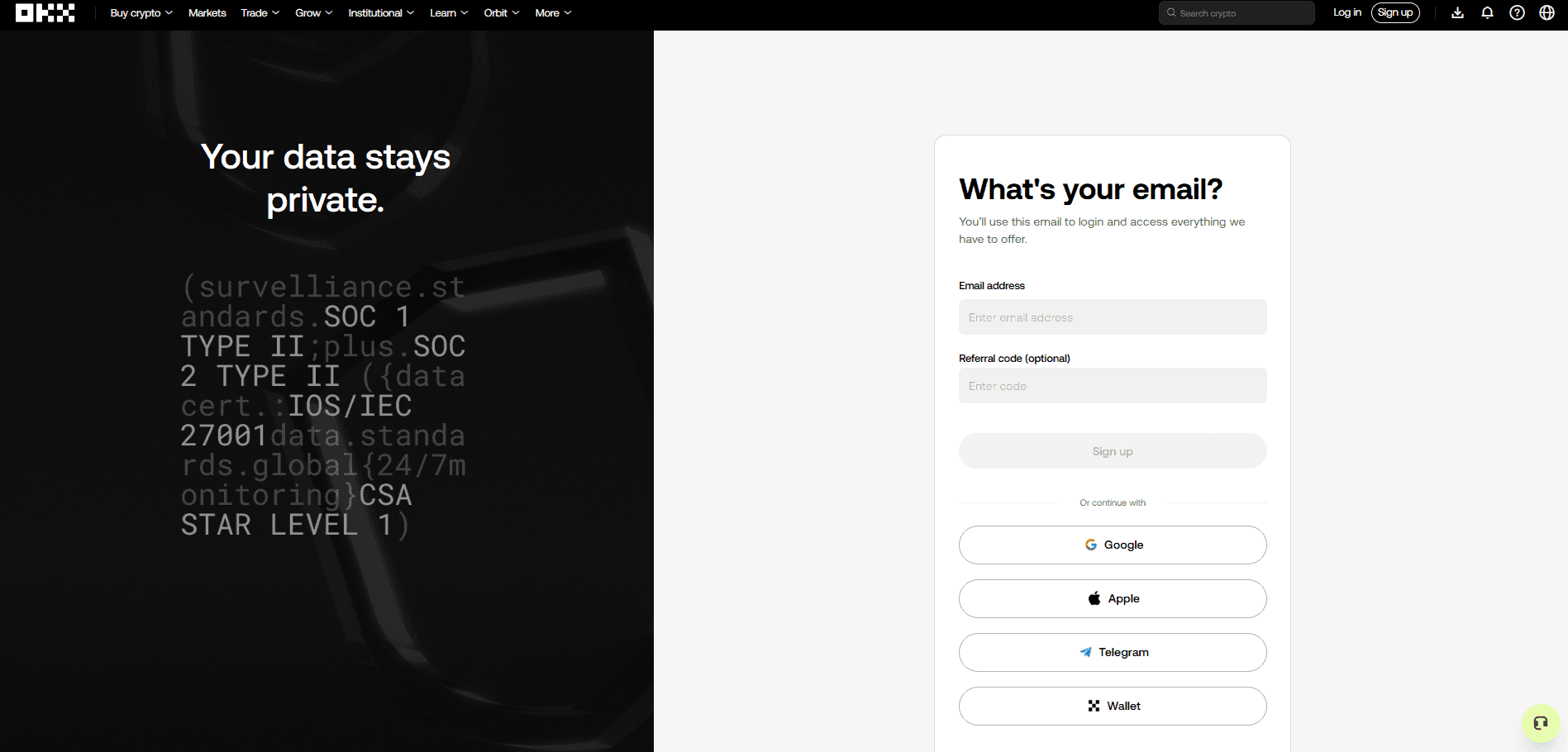
In some regions, OKX also allows users to begin registration through Google, Apple, or Telegram, although they may still need to link their contact details during the process. Users must be at least 18 years old, and registration from prohibited jurisdictions is unavailable.
After registration, the account does not yet provide full access to trading. To trade, make deposits, and withdraw funds, the user must complete KYC.
Verification
Identity verification on OKX is mandatory. The procedure complies with Know Your Customer (KYC) requirements and is used to confirm the client's identity and comply with AML requirements. Account functionality is significantly restricted until verification is complete.
To complete KYC, the user provides basic personal information, including:
- country of residence and citizenship;
- first and last name;
- date of birth;
- residential address;
- identity document type and number.
The user must then upload or scan a supported document and complete a facial verification. Depending on the country, OKX accepts a passport, national identity card, driver's licence, residence permit, or another government-issued document. The exact list is displayed directly in the verification form and depends on the user's jurisdiction.
Most applications are processed fairly quickly. OKX states that standard verification is usually completed within 24 hours, although the process may take longer if additional checks are required. The exchange may also subsequently request reverification, an updated document, or additional information about the client.
Account Types
The range of trading products offered by OKX is very broad. The exchange is suitable not only for ordinary cryptocurrency purchases and sales, but also for derivatives, algorithmic and professional trading, passive strategies, and working with Web3. However, some of the most complex products are not available in every country, so the actual features available for a particular account may vary.
Spot Trading
The spot market at OKX is designed for directly buying and selling cryptocurrencies. Users purchase an actual digital asset that remains in their exchange balance after the transaction and can be withdrawn to an external wallet.
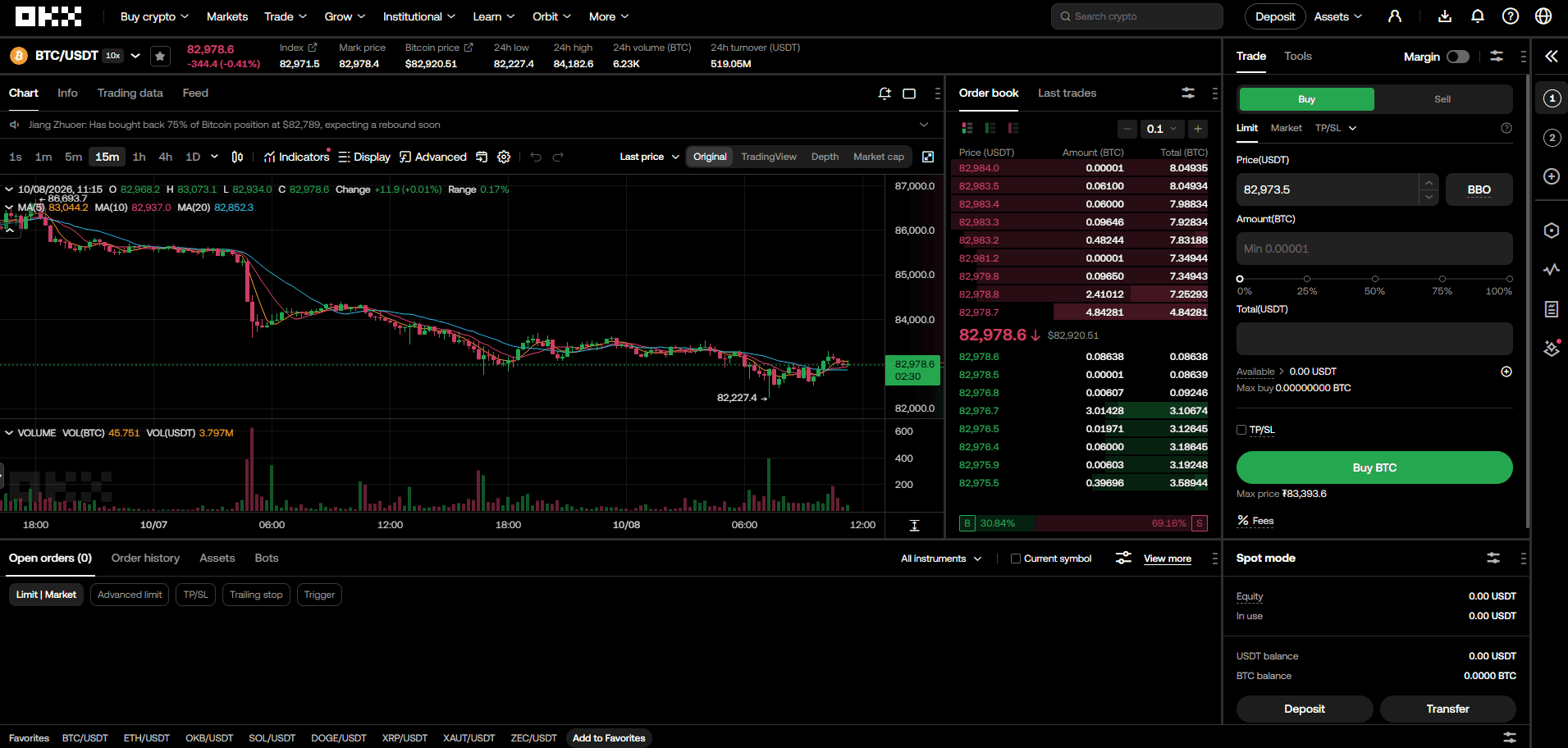
The trading terminal supports market, limit, and other order types. Margin trading using borrowed funds is also available to experienced users. In this case, both potential returns and risk increase, and the position may be liquidated if collateral is insufficient.
Futures
OKX offers a well-developed cryptocurrency derivatives market, including perpetual and dated futures. Perpetual contracts have no fixed expiration date, and their price is kept close to the spot price through the funding-rate mechanism.
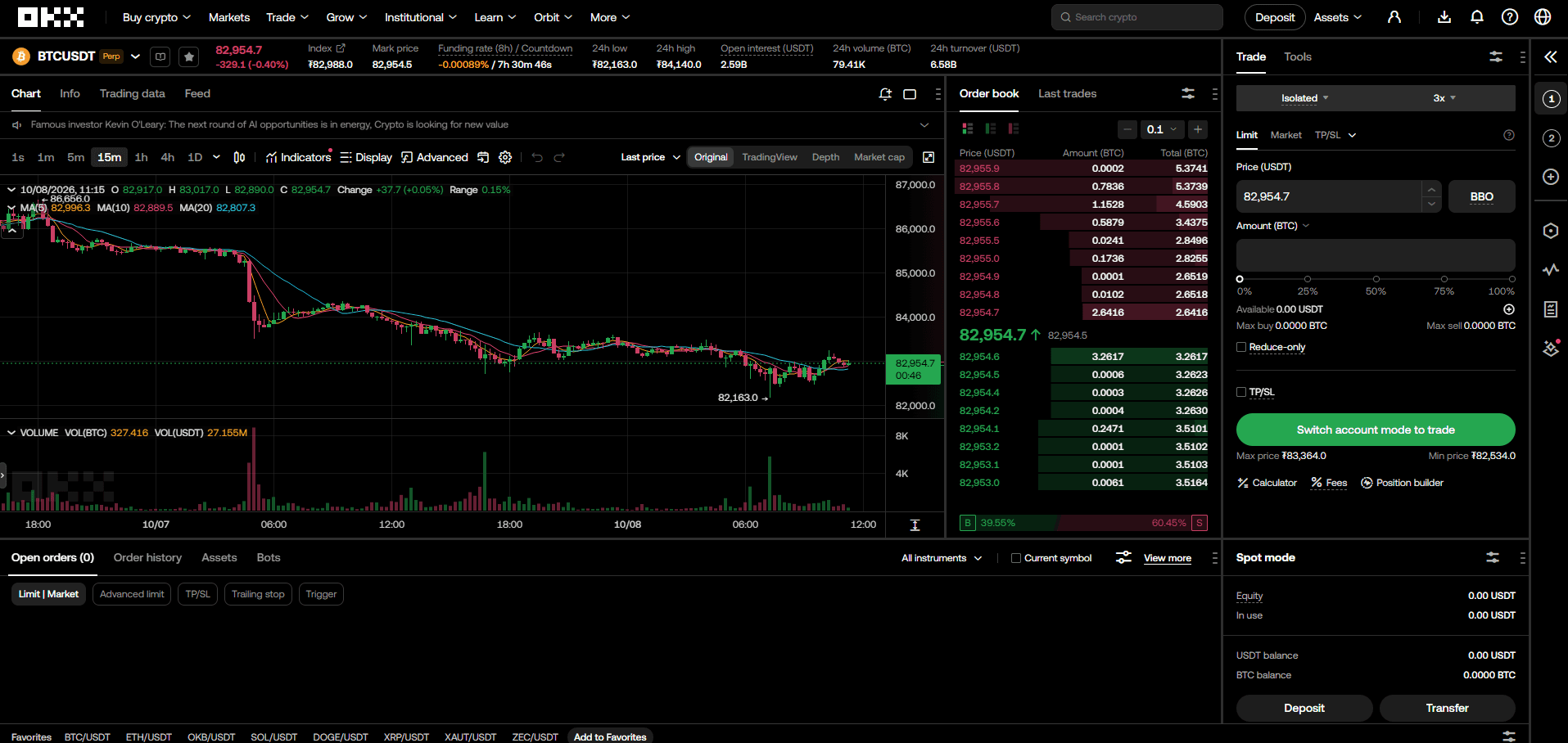
Depending on the contract, collateral and settlement may be denominated in USDT, USDC or in the cryptocurrency itself. Leverage is available, with the amount depending on the instrument and position. Futures are therefore primarily suitable for traders who understand how margin, liquidation, and funding work.
Options
OKX offers European-style options Call and Put on BTC and ETH. The option buyer has the right, but not the obligation, to buy or sell the underlying asset at a predetermined price.
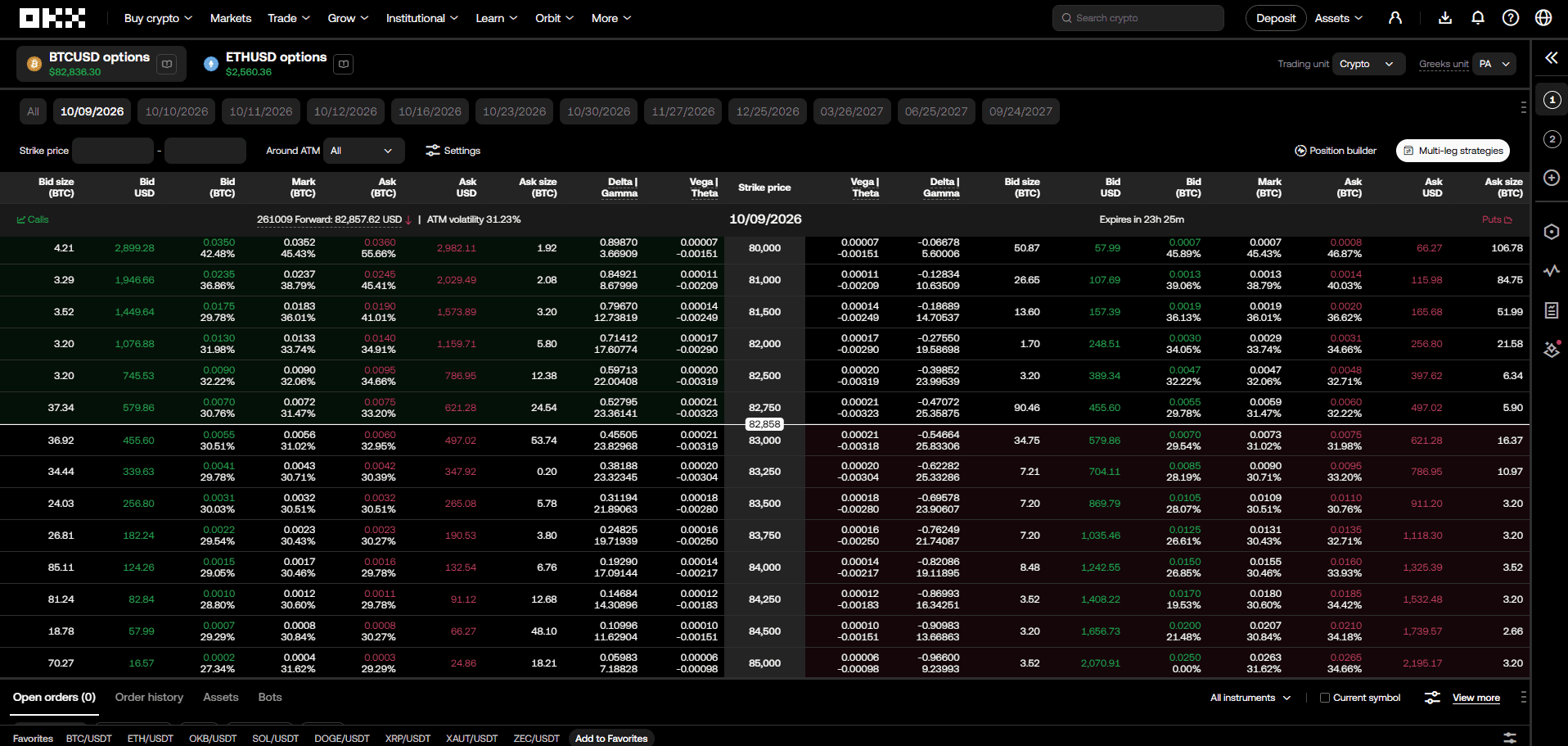
Contracts with various terms are available, ranging from daily to weekly, monthly, and quarterly expirations. Trading is available through the simplified Simple Options interface, a full options chain, or the professional RFQ. Options are intended primarily for experienced traders who use hedging, volatility trading, and complex strategies.
TradFi
The TradFi section provides price exposure to traditional financial markets using the infrastructure of OKX. Depending on the jurisdiction, derivatives are available on stocks, ETFs and commodities, including gold, silver, and oil.
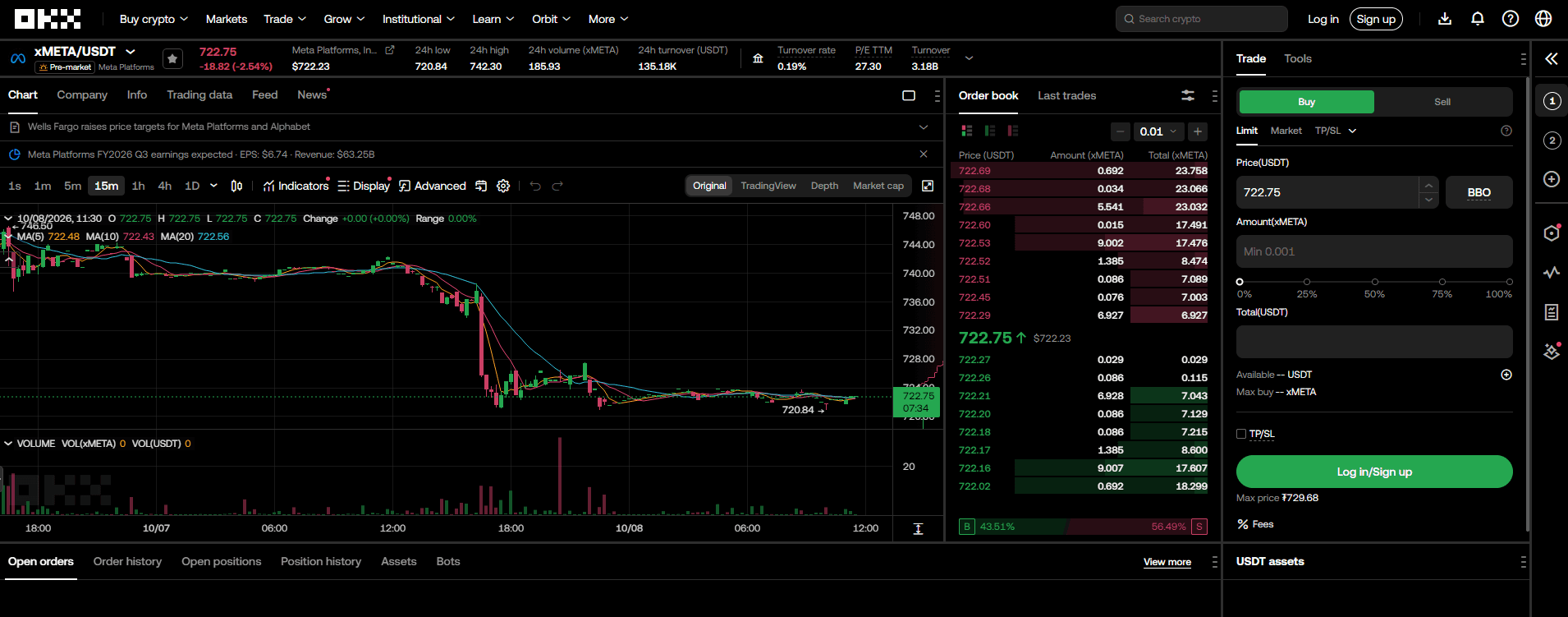
It is important to note that buying such a contract does not mean owning the corresponding stock, ETF or physical commodity. It is a derivative whose value is linked to the underlying traditional asset.
DEX
OKX is developing its own DEX aggregator within Web3 Wallet. Unlike on a centralized exchange, trades here are executed directly through the blockchain, while users retain control over their assets and private keys.
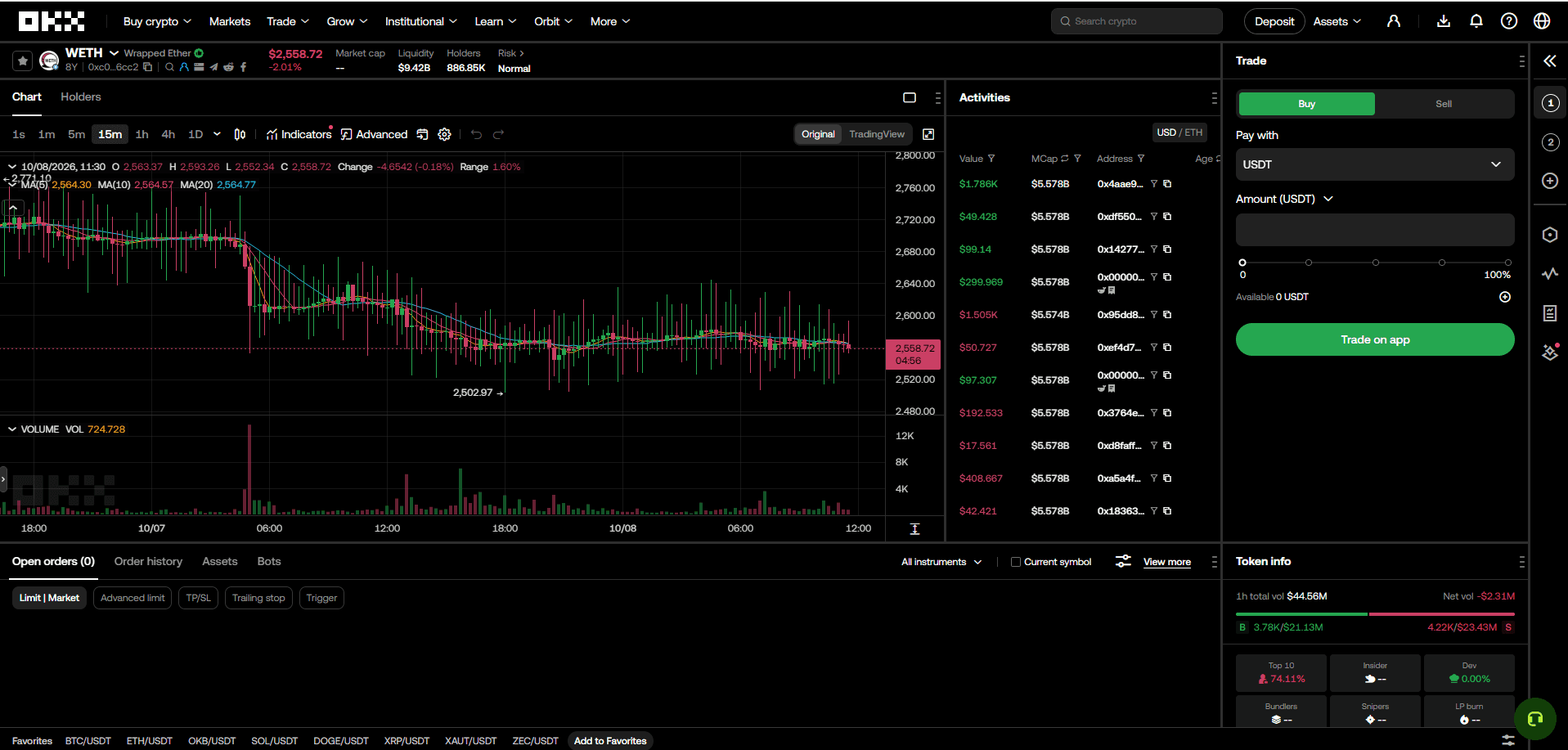
OKX DEX aggregates liquidity from more than 400 decentralized exchanges, more than 25 cross-chain bridges, and over 30 blockchain networks. This makes it possible to search for swap routes among hundreds of thousands of tokens through a single interface.
Professional Trading: Nitro Spreads and RFQ
For large-volume and professional traders, OKX offers Liquid Marketplace, which includes Nitro Spreads and RFQ.
Nitro Spreads is designed for spread and basis trading. Instead of opening two related positions separately, a trader can execute both legs of the trade simultaneously. Execution is atomic: either both legs are filled in the required volume or neither is filled. This reduces the risk of only one side of the strategy being executed. Nitro Spreads can be used, for example, to trade funding rates, spot-futures carry, and calendar spreads.
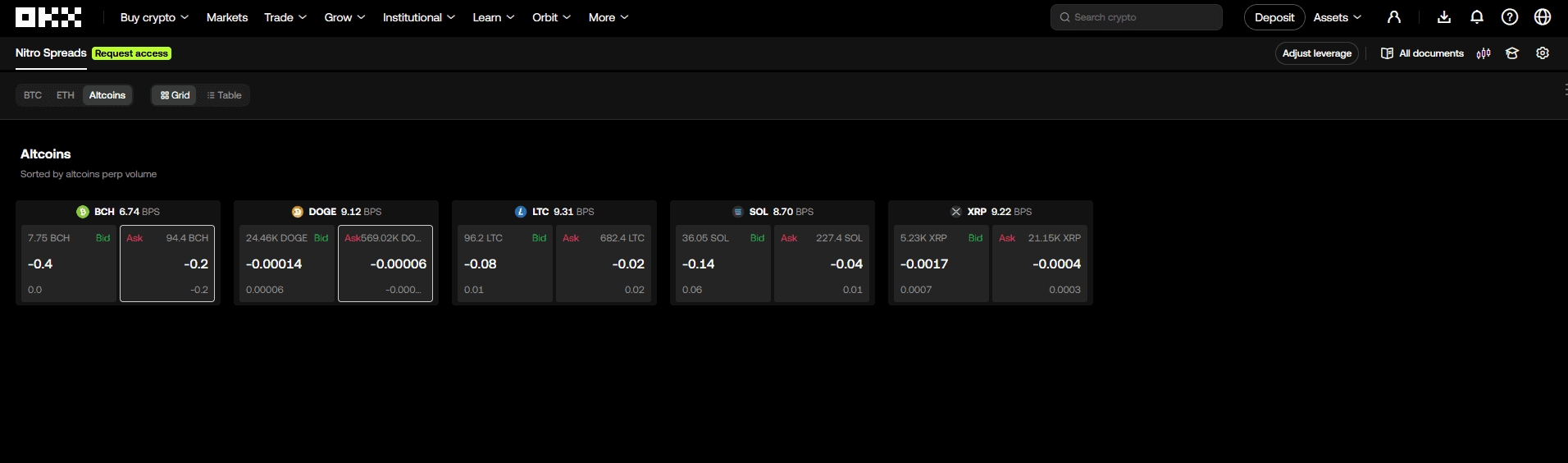
RFQ (Request for Quote) allows users to submit a quote request for a large or complex trade and receive prices from market makers. Users can also create multi-leg strategies involving spot, futures, and options. This format is intended primarily for professional and institutional participants.
Demo Trading
OKX offers a full-featured demo mode with virtual funds. It allows users to test the interface and trading strategies without risking real capital.
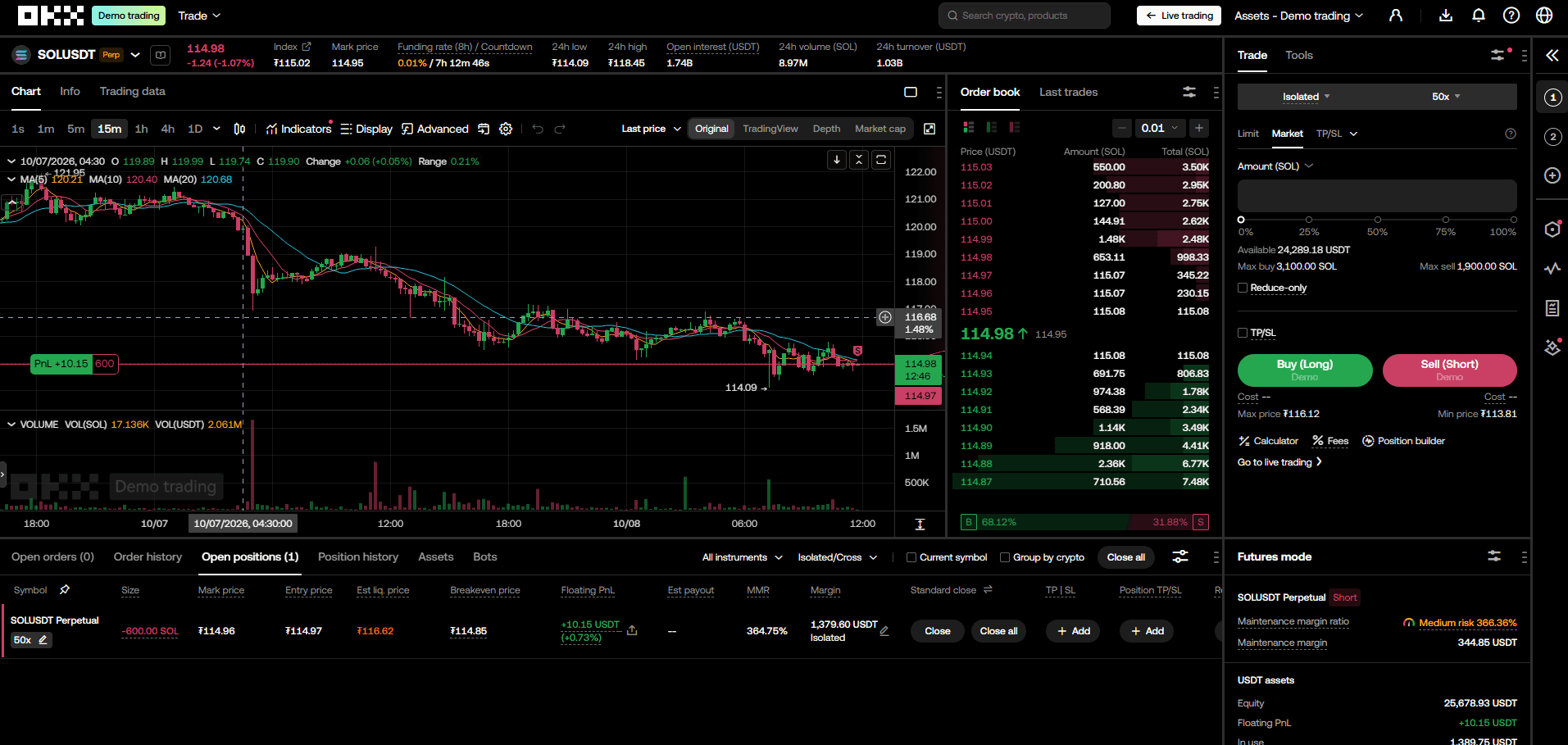
The demo environment supports spot and margin transactions, as well as futures trading. It uses virtual assets, so any profits earned cannot be withdrawn or transferred to a real account.
Trading Bots
OKX has one of the most advanced sets of built-in trading automation tools. Users have access to various algorithmic strategies, including:
- Spot Grid;
- Futures Grid;
- Spot DCA;
- Futures DCA (Martingale);
- Smart Arbitrage;
- Smart Portfolio;
- TWAP;
- Iceberg;
- Recurring Buy;
- Signal Bot with the option to use signals from TradingView.
Bots operate directly within the infrastructure of OKX, so users do not need to connect a third-party service via API.
Copy Trading
OKX Copy Trading allows users to automatically replicate the trades of selected lead traders. Users can review each strategy provider's statistics, select one, and determine how much capital to allocate to copying.
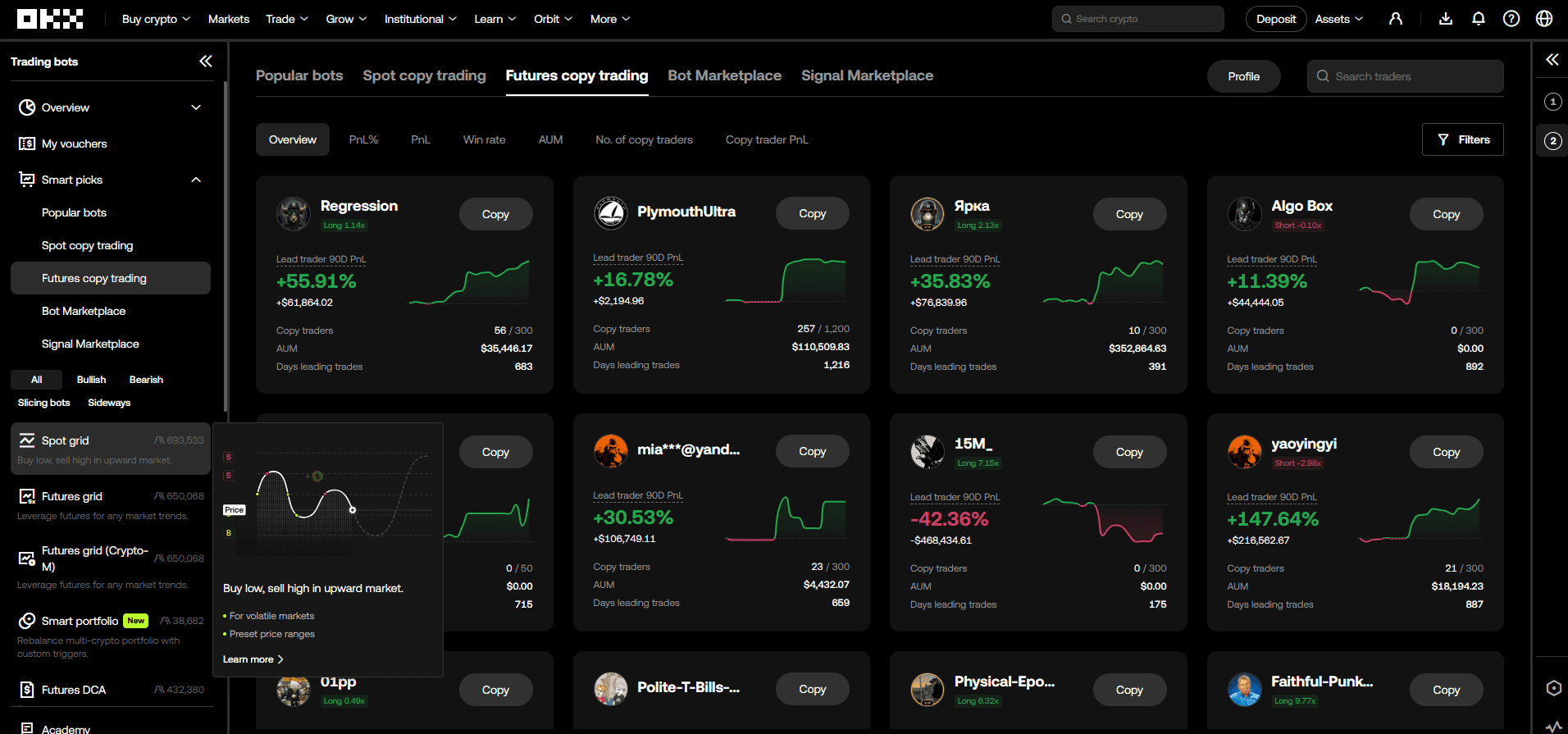
Both spot and futures copy trading are supported. Position size can be set as a fixed amount or proportionally to the lead trader's position size. The lead trader receives a share of their followers' profits in accordance with the program's terms.
Keep in mind that a lead trader's successful track record does not guarantee similar results in the future, and copying futures strategies still carries a risk of liquidation.
Buy, Convert, and P2P
For users who do not need a conventional trading terminal, OKX offers several simpler ways to buy and exchange cryptocurrency.
Buying Cryptocurrency allows users to purchase an asset with fiat through payment methods available in their country, such as a bank card, third-party payment provider, or other supported channels. The specific currencies and payment methods available depend on the region.
The converter is designed for instantly exchanging one cryptocurrency for another without an order book. Users receive a firm quote and can see in advance how much cryptocurrency will be credited after the transaction. No separate trading fee is shown, but the quote includes a spread, so it is worth comparing it with the spot-market price.
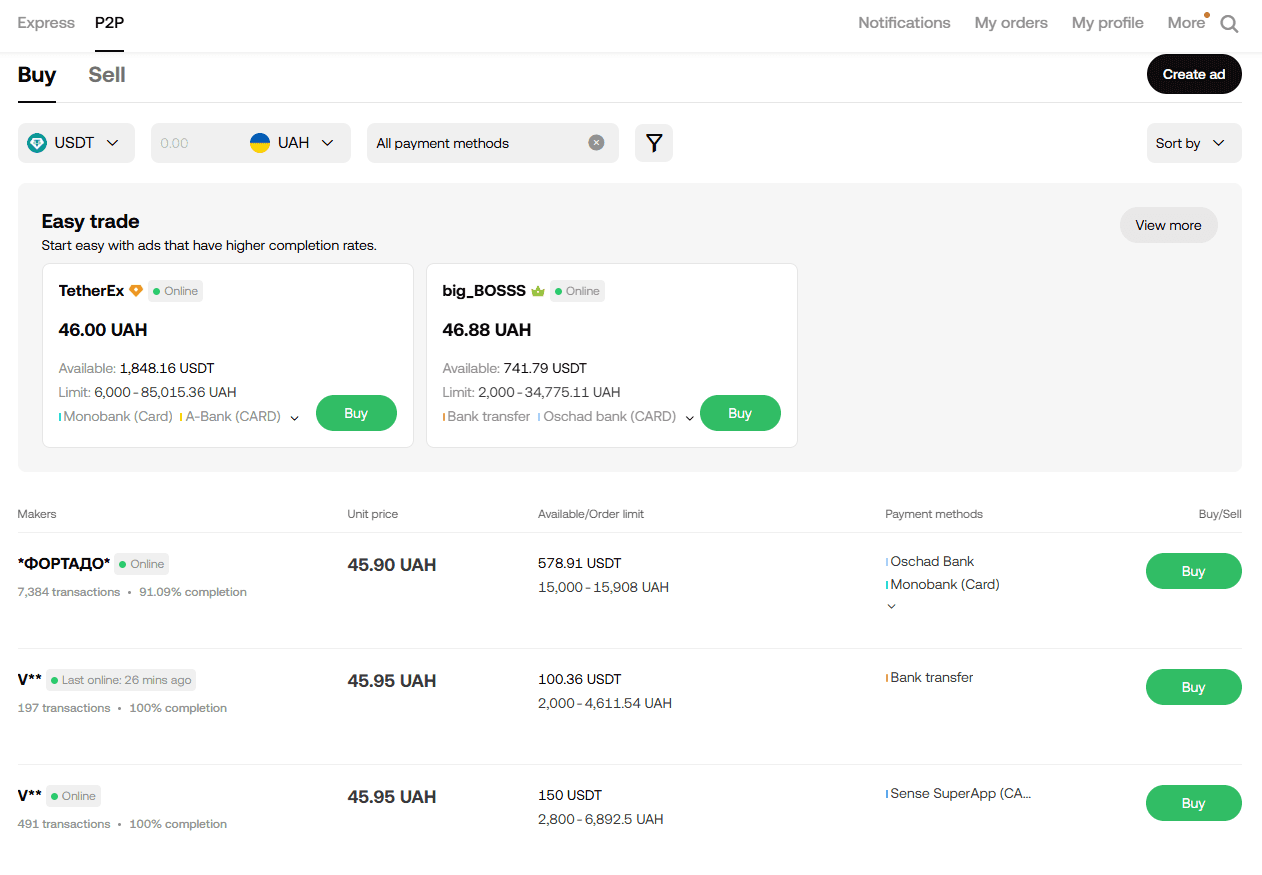
P2P allows users to buy and sell cryptocurrency directly from and to other users. OKX acts as the platform and holds the cryptocurrency in escrow until the seller confirms payment. Available fiat currencies and payment methods depend on the country and the specific merchant. Using P2P requires identity verification.
OKX Earn
The OKX Earn section brings together products for earning returns on existing cryptocurrency assets.
The main product is Simple Earn. With Flexible, users deposit idle cryptocurrency and earn a market-based rate, while retaining the ability to withdraw their funds at any time. Returns are generated by lending assets to borrowers, including margin traders.
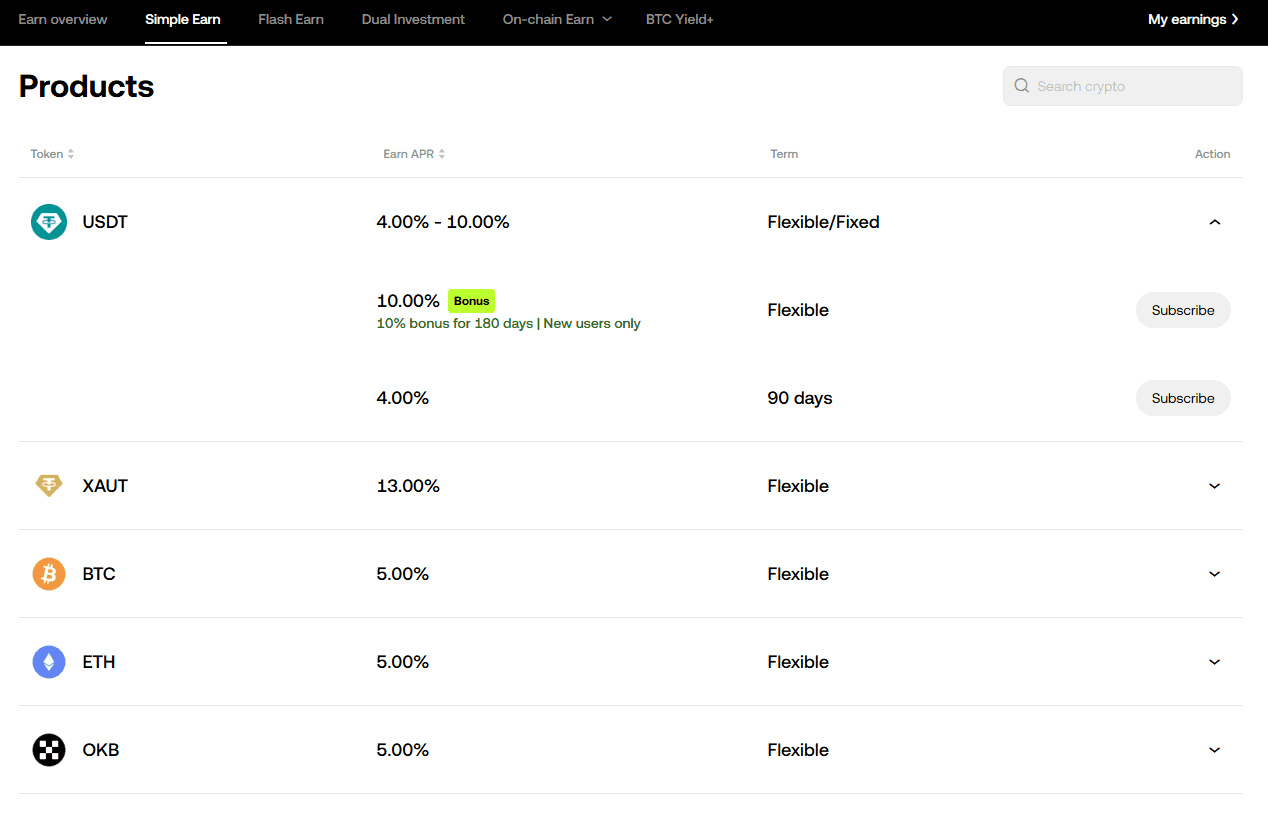
With Simple Earn Fixed, funds are lent for a specific term at a fixed rate. Early redemption is usually unavailable once the term begins, so liquidity is lower than with Flexible.
Also available is On-chain Earn, through which users can participate in PoS staking and selected DeFi protocols. In this case, returns depend on the terms of the relevant blockchain network or protocol, and using the product involves not only the risks of OKX, but also the risks of the specific protocol.
Flash Earn
Flash Earn is a separate section for short-term promotional campaigns from OKX, allowing users to earn additional tokens and other rewards.
Campaigns may use several models:
- Hold to Earn — holding a specific asset;
- Trade to Earn — reaching a specified trading volume;
- Stake to Earn — depositing supported cryptocurrency to earn rewards.
Terms, duration, maximum amount, and reward size vary between campaigns. Flash Earn is therefore better viewed not as a conventional deposit product, but as a set of temporary reward programs.
Crypto Loans
OKX Flexible Loan allows users to borrow cryptocurrency against other digital assets as collateral. This tool may be useful for users who need liquidity but do not want to sell their long-term cryptocurrency position.
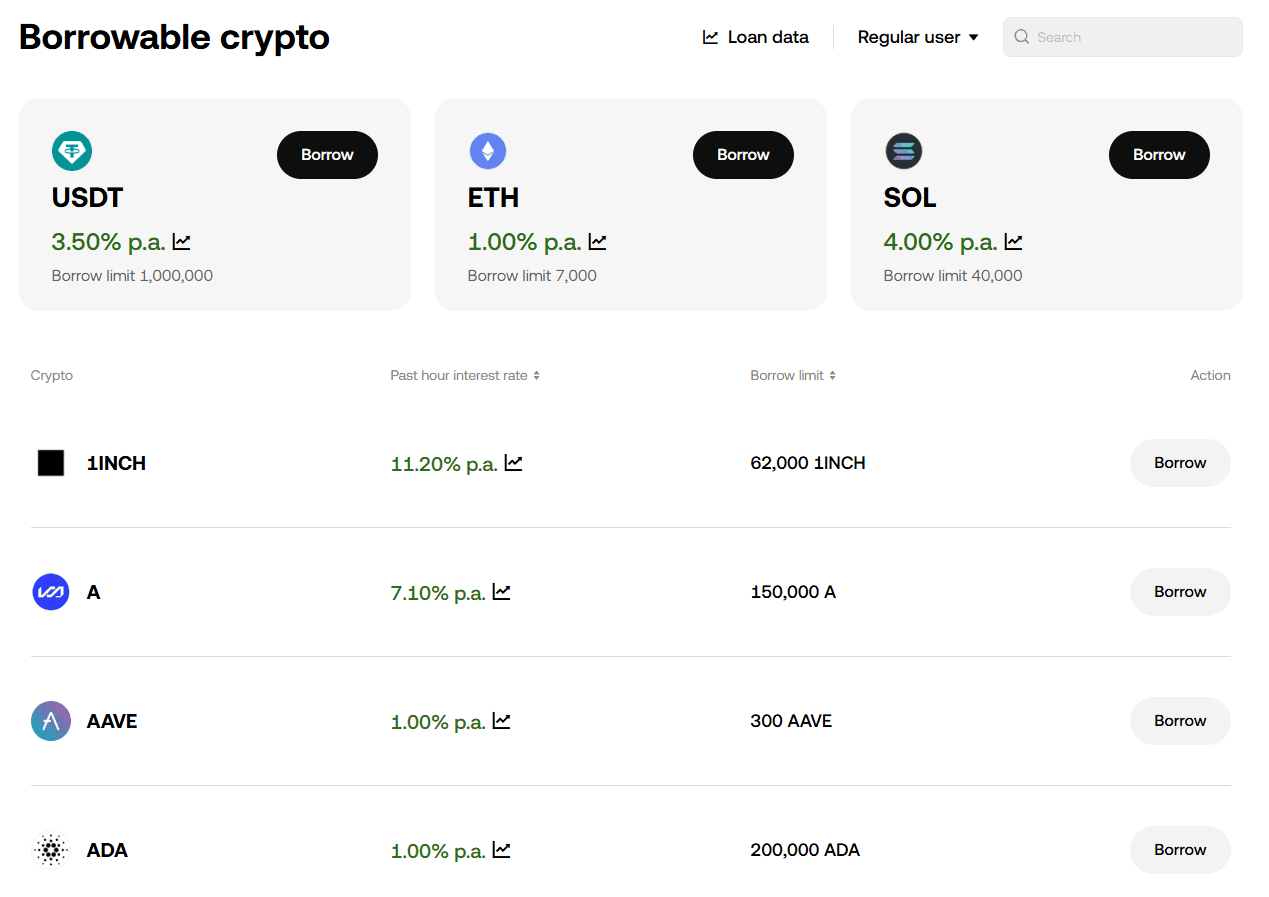
The loan is secured by collateral, and its status is determined by the ratio of the debt's value to the collateral's value. If the collateral's value falls substantially, there is a risk of forced liquidation. The interest rate and list of available assets may change with market conditions.
Jumpstart
OKX Jumpstart functions as a cryptocurrency launchpad and provides early access to selected new projects and tokens chosen by OKX.
The platform uses two main formats:
- Mining — users deposit supported assets for a specific period and receive new tokens as a reward.
- On Sale — users have an opportunity to purchase tokens from a new project through a limited sale.
The number of available projects is limited, and campaigns are held periodically.
Web3
In addition to the centralized exchange, OKX is developing a large Web3 ecosystem around OKX Wallet. It is a non-custodial multichain wallet: the user, rather than the exchange, controls the private keys.
OKX Wallet supports more than 80 blockchain networks and provides access to DEX, cross-chain swaps, DeFi, NFT and more than 1 000 decentralized applications. The wallet is available as a mobile app and browser extension.
It is important to distinguish the exchange account at OKX from OKX Wallet: funds on the centralized exchange are controlled by OKX, while with the non-custodial wallet, the user is responsible for safeguarding the seed phrase and private keys.
API
For algorithmic traders and developers, OKX provides a full-featured API. It supports REST and WebSocket, which can be used to obtain market data and account information and to automate order placement and management.
API is suitable for custom trading bots, terminals, market-making systems, and other external applications.
OKX Card
OKX Card is an international virtual debit card that allows funds from OKX Pay to be used to pay for goods and services. Depending on the region, the card is issued through Visa or Mastercard.
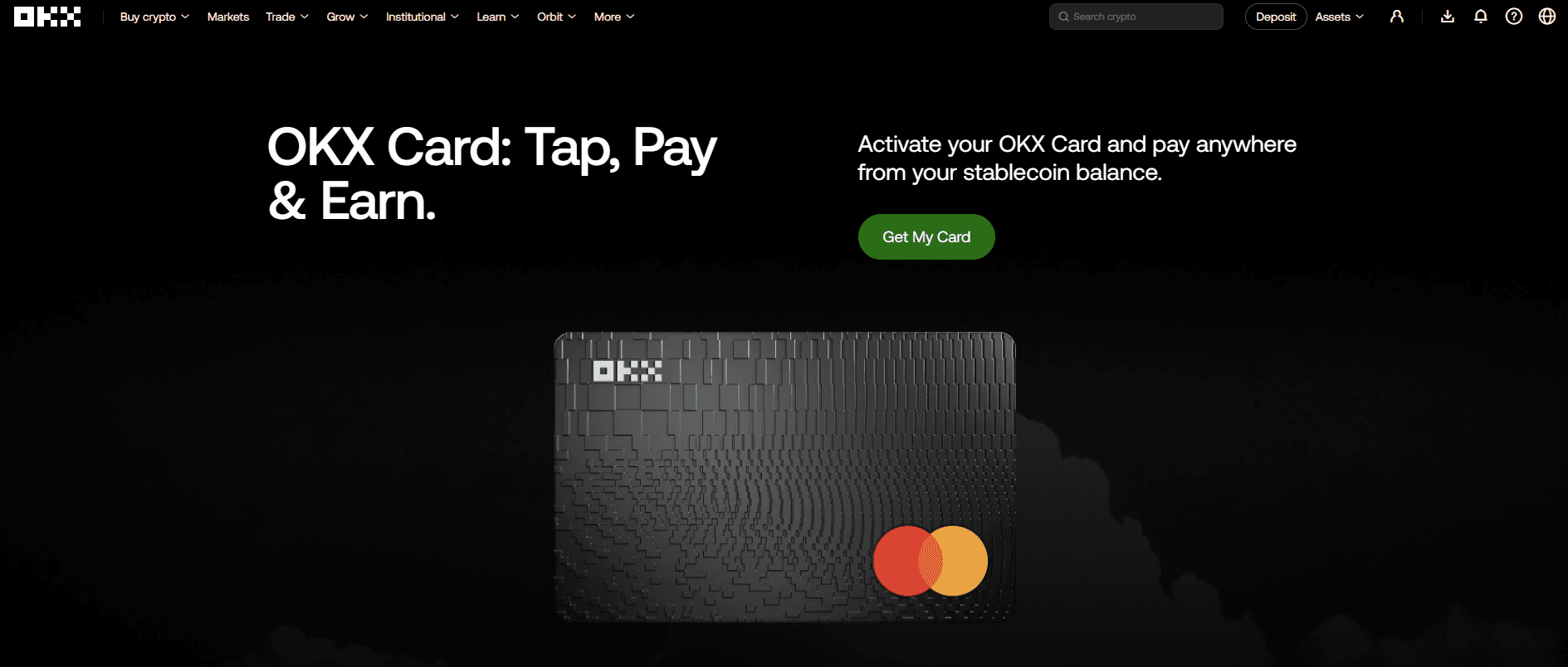
Currently, OKX offers only a virtual card — no physical version is issued. The card is linked directly to the OKX Pay balance and can be used for regular purchases wherever the relevant payment network is accepted.
Card availability, supported assets, settlement currency, and fees depend on the user's country. It is therefore necessary to check the local terms of OKX before applying for the card.
Commissions
Fees on OKX can generally be considered low, especially for derivatives trading and high-volume clients. The exchange uses the standard maker/taker model: a maker adds liquidity to the order book and usually pays less, while a taker fills an order against an existing order and pays a higher fee.
Trading fees depend on the market, trading volume over the past 30 days, the value of assets in the account, and the VIP level. The global fee schedule includes nine VIP levels, and at the highest levels the maker fee can become negative, meaning the exchange effectively pays a reward for providing liquidity.
Spot trading fees
Under the OKX fee schedule, the standard fee for a regular user is 0.08% for makers and 0.10% for takers. This is a competitive rate for a major centralized crypto exchange.
As asset holdings or 30-day trading volume increase, the rates decrease.
Level | Assets | Spot trading volume over 30 days | Maker | Taker |
|---|---|---|---|---|
Regular | < $100 000 | < $1 million | 0.0800% | 0.1000% |
VIP 1 | ≥ $100 000 | ≥ $1 million | 0.0675% | 0.0800% |
VIP 2 | ≥ $200 000 | ≥ $5 million | 0.0600% | 0.0700% |
VIP 3 | ≥ $2 million | ≥ $10 million | 0.0550% | 0.0650% |
VIP 4 | ≥ $5 million | ≥ $20 million | 0.0300% | 0.0450% |
VIP 5 | ≥ $20 million | ≥ $100 million | 0.0250% | 0.0350% |
VIP 6 | ≥ $50 million | ≥ $200 million | 0.0000% | 0.0300% |
VIP 7 | ≥ $100 million | ≥ $500 million | -0.0010% | 0.0230% |
VIP 8 | ≥ $250 million | ≥ $1 billion | -0.0025% | 0.0200% |
VIP 9 | ≥ $500 million | ≥ $5 billion | -0.0050% | 0.0150% |
To qualify for a VIP level, it is sufficient to meet either the asset value or trading volume requirement. The level is recalculated according to the rules of the OKX program.
However, this table does not apply universally to all countries. For example, from 25 September 2026 onward, for a regular OKX Europe customer with a spot-only account, the base rate for most spot pairs is 0.10% for makers and 0.20% for takers, while for some stablecoin pairs the rates are 0% and 0.05%, respectively. Thus, the account's registration region can significantly affect actual costs.
Futures trading fees
Futures trading on OKX is cheaper than spot trading. For a regular user of the global platform, the standard rate is 0.02% for makers and 0.05% for takers.
Tier | Assets | Futures volume over 30 days | Maker | Taker |
|---|---|---|---|---|
Regular | < $100 000 | < $5 million | 0.0200% | 0.0500% |
VIP 1 | ≥ $100 000 | ≥ $5 million | 0.0160% | 0.0450% |
VIP 2 | ≥ $200 000 | ≥ $10 million | 0.0150% | 0.0360% |
VIP 3 | ≥ $2 million | ≥ $50 million | 0.0100% | 0.0280% |
VIP 4 | ≥ $5 million | ≥ $200 million | 0.0080% | 0.0270% |
VIP 5 | ≥ $20 million | ≥ $600 million | 0.0050% | 0.0260% |
VIP 6 | ≥ $50 million | ≥ $1 billion | 0.0000% | 0.0250% |
VIP 7 | ≥ $100 million | ≥ $1.5 billion | -0.0010% | 0.0230% |
VIP 8 | ≥ $250 million | ≥ $2 billion | -0.0025% | 0.0200% |
VIP 9 | ≥ $500 million | ≥ $20 billion | -0.0050% | 0.0150% |
The fee is charged both when opening and closing a position. Leverage does not reduce the notional value of the trade used to calculate the trading fee.
For perpetual futures, it is also necessary to account for the funding rate. This is not a fee charged by OKX, but rather a periodic settlement between traders with long and short positions. Depending on the funding rate, a user may either pay or receive funding.
Compared with other major crypto exchanges, the base futures fees at OKX appear competitive. The rates of 0.02% for makers and 0.05% for takers are roughly in line with the market's most competitive standard rates and are particularly suitable for active traders. OKX does not always offer the lowest maker fee among competitors, but its combined maker/taker rates place the exchange among the lower-cost platforms.
In a forced liquidation, the taker fee rate for the user's current tier applies. For dated futures, OKX also lists an expiry settlement fee of 0.01%.
Options fees
The options fees charged by OKX also follow a maker/taker model. For the standard tier, the indicative rate is 0.02% for makers and 0.03% for takers. However, the calculation method differs from that used for spot and futures trading.
The exchange caps the trading fee at 7% of the option premium. Therefore, the actual fee is calculated as the lower of two amounts: the standard fee based on the trade's notional value or 7% of the option premium. This mechanism is particularly important for low-cost options because it prevents the fee from representing a disproportionately large share of their value.
An exercise fee may also be charged for exercised options. It is also capped and calculated based on the user's rate and the settlement value. For day options, which do not expire on Friday, no separate exercise fee is charged.
Professional traders can reduce costs further: for option combinations through RFQ OKX provides trading fee discounts of up to 50%.
Deposit and withdrawal fees
OKX does not charge a fee for cryptocurrency deposits to an exchange account. The sender may pay a network fee to the wallet or other exchange from which the transfer is made, but OKX does not charge a fee for an incoming blockchain deposit.
A fee is charged for cryptocurrency withdrawals, and its amount depends on the asset, the selected blockchain network, and the network's current load. For example, the cost of withdrawing USDT may differ significantly when using ERC-20, TRC-20 or other supported networks. OKX adjusts fees dynamically, so there is no fixed universal rate—the current amount is displayed immediately before the withdrawal is confirmed.
Internal transfers between users of OKX are processed free of charge, because the funds are not transferred to the blockchain.
For fiat deposits and withdrawals, the terms depend on the region, currency, and payment method. For example, European users can fund their accounts via SEPA, while OKX does not charge a fee for a standard EUR deposit via SEPA, although the customer's bank may charge its own fee. For other payment methods, the fee is displayed before the transaction is confirmed.
Deposit and Withdrawal
OKX offers a wide range of deposit and withdrawal methods: cryptocurrency transfers via blockchain, internal transfers between users, bank transfers, payment cards, and various local payment methods. A P2P platform is also available, which is particularly useful in countries where direct fiat transactions are restricted.
Cryptocurrency deposits
To deposit cryptocurrency, open the Deposit section, select the asset and blockchain network. OKX will generate a deposit address to which funds can be sent from your own wallet or another exchange. For some coins, such as XRP, you must also specify a tag or memo.
Particular attention should be paid to selecting the network. For example, the same USDT may be supported on several blockchains, but the sender's network must match the deposit network selected on OKX. An error may result in a delay or loss of funds.
OKX does not charge a fee for cryptocurrency deposits. Users only pay the network fee or fees charged by the platform from which the funds are sent. However, each asset and network has a minimum deposit amount: if less than the specified amount is sent, the funds may not be credited automatically.
The crediting time depends on the blockchain and the number of required confirmations. On fast networks, a transfer may appear in the account within a few minutes, while heavy network traffic or a slower blockchain may require more time.
Fiat deposits
Direct fiat deposits on OKX are well supported, although availability depends on the region. For example, customers from the EEA can deposit EUR via SEPA and SEPA Instant. OKX does not charge its own fee for SEPA deposits: a standard transfer takes up to 1–2 business days, while SEPA Instant can be credited within a few seconds if supported by the bank.
Other methods are available in certain countries:
Method | Features |
|---|---|
Bank transfer | SEPA, international and local transfers depending on the region |
Visa / Mastercard | Fast deposits, usually almost instant |
PayPal | Available, in particular, in the EU for verified customers |
Local payments | For example, iDEAL, Bancontact, and other regional systems |
P2P | Buying cryptocurrency from other users with local currency |
Cryptocurrency withdrawals
To withdraw, select Withdraw → Crypto, specify the coin, network, recipient address, and amount. OKX displays the minimum amount, available 24-hour limit, and fee before the transaction is confirmed. Withdrawing cryptocurrency requires completing KYC.
The fee depends on the specific network and current blockchain conditions. For example, the cost of sending USDT via Ethereum, Tron, or other networks may vary significantly. OKX dynamically adjusts the fee based on network load, transaction processing costs, and other factors, so there is no fixed fee for all withdrawals. The current amount is displayed directly in the withdrawal form.
In addition to standard on-chain withdrawals, an internal transfer to another user on OKX is also available. It is processed within the platform, is almost instant, and incurs no network fee.
For security, users can enable an address whitelist. After a password, phone number, email address, or certain other security settings are changed, OKX may also temporarily restrict withdrawals for 24 hours. In regulated regions, Travel Rule requirements may also apply to transfers between exchanges.
Fiat withdrawals
Direct fiat withdrawals also depend on the country. One of the most convenient options is available to customers in the EEA: EUR can be withdrawn by bank transfer via SEPA. OKX does not charge its own fee for such transfers, although the user's bank may charge a fee. Funds usually arrive instantly or within two business days.
For the first withdrawal to a bank account, OKX may require confirmation that the account belongs to the account holder. For SEPA, this is done by first depositing funds into OKX from the same bank account.
In some regions, withdrawals of USD by international bank transfer are supported. For example, this option is available to some customers in the EU, UAE, and Singapore. An international transfer may take up to five business days, and the fee depends on the region and banking channel.
If direct withdrawals in local currency are unavailable, an alternative is P2P: the user sells cryptocurrency to another participant and receives fiat directly into their bank account, onto their card, or through another supported payment method. Users should consider the specific merchant's exchange rate and any restrictions imposed by the security system of OKX.
Limits
For cryptocurrency deposits, OKX does not set a universal upper limit, but each coin and network has a minimum credit amount. The 24-hour cryptocurrency withdrawal limit is determined by the user's fee tier, and its current value is displayed directly on the Withdraw page.
Fiat limits are set separately for each payment channel. These may include minimum and maximum amounts per transaction, as well as daily, weekly, and monthly limits. OKX displays the remaining limit, fee, and estimated processing time before the transaction is submitted.
Additionally, in 2026, OKX introduced Large Withdrawal Protection. Users can set their own protective threshold for total withdrawals over 24 hours, ranging from $10 000 to $10 million. Once this threshold is reached, subsequent transactions require additional biometric verification. This is a protective threshold, not the account's standard trading limit.
Markets and Products
OKX offers one of the broadest ranges of markets and additional services among major cryptocurrency exchanges. In addition to spot and margin trading, users have access to perpetual and dated futures, options, TradFi tools, trading bots, copy trading, Earn, crypto loans, P2P and an advanced Web3 ecosystem.
This variety allows OKX to be used both as a regular exchange for buying cryptocurrency and as a professional trading platform.
Main markets and services offered by OKX
The main offerings of OKX are shown in the table:
Category | Products and Services | Description |
|---|---|---|
Spot Trading | Spot | Buying and selling more than 350 cryptocurrencies. Standard and advanced order types are available. |
Margin Trading | Cross and Isolated Margin | Cryptocurrency trading using borrowed funds. On the global platform, leverage reaches 10x. |
Futures | Perpetual and Expiry Futures | Perpetual and expiry contracts margined in cryptocurrencies or stablecoins. Leverage is available. |
Options | Call and Put | European options. On the global platform, the main underlying assets are BTC and ETH; availability may vary by region. |
TradFi | X-Perps and Other Derivatives | In certain regions, derivatives linked to stocks, ETFs, gold, silver, oil, and other traditional assets are available. |
Professional Trading | RFQ, Nitro Spreads | Liquid Marketplace tools for large and complex trades, spread trading, and multi-leg strategies. |
Demo Trading | Demo Trading | Practice spot and derivatives trading with virtual funds without risking real capital. |
Automated Trading | Trading Bots | Spot Grid, Futures Grid, DCA, Smart Arbitrage, TWAP, Iceberg, Signal Bot, and other strategies. |
Copy Trading | Spot and Futures Copy Trading | Automatic copying of trades made by selected lead traders. |
Buying and Exchanging | Buy Crypto, Convert | Simple cryptocurrency purchases with fiat and instant asset conversion without a traditional trading terminal. |
P2P | OKX P2P | Buying and selling cryptocurrency directly between users with escrow provided by OKX. |
Passive Income | Simple Earn, On-chain Earn | Flexible and fixed-term asset allocation, staking, and access to select DeFi products. |
Crypto Loans | Flexible Loan | Cryptocurrency loans secured by digital assets. |
New Projects | Jumpstart, Flash Earn | Participation in new token launches and temporary reward programs. |
Web3 | OKX Wallet, DEX, DeFi | A non-custodial wallet, decentralized exchange, cross-chain transactions, and access to dApps. |
Payments | OKX Pay, OKX Card | Cryptocurrency payments and a virtual card in supported countries. |
API | REST, WebSocket | Infrastructure for algorithmic trading, trading bots, and external terminals. |
Supported Cryptocurrencies
OKX supports more than 350 cryptocurrencies, making it one of the large all-purpose exchanges in terms of asset selection. In addition to Bitcoin and Ethereum, it offers major altcoins, stablecoins, and many lower-cap projects.
However, the number of available coins does not match the number of trading instruments. A single cryptocurrency may have several spot pairs, perpetual and expiry futures, and, for certain assets, options as well. OKX previously reported more than 730 spot pairs, 280 derivatives markets, and around 1 000 options instruments, although these figures constantly change as contracts are listed and delisted.
The options market is significantly smaller than the spot and futures markets. The main global platform has traditionally offered options on BTC and ETH, which are European options with several daily, weekly, monthly, and quarterly expiration dates.
Trading Platforms
OKX offers a full range of platforms for different trading scenarios: a web terminal, applications for iOS and Android, a dedicated application for Windows and macOS, as well as API and integration with TradingView. Functionality is generally consistent across devices: users can trade spot and derivatives, monitor positions and orders, use charts, and access the exchange's additional services.
Web Platform
The main trading terminal from OKX runs directly in a browser and requires no software installation. The interface supports both simple cryptocurrency purchases and active trading, with spot, margin trading, futures, options, and other instruments permitted in the user's region.
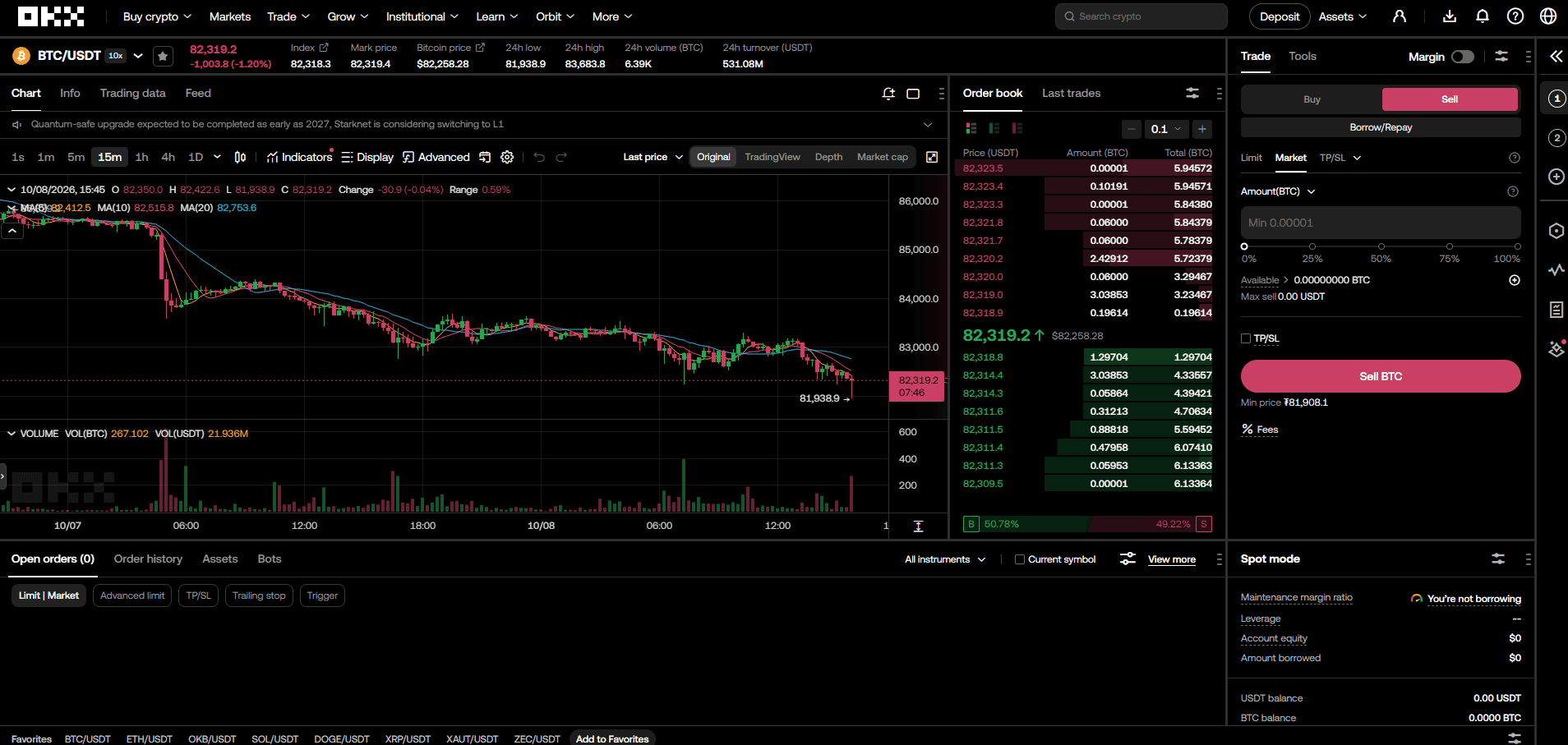
The workspace includes an order book, trade history, an order entry form, open positions, and a chart. Various order types are supported, including Market, Limit, Stop, Trigger, Trailing Stop, and more complex algorithmic options. Built-in charts allow technical analysis to be performed directly in the terminal.
Experienced users may find it convenient to switch between different account and margin modes and manage multiple positions from one interface. The web version also provides access to specialized products from OKX, including options, Nitro Spreads, RFQ, trading bots, and demo trading.
Mobile Applications
The OKX mobile application is available for iOS and Android. It provides almost full access to the exchange's ecosystem and allows users to trade without a computer. The app can be used to buy and sell cryptocurrency, trade spot and derivatives, deposit and withdraw funds, and use P2P, Earn, copy trading, and other services.
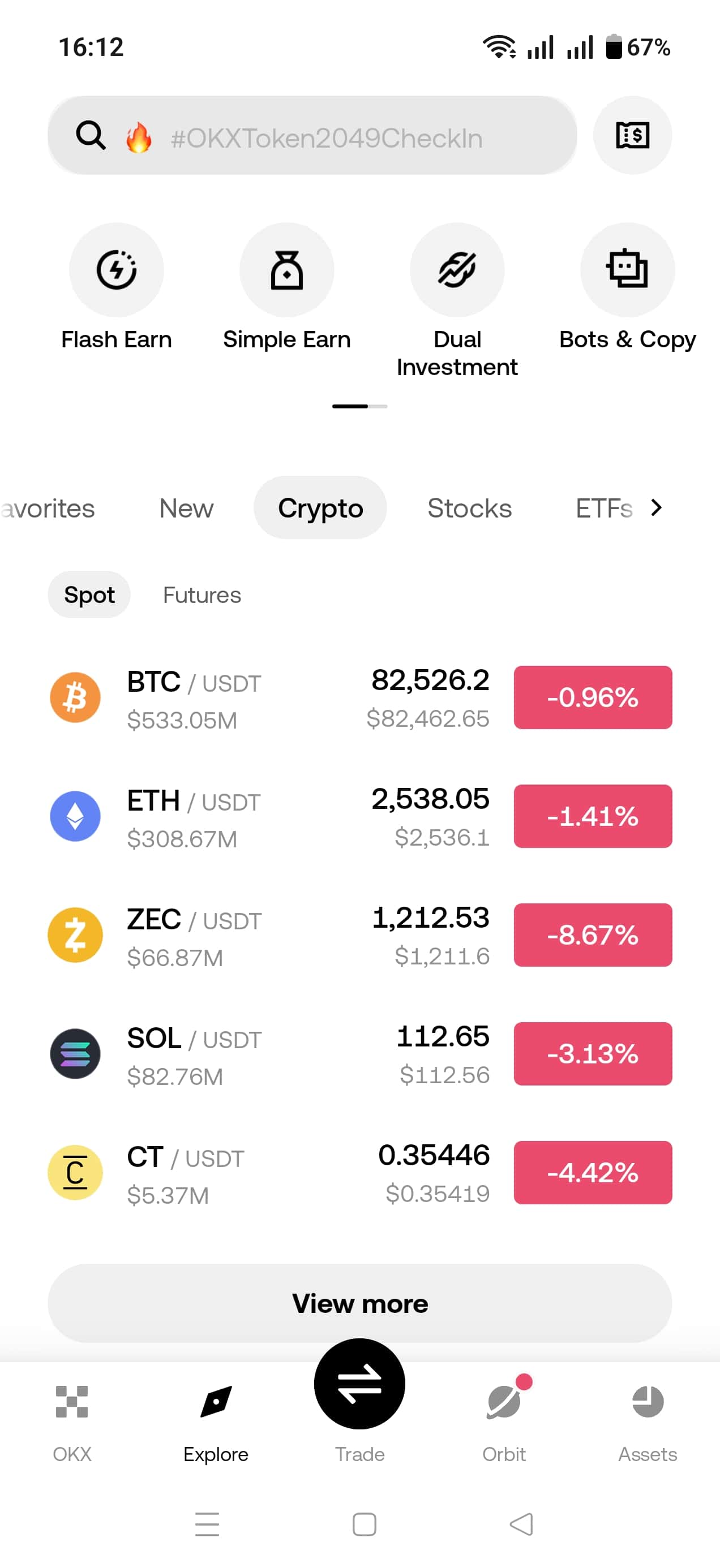
The mobile terminal includes interactive charts, an order book, position data, and advanced order types. Notifications are available for price changes, order execution, and other account events, making it convenient to monitor open positions while away from a workstation.
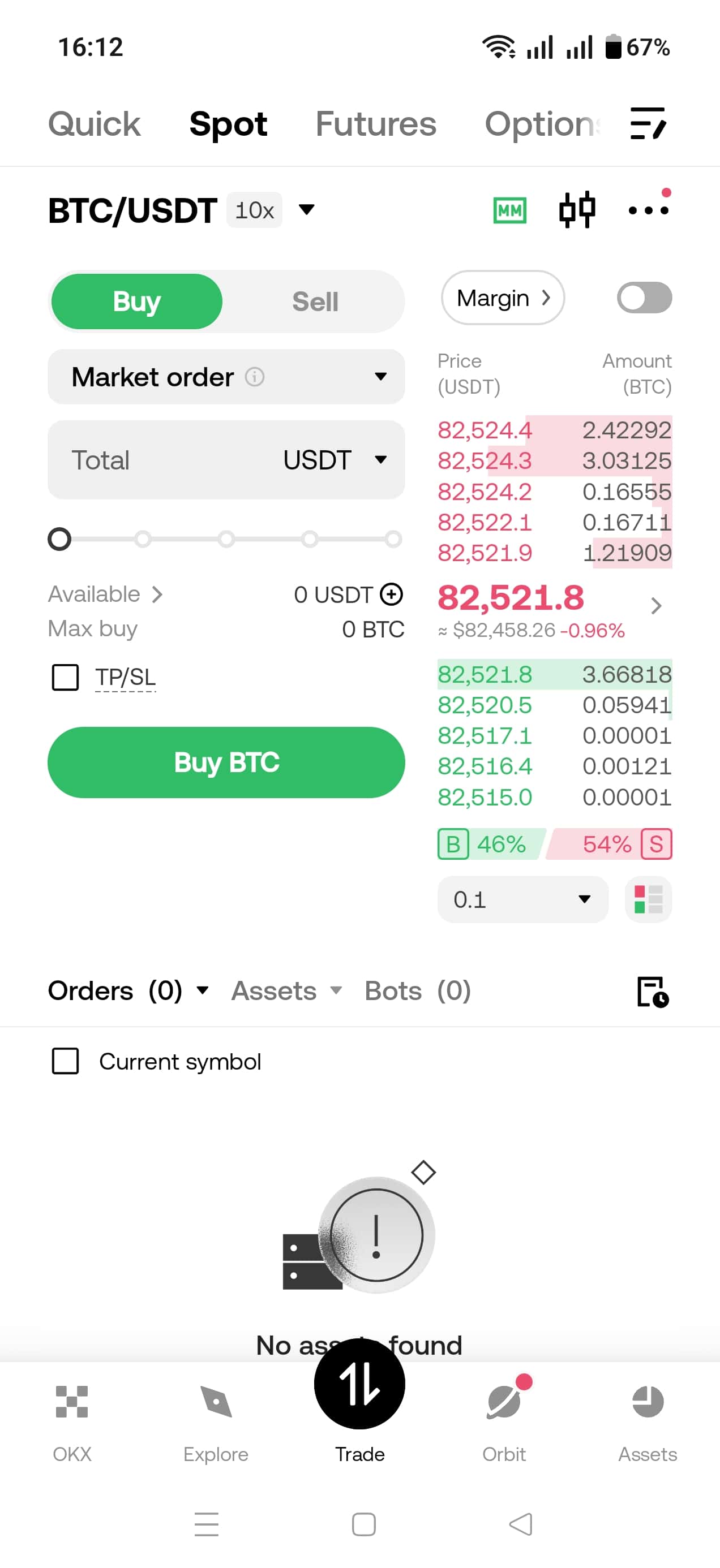
The app also integrates OKX Wallet and Web3 services, allowing users to switch between the centralized exchange and a non-custodial wallet from a single interface. This makes the app functional, but it also increases the number of sections and may make the platform more difficult to navigate at first.
Desktop application
OKX offers a standalone desktop application for Windows and macOS. It is aimed primarily at traders who spend a lot of time at the terminal and prefer a standalone program to a browser tab.
The desktop version provides access to the markets and core trading features of OKX, including order and position management, charts, and market data. Its layout is similar to the web platform, so switching between them does not require relearning the interface.
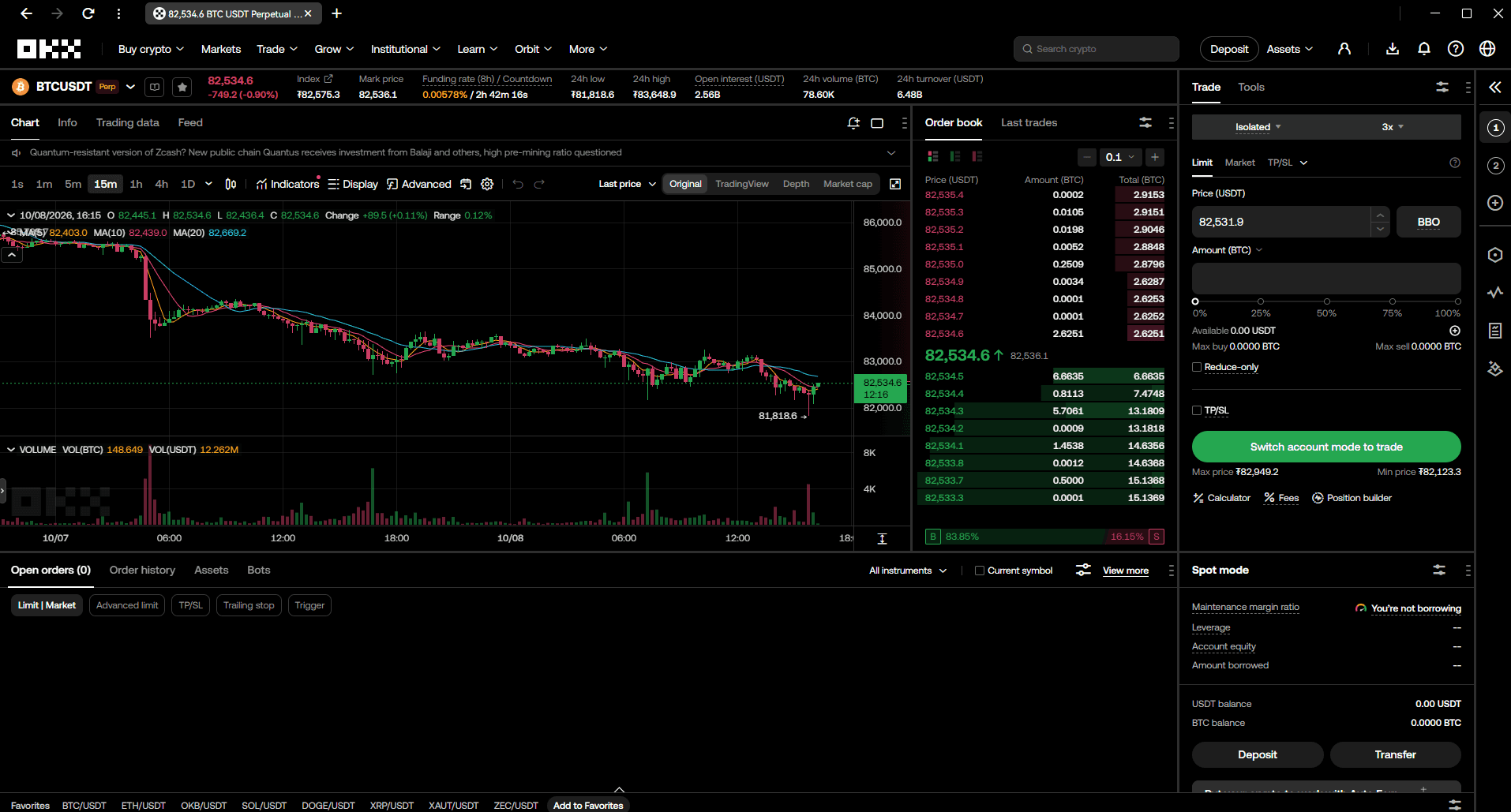
The main advantage of the standalone application is a more convenient, permanent workspace for active trading. However, there are few unique trading features that would make installing the desktop program essential for the average user: most features are also available in the browser.
TradingView
OKX has direct integration with TradingView, so users can connect their exchange account and trade directly from charts on TradingView without switching to the OKX terminal. To connect, go to the Trading Panel: select OKX, log in, and choose live or demo trading mode.
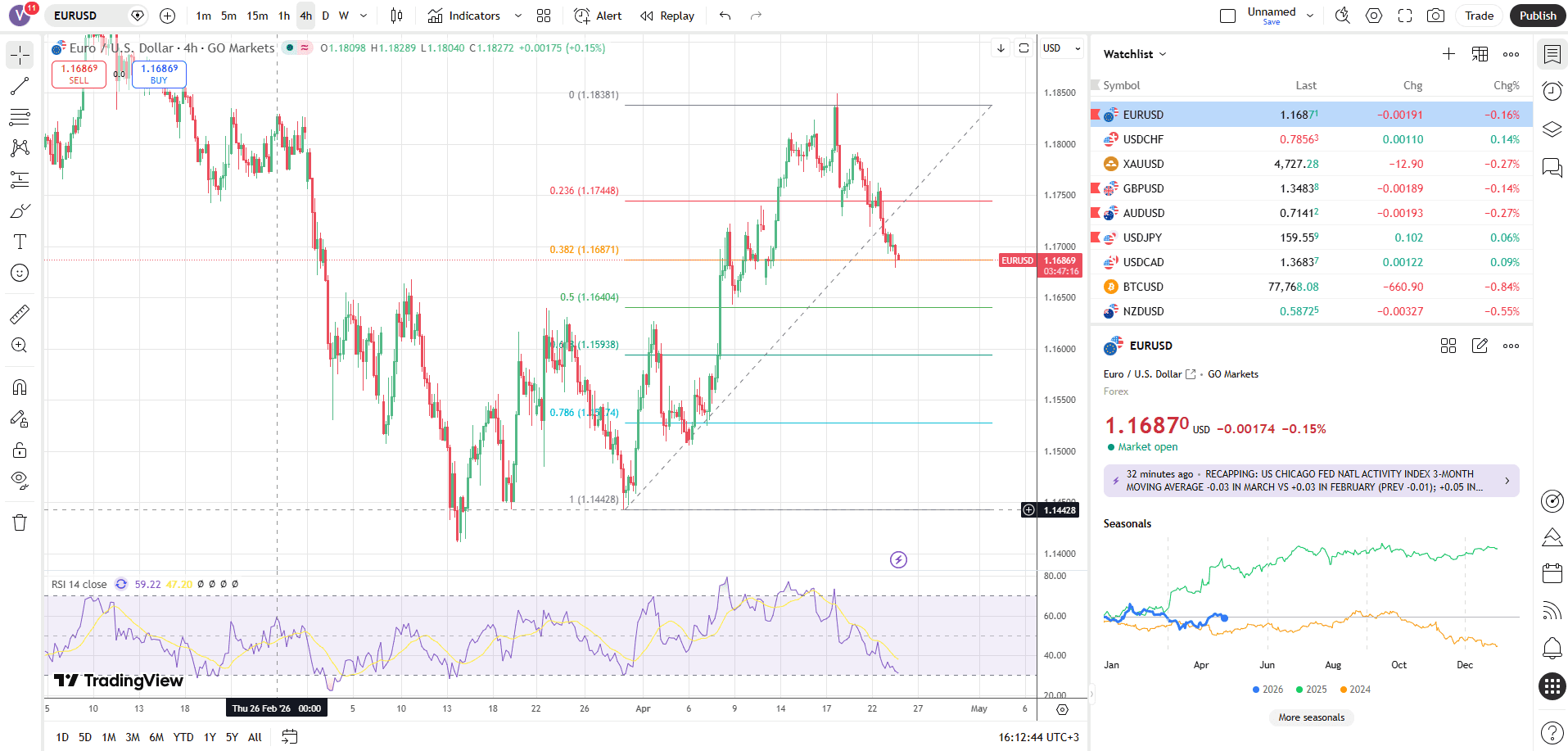
Through TradingView, users can access charts on OKX, place and manage orders, and monitor open positions. Spot trading is supported, while the range of available derivatives depends on the region and account settings.
The integration is particularly useful for traders who perform technical analysis on TradingView. The platform offers hundreds of built-in indicators, more than 100 drawing tools, and various chart types. Users can also create custom indicators and strategies in Pine Script, backtest them, and automate the delivery of trading signals to OKX via webhooks.
API and external platforms
For algorithmic and professional trading, OKX offers an advanced API, including REST and WebSocket. REST is suitable for sending requests and managing accounts and orders, while WebSocket is designed to receive market data, order book updates, and real-time order and position status information. OKX recommends WebSocket for streaming market data and order book depth.
Through API, users can retrieve quotes and historical data, place and cancel orders, monitor balances and positions, and create custom trading bots and external terminals. A separate API environment is provided for demo trading.
Analytics
The analytical capabilities of OKX are noticeably more advanced than those of many crypto exchanges. In addition to standard charts and technical indicators, the platform provides market statistics, derivatives data, participant sentiment indicators, asset rankings, and a dedicated center for analyzing the trader's own performance. This makes OKX convenient not only for executing trades but also for preparing trading decisions.
Market Analytics
The Markets section of OKX brings together key cryptocurrency market data: prices, price changes, trading volumes, market capitalization, and asset rankings. Users can separately view popular coins, new listings, top gainers and losers, and categories such as DeFi, AI, meme tokens, and Layer 1/2.
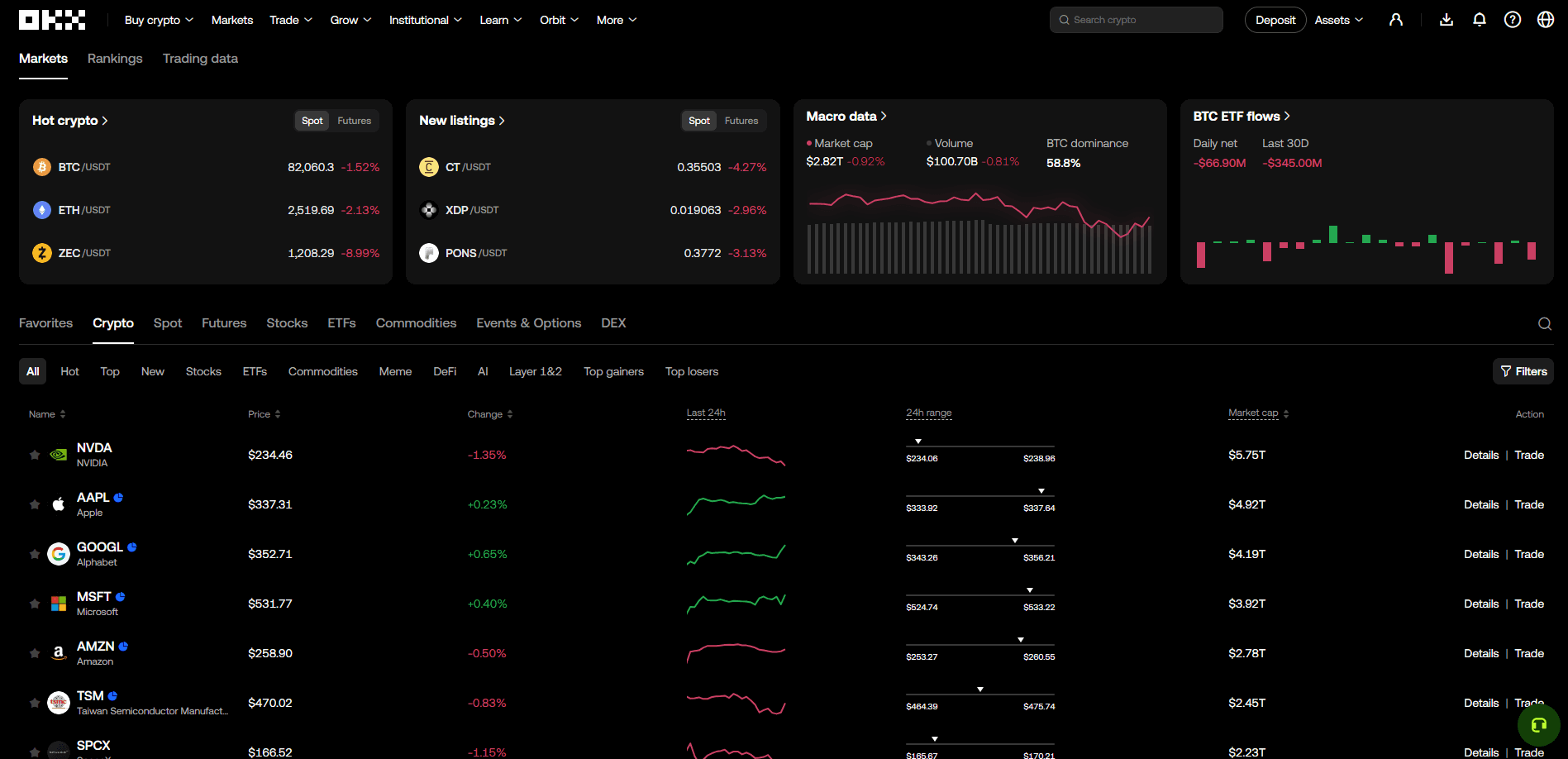
In addition, OKX displays aggregate crypto market indicators, including:
- total market capitalization;
- total trading volume;
- dominance of Bitcoin;
- data on flows into Bitcoin ETFs;
- the performance of individual market segments.
This summary is useful for quickly assessing overall market conditions without switching to third-party analytics services.
Futures and Market Sentiment Analytics
One area where OKX is particularly strong is derivatives market data. Additional indicators for assessing participant positioning and activity can be enabled directly in the trading terminal.
The main indicators include:
Indicator | What it shows |
|---|---|
Open Interest | The total value of open long and short futures positions |
Account Long/Short Ratio | The ratio of accounts with net long and short positions |
Top Account Long/Short Ratio | The positioning of the largest or most active accounts |
Top Position Long/Short Ratio | The ratio of longs to shorts among large positions |
Taker Buy/Sell Volume | The volume of aggressive buys and sells |
Funding Rate | The cost of holding a perpetual futures position |
Open Interest helps assess whether trader participation in a particular futures market is increasing. Rising open interest alongside a price move may confirm a strengthening trend, while declining OI often indicates that positions are being closed.
Account Long/Short Ratio shows the ratio of accounts with net long positions to accounts with short positions and is used as a market sentiment indicator.
Another useful indicator is Taker Buy/Sell Volume, which compares the volume of market buys and sells. It shows which side of the market is more aggressive at a given time.
For perpetual contracts, the funding rate is also important. A positive rate means payments from long traders to short traders, while a negative rate means the opposite. By default, funding for many contracts is calculated every eight hours, although shorter intervals are used for some instruments.
Charts and Technical Analysis
The trading terminal on OKX includes full-featured charts with a large number of classic technical analysis tools. Users can apply moving averages, RSI, MACD, Bollinger Bands, volume indicators, and other indicators, as well as use drawing tools and multiple timeframes.
For more advanced analysis, the previously discussed integration with TradingView, which significantly expands technical analysis through custom indicators, Pine Script, backtesting, and a wide range of charting tools, is available.
Thus, the basic functionality of OKX is sufficient for most traders, while advanced technical analysis can be performed through TradingView without having to switch exchanges.
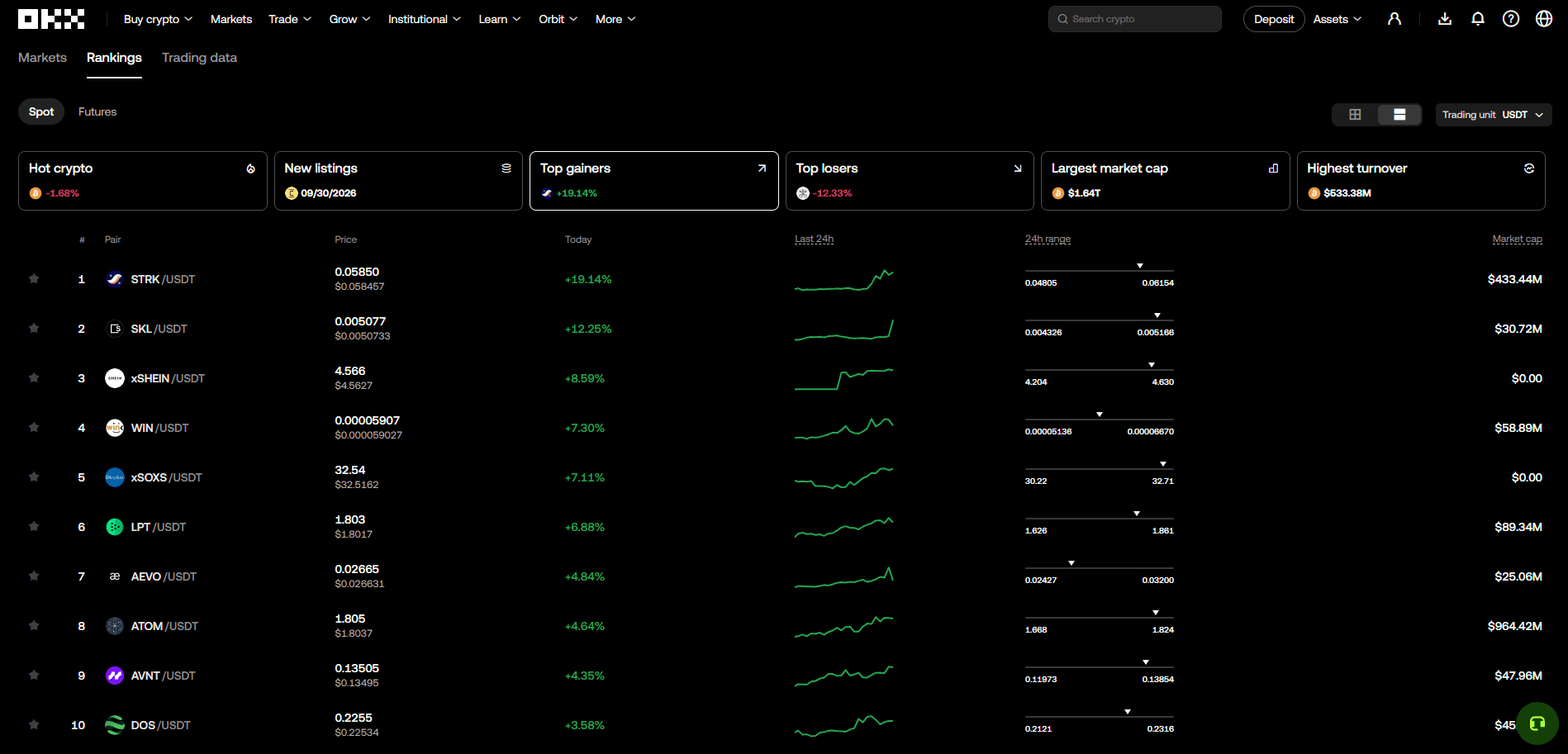
Rankings and Finding Trading Ideas
OKX compiles several lists and rankings that help users quickly find active markets. Users can track:
- the most popular cryptocurrencies;
- top gainers and losers;
- new listings;
- assets with high trading volume;
- trending tokens;
- specific thematic categories.
In the Hot Crypto section, for example, assets can be sorted by trading volume, price change, and popularity among traders. It is not a full-featured screener on the level of specialized analytics platforms, but it provides enough functionality for an initial search for trading ideas.
Trading Performance Analysis
In 2026, OKX significantly expanded its own Analysis Center, which is designed to evaluate user performance rather than analyze the market.
In the mobile app, the section is divided into three main areas:
Assets shows the total portfolio value, daily, monthly, and historical profit or loss, asset allocation, and statistics on profitable and unprofitable days.
Spot PnL allows users to analyze spot portfolio performance over 7, 30, 90 days or over the entire period. Users can view the PnL chart and performance by individual asset.
Futures PnL provides more detailed derivatives trading statistics, including:
- total profit and loss;
- the percentage of profitable trades;
- the number of positions;
- the risk-to-reward ratio;
- a daily performance calendar;
- ranking by PnL;
- separate statistics on funding fees.
This is a useful feature for active traders because it enables analysis not only of returns but also of the quality of a trading strategy over an extended period.
Analytical materials from OKX
In addition to the tools within the terminal, OKX publishes its own analytical and informational materials in the Learn section. It features cryptocurrency reviews, explanations of market events, and materials on trading strategies, derivatives, DeFi and Web3.
At the same time, OKX Learn combines educational and analytical content, so it should not be regarded as independent investment research. It is primarily the exchange's own information resource.
Education
The educational resources offered by OKX are well developed and designed for users of different experience levels. The main learning hub is OKX Learn, which features articles, step-by-step guides, and resources on cryptocurrencies, trading, derivatives, technical analysis, Web3, and security. The exchange also runs educational campaigns, schools with guest traders, and AMA sessions, while users can practice what they have learned in demo mode.
At the same time, the training offered by OKX is more like a large resource library than a structured academic program: there are many articles, but users must create their own learning path.
OKX Learn
OKX Learn is the exchange's main educational section. The resources are organized by difficulty and topic for beginners, intermediate users, and more experienced users. The main areas include:
- cryptocurrency and blockchain fundamentals;
- buying and storing digital assets;
- spot trading;
- futures and perpetual contracts;
- options;
- margin trading;
- technical analysis;
- trading strategies;
- order types;
- trading bots;
- DeFi and Web3;
- security and self-custody;
- market indicators and data.
For example, the dedicated Trading section contains more than 240 resources on trading, technical analysis, derivatives, signals, bots, and strategies. It includes both basic explanations of limit orders and trading pairs and more specialized guides on mark price, the long/short ratio, and options.
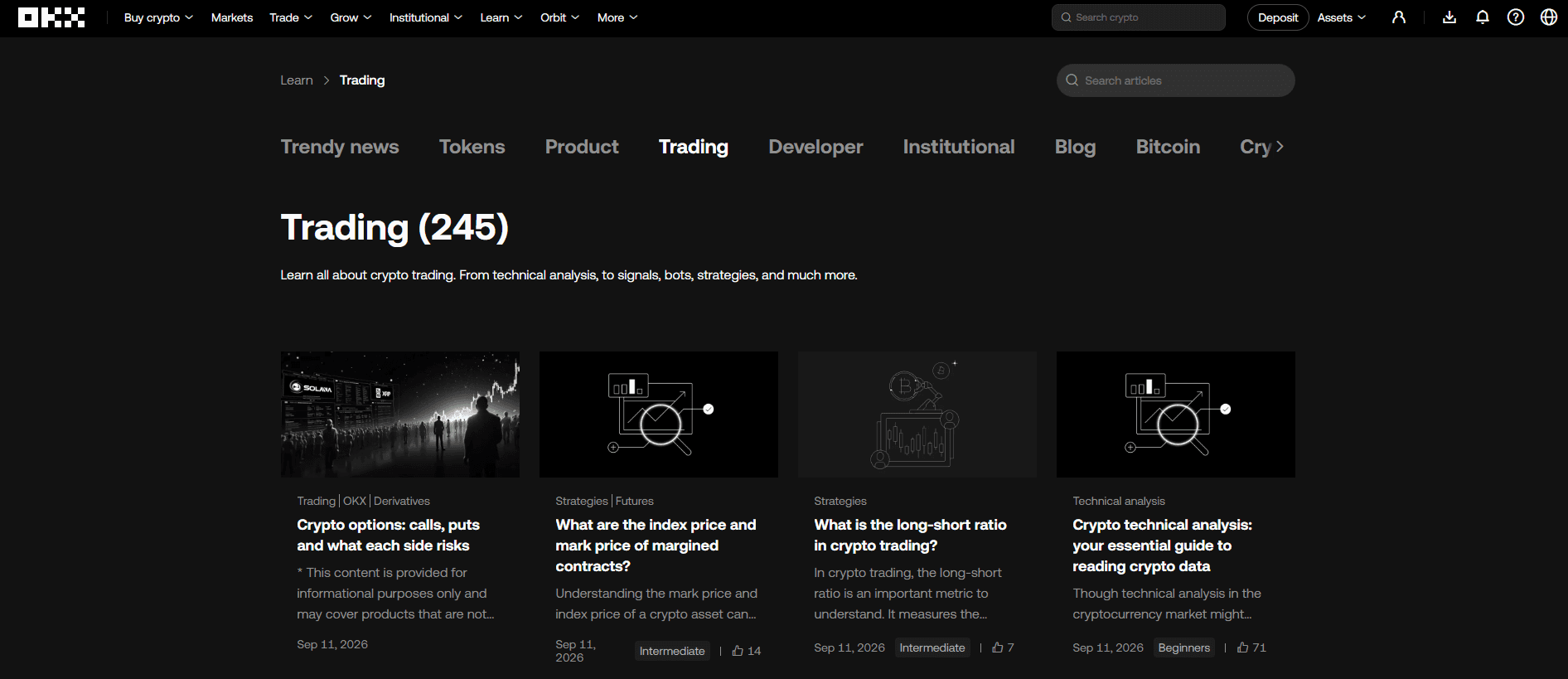
Detailed introductory guides are available for beginners. They explain the basic concepts of the crypto market, how the exchange works, order types, risk management, and first trades in a step-by-step manner.
Practical guides
A strength of OKX's educational content is the large number of instructions directly related to the platform's functionality.
Users can find step-by-step resources explaining how to:
- open and secure an account;
- buy cryptocurrency;
- deposit and withdraw funds;
- place a market or limit order;
- trade spot and futures;
- use options;
- configure a trading bot;
- use P2P;
- connect TradingView;
- work with OKX Wallet and DEX.
This makes the training practical: after studying a resource, users can immediately repeat the described steps directly in the trading terminal.
Web3 education
There is a separate learning track for decentralized products: OKX Web3 Learn. Here, the focus is not on centralized exchange trading but on self-custody of assets, wallets, DEX, DeFi, blockchain protocols, and decentralized applications.
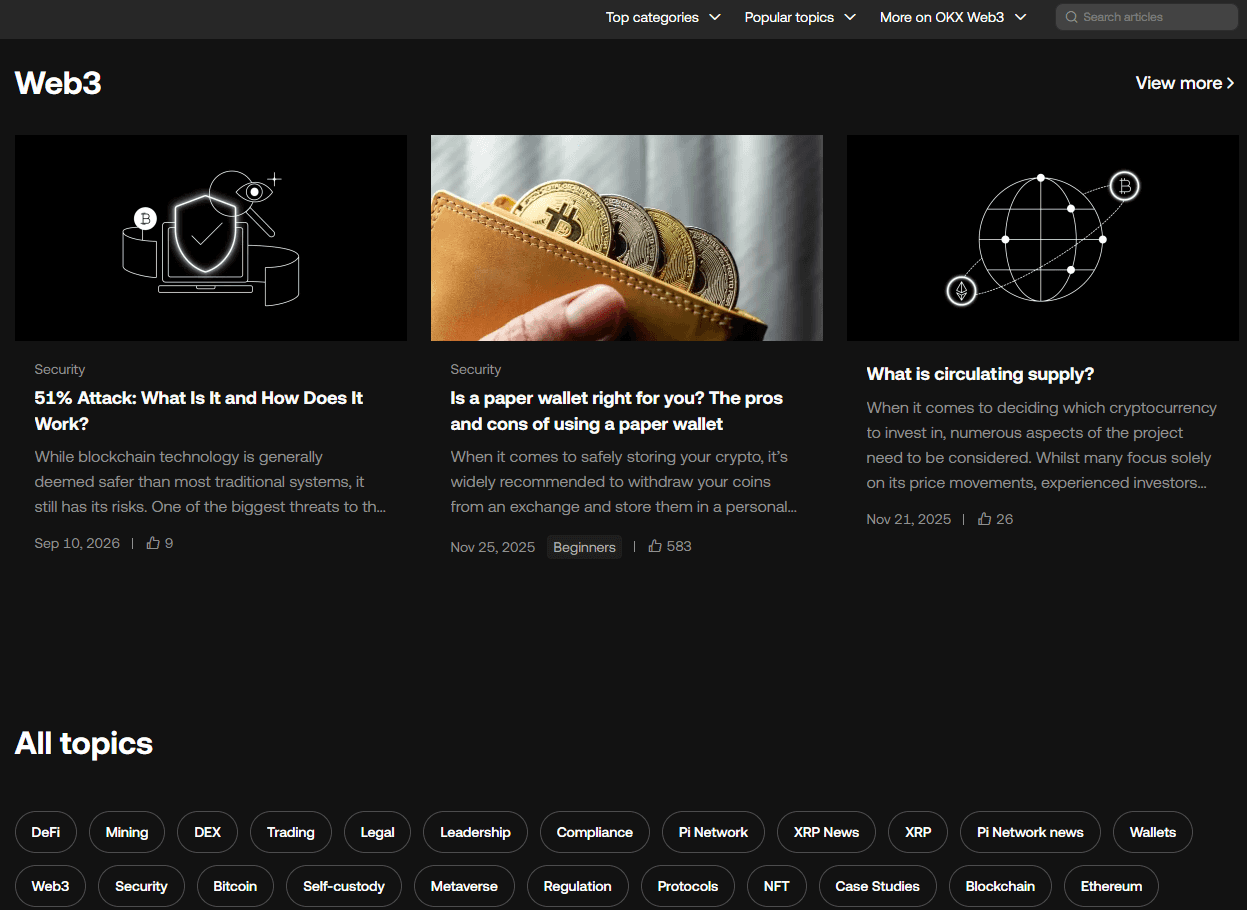
This separation is convenient: beginners can study conventional trading through OKX Learn and then explore non-custodial wallets and Web3. For a large centralized exchange, having extensive educational resources on self-custody and DeFi is a notable advantage.
Demo trading
The training is complemented by a demo account, where users can practice without using real funds. Users receive virtual assets that they can use to learn the interface, place orders, and test trading strategies.
Demo mode is useful not only for beginners. Experienced traders can test a new strategy or familiarize themselves with futures instruments before using real money. Transactions in the demo environment do not affect the user's main balance in any way.
Video lessons, schools, and webinars
OKX periodically organizes educational programs with traders and representatives of the crypto industry. Formats include video lessons, live streams, AMA sessions, and themed mini-courses.
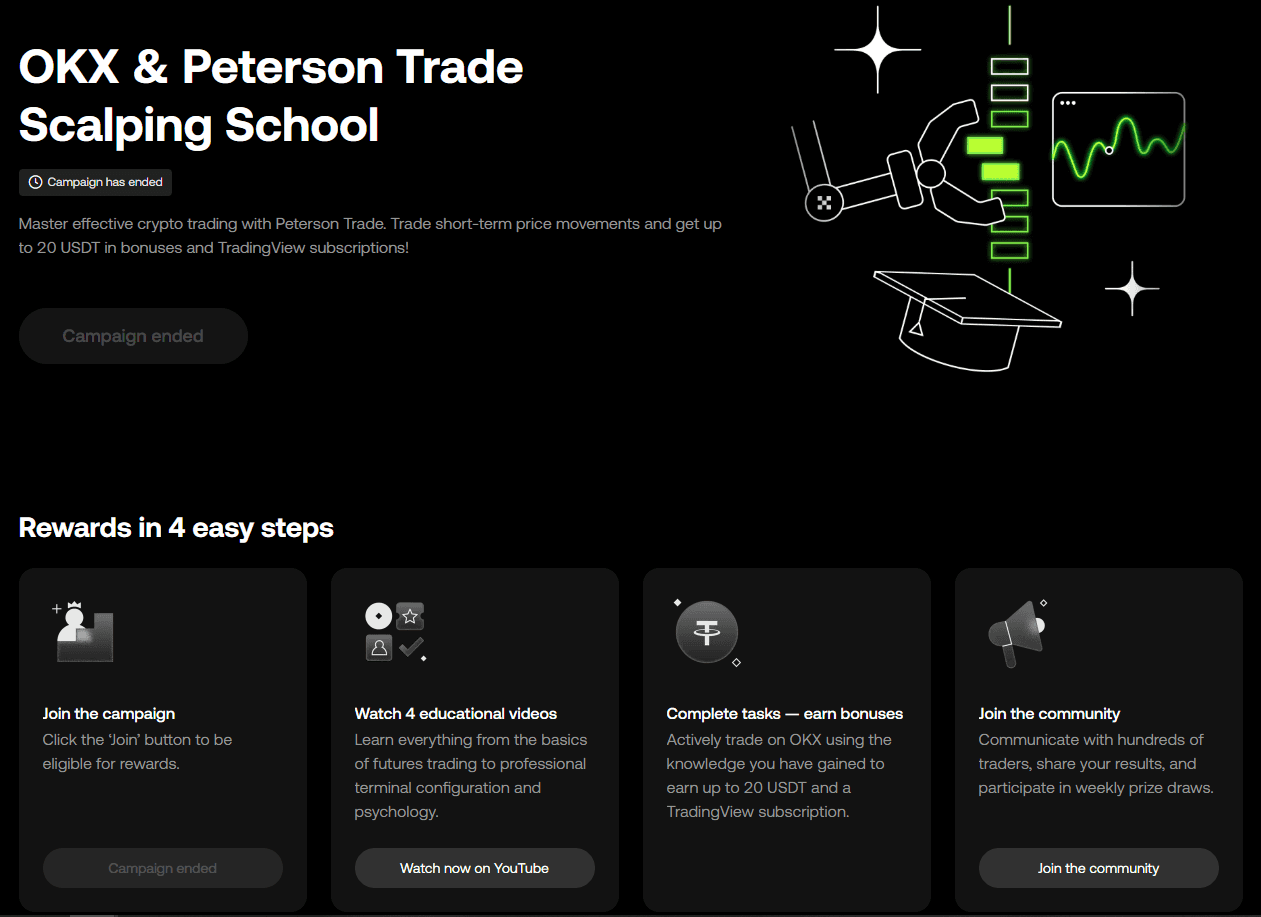
For example, in 2026, the Scalping School by OKX & Peterson Trade was held. The program consisted of four lessons on scalping and futures, video resources on YouTube and AMA sessions with a trader.
In addition, OKX ran a separate options school, which covered Call and Put options, strike prices, premiums, expiration, and options strategies using examples of BTC and ETH. The training included an AMA session.
However, a full, regular webinar schedule comparable to those of traditional Forex brokers offering daily or weekly live market analysis is not available from OKX. Educational live streams are more commonly held as part of individual regional campaigns and special events.
Learn & Earn
OKX periodically runs programs in the Learn & Earn format, combining education with rewards. Users study resources about a particular blockchain or token, complete a short quiz, and receive a cryptocurrency reward if they meet the conditions.
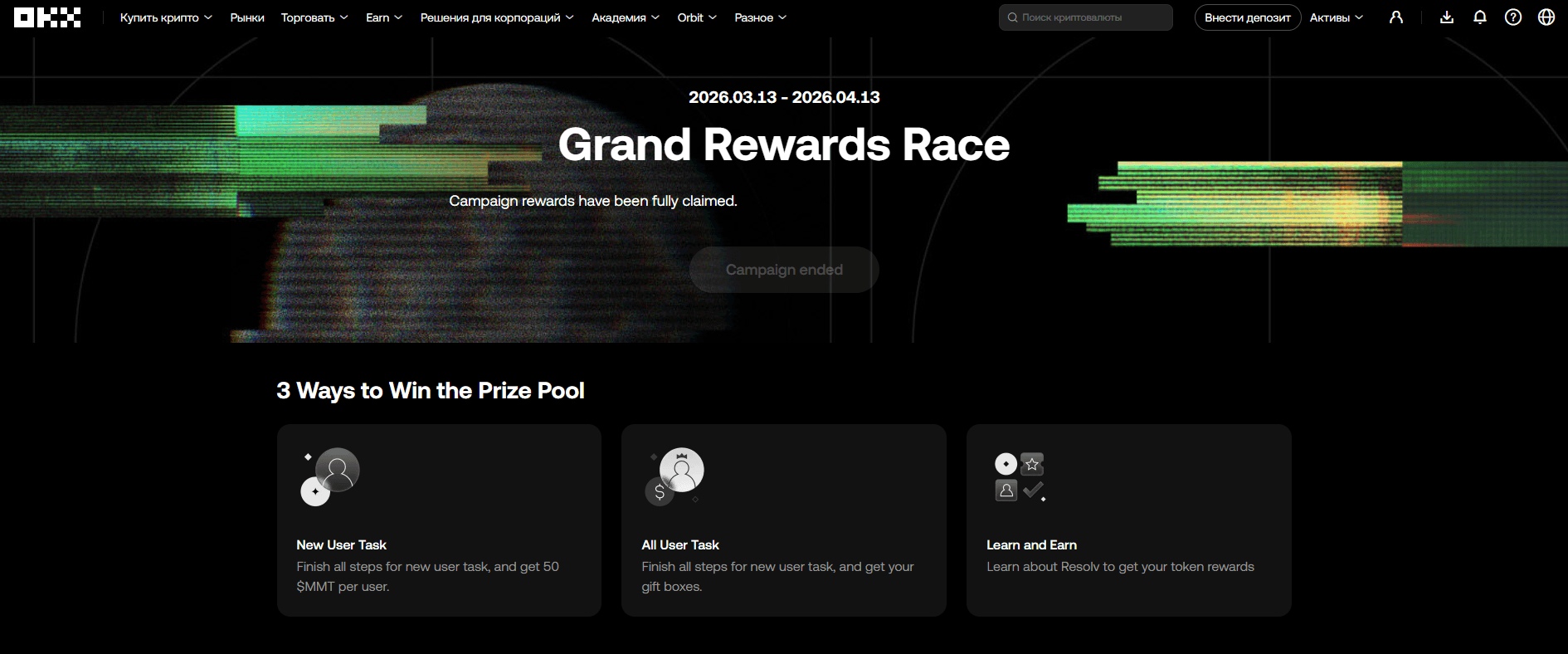
For example, during the Grand Rewards Race, users could study resources about Resolv, answer quiz questions, and receive tokens for correct answers. The availability of such campaigns depends on the region, KYC status, and campaign period.
Learn & Earn should be viewed as an additional educational feature rather than an ongoing course.
Events and expert content
OKX also hosts major industry events. For example, OKX Now 2026 featured presentations by company executives, traders, and financial industry representatives, product demonstrations, and discussions about the development of traditional and digital markets. Streams are available online, and recordings are published after the event.
These resources are useful for understanding industry trends, although their format is closer to conference and expert content than structured trading education.
Customer Support
Overall, the support service offered by OKX performs well for a large international crypto exchange. One strength is the ability to quickly contact an agent via chat, but complex issues involving KYC, account freezes, P2P disputes, or transaction reviews may require escalation to a specialized department and take considerably longer to resolve.
Support contact channels
The main ways to contact OKX:
- Online chat 24/7. Available through the Help Center on the website and the support section of the mobile app. Users can first interact with an automated system, after which the request is transferred to an agent if necessary. A description of the issue and supporting materials can be sent through the chat.
- Tickets. If an issue requires further investigation, a ticket is created and can be tracked through the Support Center. This format is more convenient for issues with deposits, withdrawals, verification, and other cases where documents or transaction history must be provided.
- Help Center. The knowledge base contains numerous instructions on accounts, security, deposits and withdrawals, spot trading, futures, options, bots, P2P, and other services. Many standard operations can be completed independently without contacting a support representative.
- Social media. OKX has official accounts on X, Telegram, and other networks. They are suitable for obtaining information and help with directing a request, but passwords, 2FA codes, seed phrases, and other confidential data must not be shared through social media.
- Formal complaints. Regulated entities have a separate procedure for filing a formal complaint if standard support has been unable to resolve the issue.
Phone support varies by region. For example, in the US, OKX publishes a toll-free number for voice messages and a separate line offering live support during business hours for California customers. Online chat remains the primary contact method in the global and European Help Centers.
Response times
Online chat is available 24 hours a day, while the typical wait to connect with a specialist is approximately 2–5 minutes. For tickets, the company gives an estimated initial response time of between 2 and 24 hours.
Some regulated entities have more specific standards. For example, OKX Singapore states that it aims to respond to requests within six hours and resolve the issue within seven calendar days after receiving all necessary information. In the UAE, formal complaints typically receive an initial response within one business day in practice.
However, these time frames should not be regarded as a guarantee that every issue will be resolved. Simple questions about the interface, fees, or account settings may indeed be resolved almost immediately, while reviews involving KYC/AML, blocked transfers, recovery of disputed deposits, and P2P disputes require the involvement of specialized departments.
Support expertise
The support team at OKX handles routine questions reasonably well. Most standard situations—changing security settings, questions about KYC, the status of a deposit or withdrawal, network selection, and the use of trading features—are well documented, allowing an agent to quickly provide appropriate instructions.
For more complex issues, the first-line agent usually acts as an intermediary. For example, a disputed P2P transaction may be escalated to the P2P team, a question about verifying the source of funds to the compliance department, and an uncredited blockchain transaction to the technical or finance team. As a result, the quality of the resolution depends less on the individual chat agent than on the speed of internal escalation.
User reviews point to inconsistent support quality. Some customers report that issues are resolved quickly and competently, while negative reviews regularly include complaints about generic responses, insufficiently detailed explanations, and lengthy handling of complex cases.
Conclusion
OKX is a large, versatile cryptocurrency exchange with a well-developed international regulatory structure and a very broad range of trading and investment instruments. At the same time, OKX offers competitive fees, high-quality trading platforms, advanced analytics, and a full-featured demo mode.
Those best suited to OKX are active and experienced crypto traders, who value low fees, extensive functionality, and professional tools. Beginners can also use the exchange, although the large number of features may make the interface take some time to master.
FAQ
What is OKX?
OKX is a large international cryptocurrency exchange founded in 2017. It provides access to buying and selling cryptocurrencies, spot and derivatives trading, as well as additional investment and Web3 services.
Is it safe to use OKX?
OKX can be considered a reasonably reliable exchange: it is regulated in several major jurisdictions and uses Proof of Reserves, cold storage, 2FA, and other protection mechanisms. However, the risks associated with centralized exchanges remain, and OKX has faced serious regulatory claims related to AML/KYC.
How does OKX work?
OKX connects buyers and sellers through its trading platform and order book. Users can buy cryptocurrency with fiat currency, trade on the spot and derivatives markets, and use P2P and other services. The exchange charges a fee for most trading transactions.
How to use OKX?
First, you need to register and complete identity verification. You can then fund your account with cryptocurrency or fiat currency, select the desired market, and make a trade. Beginners are better off starting with spot trading or a demo account before using leverage and derivatives.
How to open an account on OKX?
On the website or in the OKX app, you need to click Sign up, select your country of residence, enter your email address, confirm it with a code, and configure your account details. After registering, you need to complete KYC to gain full access to trading and financial transactions.
How to make a deposit on OKX?
To deposit cryptocurrency, open Deposit, select the coin and network, copy the provided address, and send funds to it. In supported countries, bank transfers, cards, and other fiat payment methods are also available. The available options depend on the region.
How to trade on OKX?
Select a market, such as Spot or Futures, a trading pair, and an order type. Then specify the price and amount of the asset and place a buy or sell order. When trading futures, it is also important to monitor leverage, margin, and liquidation risk.
How to sell cryptocurrency on OKX?
Cryptocurrency can be sold through the spot market, the Convert feature, or P2P. On the spot market, the user places a sell order for the selected pair; with Convert, the user receives a ready exchange quote; and on P2P the user sells cryptocurrency to another user for fiat currency.
How to withdraw funds from OKX?
To withdraw cryptocurrency, select Withdraw, specify the asset, network, recipient address, and amount. In some countries, direct fiat withdrawals to a bank account are available. Alternatively, sell cryptocurrency through P2P and receive payment directly from the buyer.
How to delete an account on OKX?
Before deleting the account, you need to withdraw any remaining funds, close open orders, and complete any pending transactions. Then select Close account in the security settings, confirm that you understand the consequences of closing the account, and complete the security check. Deletion is irreversible, and registering again with the same details may be temporarily restricted.