Bitbase Review 2026
Bitbase is suitable for active crypto traders who trade spot and futures, as well as investors interested in instruments available through TradFi.
- Bitbase is trusted. Tested via live trading.
- Bitbase №15 in the crypto exchanges list
Highlights of Bitbase

Bitbase — an international centralized cryptocurrency exchange founded in 2023 and headquartered in Panama. The platform offers spot and futures cryptocurrency trading, as well as access to instruments linked to traditional financial markets. The exchange serves both retail traders and professional market participants.
In addition to digital asset trading, Bitbase offers Earn investment products, and a mobile app. The company focuses particularly on developing its trading infrastructure, risk management, and the security of client funds. Its stated protection mechanisms include cold storage of cryptocurrencies, a multi-layered security system, and proof of reserves.
Pros and cons of Bitbase
Pros
- Wide range of trading instruments.
- Access to traditional markets through TradFi, including stocks, ETFs and precious metals.
- Competitive trading fees and VIP discounts, plus low-cost cryptocurrency withdrawals.
- User-friendly web and mobile platforms with built-in charts from TradingView.
- Advanced analytical and educational materials and publication of Proof of Reserves.
Cons
- Limited regulation and insufficient transparency regarding the legal structure.
- Limited fiat deposit and withdrawal options and no P2P trading.
- No copy trading or built-in trading bots.
- No desktop app and limited API capabilities.
Bitbase reviews

Bitbase
What traders talk about
No reviews yet.
Leave a review of your experience:
Bitbase Exchange Overview
- Foundation Year
- 2023
- Official Website
- https://www.bitbase.com
- Regulated in Countries
Panama, Australia
More Details- Trading Assets
- Cryptocurrency
- Futures
- Precious Metals
- Stocks
- ETF
- Fees (Maker/Taker)
- Spot
- 0.1% / 0.1%
- Futures
- 0.02% / 0.06%
- Max Leverage
- Spot
- 1x
- Futures
- 150x
- Email Support


Bitbase — a centralized cryptocurrency exchange founded in 2023. The company is headquartered in Panama City, Panama, while regional teams operate in Hong Kong, Singapore, and Dubai. The platform serves retail and institutional traders and specializes in trading digital assets and financial derivatives.
The main business areas of Bitbase are spot cryptocurrency trading, perpetual futures contracts, and trading tokenized assets linked to traditional financial markets, including U.S. stocks and precious metals. The exchange also offers Earn investment products and the option to buy cryptocurrencies with fiat money through third-party payment providers. The company states that it prioritizes the security of client assets, the stability of its trading infrastructure, and risk management.
Bitbase Review Summary
Reliability and Regulation
Bitbase publishes reserve data and uses modern security mechanisms, but limited regulation and insufficient transparency regarding its legal structure reduce the exchange's reliability.
Advantages
- Registrations with FinCEN and AUSTRAC, as stated by the exchange.
- Publication of Proof of Reserves with coverage exceeding 100%.
- Multi-layered asset protection system.
Disadvantages
- No full-fledged financial licenses.
- Insufficient transparency regarding the legal structure.
When evaluating Bitbase, we considered the exchange's key characteristics: reliability and security, trading conditions, commissions, the range of available instruments, platform usability, and the quality of customer support. All criteria are assessed according to our broker assessment methodology, which enables objective comparisons of trading platforms and identifies their strengths and weaknesses.
Continue reading the review to learn more about the features of Bitbase, its trading conditions, and how the exchange operates.
Reliability and Regulation
Bitbase demonstrates a fairly high level of technical security, publishes reserve reports showing coverage above 100%, and claims regulatory registrations in the United States and Australia. Another positive factor is the security audit conducted by CertiK. However, the lack of full financial licenses, limited transparency regarding its legal structure, and relatively short operating history prevent the exchange from being classified among the most reliable platforms.
Licensing and jurisdiction
The main stated jurisdiction of Bitbase is Panama. On its official website, the company lists two legal entities with registrations related to financial monitoring and anti-money laundering.
| Legal Entity | Regulator |
|---|---|


FinCEN (Financial Crimes Enforcement Network) — a bureau of the U.S. Department of the Treasury that monitors compliance with anti-money laundering and counter-terrorist financing requirements. Bitbase Global Inc. claims to be registered as a Money Services Business (MSB), covering certain types of financial activity.
AUSTRAC (Australian Transaction Reports and Analysis Centre) — Australia's financial intelligence agency, which oversees compliance with AML/CTF. The company BITBASE PTY LTD is registered as a digital currency exchange service provider (DCE/VASP).
It is important to understand that registrations with FinCEN MSB and AUSTRAC DCE/VASP are not equivalent to full brokerage or investment licenses. They do not guarantee the exchange's financial stability and do not signify government approval of its activities.
Security of funds
Bitbase uses a multi-layered security system designed to prevent hacking, unauthorized access, and the loss of client assets.
The main protection mechanisms include:
- Cold storage of cryptocurrencies. Separating hot and cold wallets reduces the risk of assets being compromised in cyberattacks.
- Multi-signature security. Multi-step transaction approval is used to manage certain cryptocurrency wallets.
- Two-factor authentication (2FA). Additional protection for user accounts during login.
- Access control. Separation of permissions and multi-level checks on transactions involving client assets.
- Risk monitoring. Automated systems monitor suspicious activity and potential security threats.
The system that warrants particular attention is Proof of Reserves (PoR). Bitbase publishes monthly information on its cryptocurrency reserves and uses Merkle Tree technology, allowing users to verify that their assets are included in the report.
However, Proof of Reserves is not a substitute for a full independent financial audit. Such reports reflect the state of assets on a specific date and do not provide a complete assessment of the exchange's liabilities, debt burden, or financial stability.
Additional security information is provided by CertiK Skynet. However, a detailed report of the audit results has not been publicly disclosed, limiting the ability to independently assess the vulnerabilities identified.
Account Opening
Opening an account on Bitbase is completed entirely online and does not require an office visit. Users can register through the exchange's official website or mobile app. An email address or phone number is sufficient to create an account, while identity verification (KYC) expands access to available features.
Registration
Registration on Bitbase takes only a few minutes. To create an account, follow these steps:
- Go to the official website of Bitbase and click the registration button (Sign Up).
- Enter your email address or mobile phone number.
- Create a strong password for logging in to your account.
- Enter the verification code sent to your email or phone.
- After confirming your contact details, log in to your account on Bitbase.
The exchange also allows quick registration through Google or Apple accounts.
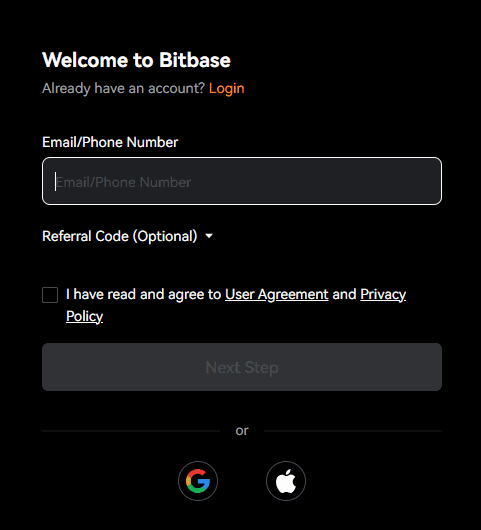
After creating an account, it is recommended that you set up two-factor authentication (2FA) through Google Authenticator. This provides additional protection for the account against unauthorized access.
According to the user agreement of Bitbase, each user may have only one primary account. Creating multiple accounts without prior permission from the exchange is prohibited.
Verification
Bitbase uses the procedure Know Your Customer (KYC) to verify users' identities and comply with anti-money laundering requirements. Verification is not required for registration itself, but it affects access to certain services and withdrawal limits.
To complete KYC, you must:
- Log in to your account on Bitbase and open the identity verification section (Identity Verification).
- Select your country of residence and the type of identity document.
- Enter the required personal information.
- Upload photographs of a document proving your identity.
- Complete biometric facial verification using a camera.
- Submit the application and wait for approval.
The following documents are accepted for verification:
- International or national passport.
- National ID card.
- Driver's license.
The list of available documents may vary depending on the user's country. According to the official guide from Bitbase, verification is usually completed within 24 hours, but may take up to 48 hours.
Important restriction: under Bitbase's requirements, users between 18 and 65 years of age may complete KYC.
Depending on verification status, the exchange imposes the following restrictions:
Features | Without KYC | With KYC |
|---|---|---|
Account funding | No restrictions based on KYC status | No restrictions based on KYC status |
Daily withdrawal limit | Up to 100 000 USDT | Up to 1 000 000 USDT |
Fiat currency transactions | Unavailable | Available |
In some cases, Bitbase may request additional documents or information about the source of funds. This is provided for under the AML/KYC policy and may be required for suspicious activity or when reviewing large transactions.
Account Types
Bitbase offers a variety of trading and investment opportunities, including spot and futures trading, TradFi and Earn products. This range of services is suitable for both beginners and experienced traders. However, the lack of copy trading, automated trading bots, and full P2P trading limits the functionality of Bitbase compared with leading cryptocurrency exchanges.
Spot trading
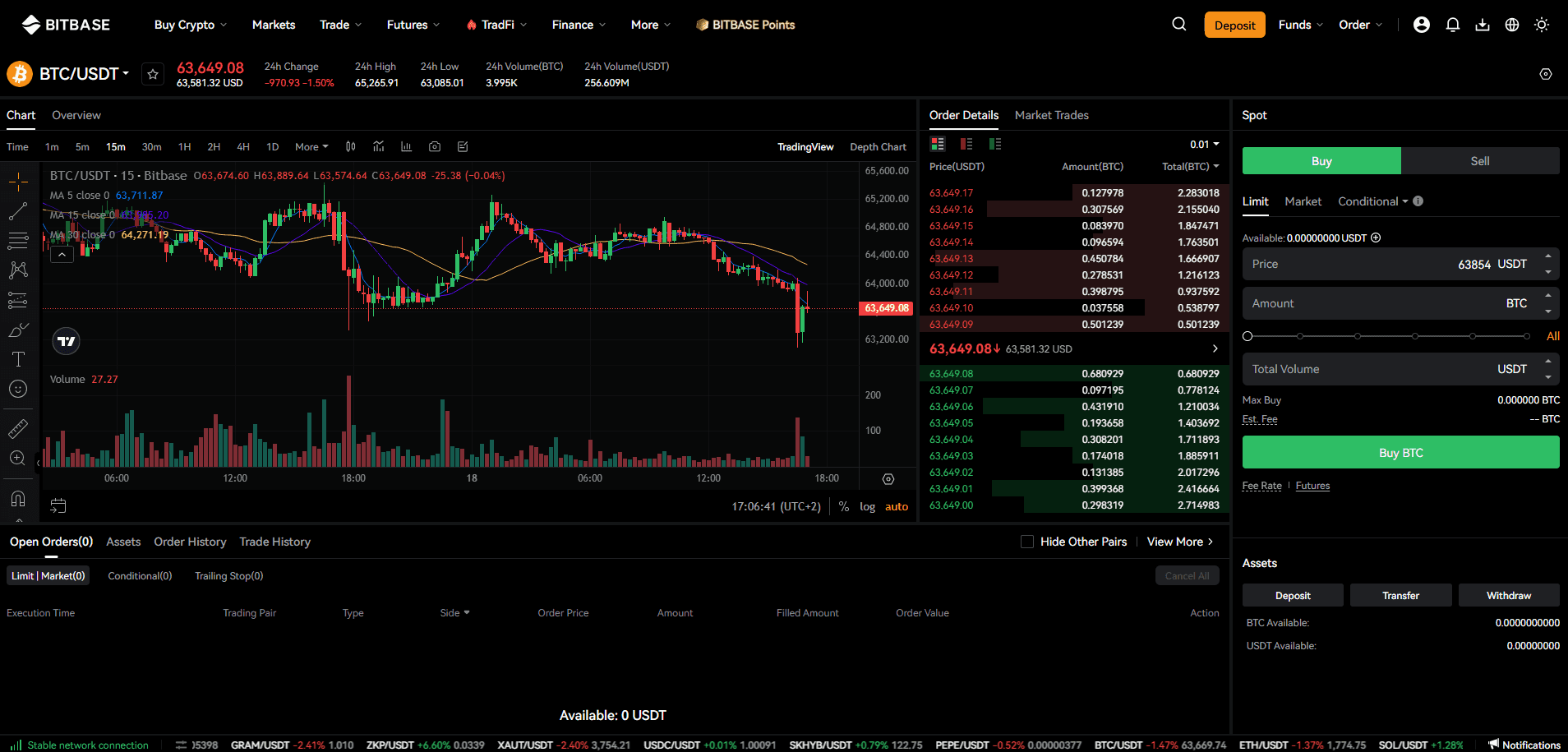
The spot market of Bitbase is intended for buying and selling cryptocurrencies, with purchased assets credited directly to the user's balance. Unlike futures, the trader owns the purchased cryptocurrency and does not use leverage.
The exchange offers trading in popular digital assets, including Bitcoin (BTC), Ethereum (ETH), Solana (SOL), and other cryptocurrencies. Most pairs are quoted against USDT.
The main spot trading features include:
- Market orders (Market) — buying or selling cryptocurrency at the best available prices.
- Limit orders (Limit) — placing an order at a predetermined price.
- Trading 24/7 — 24-hour access to the cryptocurrency market, including weekends.
- VIP program — reduced trading commissions based on trading volume and the value of the user's assets.
Spot trading is suitable for beginners, long-term investors, and traders who prefer transactions without leverage.
Futures trading
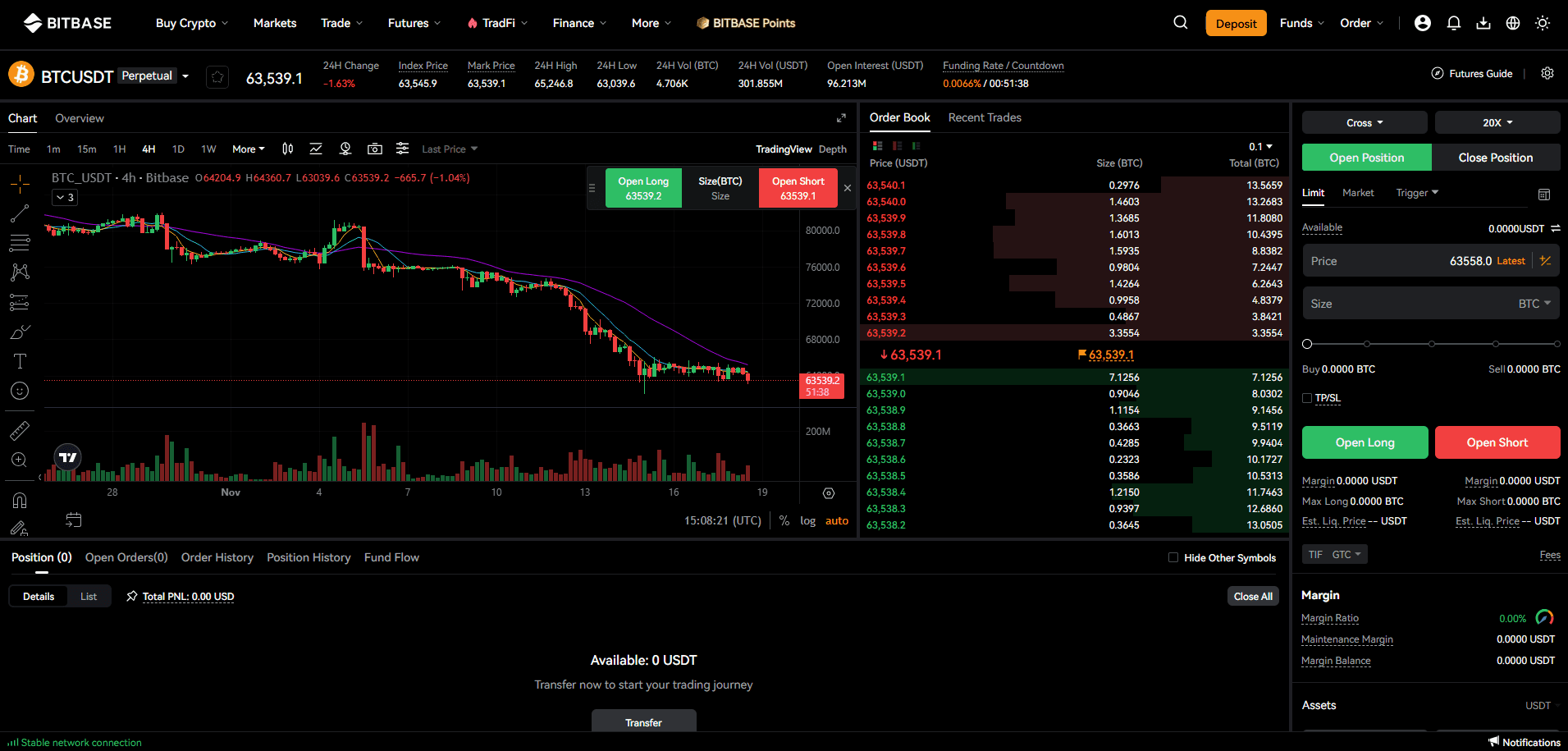
Bitbase offers perpetual futures contracts (Perpetual Futures), which allow traders to profit from both rising and falling cryptocurrency prices. The primary format is USDT-M contracts, in which margin and financial results are calculated in USDT.
Unlike spot trading, when opening a futures position, a trader does not purchase the underlying cryptocurrency but enters into a contract whose value depends on changes in its price.
The platform supports the following features:
- Long and Short — opening positions based on an expected price increase or decrease.
- Leverage — increasing position size using borrowed funds. Maximum leverage depends on the selected contract.
- Isolated margin (Isolated Margin) — allocating separate collateral to a specific position.
- Cross margin (Cross Margin) — using the available margin balance to maintain positions.
- Stop-Loss and Take-Profit — automatically closing positions when specified conditions are met.
- Hedge mode (Hedge Mode) — the ability to hold long and short positions in the same instrument simultaneously.
Perpetual contracts do not have an expiration date. A funding mechanism (Funding Rate) is used to keep their prices aligned with the spot market, under which traders periodically pay or receive funds depending on the direction of their positions.
Futures trading is intended primarily for experienced users. Leverage increases potential profit but also raises the risk of forced liquidation and loss of funds.
TradFi
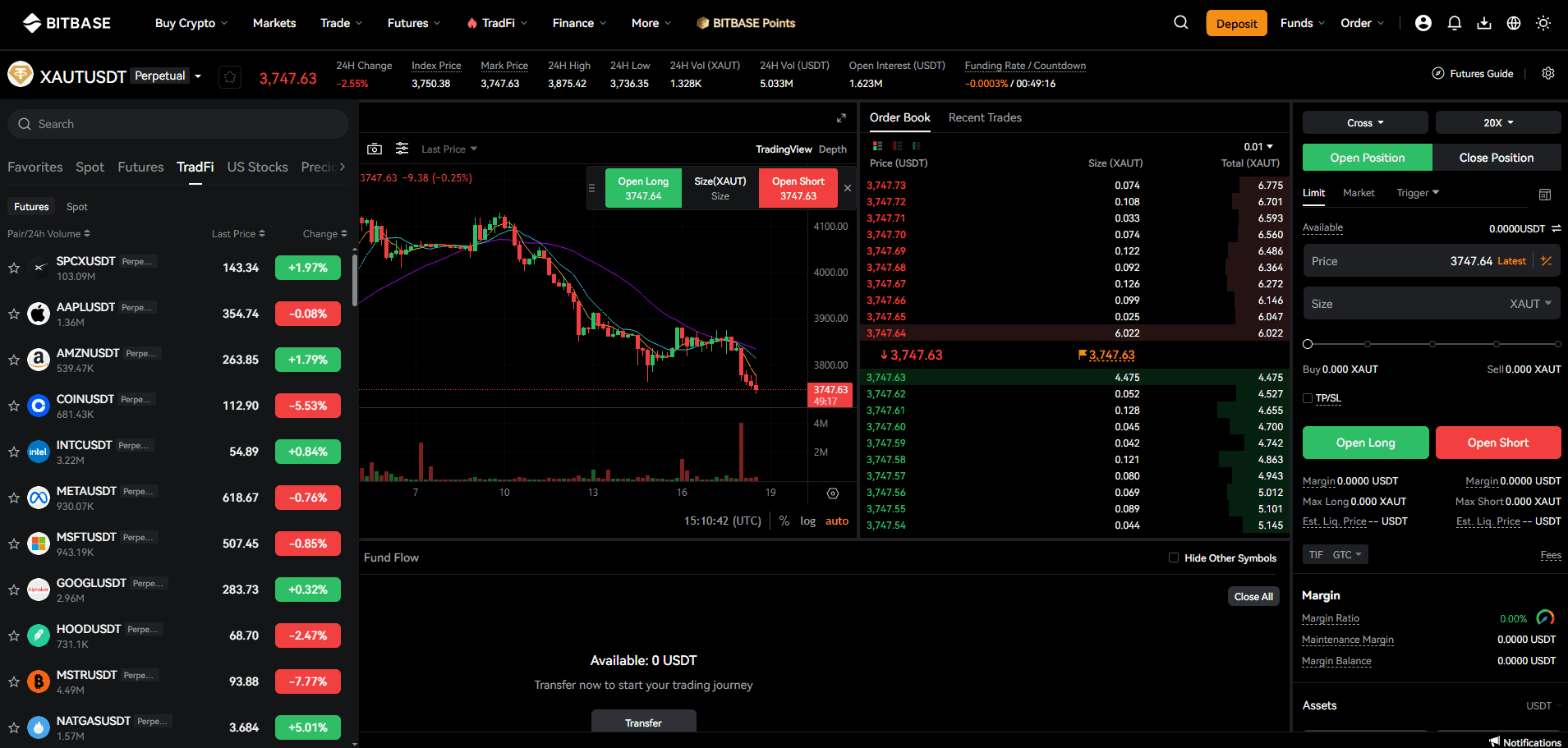
TradFi is a separate business area of Bitbase, providing access to traditional financial market instruments through cryptocurrency infrastructure. Users can trade assets whose value is linked to stocks, precious metals, currencies, oil, and stock indices.
The platform offers more than 100 trading pairs for TradFi, including instruments based on U.S. stocks, gold, silver, and major currency pairs.
The main features of TradFi:
- Access to traditional markets through a single account on Bitbase.
- Trading in tokenized instruments and derivative contracts.
- Leverage of up to 1:200 for certain instruments.
- 24-hour trading in certain assets, including when the underlying markets are closed.
- Settlement within the cryptocurrency platform.
Important: tokenized stocks and derivative instruments on TradFi are not equivalent to direct ownership of company shares. They may not provide shareholder rights, including voting rights and the right to receive dividends.
Furthermore, trading outside the main operating hours of traditional exchanges may involve lower liquidity, wider spreads, and additional position funding costs.
Buying cryptocurrency
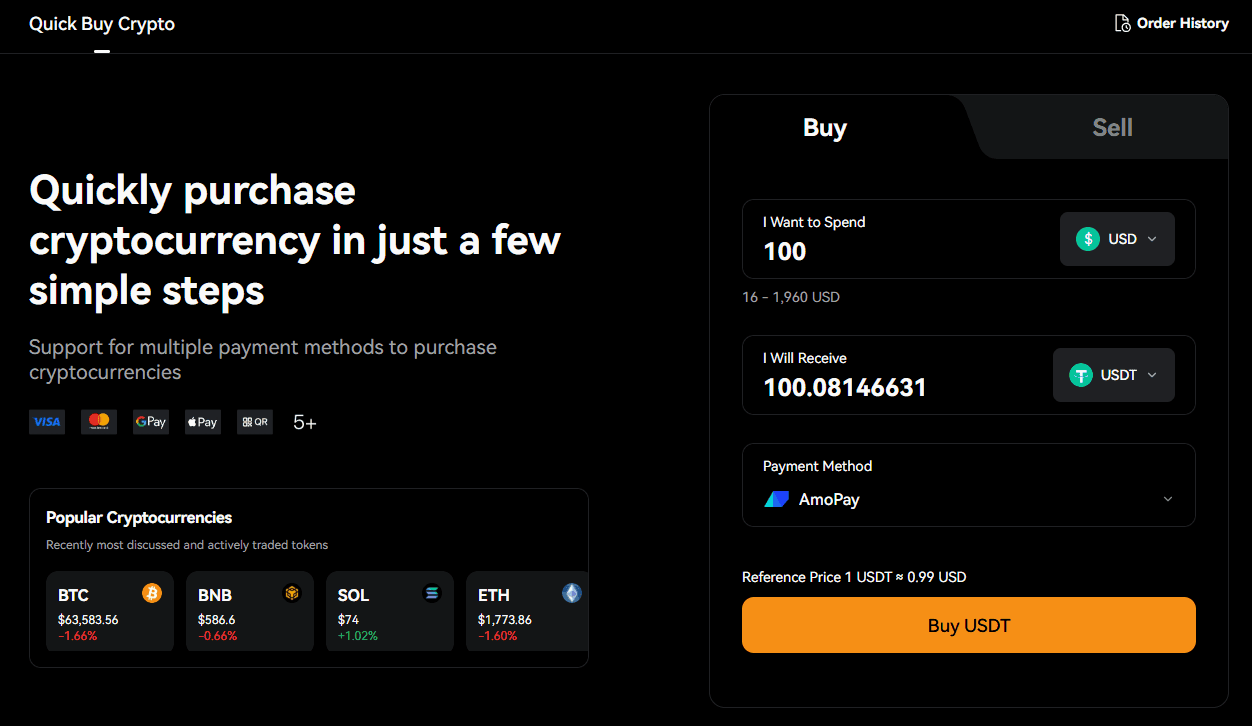
For users who do not want to place trading orders themselves, Bitbase offers the service Quick Buy. It allows users to buy digital assets with fiat currencies through third-party payment providers.
The purchase process consists of several steps:
- Go to the Buy Crypto section on the Bitbase website or in its app.
- Select the fiat currency and the cryptocurrency you want to purchase.
- Enter the purchase amount.
- Select an available payment provider and payment method.
- Check the exchange rate and commissions, then confirm the payment.
Depending on the country and payment provider, supported payment methods may include Visa and Mastercard bank cards, Apple Pay, Google Pay, and other payment methods.
The purchased cryptocurrency is usually credited to the spot account within a few minutes, although some transactions may take longer to process.
To use Quick Buy, you must complete KYC. A third-party payment provider may also request identity verification. Keep in mind that the fee and exchange rate may differ from the terms of a direct purchase on the spot market.
Bitbase Earn
Bitbase Earn is a service for earning additional income by depositing cryptocurrency assets. It is intended for users who want to put idle funds to work without having to trade constantly.
Several types of products are available under the program:
Product | Features |
|---|---|
Flexible Earn | Flexible cryptocurrency deposits with a variable yield and the option to request the return of funds at any time. |
Fixed Earn | Assets are deposited for a fixed term at an estimated yield set when the product is opened. Early withdrawal may be restricted. |
On-chain Earn | Earning rewards by participating in staking and third-party blockchain protocols. |
Yield is shown as an annualized rate, expressed as APR or APY. Actual rates depend on the selected product, cryptocurrency, deposit term, and market conditions.
Some fixed-term products lock funds until the maturity date. If funds are withdrawn early, the user may lose accrued interest, while some offers do not allow early withdrawal at all.
It is important to note that the yield from Bitbase Earn is not guaranteed. The products carry liquidity and counterparty risks, risks arising from changes in cryptocurrency values, and possible technical issues with third-party protocols. Earn therefore cannot be treated as equivalent to a bank deposit with guaranteed repayment.
Promotions
Bitbase regularly runs marketing campaigns for new and existing users. Promotions include trading bonuses, coupons, deposit rewards, and rewards for completing special tasks.
The main bonus programs include:
- Rewards Hub — a rewards center with tasks for new and existing users. Bonuses may be awarded for registration, making a deposit, and reaching a specified trading volume.
- Futures bonuses — trial funds and coupons that can be used under the established derivatives trading rules.
- Referral program — rewards for inviting new users.
- Trading competitions — competitions between traders with prizes for meeting specified conditions.
It should be noted that many bonuses from Bitbase are provided not as freely withdrawable cash but as trading vouchers or trial funds subject to usage restrictions. Receiving rewards may require a specified deposit, trading volume, or completion of tasks within a set period.
Current offers and participation rules are available in Rewards Hub.
Commissions
Fees at Bitbase are average, and they can be quite low for active traders thanks to the VIP program. Spot rates are in line with market standards, although the futures taker fee is slightly higher than those of major competitors. Free deposits and low withdrawal fees on certain networks are advantages, although additional costs for TradFi can increase the overall cost of trading.
Spot trading fees
The standard fee at Bitbase for spot trading is 0.1% for makers and 0.1% for takers. The fee is charged when an order is executed, so there is no fee for placing or canceling an unfilled order.
The base rates are in line with common terms at major crypto exchanges. Traders with high turnover or substantial account holdings can use the VIP program, which reduces fees to 0.01% for makers and 0.02% for takers.
VIP levels and spot market fees at Bitbase
VIP status | Trading volume over 30 days (USDT) | Current balance (USDT) | Average balance over 30 days (USDT) | Maker | Taker |
|---|---|---|---|---|---|
VIP 0 | ≥0 | ≥0 | ≥0 | 0.10% | 0.10% |
VIP 1 | ≥500 000 | ≥30 000 | ≥30 000 | 0.08% | 0.09% |
VIP 2 | ≥2 000 000 | ≥50 000 | ≥50 000 | 0.07% | 0.08% |
VIP 3 | ≥8 000 000 | ≥250 000 | ≥250 000 | 0.05% | 0.06% |
VIP 4 | ≥30 000 000 | ≥750 000 | ≥750 000 | 0.04% | 0.05% |
VIP 5 | ≥50 000 000 | ≥2 000 000 | ≥2 000 000 | 0.03% | 0.04% |
VIP 6 | ≥75 000 000 | ≥5 000 000 | ≥5 000 000 | 0.02% | 0.03% |
VIP 7 | ≥100 000 000 | ≥10 000 000 | ≥10 000 000 | 0.01% | 0.02% |
VIP status is determined by four metrics: spot trading volume over 30 days, futures trading volume over the same period, current balance, and average asset balance over 30 days. Meeting at least one condition is sufficient to qualify for the corresponding level. If the metrics correspond to different levels, the exchange assigns the highest one. Levels are recalculated daily at 00:00 UTC.
Thus, even a trader with low trading volume can receive reduced fees by holding enough assets on the platform. However, the thresholds for high VIP levels are substantial, so most retail users will mainly have access to the standard rates.
Futures fees
In the USDT-M perpetual futures market, the standard fee charged by Bitbase is 0.02% for makers and 0.06% for takers. The fee is calculated based on the position's notional value and charged separately when the trade is opened and closed.
For example, when opening and subsequently closing a position with a notional value of 10 000 USDT using market orders, the total fee will be 12 USDT. If both transactions are executed as maker orders, the cost will fall to 4 USDT.
Compared with leading crypto exchanges, the maker fee is competitive, but the base taker rate of 0.06% is slightly higher than the common rate of 0.05%. This is particularly important for scalpers and traders who frequently open and close positions with market orders.
VIP levels and futures market fees at Bitbase
VIP status | Trading volume over 30 days (USDT) | Current balance (USDT) | Average balance over 30 days (USDT) | Maker | Taker |
|---|---|---|---|---|---|
VIP 0 | ≥0 | ≥0 | ≥0 | 0.020% | 0.060% |
VIP 1 | ≥5 000 000 | ≥30 000 | ≥30 000 | 0.018% | 0.055% |
VIP 2 | ≥10 000 000 | ≥50 000 | ≥50 000 | 0.016% | 0.050% |
VIP 3 | ≥20 000 000 | ≥250 000 | ≥250 000 | 0.014% | 0.045% |
VIP 4 | ≥50 000 000 | ≥750 000 | ≥750 000 | 0.012% | 0.040% |
VIP 5 | ≥100 000 000 | ≥2 000 000 | ≥2 000 000 | 0.010% | 0.035% |
VIP 6 | ≥300 000 000 | ≥5 000 000 | ≥5 000 000 | 0.008% | 0.030% |
VIP 7 | ≥1 000 000 000 | ≥10 000 000 | ≥10 000 000 | 0.005% | 0.025% |
On Bitbase, a unified VIP status applies to spot and futures trading. Therefore, attaining a higher level through trading volume or assets simultaneously reduces fees in both markets.
In addition to trading fees, when trading perpetual contracts, it is necessary to account for Funding Rate — periodic payments between holders of long and short positions. They are used to keep the futures price aligned with the underlying market.
The funding amount depends on the specific contract and market conditions. Payments may either be deducted from or credited to the trader's account. When a position is held for a long time, Funding Rate costs can significantly exceed standard trading fees.
Fees on TradFi
Bitbase provides access to traditional financial market instruments, including stocks, stock indices, currency pairs, gold, silver, and oil. Costs depend on the trading format: tokenized assets on the spot market, perpetual contracts, and a separate U.S. stock trading service have different terms.
For tokenized assets traded on the spot market, the Bitbase spot fee schedule serves as a guide. For perpetual contracts on TradFi, the terms of the corresponding futures instrument apply. However, fees for individual contracts and trading pairs may differ from the standard rates.
Main trading costs on TradFi
- Trading fee. Charged when an order is executed based on the instrument's applicable rate.
- Spread. The difference between the buy and sell prices, which may widen during periods of low liquidity and outside main trading hours.
- Funding Rate. Periodic payments on perpetual contracts, the amount of which depends on market conditions.
- Slippage. The potential difference between the expected and actual order execution price.
Bitbase also offers a separate service U.S. Stock Trading for trading U.S. stocks through its partner Alpaca Securities LLC. The following fees apply to this service:
Order size | Fee |
|---|---|
Less than $340 | $0.25 per order |
From $340 | 0.15% of the order amount |
This rate applies specifically to the separate U.S. stock trading service and should not be confused with fees for tokenized stocks or futures on TradFi.
Deposit and withdrawal fees
Bitbase does not charge a fee for funding an account with cryptocurrencies. However, the sender may have to pay blockchain network fees or a fee charged by the third-party platform from which the transfer is made.
The cryptocurrency withdrawal fee depends on the selected coin and network. For popular assets, the exchange supports several blockchains, allowing users to choose a more cost-effective transfer method.
Below are examples of rates on Bitbase.
Cryptocurrency | Network | Deposit fee | Withdrawal fee | Minimum withdrawal |
|---|---|---|---|---|
BTC | Bitcoin | 0 | 0.000015 BTC | 0.00008 BTC |
BTC | BEP20 | 0 | 0.00000028 BTC | 0.00002 BTC |
ETH | ERC20 | 0 | 0.00002 ETH | 0.002 ETH |
ETH | Arbitrum | 0 | 0.0000016 ETH | 0.001 ETH |
USDT | TRC20 | 0 | 1 USDT | 3 USDT |
USDT | ERC20 | 0 | 0.39 USDT | 10 USDT |
USDT | BEP20 | 0 | 0.01 USDT | 5 USDT |
USDT | TON | 0 | 0.1 USDT | 0.1 USDT |
USDT | Arbitrum | 0 | 0.05 USDT | 1 USDT |
SOL | Solana | 0 | 0.000374 SOL | 0.1 SOL |
USDC | ERC20 | 0 | 0.5 USDC | 5 USDC |
USDC | Arbitrum | 0 | 0.001 USDC | 0.001 USDC |
Additional fees from third-party payment providers may apply to fiat currency transactions through Quick Buy. The amount depends on the payment method, currency, and the user's country. The total purchase cost should be checked before confirming the transaction.
Deposit and Withdrawal
Bitbase offers convenient ways to deposit and withdraw cryptocurrencies, supports several blockchain networks, and does not charge fees for cryptocurrency deposits. Users can also buy digital assets with fiat money through third-party payment services. However, direct fiat deposits and withdrawals are limited, and a proprietary P2P platform is not yet available. Transaction speeds depend on the selected transfer method, blockchain conditions, and additional security checks.
Cryptocurrency deposits
The main way to fund Bitbase is by transferring cryptocurrency from an external wallet or another exchange. The platform supports popular assets, including BTC, ETH, USDT, USDC, BNB and SOL. Multiple networks are available for some cryptocurrencies, allowing users to choose a suitable option based on transfer speed and cost.
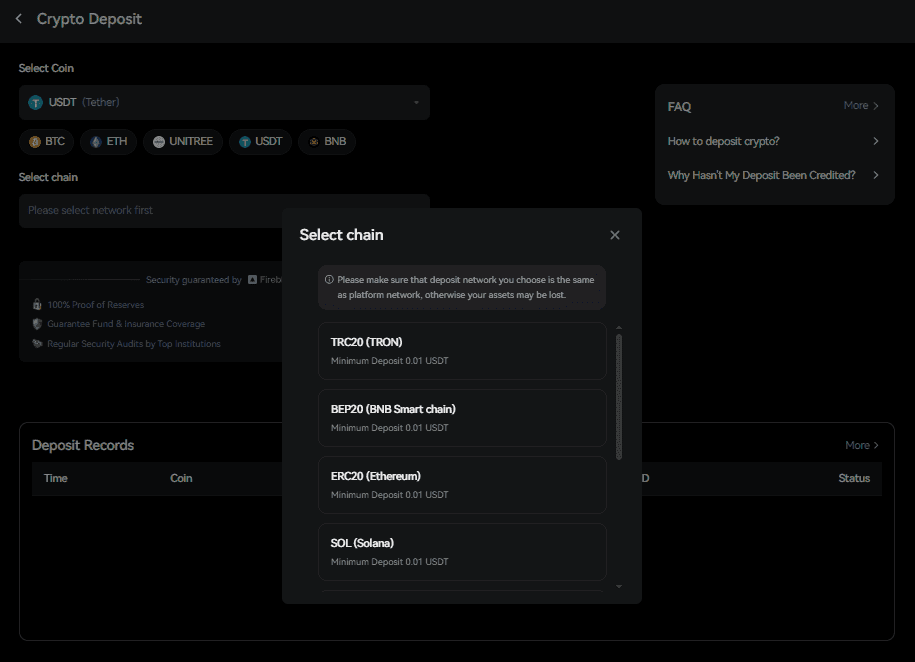
To fund your account on Bitbase, follow these steps:
- Log in to your account and click Deposit at the top of the website. In the mobile app, select Add Funds → Deposit Crypto.
- Select the cryptocurrency you want to deposit.
- Specify the blockchain network. For example, USDT is available on TRC20, ERC20, BEP20, Arbitrum, and other networks.
- Select the account to credit—the spot or futures account—if the relevant option is available.
- Copy the wallet address or use the QR code. Specify the Memo/Tag if necessary.
- Send the cryptocurrency from an external wallet and wait for the transaction to be confirmed.
Bitbase does not charge a fee for cryptocurrency deposits. However, the sender pays the network fee or the withdrawal fee charged by the third-party platform.
Deposit times depend on the blockchain used and the required number of confirmations. Transfers on fast networks may take a few minutes, while transactions through Bitcoin or Ethereum sometimes require a longer wait.
Fiat deposits
Bitbase allows users to buy cryptocurrency with fiat money through the Quick Buy. Unlike exchanges with full fiat accounts, users here do not fund a separate balance in USD or EUR, but instead pay for the cryptocurrency purchase through a third-party payment provider.
Available payment methods depend on the country of residence, selected currency, and payment partner.
Payment method | Features |
|---|---|
Visa and Mastercard | Purchase cryptocurrency with a bank card through a payment provider. |
Apple Pay | Fast payment from supported Apple devices. |
Google Pay | Purchase cryptocurrency through compatible payment services. |
Samsung Pay | Available through selected payment partners. |
Local e-wallets | Supported in some countries through third-party providers. |
In particular, Bitbase states that it supports local payment channels in Bangladesh (bKash, Nagad), in the Philippines (GCash, Maya, QRPH, GrabPay) and in Vietnam (VietQR, MoMo, ZaloPay, ViettelPay). Actual availability depends on the selected payment service.
How to buy cryptocurrency with fiat on Bitbase:
- Go to the Buy Crypto section on the website or in the mobile app.
- Select the fiat currency and enter the purchase amount.
- Select an available payment method and payment provider.
- Check the exchange rate, fee, and amount of cryptocurrency you will receive.
- Confirm the transaction and complete the payment on the payment partner's page.
Once the payment has been processed, the purchased cryptocurrency is credited to the exchange account. This usually takes a few minutes, although the actual time depends on the payment provider.
To use Quick Buy, you must complete KYC on Bitbase. In addition, the third-party provider may require separate identity verification.
Fees for purchases and conversion are set by payment partners. The amount depends on the selected currency, payment method, and exchange rate. The total cost is displayed before the transaction is confirmed.
Important limitation: cryptocurrency purchased through Quick Buy cannot be withdrawn from the exchange for 24 hours after purchase. This is a mandatory security measure that cannot be lifted early.
Cryptocurrency withdrawals
Digital asset withdrawals from Bitbase are sent to external cryptocurrency wallets or other exchanges. Users can select an available transfer network and view the fee and minimum withdrawal amount in advance.
To withdraw cryptocurrency from Bitbase:
- Log in to your account and open the Funds → Spot (Deposit & Withdrawal).
- Find the cryptocurrency you want to withdraw.
- Click Withdraw and enter the recipient's wallet address.
- Select the blockchain network that matches the destination address.
- Enter the transfer amount and check the fee.
- Confirm the transaction using the available security methods—email, SMS or Google Authenticator.
- Wait for the request to be processed and the transaction to be confirmed on the blockchain.
If only one identity confirmation method is linked to the account, an additional security method must be enabled to withdraw funds.
The withdrawal fee depends on the cryptocurrency and blockchain network. For example, transferring USDT via TRC20 costs 1 USDT, via ERC20 costs 0.39 USDT, and via BEP20 costs just 0.01 USDT.
The platform supports withdrawals through Bitcoin, Ethereum, BNB Smart Chain, Tron, Arbitrum, Solana, and other networks. However, some routes may become temporarily unavailable due to maintenance or blockchain restrictions.
After a request is submitted, its status can be tracked in the transaction history. Available statuses are Processing, Completed, and Failed. After the transaction is sent to the blockchain, users can also check it using the transaction identifier TxID.
Withdrawal times are not fixed: most standard transfers are processed relatively quickly, but delays may occur because of network congestion, internal security checks, or additional procedures related to AML/KYC.
Bitbase allows cryptocurrency withdrawals even without completing KYC, although lower daily limits apply to such users.
Limits
Bitbase imposes asset withdrawal limits based on the user's verification status. At the same time, the exchange does not set an overall daily limit on cryptocurrency deposits, although minimum deposit amounts apply to individual coins and networks.
Limits by KYC status
Parameter | Without KYC | With KYC |
|---|---|---|
Cryptocurrency deposits | No overall limit | No overall limit |
Daily withdrawal limit | Up to 100 000 USDT | Up to 1 000 000 USDT |
Buying cryptocurrency with fiat | Unavailable | Available |
Additional security checks | May apply | May apply |
In addition to daily limits, each cryptocurrency has its own minimum withdrawal amount.
Examples of minimum withdrawal amounts and fees on Bitbase
Cryptocurrency | Network | Minimum withdrawal | Fee |
|---|---|---|---|
BTC | Bitcoin | 0.00008 BTC | 0.000015 BTC |
ETH | ERC20 | 0.002 ETH | 0.00002 ETH |
ETH | Arbitrum | 0.001 ETH | 0.0000016 ETH |
USDT | TRC20 | 3 USDT | 1 USDT |
USDT | ERC20 | 10 USDT | 0.39 USDT |
USDT | BEP20 | 5 USDT | 0.01 USDT |
USDC | Arbitrum | 0.001 USDC | 0.001 USDC |
SOL | Solana | 0.1 SOL | 0.000374 SOL |
These limits may be supplemented by internal security checks. For example, the exchange may temporarily suspend withdrawals in cases of suspicious activity, changes to account security settings, or a need to verify the source of funds.
Separate restrictions apply after purchasing cryptocurrency through Quick Buy: assets purchased this way become available for withdrawal only after 24 hours.
Markets and Products
Bitbase offers a wide range of cryptocurrencies and financial derivatives, as well as access to traditional markets through the TradFi service. In addition to spot and futures trading, users can access U.S. stocks, tokenized assets, Earn investment products, and cryptocurrency purchases with fiat money. However, in terms of the variety of additional services, Bitbase still lags behind the largest cryptocurrency platforms.
Main markets and services of Bitbase
Below are the main markets and products offered by Bitbase.
Category | Products and services | Description |
|---|---|---|
Spot trading | Spot Trading | Buying and selling BTC, ETH, SOL, XRP and other cryptocurrencies. More than 300 trading pairs. Market and limit orders. |
Futures and derivatives | USDT-M and USDC-M Futures | Perpetual cryptocurrency contracts with leverage of up to 150x for selected instruments. Long and short positions, cross margin and isolated margin, Stop-Loss and Take-Profit. |
TradFi — tokenized assets | Tokenized Stocks, Tokenized Gold | Spot trading in tokenized stocks and precious metals, including instruments based on U.S. stocks and gold. |
TradFi — derivatives | Stock, Forex, Commodities, Indices Perpetuals | Perpetual contracts on stocks, stock indices, currency pairs, gold, silver, and oil. More than 100 trading pairs, with leverage of up to 200x for selected instruments. |
U.S. stocks | U.S. Stock Trading | Trading U.S. stocks through its partner Alpaca Securities LLC. Fractional shares are supported; the minimum trade amount is $5. |
Buying cryptocurrency | Quick Buy | Buying cryptocurrencies with fiat through third-party providers. Visa and Mastercard bank cards, Apple Pay, Google Pay and selected local payment methods are supported. |
Investment products | Flexible Earn | Cryptocurrency deposits with variable yields and the option to withdraw funds without a fixed term. |
Fixed Earn | Cryptocurrency deposits for fixed terms with a predetermined estimated yield. | |
On-chain Earn | Staking through supported blockchain protocols. Availability depends on the specific offer. | |
Bonus programs | Rewards Hub | Tasks for new and existing users offering trading bonuses, coupons, and rewards. |
Referral program | Rewards for referring users and for their trading activity, subject to the program terms. | |
Trading competitions | Trader competitions with prize pools and additional incentives. | |
VIP program | VIP 0–7 | Eight service tiers with discounts on spot and futures trading fees based on trading volume and asset holdings. |
The main feature of Bitbase is the ability to trade cryptocurrencies and traditional financial market instruments through a single account. The TradFi service is particularly notable, allowing users to open positions in stocks, currencies, precious metals, and stock indices using cryptocurrency as collateral.
Supported cryptocurrencies
Bitbase offers a wide selection of digital assets, including Bitcoin (BTC), Ethereum (ETH), Solana (SOL), XRP, Dogecoin (DOGE), as well as popular altcoins, stablecoins, and tokens from new cryptocurrency projects.
For comparison, here is the number of assets and trading instruments on Bitbase and other major cryptocurrency exchanges.
Spot instruments on Bitbase are grouped into thematic categories, including major cryptocurrencies, stablecoins, meme coins, DeFi, AI, RWA and tokens in the Solana ecosystem. This simplifies asset discovery and allows users to select instruments according to their interests and trading strategies.
An even wider range of contracts is available on the futures market, making Bitbase attractive to active traders who use leverage.
An additional advantage of the exchange is access to traditional financial instruments through TradFi. Users can trade stocks, ETFs, precious metals, currencies, and stock indices without switching to a separate trading platform.
Trading Platforms
Bitbase offers its own web platform and mobile apps for iOS and Android. The trading terminals support spot and futures trading, integrated charts from TradingView, various order types, and risk management tools. The interface is convenient enough for everyday trading, but the lack of a dedicated desktop app and the limited capabilities of the API make the platform less attractive to traders who use complex algorithmic strategies.
Web platform
The main trading terminal of Bitbase is available directly through the official website. A modern browser is all that is needed, with no additional software installation required.
The interface uses a layout familiar to crypto exchange users. The workspace contains an instrument chart, order book, order entry form, trade history, and information about current positions.
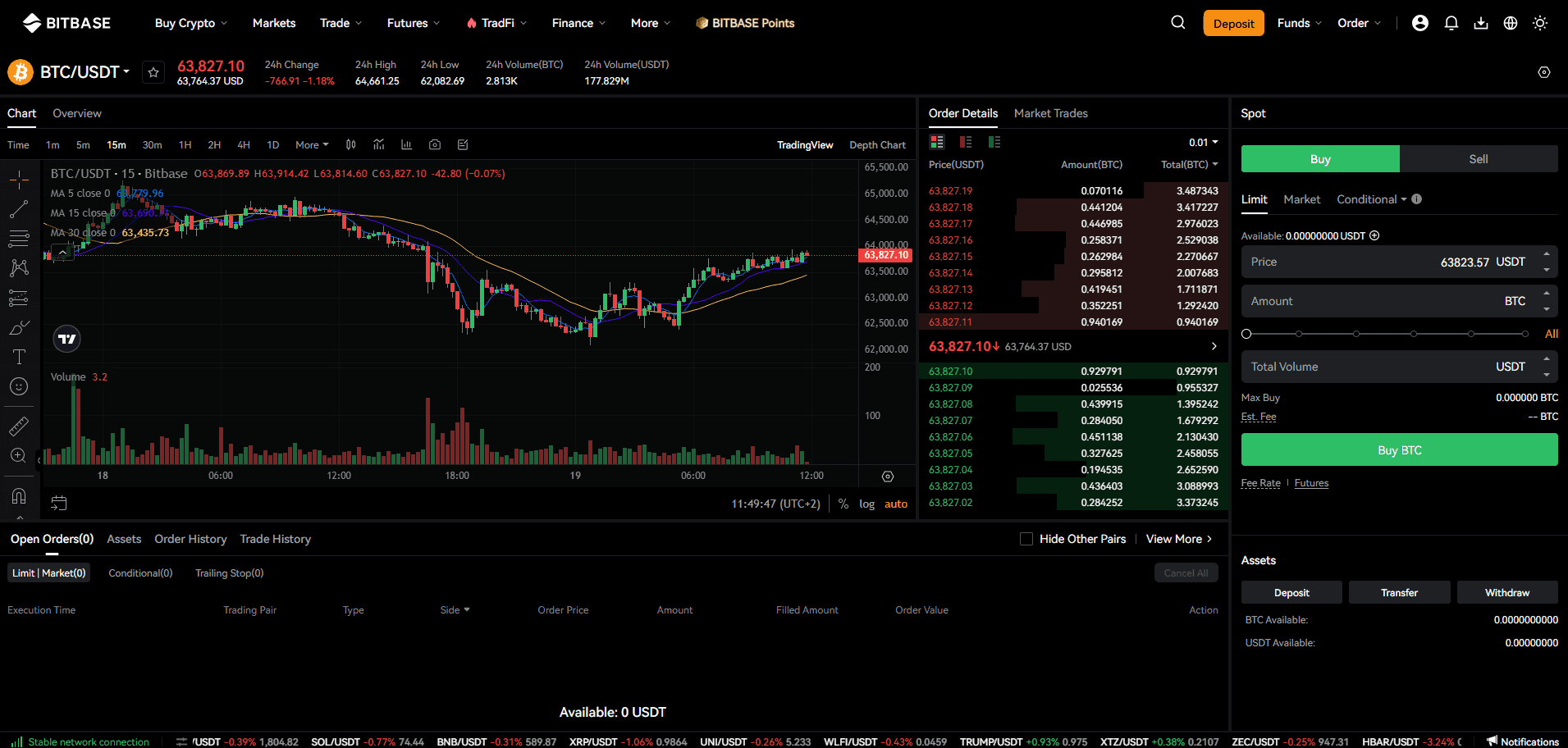
Key features of Bitbase's web platform:
- Charts from TradingView. Integrated charts with various time frames and technical analysis tools. Users can switch between the price chart and the market depth chart (Depth Chart).
- Order book (Order Book). Displays active buy and sell orders with information about prices, volumes, and market liquidity.
- Various order types. Market (Market), limit (Limit), conditional (Conditional), and trailing stop orders (Trailing Stop).
- Futures trading. Opening long and short positions with a choice of leverage, cross margin, and isolated margin.
- Risk management. Setting Stop-Loss and Take-Profit, monitoring margin collateral and the estimated liquidation price.
- Transaction history. Viewing open orders, completed trades, current positions, and financial results.
- Instrument search. Filtering trading pairs by category, including major cryptocurrencies, meme coins, DeFi, AI and TradFi.
On the spot market, the terminal lets users quickly switch between trading pairs, view charts, and place orders. For convenience, there is a list of favorite instruments and an option to set the trade size as a percentage of the available balance.
The futures terminal offers more extensive functionality. In addition to standard trading operations, users can choose the margin mode, adjust leverage, track the Funding Rate and unrealized profit or loss (PnL), and manage open positions.
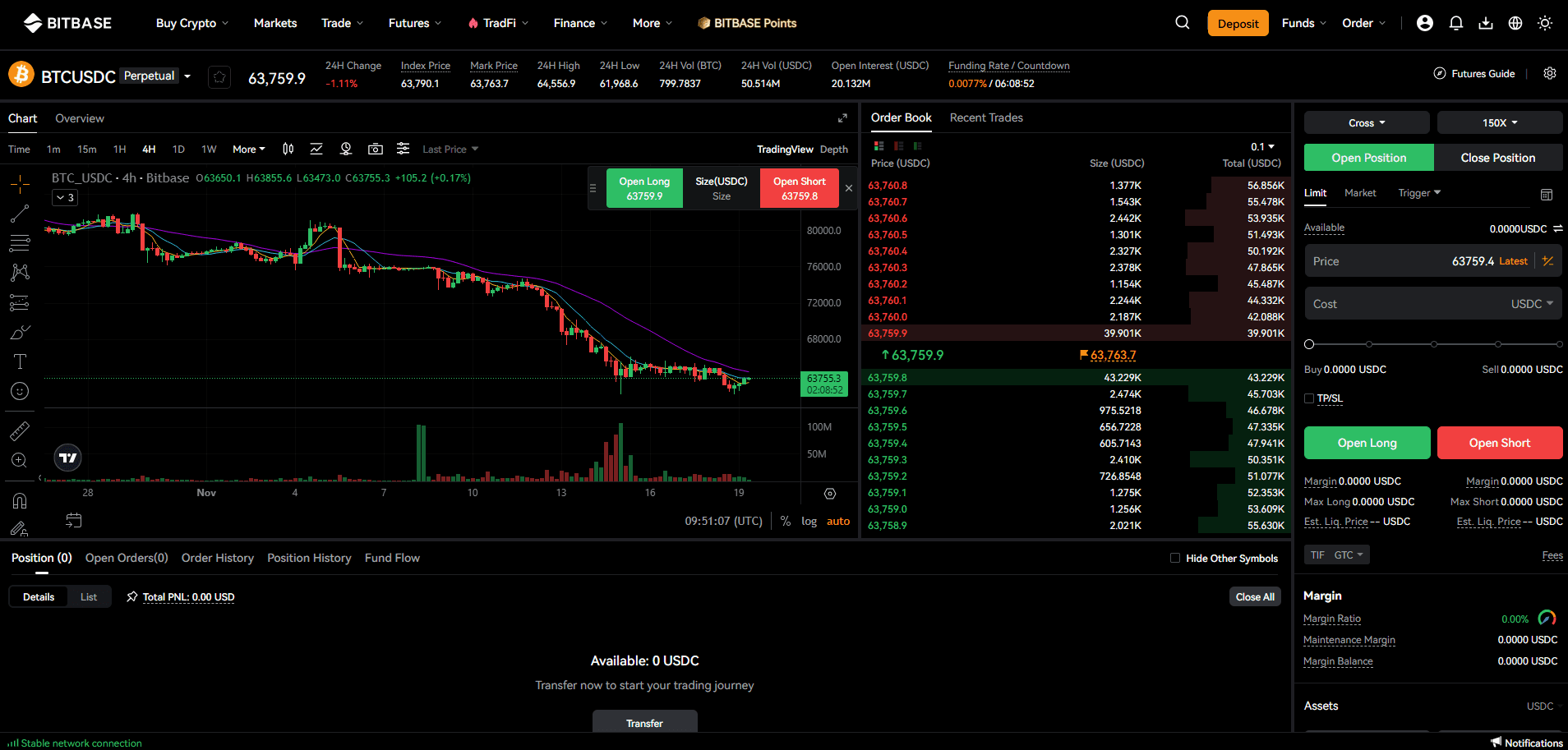
A distinct advantage is the integration of charts from TradingView. Traders have access to familiar tools for analyzing price movements, but having charts from TradingView within Bitbase does not mean that users can trade directly through the standalone platform TradingView.
Mobile apps
Bitbase offers its own mobile apps for devices running Android and iOS. They allow users to track market prices, buy and sell cryptocurrencies, manage futures positions, and monitor their account without using a computer.
The apps can be downloaded through the official stores:
For Android, there is also an option to install an APK file from the official website of Bitbase.
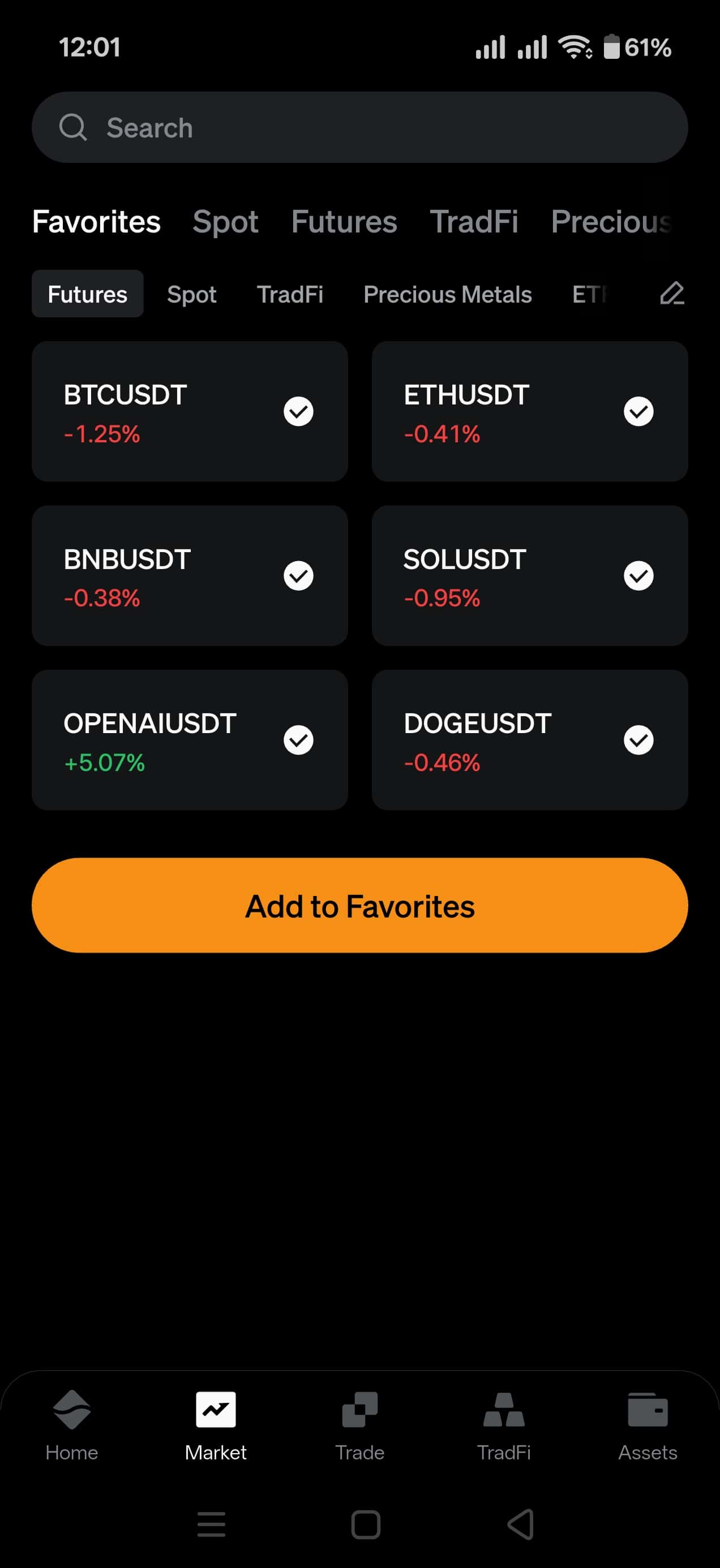
Key features of the mobile apps:
- Viewing cryptocurrency prices and real-time price movements.
- Spot trading using market, limit, and conditional orders.
- Leveraged perpetual futures trading.
- Setting Stop-Loss, Take-Profit and trailing stop orders.
- Viewing the order book and price charts.
- Transferring funds between spot and futures accounts.
- Depositing and withdrawing cryptocurrencies.
- Monitoring open positions, balances, and trading history.
The mobile interface is adapted for smaller screens. The main features are accessible through the bottom navigation bar, while users can switch between spot and futures trading directly in the trading section.
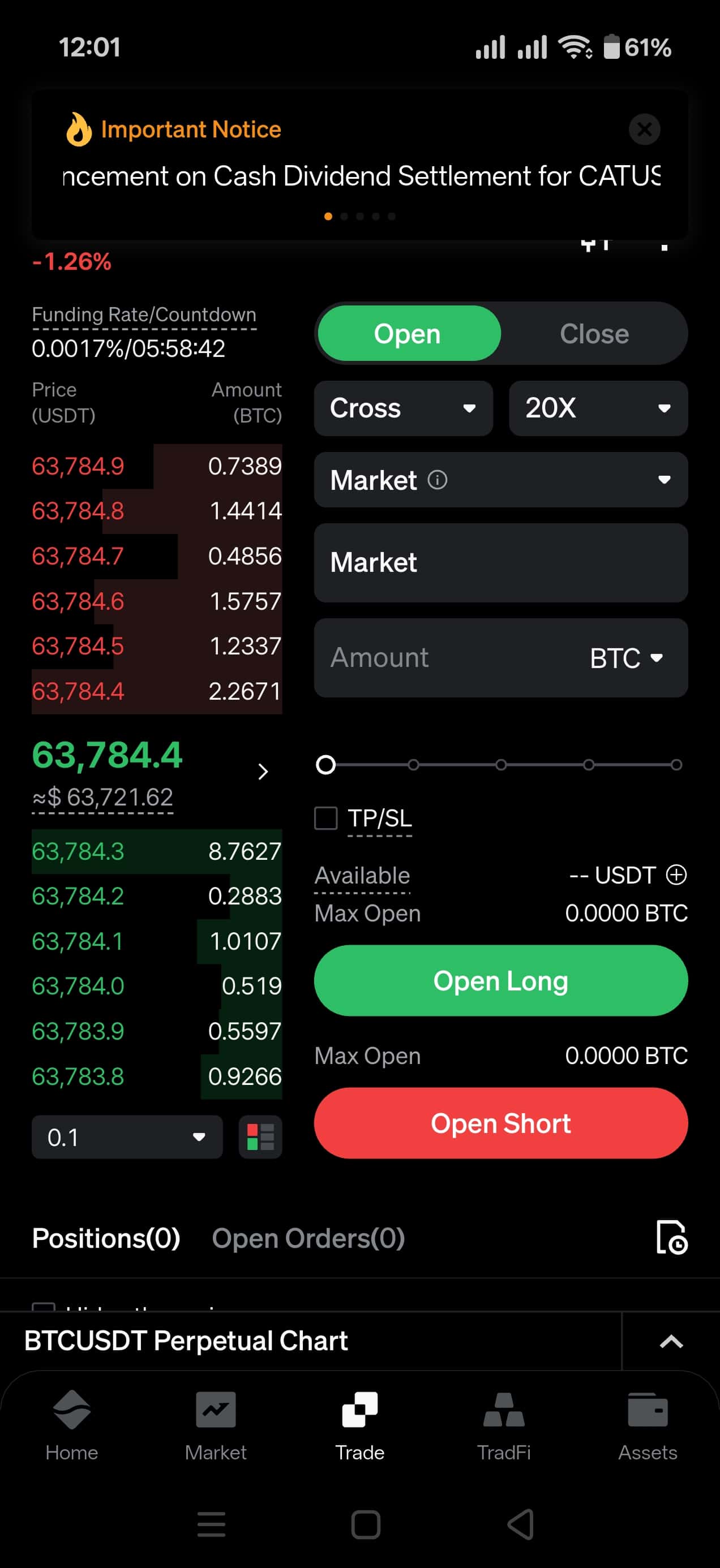
When trading futures, users can choose the margin mode, configure leverage, set protective orders, and monitor current positions. This makes it possible to manage risk and respond to market changes even when away from the workstation.
API and external platforms
Bitbase provides an API for programmatic access to certain trading platform data. This is of interest to developers, analysts, and users who create their own tools for monitoring the market and trading activity.
According to the official Bitbase API documentation, version v1 provides methods for retrieving data in read-only mode (Read-Only).
The documentation lists the following data categories:
API category | Available features |
|---|---|
Contract orders | Retrieving information about futures orders. |
Trade history | Retrieving information about completed transactions. |
Conditional orders | Viewing information about conditional orders. |
Open positions | Retrieving data about futures positions. |
Trading settings | Reading parameters related to the trading account. |
The published API version is primarily intended for retrieving information. There is currently insufficient confirmed public documentation for automatically placing, modifying, and canceling orders through the API. Therefore, the ability to create full-fledged trading bots based on the official API Bitbase remains limited.
When using the programming interface, request rate limits (Rate Limits) must be taken into account. In its risk documentation, Bitbase also warns that during periods of high volatility, access to the API may be temporarily restricted to protect the trading infrastructure.
Thus, the Bitbase API is currently intended primarily for monitoring trading activity and retrieving account information rather than full trading automation.
Analytics
Bitbase provides tools for technical analysis, monitoring market prices, and assessing risks when trading futures. In addition to integrated charts from TradingView and exchange statistics, the platform has its own analytics division, Bitbase Research, which publishes cryptocurrency market research and regular reports. However, specialized tools for in-depth on-chain and derivatives market analysis are primarily provided in research materials rather than as separate interactive services.
Market data and statistics
On Bitbase, there is a dedicated section called Markets, designed for tracking prices and finding trading opportunities. Users can view popular cryptocurrencies, the top price gainers, and instruments from traditional financial markets.
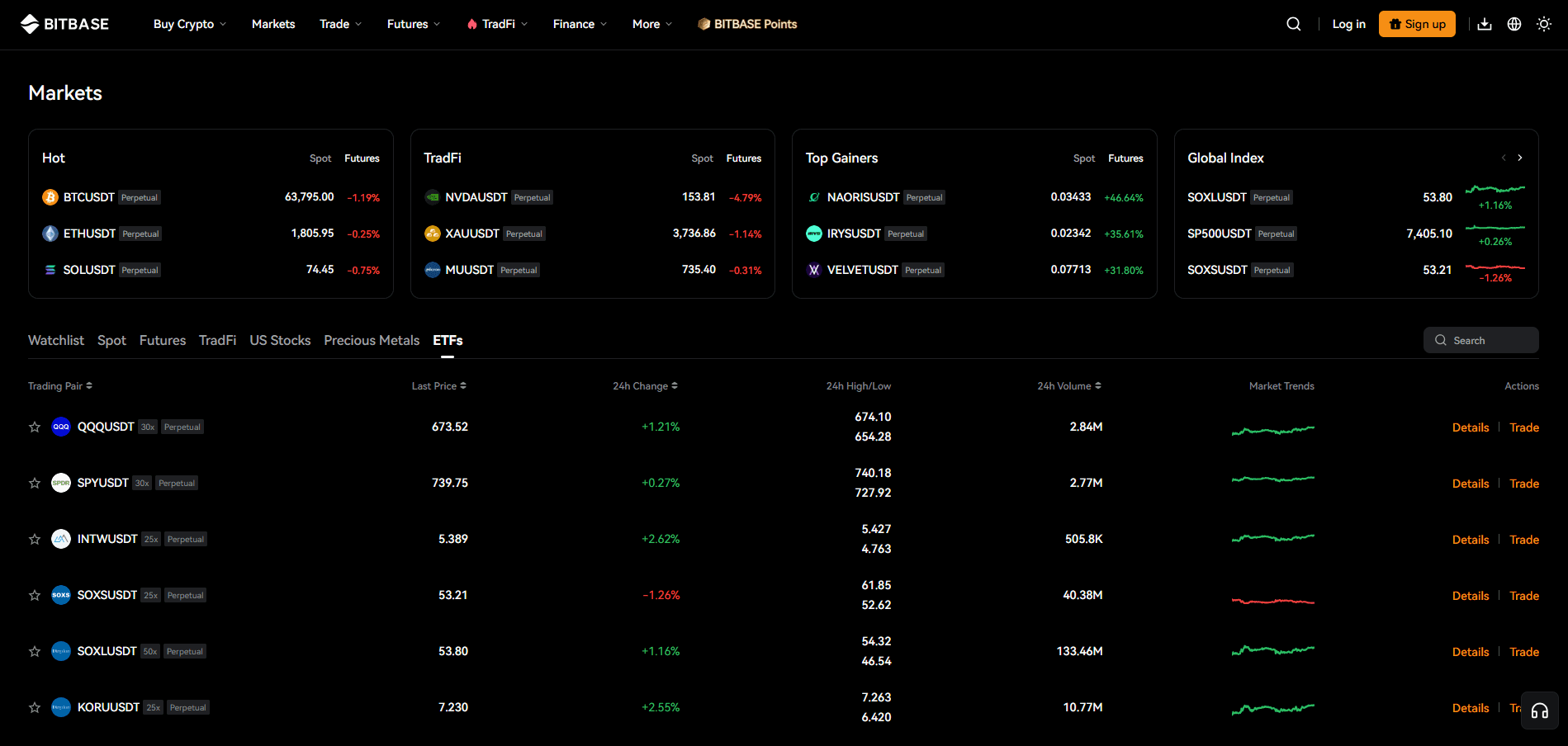
The section provides the following information:
- Current prices. The latest price of the trading instrument, updated as market data becomes available.
- Price change over 24 hours. The percentage change in the asset's value, which helps assess short-term performance.
- Daily highs and lows. The price range in which the instrument traded over the past 24 hours.
- Trading volume. The daily transaction volume, which helps assess market participant activity.
- Market trends. Mini charts showing changes in asset values.
- Instrument rankings. Lists of popular assets and top gainers.
- Favorites list. The ability to save instruments of interest for quick access.
Instruments are grouped into categories, including spot and futures markets, U.S. stocks, stock indices, precious metals, and TradFi.
The home page also features a Market Pulse section that brings together information about market movements and market participant sentiment.
This organization of data simplifies asset searches and helps users quickly assess current conditions. However, its filtering and analysis capabilities are limited compared with specialized cryptocurrency screeners.
Technical analysis tools
For technical analysis, Bitbase uses integrated charts from TradingView. They are available directly in the trading terminal and allow users to study cryptocurrency price movements without using third-party services.
The terminal's main analytical features include:
- Price charts. Analysis of historical and current price movements with a choice of different time intervals.
- Tools from TradingView. Working with charts and technical analysis tools available in the integrated version of the platform.
- Order book (Order Book). Viewing active buy and sell orders to assess market liquidity.
- Market depth chart (Depth Chart). Visualization of the distribution of buy and sell orders at different price levels.
- Trade history. Information about recently executed trades, allowing users to track market participant activity.
- Trading volumes. Data on trading activity for the selected instrument.
The market depth chart is particularly useful for traders. It allows them to visually identify levels with a high concentration of orders and assess the potential impact of large orders on the price.
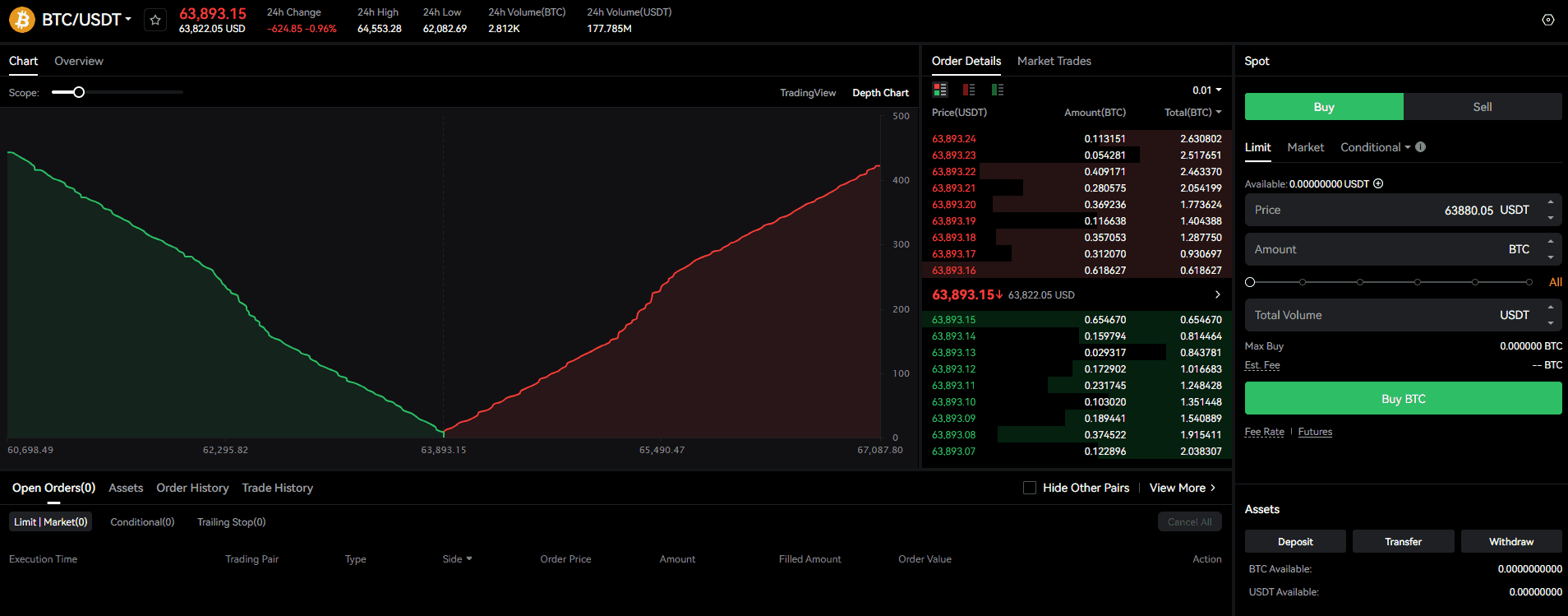
Integration with TradingView is an advantage of Bitbase, as users get a familiar environment for chart analysis. However, the functionality of the integrated version may differ from the standalone platform TradingView.
Futures market analytics
Bitbase provides separate metrics for analyzing perpetual futures and managing the risks of open positions.
The following data is available in the trading terminal:
Metric | Purpose |
|---|---|
Last Price | The latest execution price for a futures contract trade. |
Index Price | An index price calculated from quotes for the underlying asset across several trading venues. |
Mark Price | The calculated price used to assess unrealized PnL and liquidation risk. |
Funding Rate | The funding rate for a perpetual contract and the time until the next settlement. |
Estimated Liquidation Price | The estimated price at which a position will be forcibly closed. |
Margin Ratio | An indicator of margin collateral status and liquidation risk. |
Unrealized PnL | The current unrealized profit or loss on an open position. |
Mark Price and Funding Rate are particularly important. The former helps manage liquidation risk, while the latter helps assess the potential cost of holding perpetual contracts.
News and analytical reports
One advantage of Bitbase is its own News Center, which publishes cryptocurrency market news and material about events affecting the value of digital assets.
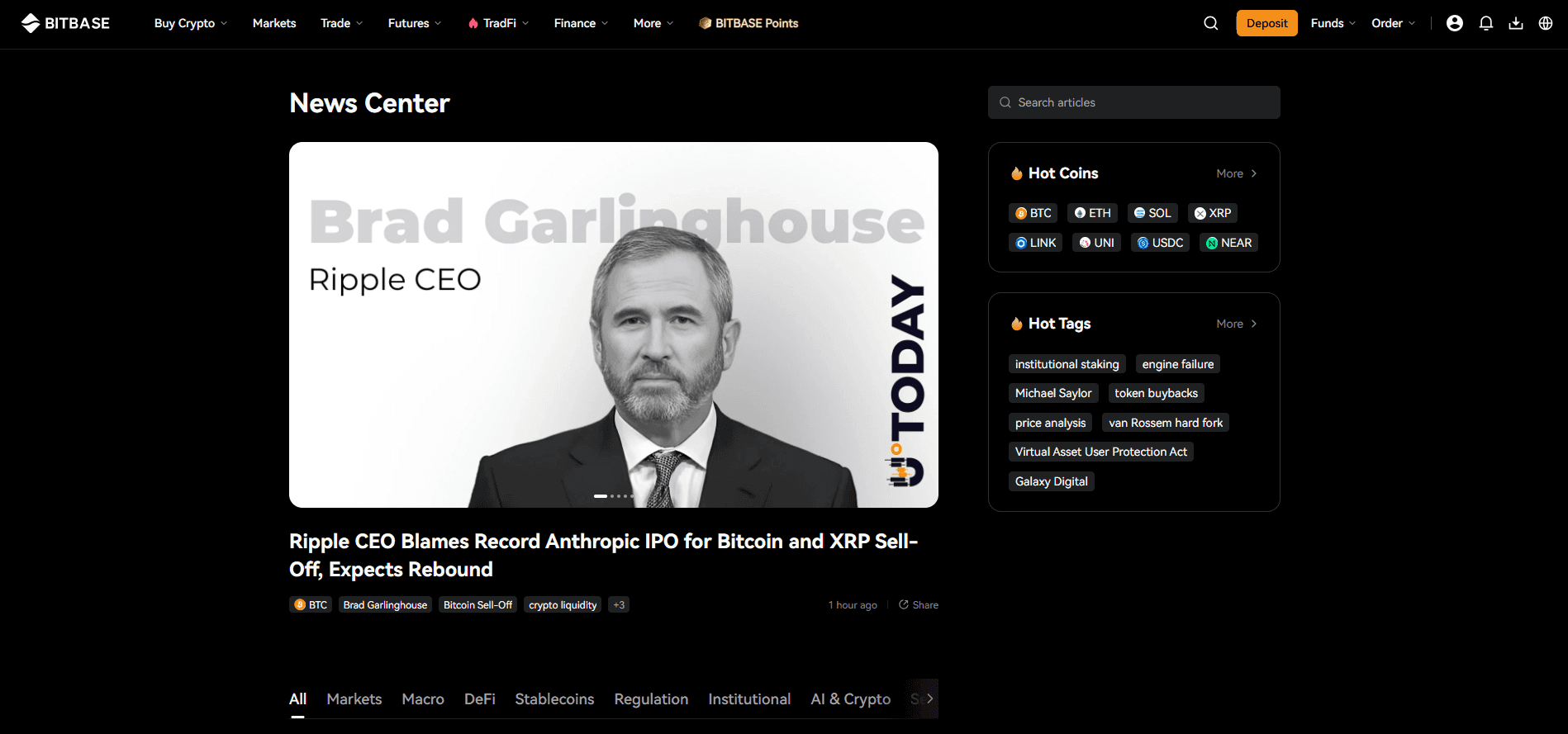
The news section covers several areas:
- Markets — market movements and events affecting cryptocurrency prices.
- Macro — macroeconomic indicators and monetary policy.
- DeFi — decentralized finance news.
- Stablecoins — changes in the stablecoin market.
- Regulation — legislative initiatives and cryptocurrency regulation.
- Institutional — the activities of institutional investors.
- AI & Crypto — the development of artificial intelligence and related blockchain projects.
- Security — cybersecurity, hacks, and other risks in the cryptocurrency industry.
The News Center includes publication search, topic categories, and selections of popular cryptocurrencies. This allows users to follow events that could potentially affect the market.
Bitbase Research
In addition to its news section, Bitbase is developing its own research division Bitbase Research, which publishes research in two main formats.
Market Insights
A series of analytical reviews covering changes in market structure, capital flows, and macroeconomic events.
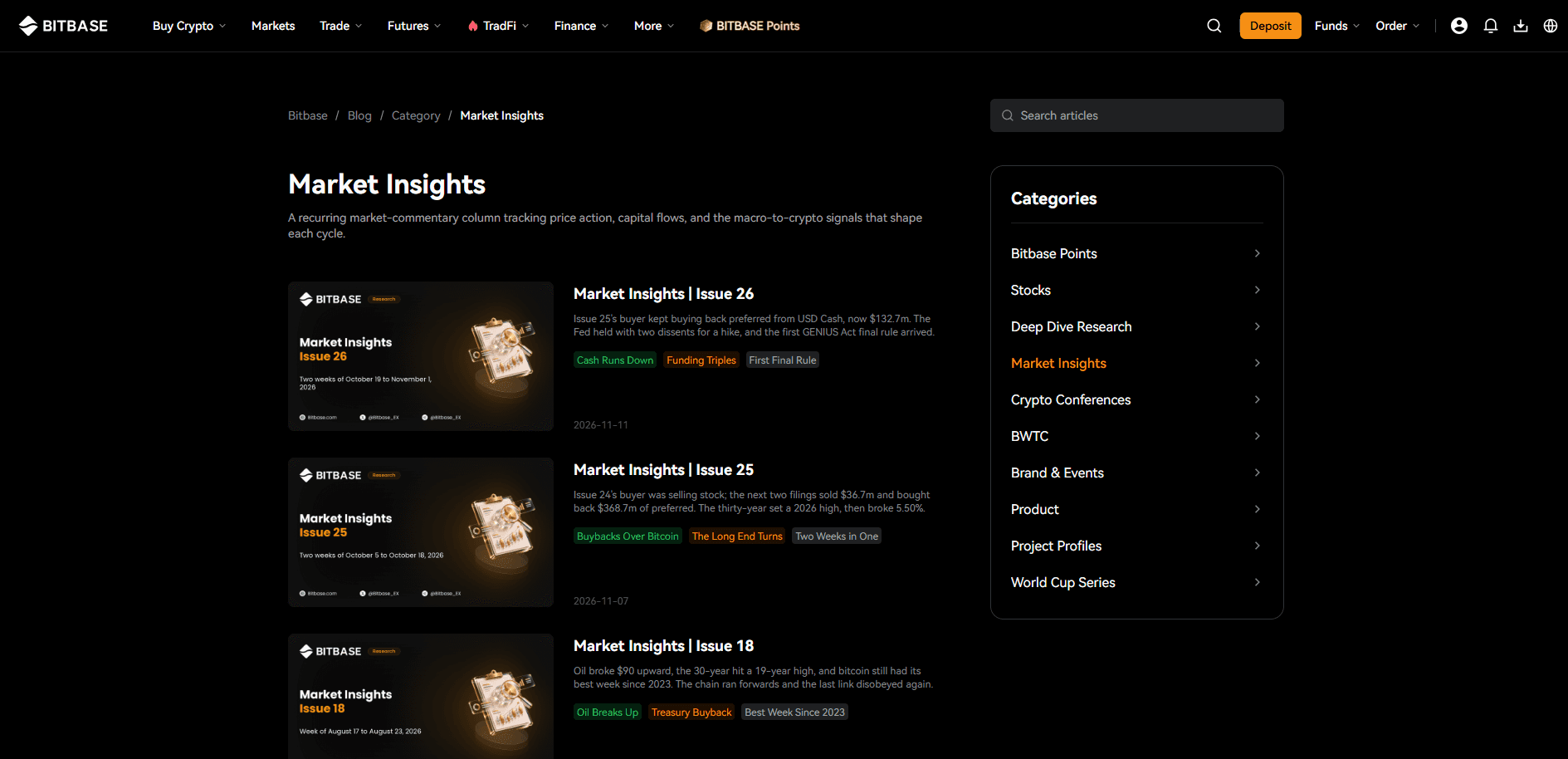
The materials examine the performance of Bitcoin and other cryptocurrencies, fund inflows into and outflows from ETFs, changes in open interest, funding rates, and the state of the derivatives market.
The reports include tables, charts, links to sources, and analysis of the factors affecting market performance.
Deep Dive Research
More detailed research on specific segments of the cryptocurrency industry and methods for assessing market risks.
In the Deep Dive Research section, the following topics are covered:
- Analysis of Funding Rate, Open Interest, and liquidation levels.
- Tracking large cryptocurrency holders and the movement of funds on the blockchain.
- Assessment of tokenomics, token unlocks, and potential selling pressure.
- Research on memecoins, DeFi and AI projects.
- Analysis of cryptocurrency derivatives infrastructure.
- Assessment of counterparty risks and the financial stability of crypto exchanges.
Unlike brief news items, these studies focus on understanding market mechanisms and long-term trends. They may be useful to experienced traders and investors who use fundamental analysis when selecting assets.
At the same time, Bitbase Research reflects the views of the exchange's own research division. Users are advised to compare its conclusions with independent data sources.
Education
Bitbase offers an extensive library of educational materials for both novice and experienced traders. The platform operates its own Bitbase Academy, which publishes articles on cryptocurrency fundamentals, technical analysis, trading strategies, and risk management. Users also have access to step-by-step guides on using the exchange and its products. The main emphasis is on written guides, while interactive courses, webinars, and practical sessions are not currently available.
Bitbase Academy
The exchange's main educational resource is Bitbase Academy. It is a free library of articles and guides designed for self-directed study of the cryptocurrency market.
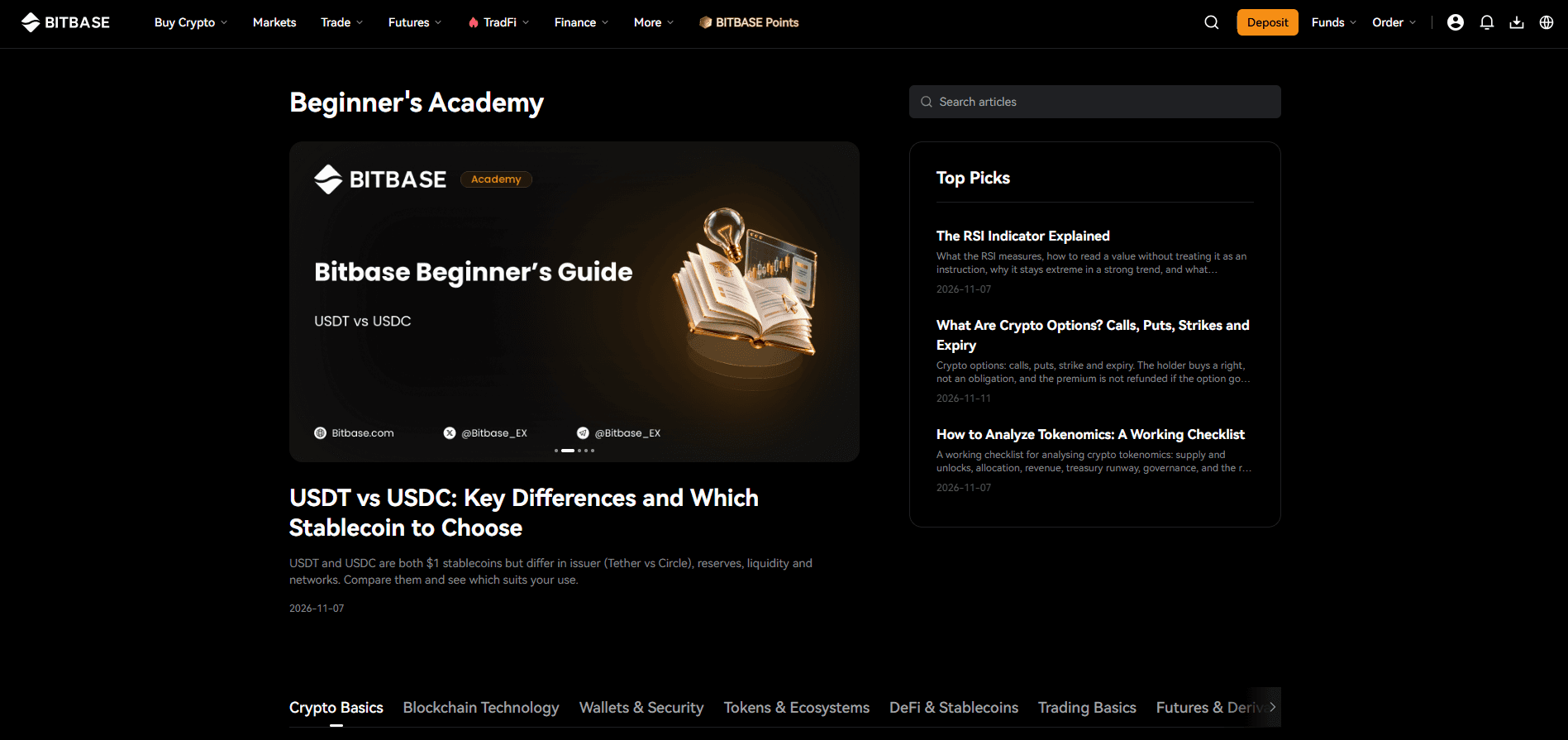
The materials are divided into 12 thematic categories covering both basic concepts and complex aspects of trading.
Category | Content |
|---|---|
Cryptocurrency fundamentals | How Bitcoin and other cryptocurrencies work, blockchain, stablecoins, and digital assets. |
Blockchain technology | Consensus, mining, staking, transactions, and the structure of blockchain networks. |
Wallets and security | Types of cryptocurrency wallets, private keys, seed phrases, and asset protection. |
Tokens and ecosystems | Altcoins, NFT, tokenomics, and the characteristics of blockchain projects. |
DeFi and stablecoins | Decentralized finance, liquidity, staking, and associated risks. |
Trading fundamentals | Order types, trading fees, liquidity, spreads, and the mechanics of exchange trades. |
Futures and derivatives | Perpetual contracts, leverage, margin, liquidations, and Funding Rate. |
Technical analysis | Candlestick charts, trends, support and resistance levels, RSI, MACD, and moving averages. |
Strategies and risk management | Trading strategies, position sizing, Stop-Loss, risk-reward ratios, and trading psychology. |
Market and on-chain data analysis | Analysis of blockchain transactions, on-chain metrics for Bitcoin, and capital flows. |
Exchanges and regulation | How crypto exchanges work, KYC, Proof of Reserves, and regulatory requirements. |
TradFi and tokenization | Tokenized stocks, ETF, traditional financial markets, and associated risks. |
The articles are available without registration and grouped by topic. Users can also search the materials, making it easier to study topics of interest independently.
Guides to using Bitbase
In addition to the educational academy, the exchange provides a Support Center with detailed instructions on using its trading and investment services.
Unlike Bitbase Academy, which explains general principles of the cryptocurrency market, this section focuses primarily on specific actions within the platform.
The main topics of the practical guides are:
- Registration and security. Creating an account, setting up two-factor authentication, and completing KYC.
- Deposits and withdrawals. Selecting a cryptocurrency and blockchain network, obtaining a deposit address, and making a withdrawal.
- Spot trading. Buying and selling cryptocurrencies, using market and limit orders, and viewing trade history.
- Futures trading. Activating a futures account, selecting margin and leverage, and opening and closing positions.
- TradFi. Features of trading instruments from traditional financial markets.
- Bitbase Earn. Allocating cryptocurrencies, accruing returns, and withdrawing funds.
- Bonus programs. Using trading coupons, futures bonuses, and other rewards.
Many guides include interface illustrations and step-by-step descriptions of actions for the web version and mobile app.
Learning trading strategies and risk management
Bitbase pays particular attention to the practical aspects of trading. The academy includes materials on trading strategies, technical indicators, and methods for limiting losses.
In the strategies and risk management section, the following topics are covered:
- Determining position size based on acceptable risk.
- Setting Stop-Loss and Take-Profit.
- Calculating profit, loss, and trading costs.
- Scalping and swing trading.
- Developing a trading plan.
- Managing emotions and maintaining trading discipline.
- Using indicators to identify entry and exit points.
More experienced traders can access articles on on-chain analysis, tokenomics, and cryptocurrency project assessment. These articles help users better understand the factors affecting the market value of assets.
Customer Support
Bitbase offers 24-hour technical support via live chat and email. Users also have access to a multilingual help center with instructions on trading, verification, deposits, and withdrawals. Having several contact channels and support available 24/7 is an advantage of the exchange.
Support contact channels
Bitbase provides several ways to get help. The main channels are live chat, email, and the help center's request system.
Contact channel | Contact | Hours of operation |
|---|---|---|
Live chat | Available on the exchange's website | 24/7 |
Requests accepted around the clock | ||
Request form | Around the clock | |
Help center | 24/7, self-service |
The exchange also maintains official communities on Telegram and X, where it publishes news, information about updates, and security warnings. However, these channels should not be considered a full replacement for customer support.
Support hours
Bitbase states that it provides 24-hour customer support seven days a week. This is particularly important for a crypto exchange because digital assets are traded continuously, and issues with open positions or withdrawals may arise at any time.
Support competence
Bitbase provides a sufficiently detailed knowledge base covering the exchange's main functions. The instructions explain the required sequence of actions and the features of trading products, allowing users to resolve many common issues independently.
For registration, security setup, account funding, and placing trading orders, the published guides are usually sufficient to complete the required operations.
For more complex situations, Bitbase provides procedures for additional review of requests.
In particular, according to the exchange's privacy policy, users may appeal automated decisions involving verification denials or account restrictions. Such appeals are forwarded to regulatory compliance specialists (Compliance) for manual review.
This is a positive factor because the resolution of disputed issues is not limited solely to an automated risk control system.
Nevertheless, assessing the actual competence of support agents is quite difficult. Public sources currently contain few substantive user reviews that would make it possible to judge the quality of advice, the ability of staff to resolve unusual issues independently, and the effectiveness of coordination between departments.
User tip: when contacting Bitbase, it is advisable to provide your account UID, a description of the issue, the time of the transaction, the transaction identifier (TxID), and the necessary screenshots right away. This may reduce the number of follow-up requests and simplify the review process.
Users must not share their password, two-factor authentication codes, or wallet private keys with support staff. Bitbase explicitly warns that official representatives do not request such information.
Conclusion
Bitbase — a promising crypto exchange with a wide range of trading instruments, competitive fees, and user-friendly trading platforms. The ability to trade cryptocurrencies and traditional financial assets through a single account makes it an interesting alternative to larger platforms.
Bitbase is best suited to active cryptocurrency traders, who trade independently on spot and futures markets, use technical analysis, and want access to different asset classes. The exchange may also appeal to beginners thanks to its simple interface and educational materials.
FAQ
What is Bitbase?
Bitbase is a centralized crypto exchange founded in 2023 and headquartered in Panama. The platform offers spot and futures trading, traditional financial market instruments through TradFi, as well as Earn investment products. The exchange caters to both novice and experienced traders.
Is Bitbase safe?
Bitbase uses cold storage for cryptocurrencies, two-factor authentication, and a multi-layered asset protection system. The exchange publishes Proof of Reserves reports with coverage of more than 100% for major cryptocurrencies and claims registrations with FinCEN and AUSTRAC. However, these registrations are not equivalent to full financial licences, while the lack of an independent financial audit and limited transparency of the legal structure create additional risks.
How does Bitbase work?
Bitbase provides a trading venue where users buy and sell cryptocurrencies through an exchange order system. On the spot market, trades involve the direct purchase of assets, while futures allow users to open leveraged positions based on whether prices will rise or fall. Additional instruments include TradFi and Earn products for generating returns on allocated cryptocurrencies.
How to use Bitbase?
To get started, users must register on the official Bitbase website or in the mobile app, secure their account, and fund their balance with cryptocurrency. They can then go to the trading terminal, select the desired pair, and place a buy or sell order. Access to certain features, including purchasing cryptocurrency with fiat currency, requires identity verification.
How to open an account on Bitbase?
Go to the official website of Bitbase, click Sign Up, and register using your email address or phone number. Create a password and confirm your registration with the code you receive. After signing in, it is recommended that you enable two-factor authentication (2FA). Completing KYC is required to access certain services and increase withdrawal limits.
How to make a deposit on Bitbase?
Sign in to your account, open the Deposit section, select a cryptocurrency and the appropriate blockchain network. Copy the wallet address and send funds to it from another exchange or an external wallet. Once the required network confirmations are complete, the cryptocurrency will be credited to your balance. Bitbase does not charge a fee for cryptocurrency deposits. You can also buy cryptocurrency with a bank card through the Quick Buy service.
How to trade on Bitbase?
Open the Spot or Futures section, select a trading pair, for example BTC/USDT, and choose the direction of the trade. Specify the order type and amount, then confirm the transaction. On the spot market, you can buy and sell cryptocurrencies, while on the futures market, you can open leveraged long and short positions. To limit risk, it is recommended to use Stop-Loss and Take-Profit.
How to sell cryptocurrency on Bitbase?
Go to the spot trading section, select a pair containing the desired cryptocurrency, for example ETH/USDT, and click Sell. Enter the number of coins and select a market order to sell at the current price or a limit order to sell at a specified price. Once the trade is executed, the proceeds will be credited to your spot balance.
How to withdraw money from Bitbase?
To withdraw cryptocurrency, open Funds → Spot (Deposit & Withdrawal), select the asset, click Withdraw, and enter the recipient's wallet address, the network, and the amount. Check the fee and confirm the transaction using your configured security methods. Direct withdrawals of fiat currencies to bank cards and accounts have not been publicly confirmed, so receiving conventional money may require transferring the cryptocurrency to another platform that supports fiat payouts.
How to delete an account on Bitbase?
To close an account on Bitbase, you must cancel all active orders, close trading positions, withdraw any remaining funds, and complete the required identity checks. You should then submit a written closure request through the account settings. Bitbase processes such requests within 7 business days after all requirements have been met. If you encounter any difficulties, you can contact support at support@bitbase.com.