Bitfinex Review 2026
Bitfinex is suitable for experienced crypto traders who need spot, margin, derivatives, OTC, API and advanced trading tools.
- Bitfinex is trusted. Tested via live trading.
- Bitfinex №11 in the crypto exchanges list
Highlights of Bitfinex

Bitfinex is one of the oldest cryptocurrency exchanges, founded in 2012 and aimed primarily at active traders and professional market participants. The platform offers a wide selection of cryptocurrencies, spot and margin trading, derivatives, advanced order types, and liquidity management tools.
The exchange is known for high liquidity in major cryptocurrency pairs, flexible trading capabilities, and a well-developed infrastructure for experienced users. At the same time, Bitfinex is better suited to traders who already understand the specifics of the crypto market, as its interface and toolset may be more complex for beginners compared to more mainstream platforms.
Pros and Cons of Bitfinex
Pros
- Low trading fees, including 0% maker/taker on a range of major markets.
- Advanced trading infrastructure for experienced traders.
- Demo trading for testing strategies without risk.
- High liquidity on key cryptocurrency pairs.
- Support for spot, margin, derivatives up to 100x, OTC, API, lending and staking.
Cons
- Offshore jurisdiction and lack of Tier-1 regulation.
- There have been regulatory claims and security incidents in the past.
- Fewer educational materials than major crypto ecosystems.
- Complex interface for beginners.
Bitfinex reviews

Bitfinex
What traders talk about
No reviews yet.
Leave a review of your experience:
Bitfinex Exchange Overview
- Foundation Year
- 2012
- Official Website
- https://www.bitfinex.com
- Regulated in Countries
Kazakhstan, El Salvador
More Details- Trading Assets
- Cryptocurrency
- Futures
- Fees (Maker/Taker)
- Spot
- 0% / 0%
- Futures
- 0% / 0%
- Max Leverage
- Spot
- 10x
- Futures
- 100x
- Email Support





Bitfinex is one of the oldest cryptocurrency exchanges, founded in 2012 and focused mainly on active traders, professional market participants, and institutional clients. The platform is operated by iFinex Inc. and offers spot trading, margin trading, derivatives, OTC trades, advanced order types, and a wide range of cryptocurrency markets.
The exchange is known for high liquidity across key trading pairs, an advanced trading interface, and tools for experienced users. At the same time, Bitfinex has a mixed reputational history due to past hacks and its connection with Tether, so when choosing the platform, traders should consider not only functionality and fees but also security, transparency, and regulation.
Bitfinex Review Summary
Reliability and Regulation
Bitfinex is a reliable crypto exchange for experienced traders, but its offshore jurisdiction, complex product structure and past incidents prevent its regulation from being rated as strong.
Advantages
- Operating since 2012
- High liquidity and developed infrastructure
- Advanced security tools
Disadvantages
- No FCA, ASIC or CySEC-level regulation
- There have been regulatory claims and hacks
Bitfinex ratings in our review are based on a comprehensive analysis of the cryptocurrency exchange's key parameters: reliability, trading conditions, fees, available instruments, platform usability, deposit and withdrawal methods, and the quality of customer support. You can read more about how we assign ratings and which criteria we consider in our broker evaluation methodology.
Further in the review, we will examine Bitfinex in more detail: trading conditions, fees, available markets, platforms, security, and the exchange's pros and cons.
Reliability and Regulation
Bitfinex can be considered a fairly reliable cryptocurrency exchange thanks to its long operating history since 2012, high liquidity, advanced trading infrastructure, institutional services, and a broad set of security tools. The platform remains one of the notable players in the crypto market and offers a more professional level of service than many less mature exchanges. However, the assessment is limited by its offshore jurisdiction, the absence of FCA-, ASIC-, or CySEC-level regulation for its core exchange operations, the complex structure of products and partner integrations, including Thalex, as well as past regulatory claims and security incidents. Therefore, Bitfinex appears reliable for experienced traders, but in terms of regulation and client protection, it lags behind more strictly regulated platforms.
Licensing and Jurisdiction
| Legal Entity | Regulator |
|---|---|
| — | |



The operator of the Bitfinex platform is iFinex Inc., a company registered in the British Virgin Islands. Bitfinex's terms of service are also governed by the laws of the British Virgin Islands. This means users interact not with a traditional broker licensed in a major financial jurisdiction, but with an international cryptocurrency platform.
The Bitfinex group has separate regulated areas, including Bitfinex Securities and Bitfinex Derivatives, as well as licensed operations in El Salvador and Kazakhstan. The Bitfinex integration with Thalex is also worth noting separately. Through Thalex, Bitfinex users may gain access to certain derivative instruments, including futures and options.
However, these licenses should not automatically be extended to all Bitfinex products and services. Before opening an account, a trader should understand exactly which legal entity services their account and which rules apply to the specific product.
Regulatory Risks
Bitfinex's regulatory history is mixed. The exchange and related companies, including Tether, have previously faced claims from regulators, including in the United States. These episodes concerned disclosure issues, handling of client funds, activities in certain markets, and compliance with regulatory requirements.
For traders, this means Bitfinex should not be viewed as a completely risk-free platform solely because of its long history and high liquidity. The exchange remains a large and technologically advanced crypto market player, but its regulatory profile is weaker than that of brokers operating under the supervision of leading financial regulators. Therefore, Bitfinex is better suited to users who understand the specifics of cryptocurrency infrastructure and are ready to independently assess legal and counterparty risks.
Security of Funds
Bitfinex pays significant attention to account protection and offers users a set of security tools: two-factor authentication, U2F hardware key support, withdrawal address whitelists, API key settings, activity monitoring, and additional transaction confirmation measures. The exchange also states that it uses cold storage for a significant portion of client assets.
Nevertheless, Bitfinex has had serious security incidents in its history, including a major hack in 2016. After that, the exchange strengthened its protection mechanisms, but the very fact of past attacks remains an important factor in assessing reliability. Users should be sure to enable 2FA, restrict API key permissions, use withdrawal address whitelists, and avoid keeping more funds on the exchange than necessary for active trading.
Account Opening
Opening an account on Bitfinex is done online and is generally straightforward. The user needs to register an account, confirm their email, and, if necessary, complete identity verification. Available functions depend on the verification level: a basic account is suitable for limited platform use, while a higher verification level may be required for expanded capabilities, including margin trading, derivatives, and certain deposit methods.
Registration
Registration on Bitfinex begins by filling out a standard form on the exchange's website. The user needs to provide an email, username, password, and country of residence. It is also possible to sign in or create an account via Google. During registration, Bitfinex automatically detects the country of residence, but the user can change it manually if the data is detected incorrectly.
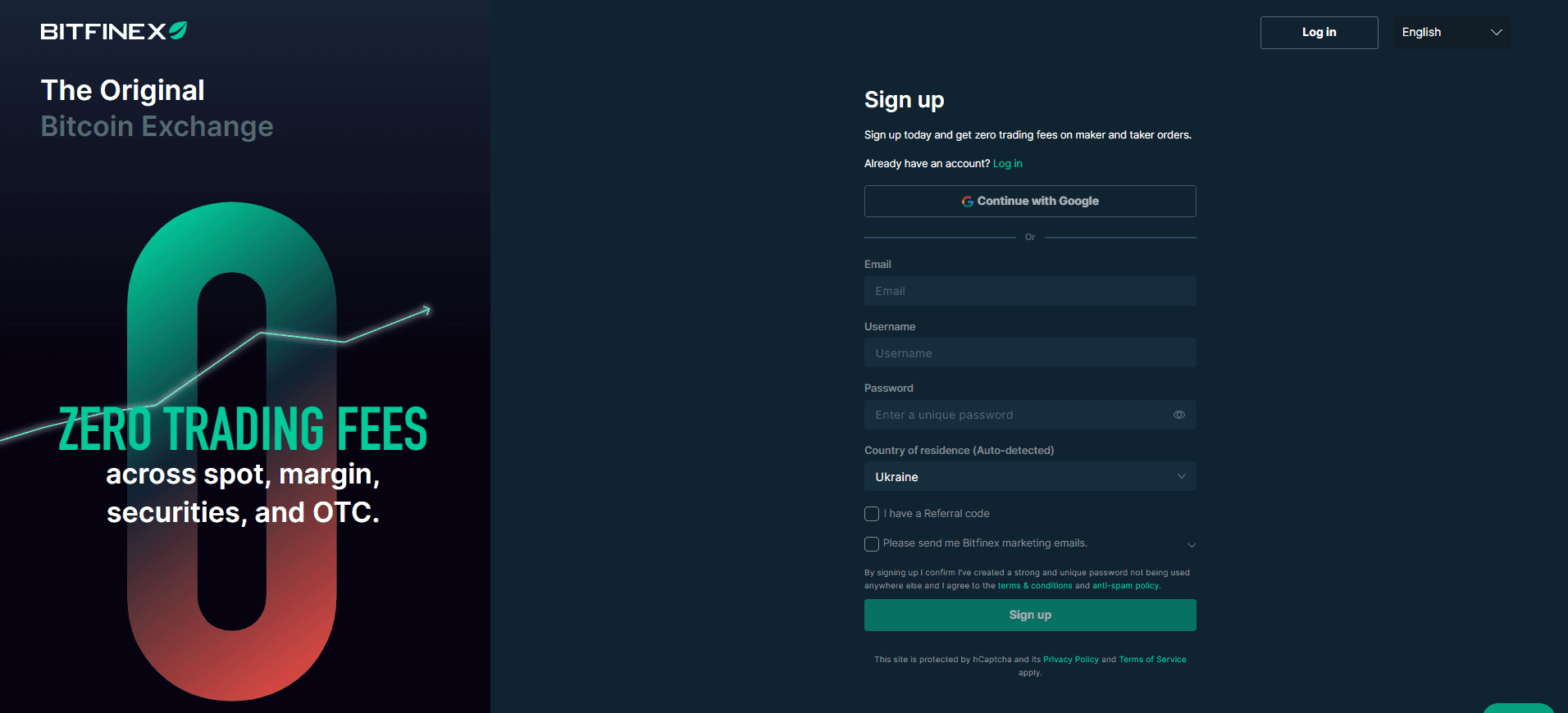
After filling out the form, the user must accept the terms of service and confirm account creation. Bitfinex also offers the option to enter a referral code and subscribe to marketing emails, but these items are not mandatory. After confirming the email, the user receives basic access to the account and can proceed to security setup and verification.
Verification
Verification on Bitfinex is divided into several levels. The higher the verification level, the more functions and limits the user receives. For individual clients, Basic Access, Basic Plus, Intermediate, and Full are available.
Verification Level | What is required | Review time | What it unlocks |
|---|---|---|---|
Basic Access | Account creation and email confirmation | Immediately after registration | Basic account access and limited platform functions |
Basic Plus | Identity document, biometric photo, phone number, and residential address | Usually almost instantly | Expanded access to account functions |
Intermediate | Basic Plus data, an additional document, proof of address, financial questionnaire, and KYC declaration | Usually 2–3 business days | Access to a broader set of trading and financial capabilities |
Full | Intermediate data and additional documents, including a bank statement if necessary | Usually 2–3 business days or longer | Maximum access level to Bitfinex services |
Review times may increase if the application is incomplete, documents require additional checks, or the compliance team's workload is higher than usual. For corporate clients, Bitfinex offers separate access levels: Basic Access, Intermediate, and Full. In this case, the exchange additionally assesses the legal entity, ownership structure, and source of funds.
Account Types
Bitfinex provides a single account within which users have access to different trading modes and services: spot trading, margin trading, derivatives, OTC trades, lending, staking, API access, and separate Bitfinex Securities products. The set of available features depends on the user's verification level, jurisdiction, and the specific product. For example, basic spot trading is more widely available, while derivatives, margin products, tokenized stocks, and certain financial services may require a higher KYC level and be unavailable in some countries.
Spot Trading
Spot trading is the main operating mode on Bitfinex. The user buys and sells cryptocurrencies directly through the exchange order book using funds in the exchange wallet. Trading pairs with Bitcoin, Ethereum, Tether, UNUS SED LEO, and other digital assets are available on the platform.
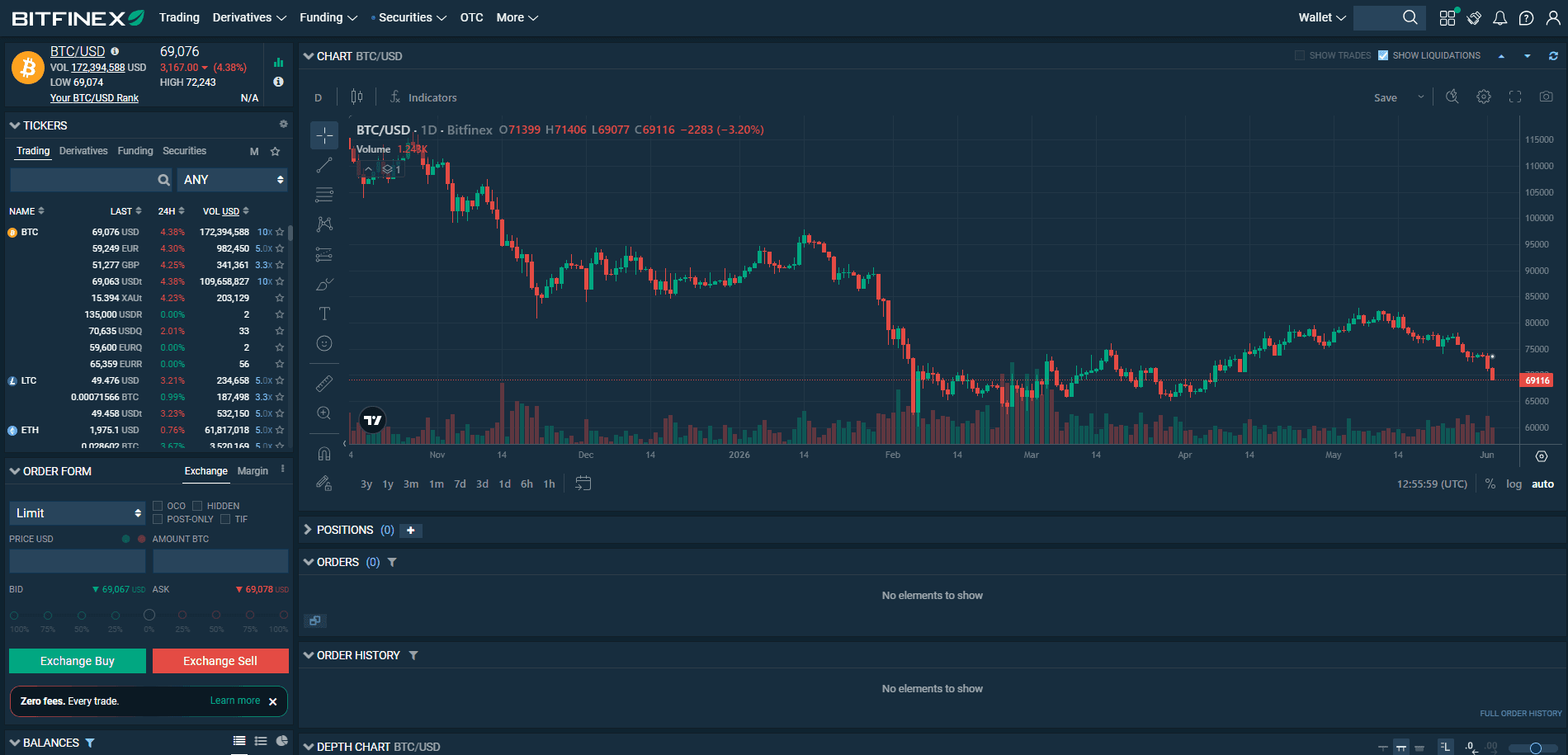
Bitfinex is geared toward active traders, so the spot terminal supports different order types: market, limit, stop orders, stop-limit, trailing stop, OCO, hidden orders, and other tools for more precise trade management. This functionality makes spot trading on Bitfinex convenient not only for ordinary cryptocurrency purchases but also for more complex trading strategies.
Margin Trading
Margin trading on Bitfinex allows users to open positions using borrowed funds. Financing for such trades is provided through the Bitfinex Funding P2P platform, where some users provide funds at interest and others use them for leveraged trading.
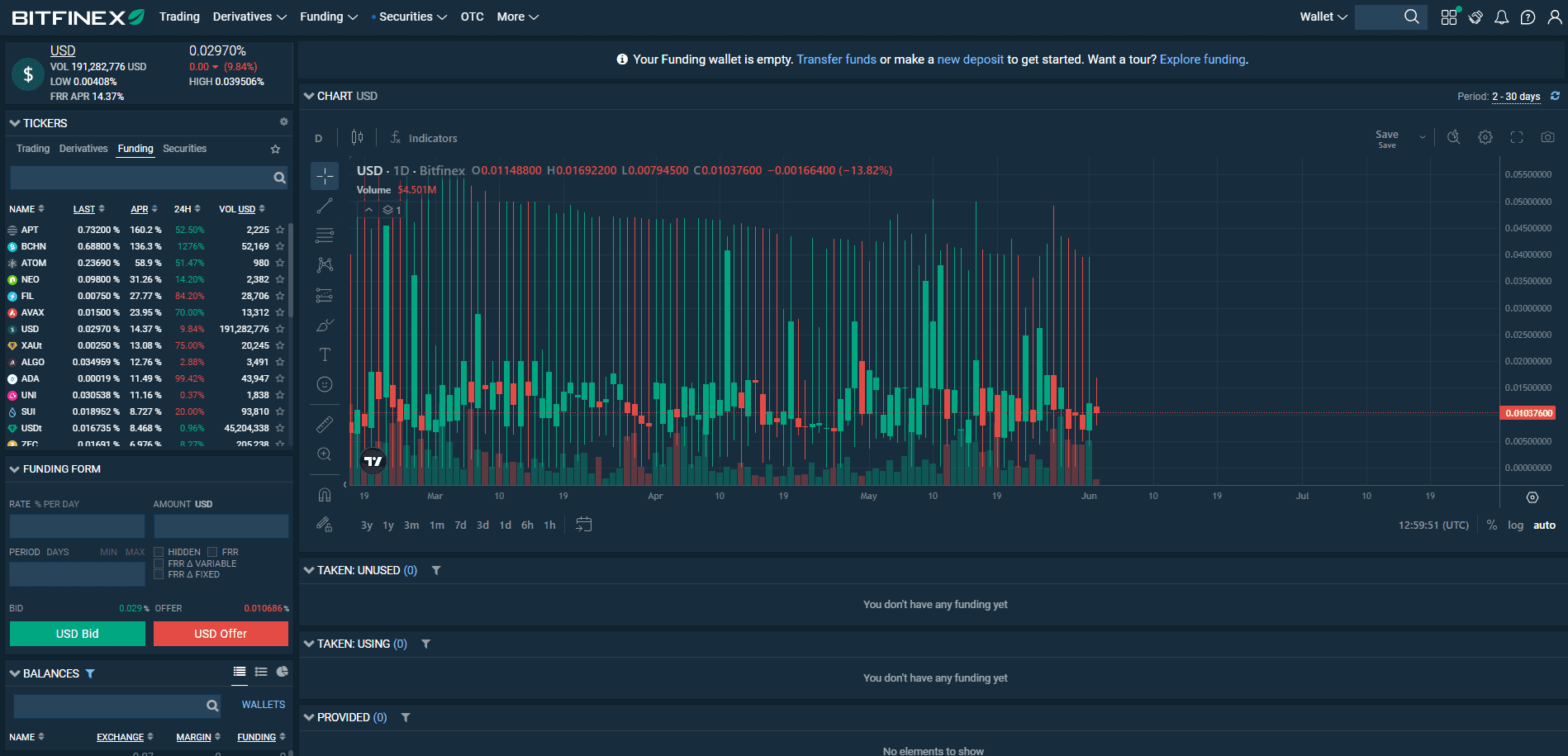
This mode is suitable only for experienced traders, as leverage increases not only potential profit but also the risk of losses. Margin trading may be subject to additional requirements for verification level, collateral size, and maintenance margin. If the market moves against the position, the user may face a margin call or liquidation.
OTC Trading
Bitfinex offers an OTC service for large trades that are executed directly with a counterparty without passing through the public exchange order book. This format makes it possible to conduct high-volume trades with less impact on the market price and visible liquidity in the order book.
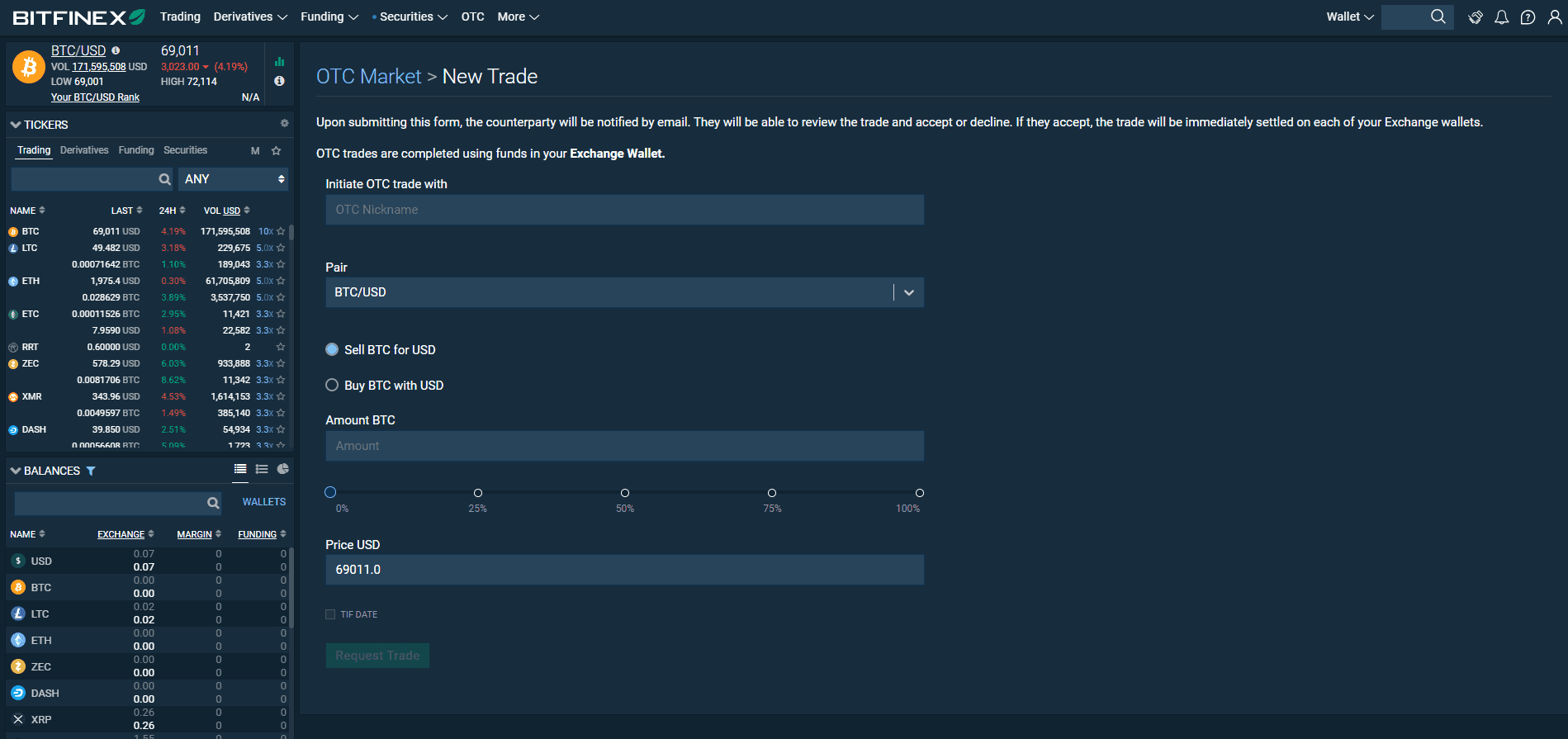
The OTC service is primarily aimed at large traders, professional market participants, and institutional clients. It can be useful if a user needs to buy or sell a significant amount of cryptocurrency without sharp slippage and without publicly placing a large order in the market.
Bitfinex Derivatives
Bitfinex Derivatives is a separate area for trading derivative instruments. Through it, users can trade perpetual futures on cryptocurrencies and other underlying assets with leverage of up to 100x. The value of such contracts depends on the price of the underlying asset, while profit or loss is formed through changes in the market price and the amount of leverage used.
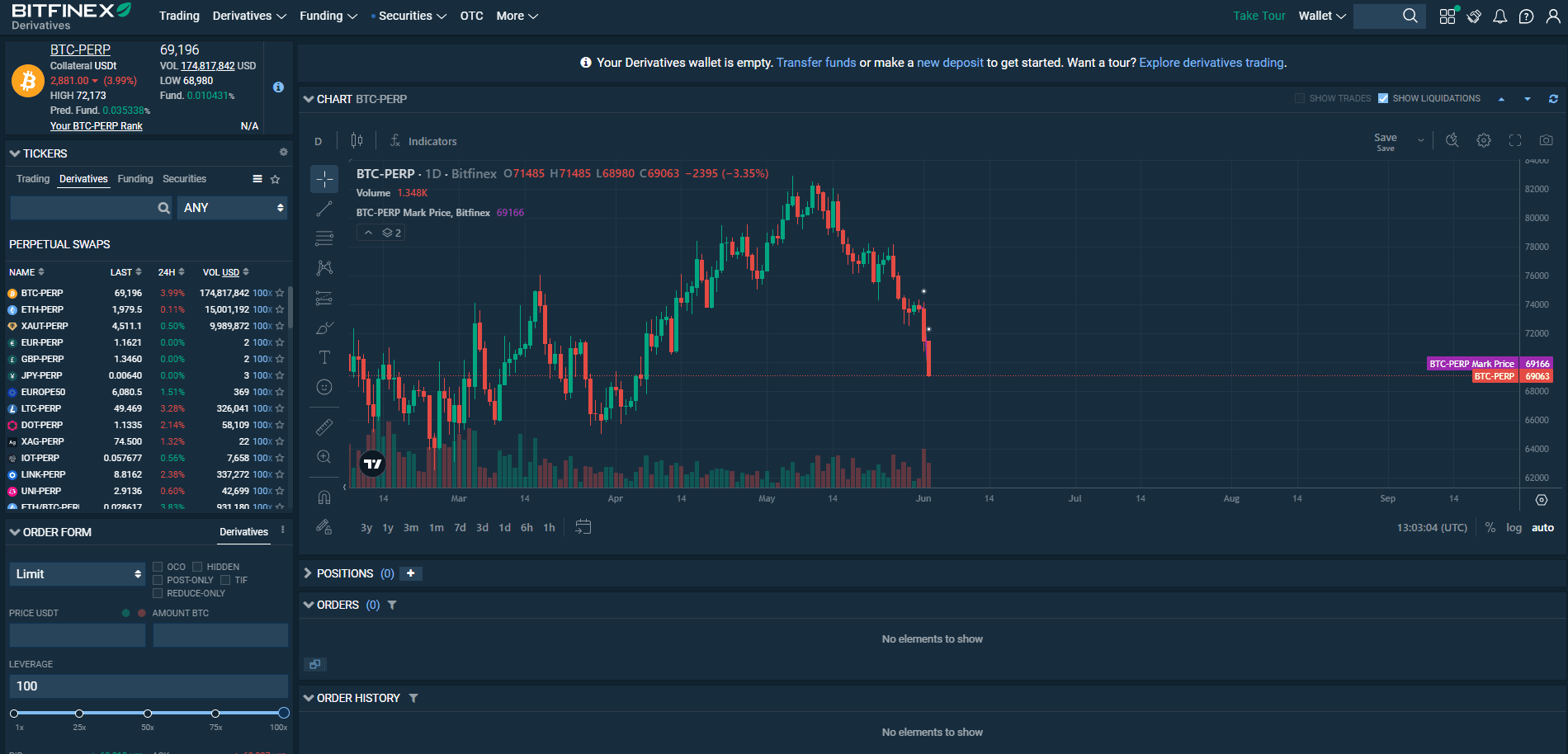
Access to derivatives usually requires a higher verification level and depends on the user's jurisdiction. This section is designed for experienced traders, as leveraged trading significantly increases risks: if the market moves unfavorably, the position can be quickly liquidated.
In addition to its own derivative products, Bitfinex is integrated with Thalex, which allows users to access certain futures and options through Thalex's infrastructure. This expands the toolkit for advanced traders, but also increases product complexity: before trading, it is important to carefully study contract terms, margin requirements, settlement procedures, and liquidation risks.
Bitfinex Securities
Bitfinex Securities is a separate platform of the Bitfinex group for trading tokenized securities and raising capital. This section differs from ordinary spot cryptocurrency trading: here users have access to digital assets that represent investment instruments issued in a regulated format.
The platform features listings in different jurisdictions, including Astana and El Salvador. Among the available instruments, tokenized debt and investment products can be found.
Bitfinex Securities may be of interest to investors who want access to tokenized financial instruments through cryptocurrency infrastructure. However, this is a more complex product than buying Bitcoin or Ethereum on the spot market. Access to such securities may require additional verification, and the availability of specific instruments depends on the user's jurisdiction, platform requirements, and the terms of the issuance itself.
Demo Trading (Paper Trading)
Bitfinex offers a demo trading mode (Paper Trading), a simulated trading environment in which users can test strategies without risking real funds. Such an account is created as a separate sub-account and operates with test balances that have no real value and are used only within the training environment.
A demo account can be funded via the Refill Paper Balances function. The total test balance of a sub-account can be topped up to a maximum equivalent of $1 000 000, and for a single test currency, up to $100 000. At the same time, it is important to understand that demo trading does not fully replicate real market conditions: for example, the training environment for margin funding may differ from the real market.
Demo trading mode is useful for beginners who want to understand the Bitfinex interface and for experienced traders testing strategies, orders, margin scenarios, or derivatives before moving to real trading.
API
Bitfinex provides an API for traders, developers, market makers, and teams that use algorithmic trading or automated account management. Through the API, users can receive market data and work with orders, wallets, positions, and other account functions.
Lending
Lending on Bitfinex is implemented through margin funding. Users can provide their funds to other traders who use them for margin trading and earn interest income. Rates and terms depend on supply and demand in the funding market.
This service may be of interest to users who want to earn income from idle assets within the platform. However, returns are not guaranteed, and the product itself involves market and platform risks.
Staking
Bitfinex offers a soft staking program, under which users can receive rewards for holding supported tokens on the platform. Unlike independent staking through an external wallet, the user does not need to manually configure a validator or work with technical infrastructure.
The advantage of this approach is simplicity: supported assets can remain in the Bitfinex account, and rewards are credited automatically if the program conditions are met. At the same time, returns are not guaranteed and may change depending on the network, asset, and the platform's own terms.
UNUS SED LEO
UNUS SED LEO is the utility token of the iFinex and Bitfinex ecosystem. It is used within the platform and may give holders certain advantages, including discounts on some fees and other bonuses depending on the program terms.
LEO is traded on Bitfinex as a separate digital asset. Users should note that this is not a separate account type, but an ecosystem token whose value depends on market demand, supply, and trust in the iFinex group.
Buying Gift Cards
Bitfinex offers an integration with Bitrefill, through which users can buy gift cards, eSIMs, top up mobile balances, and pay for certain everyday services with cryptocurrency. This is an additional service that expands the practical use of digital assets beyond trading.
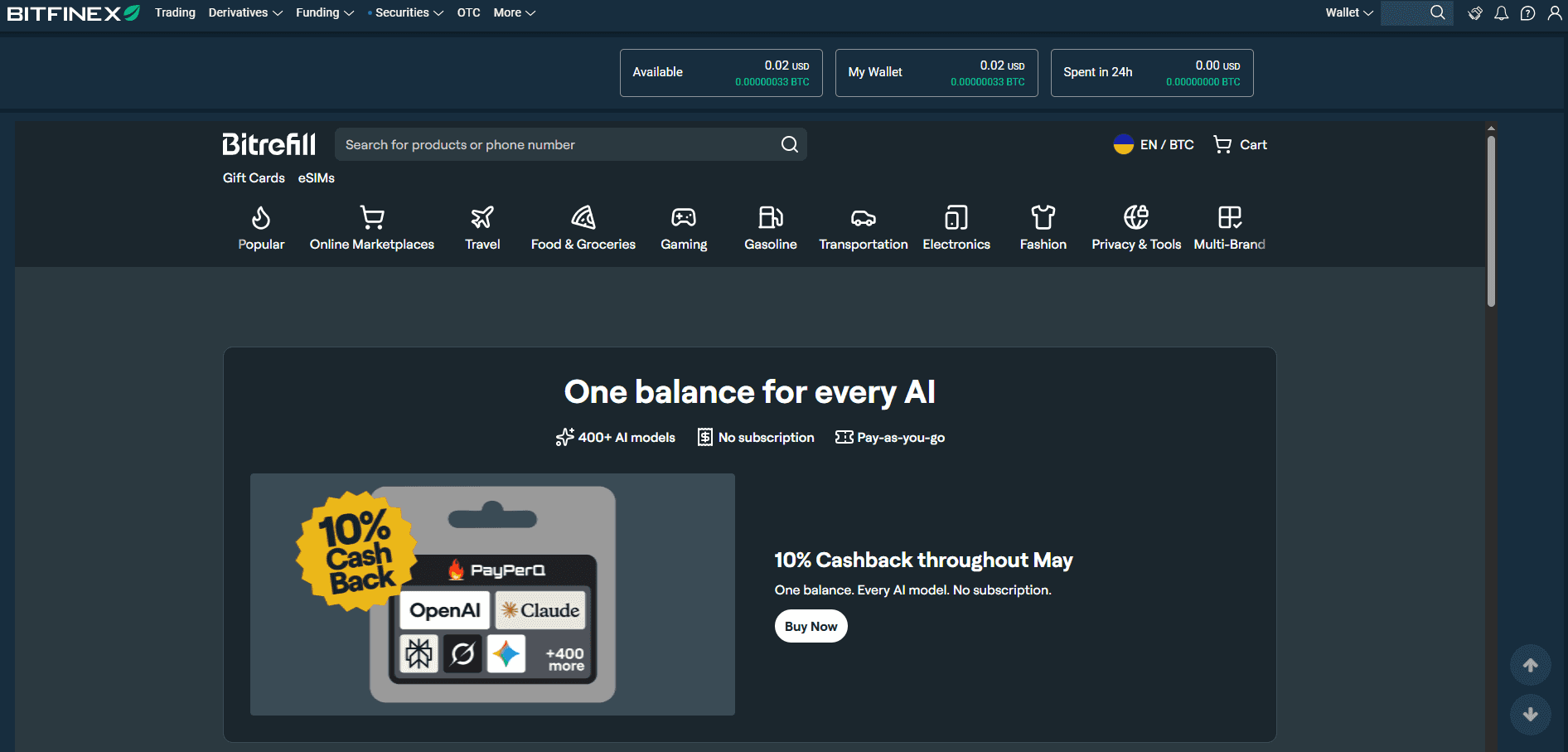
This functionality can be convenient for users who want to spend cryptocurrency directly without withdrawing funds to a bank account. At the same time, terms, available brands, countries, and fees depend on Bitrefill and the user's region, so it is worth checking the details of a specific offer before making a purchase.
Commissions
Bitfinex's fee structure currently looks very competitive for active traders: the exchange lists zero order execution fees on the spot market, margin trading, derivatives, Securities, and OTC. This is a strong advantage compared with many crypto exchanges, where base fees usually depend on the maker/taker model and VIP level.
Spot Fees
On Bitfinex, spot order execution fees are 0% for makers and 0% for takers. This means the user does not pay a standard trading fee when buying or selling cryptocurrency on the spot market through the exchange order book.
This approach makes Bitfinex especially interesting for active traders who make many trades and are sensitive to trading costs.
Derivatives Fees
For derivatives trades, Bitfinex also lists zero order execution fees. This applies to trading derivative instruments, including perpetual contracts available in the Bitfinex Derivatives section.
Margin Funding Fees
Margin funding on Bitfinex works through a P2P model: some users provide funds at interest, while others use them for margin trading or borrowing. For the borrower, the main expense is the interest on the attracted funding, which depends on the market rate, term, and available supply.
For users who provide funding, Bitfinex withholds a fee from the income received:
Operation | Fee |
|---|---|
Fee on income of a margin funding provider | 15% of the active offer amount |
Fee on provider income when posting a hidden offer | 18% of the active offer amount |
Borrower fee | 0% from Bitfinex, but loan interest is charged |
UNUS SED LEO holders may receive a discount on margin funding and lending fees of up to 5%, depending on the amount of LEO in the account. At the same time, interest on borrowed funds is charged separately and may change depending on market conditions.
Deposit Fees
Deposits in cryptocurrency, stablecoins, and securities on Bitfinex are usually not subject to a fee from the exchange. The user only pays the network fee when sending funds from an external wallet, if it applies in the specific blockchain network.
Deposit method | Fee |
|---|---|
Cryptocurrency | Free |
Stablecoins | Free |
Securities | Free |
Bank transfer | 0.1%, minimum 60 USD/EUR |
Bank deposits can be more expensive than cryptocurrency transfers, especially for small amounts due to the minimum fee. It is also worth considering possible fees from correspondent banks and payment providers, which do not depend directly on Bitfinex.
Withdrawal Fees
Withdrawal fees on Bitfinex depend on the asset and the selected withdrawal method. For cryptocurrencies, the fee amount is set separately for each coin and network. Some assets may be withdrawn for free, while others have a fixed fee.
Withdrawal method | Fee |
|---|---|
Cryptocurrency withdrawal | Depends on the coin and network |
Securities withdrawal | Free |
Bank transfer | 0.1%, minimum 100 USD/EUR |
Express bank transfer | 1%, minimum 125 USD/EUR |
Bank transfer via OpenPayd up to 10 000 EUR/GBP | 5 EUR/GBP per transaction |
Bank transfer via OpenPayd over 10 000 EUR/GBP | 0.1% of the transfer amount |
Internal transfer of digital assets between Bitfinex users | Free |
Before withdrawing funds, it is important to check the current fee in the Bitfinex interface, as cryptocurrency withdrawal costs may change depending on the network, asset, and transaction processing conditions.
Other Fees
Other Bitfinex fees include costs that are not directly related to trade order execution. For example, if a user mistakenly sends tokens without the required memo, tag, or payment ID, Bitfinex may charge a fee for recovering funds.
Separate conditions may also apply to Bitfinex Securities, third-party services, integrations, and operations that do not proceed as a standard spot trade. Therefore, before using additional products—tokenized securities, OTC, derivatives, lending, or margin funding—it is worth checking the current terms of the specific instrument in advance.
Deposit and Withdrawal
Bitfinex supports several deposit and withdrawal methods: cryptocurrency transfers, bank transfers, transactions with Tether tokens, USDT0/XAUT0, cryptocurrency purchases by card through third-party providers, and withdrawals via the Lightning Network for Bitcoin. The exchange's deposit and withdrawal infrastructure is well developed, but it is better suited to users who understand the difference between networks, wallets, and balance types.
Wallets
Several wallets are used within Bitfinex:
Wallet | What it is used for |
|---|---|
Exchange | Spot trading and regular exchange operations |
Margin | Margin trading |
Funding | Margin funding and lending |
The user can fund the required wallet directly or transfer funds between wallets within the platform. This is convenient for active traders, but beginners may find this structure more complex than a single balance on simpler crypto exchanges.
Cryptocurrency Deposits
Cryptocurrency deposits are made through Wallet → Deposits. The user selects the asset, network, and wallet for crediting, after which Bitfinex generates a deposit address. For example, for Bitcoin a BTC address is displayed, while for Tether it is additionally necessary to select the appropriate network or transport protocol.
Deposit type | What is available | Features |
|---|---|---|
Cryptocurrencies | BTC, ETH, TRON, Algorand, and other assets | Credited after network confirmations |
Stablecoins | USDT, USDC, and other supported tokens | It is important to choose the correct network |
Tether | USDT, CNHt, MXNt, XAUt | Availability depends on the network and region |
USDT0 and XAUT0 | Cross-chain Tether tokens | Used for transfers between supported networks |
Securities | Tokenized instruments | Availability depends on verification and jurisdiction |
Cryptocurrency deposits are usually not subject to a fee from Bitfinex. The user only pays the network fee when sending funds from an external wallet or another exchange.
Important considerations:
- you need to carefully choose the transfer network;
- some assets may require a memo, tag, or payment ID;
- sending an unsupported token or transferring via the wrong network may lead to delays or loss of funds;
- in some cases, recovery of mistakenly sent tokens may be paid.
Fiat Deposits
Bitfinex supports fiat deposits via bank transfer and cryptocurrency purchases with a bank card through third-party providers. Fiat transactions usually require a higher verification level.
Deposit method | Currencies / assets | Features |
|---|---|---|
Bank transfer | EUR, JPY, GBP, USD | Suitable for large amounts, requires KYC |
Bank card | USD, EUR, JPY, TRY, GBP | Available through third-party providers |
Mercuryo | BTC, USDT, ETH, TRON, Algorand | Terms depend on the provider |
Simplex | BTC, ETH, USDT, Algorand, USDC | Fees and limits are set by the provider |
Card purchases are convenient for quickly entering cryptocurrency, but the final cost may be higher due to provider fees, conversion rates, and transaction amount limits. Bank transfer is usually more suitable for large deposits, but may take more time.
Cryptocurrency Withdrawals
Cryptocurrency withdrawals are made through Wallet → Withdrawals. The user selects the asset, debit wallet, network, recipient address, and amount. For multi-network assets such as USDT, it is especially important to choose the correct transport protocol.
Withdrawal method | What is available | Features |
|---|---|---|
Cryptocurrencies | All assets supported by Bitfinex | Fee depends on the coin and network |
Tether tokens | USDT, CNHt, MXNt, XAUt | A compatible network must be selected |
USDT0 and XAUT0 | Cross-chain tokens | Availability depends on supported networks |
Lightning Network | Bitcoin | A faster way to withdraw BTC |
Internal transfer | Transfers between Bitfinex users | May be free for digital assets |
Before confirming a withdrawal, Bitfinex shows the minimum amount, fee, and selected network. These details should be checked every time, as withdrawal fees and conditions may change.
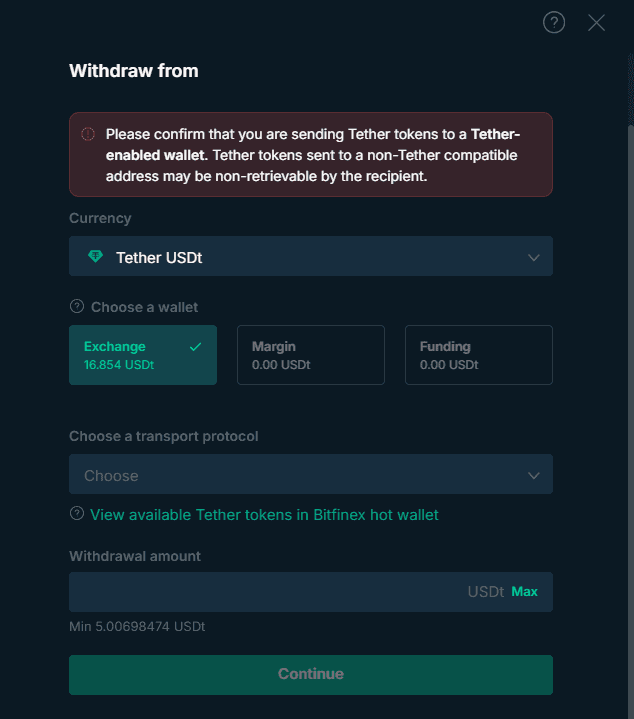
When withdrawing cryptocurrency, it is important to:
- verify the recipient address;
- choose the correct network;
- check the memo/tag if required;
- take the minimum withdrawal amount into account;
- enable 2FA and additional security settings.
Fiat Withdrawals
Fiat funds can be withdrawn via bank transfer. The availability of the method depends on the user's country, verification level, currency, and payment partner requirements.
Withdrawal method | Currencies | Fee / features |
|---|---|---|
Bank transfer | EUR, JPY, GBP, USD | Usually suitable for large amounts |
Express bank transfer | EUR, JPY, GBP, USD | Faster but more expensive than a standard transfer |
OpenPayd | EUR, GBP | May have a fixed or percentage fee |
Bank withdrawals can take several business days. Timing is affected by the currency, recipient bank, correspondent banks, the user's country, and Bitfinex's internal checks. Unlike cryptocurrency transfers, fiat transactions are usually less instant and may require additional review.
Markets and Products
Bitfinex offers a wide range of markets and products, primarily aimed at active and professional crypto traders. The platform combines spot trading, margin trades, derivatives, OTC, lending, staking, API infrastructure, and a separate Bitfinex Securities division for tokenized securities.
In terms of product variety, Bitfinex is behind universal ecosystems such as Binance, but it still looks stronger than many crypto exchanges that are limited to spot and futures only. Bitfinex's main focus is deep liquidity, an advanced trading terminal, professional orders, margin instruments, and services for large clients.
Main Bitfinex Markets and Services
Let's look at the main markets and services available on Bitfinex:
Category | Products and services | Description |
|---|---|---|
Spot trading | Spot market | Buying and selling cryptocurrencies through the exchange order book. Major digital assets, stablecoins, and numerous trading pairs are available. |
Margin trading | Margin trading | Trading using borrowed funds through a P2P funding model. Suitable for experienced traders, as it increases the risk of losses and liquidation. |
Derivatives | Bitfinex Derivatives | Trading perpetual contracts on cryptocurrencies and other underlying assets with leverage of up to 100x. |
Futures and options | Thalex Derivatives | Integration with Thalex provides access to certain futures and options through a third-party provider's infrastructure. |
OTC | OTC Desk | Over-the-counter trades directly with a counterparty without placing a large order in the public order book. Suitable for large volumes. |
Securities | Bitfinex Securities | A platform for tokenized securities, including certain debt and investment instruments in the jurisdictions of the AIFC and El Salvador. |
Lending | Bitfinex Borrow | The ability to borrow funds secured by crypto assets. Terms depend on the verification level and available collateral. |
Margin funding | Margin Funding | A P2P funding market where users can provide funds to traders at interest. |
Staking | Soft Staking | Receiving rewards for holding supported tokens on Bitfinex without independently setting up a validator. |
API | REST and WebSocket API | Tools for algorithmic trading, strategy automation, connecting trading bots, and external analytics systems. |
Ecosystem token | UNUS SED LEO | The utility token of the iFinex ecosystem, which may provide discounts on certain fees and other benefits within the platform. |
Buying cryptocurrency by card | Mercuryo, Simplex | The ability to buy selected cryptocurrencies and stablecoins with a bank card through third-party providers. |
Gift cards and payments | Bitrefill | Integration for buying gift cards, eSIMs, topping up mobile balances, and paying for other services with cryptocurrency. |
Mobile trading | Bitfinex Mobile App | Access to markets, wallets, orders, and account management through the mobile app. |
Bitfinex is especially strong in products for experienced users: the spot terminal, margin trading, funding market, derivatives, API, and OTC create a full-fledged infrastructure for active trading.
Supported Cryptocurrencies
Bitfinex supports a wide selection of cryptocurrencies and trading pairs. Bitcoin, Ethereum, Litecoin, XRP, TRON, Cardano, Solana, Polkadot, Chainlink, Uniswap, Monero, Zcash, Algorand, Dogecoin, and other popular digital assets are available on the platform. Stablecoins and Tether ecosystem tokens are also widely represented, including USDT, XAUt, CNHt, and other supported assets.
In terms of the number of supported coins, Bitfinex does not always compete with exchanges that list hundreds of high-risk altcoins. Its strength is not the maximum number of tokens, but the availability of liquid markets, advanced order types, margin funding, derivatives, and professional infrastructure.
Trading Platforms
Bitfinex provides access to trading through a web platform and mobile apps. The main emphasis is placed on an advanced terminal for active traders: charts, order book, different order types, management of multiple wallets, and access to spot, margin, derivatives, and OTC.
The Bitfinex interface is functional but not the easiest for beginners. The exchange is clearly aimed at users who are already familiar with cryptocurrency wallets, trading terminals, margin products, and risk management.
Web Platform
The Bitfinex web platform is available through the exchange's official website and is the main tool for trading. The interface is designed in a professional style: tickers, the market list, and balances are located on the left; the TradingView chart is in the center; and positions, orders, and trade history are below. The user can switch between the Trading, Derivatives, Funding, Securities, and OTC sections.
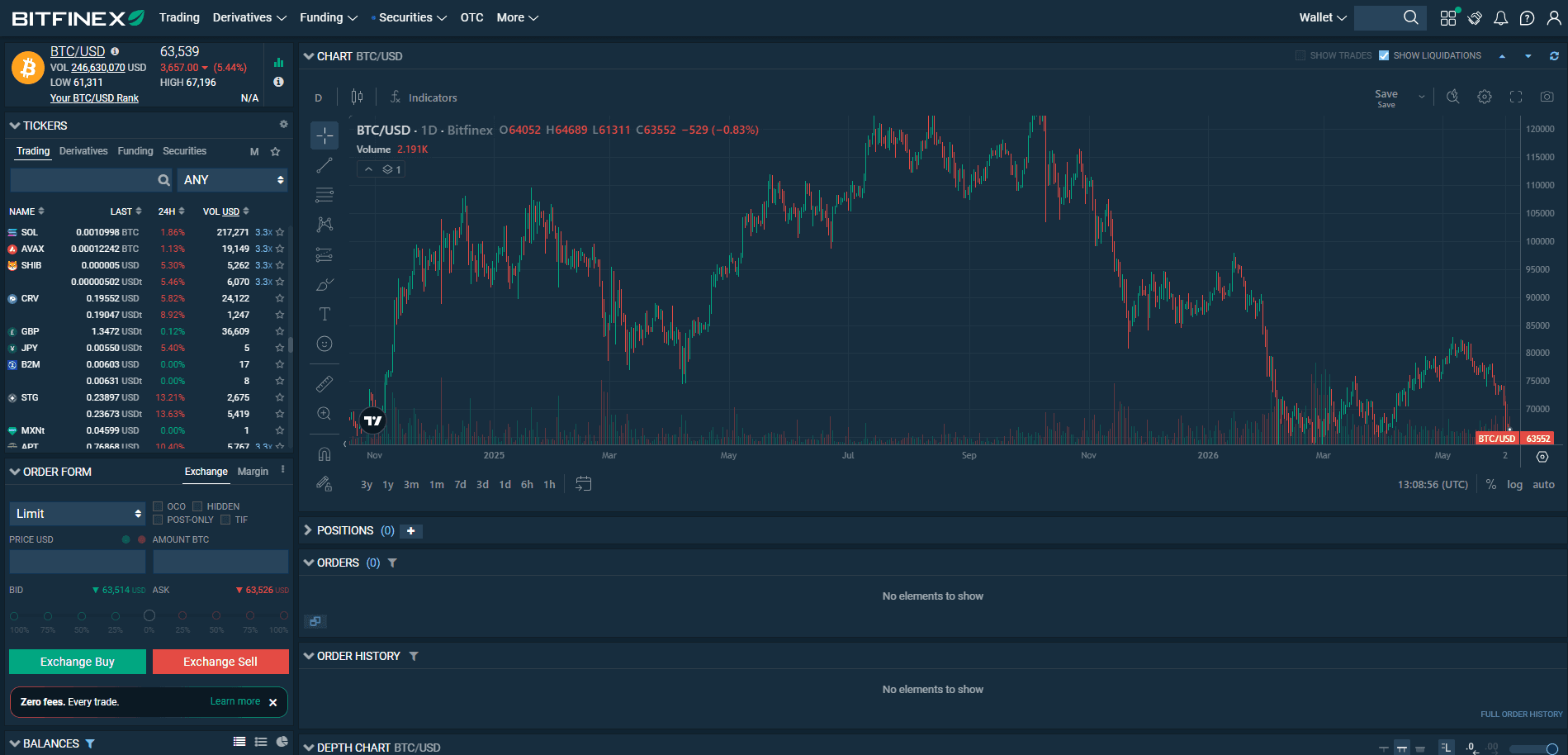
The web terminal supports:
- spot trading;
- margin trading;
- perpetual contracts;
- tokenized securities;
- OTC trades;
- margin funding;
- management of Exchange, Margin, and Funding wallets.
Advanced order types are available for trading: limit, market, stop orders, OCO, hidden orders, post-only, reduce-only, and other tools. This set of functions makes the platform convenient for active traders who use different entry and exit scenarios.
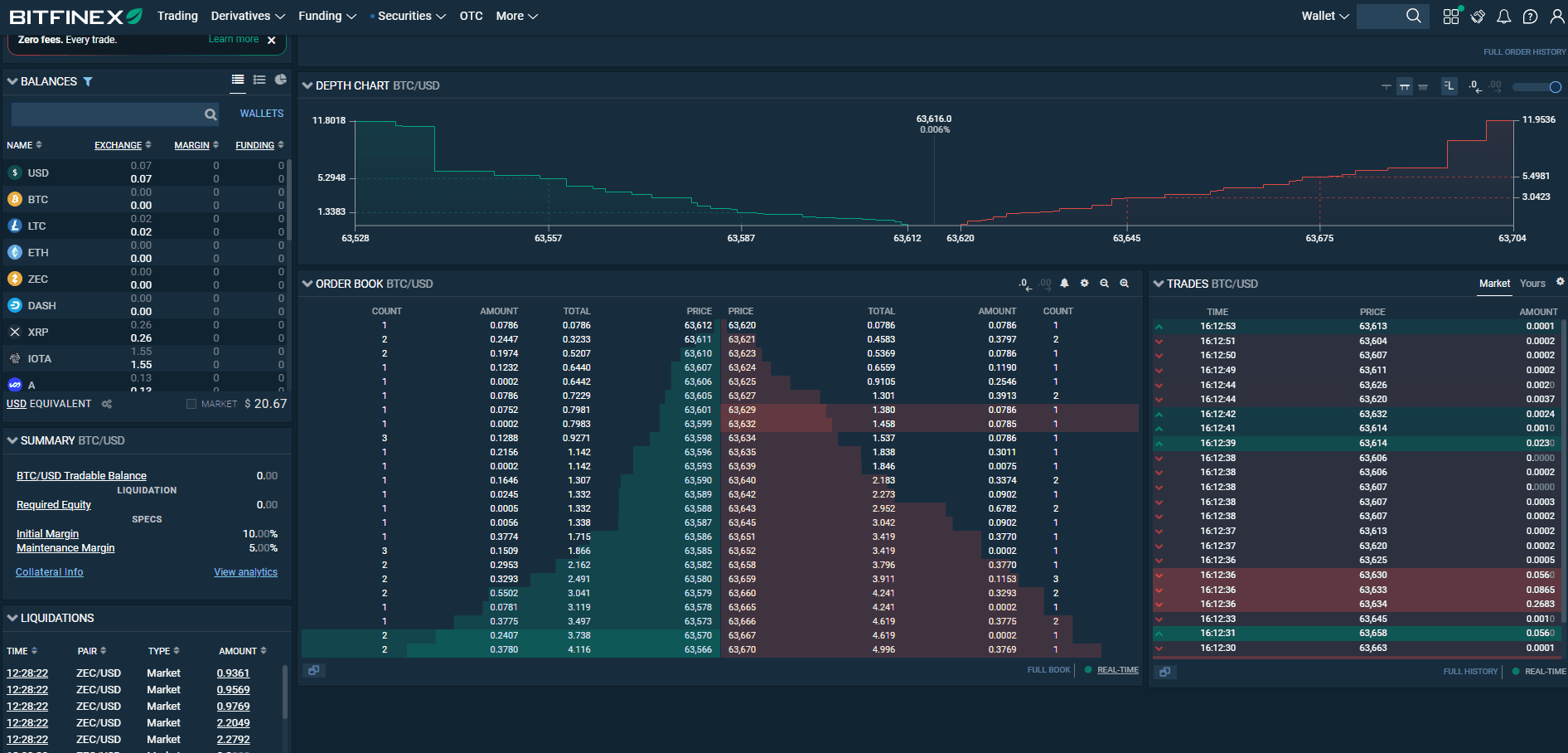
The advantages of the Bitfinex web platform include:
- TradingView charts for technical analysis;
- a convenient exchange order book;
- a wide selection of order types;
- access to spot, margin, derivatives, margin funding, and OTC;
- separate wallets for different tasks;
- API, 2FA, and other security parameter settings.
The main drawback of the web platform is its high complexity for beginners. Dividing balances into Exchange, Margin, and Funding, the large number of markets, and the professional interface require time to master.
Mobile Apps
Bitfinex offers mobile apps for iOS and Android. Through the app, users can monitor markets, open and close trades, manage orders, check balances, fund the account, withdraw funds, and configure the main account settings.
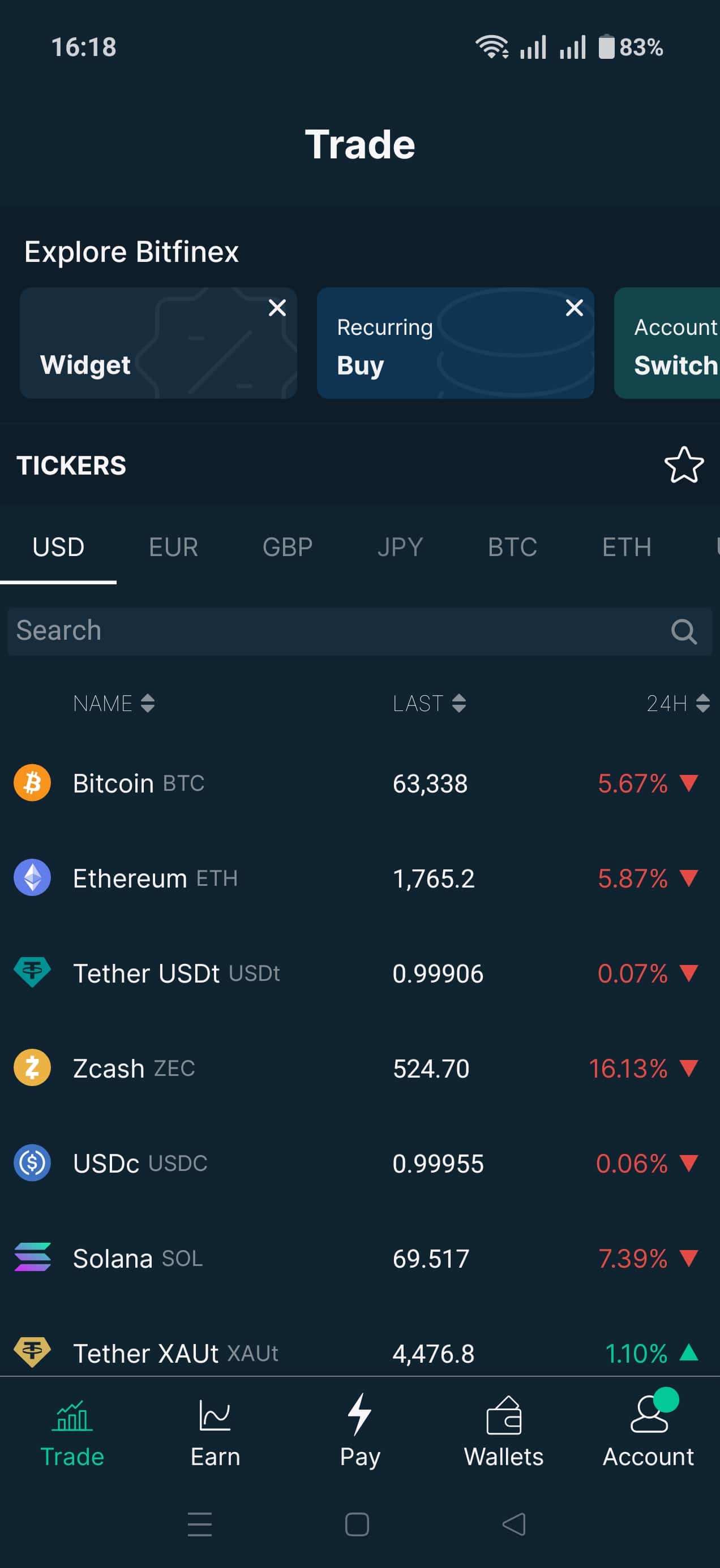
The mobile app supports the platform's main functions:
- trading on supported markets;
- viewing charts and quotes;
- managing orders and positions;
- monitoring balances across different wallets;
- deposits and withdrawals;
- viewing transaction history;
- notifications and security settings.
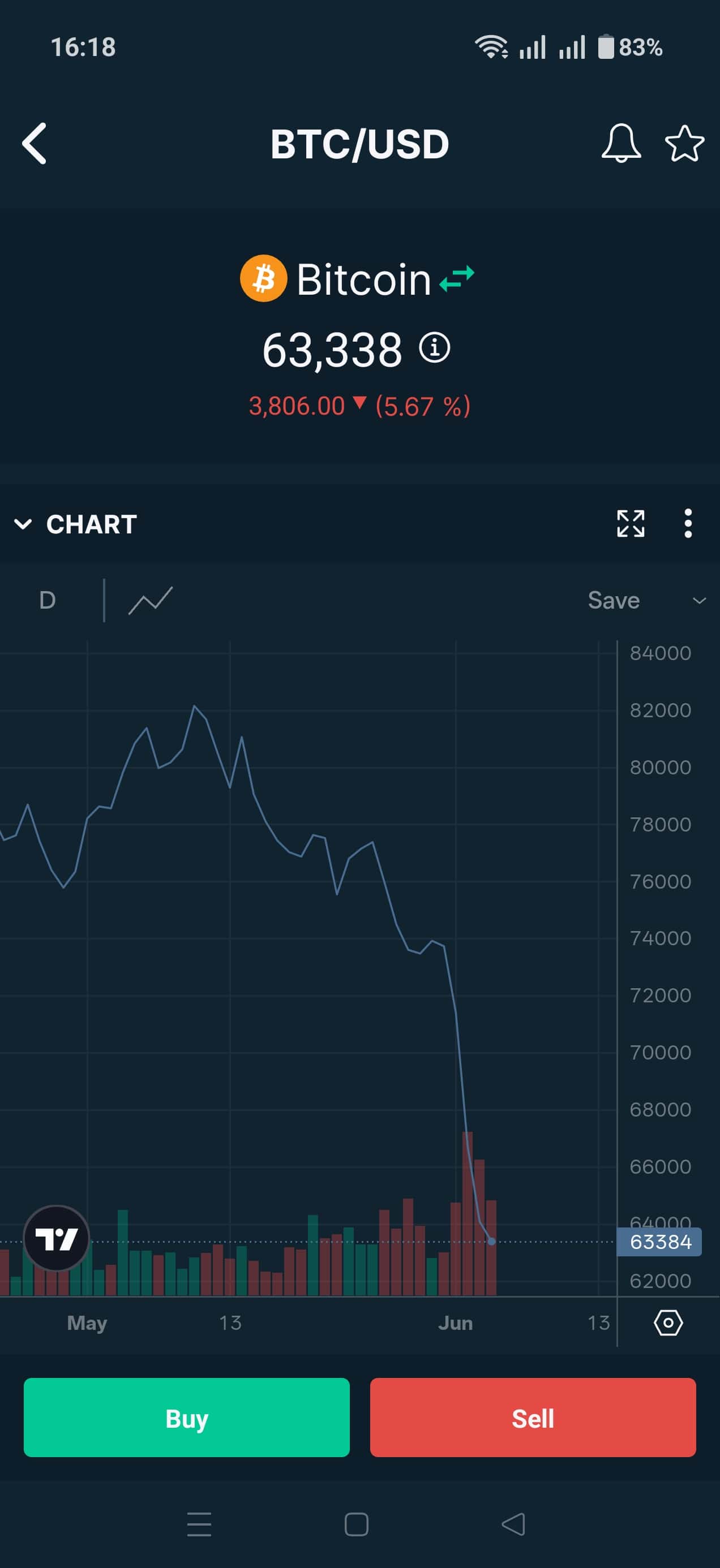
The app is convenient for monitoring positions, quick operations, and tracking the market on the go. However, for full analysis, working with the order book, and active trading, the web terminal remains the more convenient option. On a small screen, it is harder to simultaneously monitor the chart, orders, order book, and several markets.
Analytics
Bitfinex offers not only a trading terminal but also its own analytical materials for users who want to better understand the state of the crypto market. The main focus is on market reviews, Bitcoin data, macroeconomic factors, institutional demand, liquidity, and events affecting digital assets.
Bitfinex Alpha
Bitfinex Alpha is a regular analytical review from Bitfinex in which the exchange's team analyzes the situation in the cryptocurrency market. Alpha offers weekly research, market data, and institutional-level analytics. Materials can be received via newsletter subscription or read on the Bitfinex blog.
Bitfinex Alpha usually covers:
- the dynamics of Bitcoin and major crypto assets;
- capital inflows and outflows;
- the behavior of long-term holders;
- derivatives and liquidation data;
- macroeconomic events;
- Fed decisions and the impact of interest rates;
- market liquidity;
- the sentiment of institutional participants.
Such materials are useful for traders who make decisions not only based on charts but also on fundamental and market data. For example, Bitfinex Alpha reviews regularly cover topics such as Bitcoin market structure, the state of derivatives, the behavior of large participants, and the impact of macroeconomics on cryptocurrencies.
At the same time, Bitfinex Alpha should not be treated as ready-made trading signals. It is rather an analytical source that helps form a general understanding of the market, but does not replace independent analysis, risk management, and checking data from other sources.
Latest News
Bitfinex also publishes news and updates on its own blog. There you can find announcements about new products, platform changes, listings, integrations, Bitfinex Alpha analytical releases, and other events related to the exchange and the crypto market.
For users, this is useful for several reasons:
- they can track new trading instruments and products;
- receive information about changes in platform operation;
- follow market reviews and analyst comments;
- learn about new listings and service updates;
- understand which topics the exchange itself considers important for traders.
In addition to the blog, Bitfinex offers newsletter subscriptions with market materials, educational articles, and industry updates. This is convenient for users who want to receive news and analytics without constantly searching for information on the website manually.
Education
Bitfinex's educational component is less developed than that of the largest crypto exchanges with full-fledged academies and interactive courses. The platform is more focused on experienced traders who already understand the basics of the crypto market and need not so much basic training as reference materials, instructions, and market analytics.
Nevertheless, Bitfinex has useful sources of information: a blog with news, analytical publications, and product materials, as well as a help center with detailed instructions on working with the platform.
Blog
The Bitfinex blog brings together platform news, market reviews, analytical materials, and publications about new products. Here you can find Bitfinex Alpha releases, comments on the state of the crypto market, announcements of listings, service updates, infrastructure changes, and integrations.
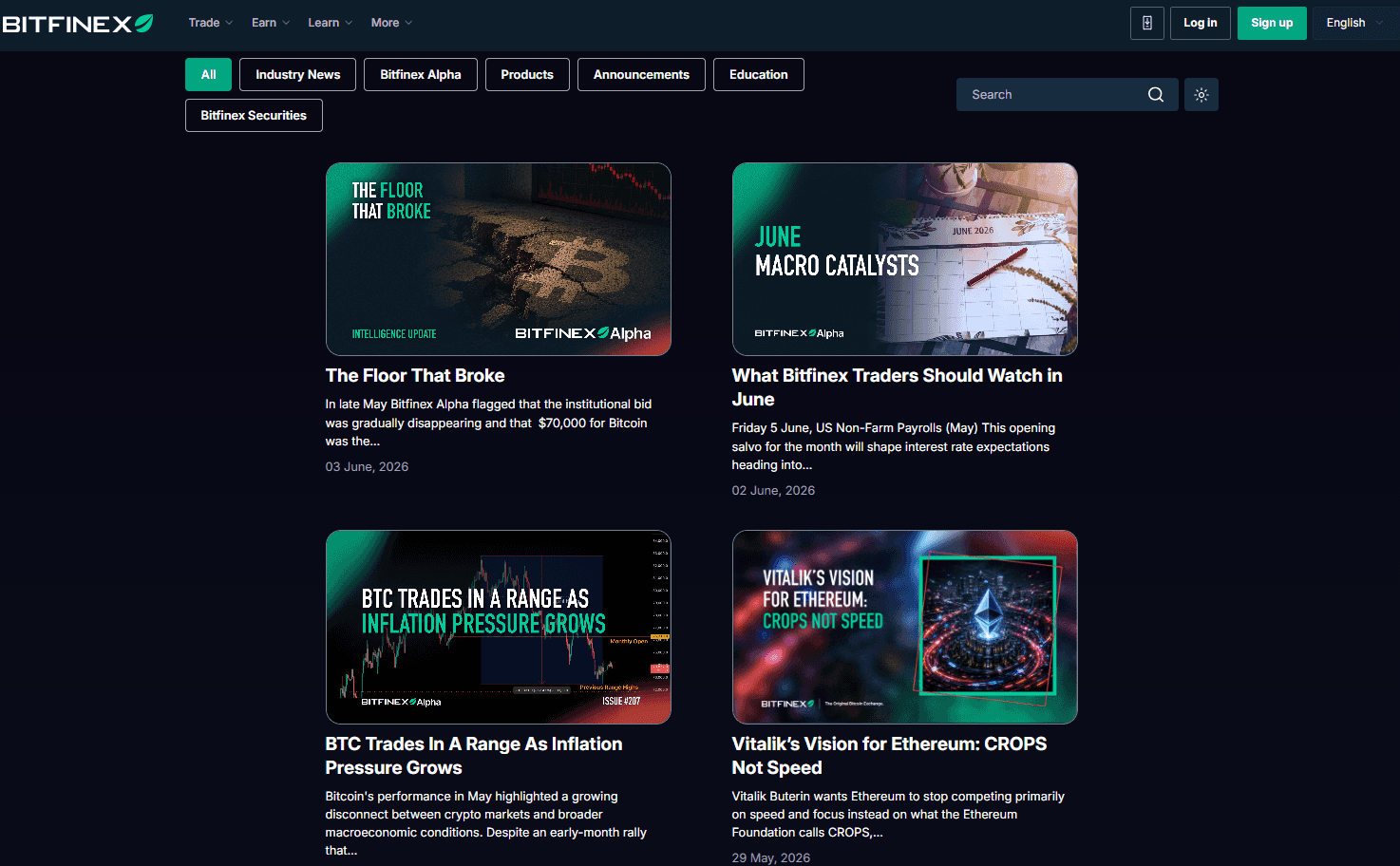
The blog is useful primarily for users who want to follow the development of the exchange itself and gain broader market context. The materials often address topics such as Bitcoin, liquidity, derivatives, macroeconomics, institutional demand, and the behavior of market participants.
Help Center
The Bitfinex Help Center is the platform's main reference section. It contains instructions on registration, security setup, verification, account funding, withdrawals, trading, working with wallets, API, margin funding, derivatives, demo trading, and other functions.
Help center materials are mainly practical in nature. They explain how to perform a specific action on the platform: create an account, enable two-factor authentication, complete KYC, deposit cryptocurrency, select a network, withdraw funds, create an API key, or set up a sub-account.
Customer Support
Bitfinex customer support is built around the help center, ticket system, and online chat. The exchange states that support is available 24/7, and for typical questions it offers a large knowledge base: registration, verification, deposits, withdrawals, account security, trading, API, margin funding, and other platform functions.
Overall, Bitfinex support looks fairly professional, but not always fast in complex situations. Simple questions can be resolved through help articles or chat, while account-related, KYC, withdrawal, mistaken transfer, and security requests usually require creating a ticket and waiting for a response from the relevant team.
Support Contact Channels
The main communication channel with Bitfinex is a request through the support form. The user selects the topic of the request, describes the problem, and, if necessary, attaches details: transaction ID, screenshots, wallet address, transaction date, or other information. This format is convenient for issues related to the account, verification, deposits, withdrawals, and security.
Bitfinex also offers online chat, which appears on the platform pages. It is more suitable for general questions and initial navigation through the knowledge base. If the issue is related to a specific account or requires data verification, the user is usually directed to the ticket system.
Response Time
Bitfinex states that support operates around the clock, but the exact response time depends on the topic of the request and the support team's workload. For simple questions, the user may quickly find an answer in the help center or receive an initial hint via chat.
More complex requests—for example, verification problems, bank transfer delays, an incorrectly specified memo/tag, account access recovery, or withdrawal review—usually take more time. Such requests may be forwarded to specialized departments: compliance, the payments team, security, or technical specialists.
Support Competence
For typical questions, Bitfinex support is fairly competent: the exchange has detailed instructions, a clear request structure, and separate request categories. Users can get help with registration, KYC, security setup, deposits, withdrawals, API, sub-accounts, demo trading, and other products.
Complex cases take longer to resolve because they do not always depend only on the support operator. For example, a mistaken cryptocurrency transfer may require checking the blockchain and the technical possibility of recovery, a bank payment may require involvement from the payment provider, and KYC questions may require a decision from the compliance team.
Conclusion
Bitfinex is a strong cryptocurrency exchange for experienced traders who value high liquidity, an advanced trading terminal, margin trading, derivatives with leverage up to 100x, OTC, API, lending, staking and access to tokenized securities through Bitfinex Securities. The platform offers competitive fees, developed infrastructure and a wide range of professional tools, but it requires an understanding of the crypto market, different wallet types, verification levels and the risks of margin trading.
The exchange is best suited to active crypto traders, professional market participants, algorithmic traders, large clients and users who need spot, margin, derivatives, OTC and API in one ecosystem. Beginners may find Bitfinex difficult due to its professional interface, product structure and less robust educational base.
FAQ
What is Bitfinex?
Bitfinex is a cryptocurrency exchange founded in 2012. The platform offers spot trading, margin trading, derivatives, OTC trades, lending, staking, API, and access to certain tokenized securities through Bitfinex Securities.
Is Bitfinex safe?
Bitfinex uses two-factor authentication, address whitelists, API key settings, account monitoring, and cold storage for part of its assets. However, the exchange has had hacks and regulatory claims in its history, so users should enable all protection measures and not keep more funds on the exchange than needed for trading.
How does Bitfinex work?
Bitfinex works as a cryptocurrency trading platform. Users fund their account with cryptocurrency or fiat, transfer funds between Exchange, Margin, and Funding wallets, then trade spot, margin, derivatives, or use additional services such as lending, staking, and OTC.
How do you use Bitfinex?
To use Bitfinex, you need to create an account, confirm your email, set up security, and complete verification if necessary. After that, the user can fund the account, choose the required market, open the trading terminal, place an order, and manage positions through the web platform or mobile app.
How do I open an account on Bitfinex?
To open an account on Bitfinex, go to the exchange's website, click Sign Up, and enter your email, username, password, and country of residence. After registration, you need to confirm your email. KYC verification may be required for expanded access to platform functions.
How do I deposit funds on Bitfinex?
To make a deposit, open Wallet → Deposits, select the asset, network, and wallet for crediting: Exchange, Margin, or Funding. Bitfinex will then show the deposit address. Before transferring, it is important to check the network, address, and the presence of a memo/tag if required for the selected cryptocurrency.
How do I trade on Bitfinex?
To trade, you need to fund the Exchange or Margin wallet, select a trading pair, and open the Bitfinex terminal. The user can place a market, limit, stop order, or another available order type. Bitfinex offers spot trading, margin trades, and leveraged derivatives.
How do I sell cryptocurrency on Bitfinex?
To sell cryptocurrency, select a trading pair, such as BTC/USD or ETH/USDT, go to the trading terminal, and create a sell order. You can use a market order for a quick sale at the current price or a limit order to specify your desired selling price.
How do I withdraw money from Bitfinex?
To withdraw, go to Wallet → Withdrawals, select a cryptocurrency or fiat method, specify the debit wallet, network, recipient address or bank details, and amount. Before confirming, check the fee, minimum withdrawal amount, network, and recipient details.
How do I delete a Bitfinex account?
To delete a Bitfinex account, you need to contact support through the official help center and submit an account closure request. Before doing so, it is advisable to withdraw funds, close open orders and positions, cancel active orders, and save the necessary transaction reports.