Bitget Review 2026
Bitget is suitable for beginner and experienced cryptocurrency traders, especially those who use futures, copy trading, trading bots, and automated strategies.
- Bitget is trusted. Tested via live trading.
- Bitget №7 in the crypto exchanges list
Highlights of Bitget

Bitget is one of the leading international cryptocurrency exchanges, founded in 2018. The platform offers a wide selection of digital assets, spot and futures trading, as well as additional investment tools. Bitget has become particularly popular for its copy trading service, which allows users to automatically copy the trades of experienced traders.
The exchange is aimed at both beginners and professional traders, offering competitive fees, trading bots, a mobile app, and a well-developed ecosystem of cryptocurrency services. Bitget continues to expand its product range, combining traditional cryptocurrency trading with new investment opportunities.
Pros and Cons of Bitget
Pros
- A wide range of cryptocurrencies, trading instruments, and investment products.
- Advanced copy trading, trading bots, and automation tools.
- User-friendly trading platforms supporting TradingView, MetaTrader 5 and API.
- High-quality analytics, educational materials, and a free demo account.
- Various deposit and withdrawal methods, including P2P trading.
Cons
- High futures fees, especially for takers.
- A major hack in September 2026, which exposed security issues.
- Lengthy handling of complex technical support requests.
Bitget reviews

Bitget
What traders talk about
No reviews yet.
Leave a review of your experience:
Bitget Exchange Overview
- Foundation Year
- 2018
- Official Website
- https://www.bitget.com
- Regulated in Countries
Mauritius, South Africa, El Salvador, Australia, Argentina
More Details- Trading Assets
- Cryptocurrency
- Futures
- Forex
- Precious Metals
- Energy Carriers
- Soft Commodities
- Stocks
- Indices
- Fees (Maker/Taker)
- Spot
- 0.1% / 0.1%
- Futures
- 0.036% / 0.1%
- Max Leverage
- Spot
- 10x
- Futures
- 150x
- Email Support









Bitget is an international cryptocurrency exchange founded in July 2018 by a team of specialists with experience in traditional finance and the blockchain industry. The company initially focused on cryptocurrency derivatives trading, and in 2020 it launched a copy trading service that became one of the key areas of its development.
Today, Bitget provides services for buying, selling, exchanging, and storing cryptocurrencies. Its main areas of activity include spot and futures trading, P2P transactions, copy trading, automated trading strategies, and investment products. The company is also developing a Web3 ecosystem, including the non-custodial Bitget Wallet. In recent years, Bitget has expanded beyond the cryptocurrency market by offering access to tokenized traditional financial assets.
Bitget Review Summary
Reliability and Regulation
Bitget has a moderate level of reliability. The exchange is registered in several jurisdictions, publishes reserve reports, and maintains a protection fund, but its level of regulation and security warrants caution.
Advantages
- Licences and registrations in several jurisdictions.
- Public proof of reserves.
- User protection fund of at least $300 million.
Disadvantages
- A major hack in September 2026.
- Regulatory warnings and restrictions in several countries.
When evaluating Bitget, we consider the exchange's reliability and security, trading fees, range of available markets, platform usability, deposit and withdrawal methods, and the quality of technical support. Each criterion is analyzed separately, allowing the platform's advantages and disadvantages to be assessed objectively. Read more about our rating principles in our broker evaluation methodology.
Continue reading the Bitget review to learn more about the trading conditions and exchange features and to determine how well it suits your goals.
Reliability and Regulation
Bitget has a moderate level of reliability. The exchange holds licenses and registrations in several jurisdictions, publishes proof of reserves, and maintains a user protection fund. However, regulation remains inconsistent, and the main international operator does not have a confirmed full financial license. A major hack in September 2026 revealed serious security shortcomings, although the exchange resumed operations and stated that it covered the losses without affecting client balances.
Licensing and Jurisdiction
| Legal Entity | Regulator |
|---|---|
| — | |
| — |


According to the current Bitget Terms of Use, the global platform is operated by BTG Technology Holdings Limited. The company conducts international business through several legal entities. The user agreement provides for the application of Hong Kong law and the resolution of disputes at the Hong Kong International Arbitration Centre (HKIAC).
Bitget holds a number of regulatory approvals and registrations:
- Australia (AUSTRAC) — registration as a digital currency exchange service provider.
- El Salvador (BCR and CNAD) — Bitcoin Service Provider (BSP) and Digital Asset Service Provider (DASP) authorizations.
- South Africa (FSCA) — crypto asset service provider (CASP) and over-the-counter derivatives provider (ODP) licenses.
- Mauritius (FSC) — an Investment Dealer license allowing the relevant legal entity to provide certain investment services.
- Argentina (CNV) — registration as a Virtual Asset Service Provider (VASP).
It is important to note that registration in one country does not automatically authorize the provision of all trading products in other jurisdictions. For example, AUSTRAC registration is not a substitute for an Australian AFS license, which is required for certain financial services.
Regulatory Risks
Despite its international presence, Bitget has repeatedly faced scrutiny from financial regulators.
In April 2024, the French regulator AMF warned investors that Bitget lacked the necessary registration. The exchange had been blacklisted since November 7, 2023, but it was removed from the list on July 9, 2026. At the same time, Bitget stopped serving users from France on March 31, 2026, to comply with local regulatory requirements.
On July 28, 2025, the Australian regulator ASIC warned investors about the offering of cryptocurrency futures without the necessary financial license. Similar complaints had previously arisen in other countries. In February 2024, Germany's BaFin reported that BG Limited was providing financial services without the appropriate authorization. Spain's CNMV added Bitget to its list of unauthorized entities back in April 2022, while Japan's FSA issued warnings regarding Bitget Limited for providing cryptocurrency services without registration.
Fund Security
Bitget uses several mechanisms to protect user assets, including cold storage of cryptocurrencies, two-factor authentication, withdrawal controls, and suspicious activity monitoring.
One of the main transparency tools is the Proof of Reserves system, which allows users to verify that their assets are included in the exchange's published reserves. However, Proof of Reserves is not a full guarantee of solvency and does not eliminate operational risks.
The exchange also maintains the Bitget Protection Fund — a reserve fund intended to cover extraordinary losses. The company commits to maintaining its value at no less than $300 million.
A serious test of the security system was the hack on September 24, 2026, when attackers withdrew about $388 million from the exchange's hot and intermediary wallets. According to Bitget, the attack was made possible by a vulnerability in third-party software, while cold wallets and private keys were not affected.
Following the incident, the exchange temporarily suspended withdrawals, brought in Mandiant and SlowMist specialists to investigate, and stated that the protection fund would cover the losses. Withdrawals were fully restored by October 2, 2026, and the fund was replenished to more than $300 million. According to the company, client balances were not affected.
Account Opening
The account-opening process at Bitget is simple, convenient, and fast. Registration is free, takes only a few minutes, and is available through the website or mobile app. Identity verification is mandatory, but the KYC procedure is well organized and is usually completed within an hour. Step-by-step instructions and automated document checks make the process accessible even to beginners.
Registration
To create an account on Bitget, follow these steps:
- Go to the official Bitget website and click the “Register” (Sign Up) button.
- Choose a registration method — by email or mobile phone number. Alternative sign-in options, including Google and Telegram, are also available.
- Create a strong password between 8 and 32 characters long containing uppercase letters, numbers, and special characters.
- Review the user agreement, accept the terms, and complete the CAPTCHA check.
- Enter the six-digit confirmation code sent to your email or phone.
Once the contact details have been confirmed, the account will be created. For additional protection, users are advised to enable two-factor authentication (2FA) immediately through an authenticator app.
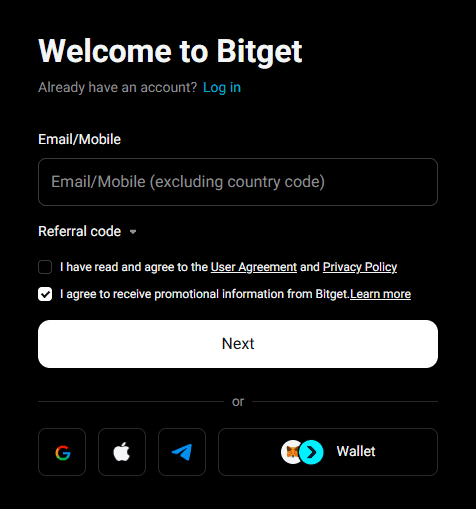
Registration on Bitget is free, and no documents are required at this stage. However, platform availability depends on the user's country of residence.
Verification
Bitget requires users to complete the Know Your Customer (KYC) procedure to access the exchange's main features. Without identity verification, users cannot deposit funds, trade cryptocurrencies, or withdraw funds.
To complete verification, users must:
- Sign in to the account dashboard and open the “Identity Verification” section.
- Specify the country of residence and the country where the document was issued, then select the document type.
- Provide personal details, including the first and last name shown on the identity document.
- Upload photos of a passport, national identity card, or driver's license — the list of accepted documents depends on the country.
- Complete facial recognition using a smartphone or computer camera.
- Submit the application for review and wait for confirmation.
According to Bitget, document verification usually takes up to 60 minutes, although it may take longer in some cases. The result is displayed in the account dashboard, and a notification may also be sent by email.
After successfully completing KYC, the user gains access to spot and futures trading, P2P transactions, and cryptocurrency deposits and withdrawals. Specific features and limits depend on the jurisdiction and account status.
Bitget may also request reverification, for example when an identity document expires. One document may be used to verify only one primary account.
Account Types
Bitget offers a wide range of trading instruments and investment services, available within a single account. Users can trade cryptocurrencies on spot and derivatives markets, use leverage, automated strategies, and copy trading, as well as earn returns by depositing digital assets.
Separate trading balances and a Unified Trading Account (UTA) are available for managing capital. The latter allows transactions involving different instruments to be combined and a shared collateral system to be used, depending on the selected mode.
Spot Trading
Spot trading on Bitget allows users to buy and sell cryptocurrencies at current market prices. Available assets include Bitcoin, Ethereum, Solana, XRP, BGB, popular stablecoins, and many other digital assets.
The trading terminal supports market, limit, and conditional orders, including tools for limiting losses and taking profits. Charts, an order book, and trade history are available for market analysis.
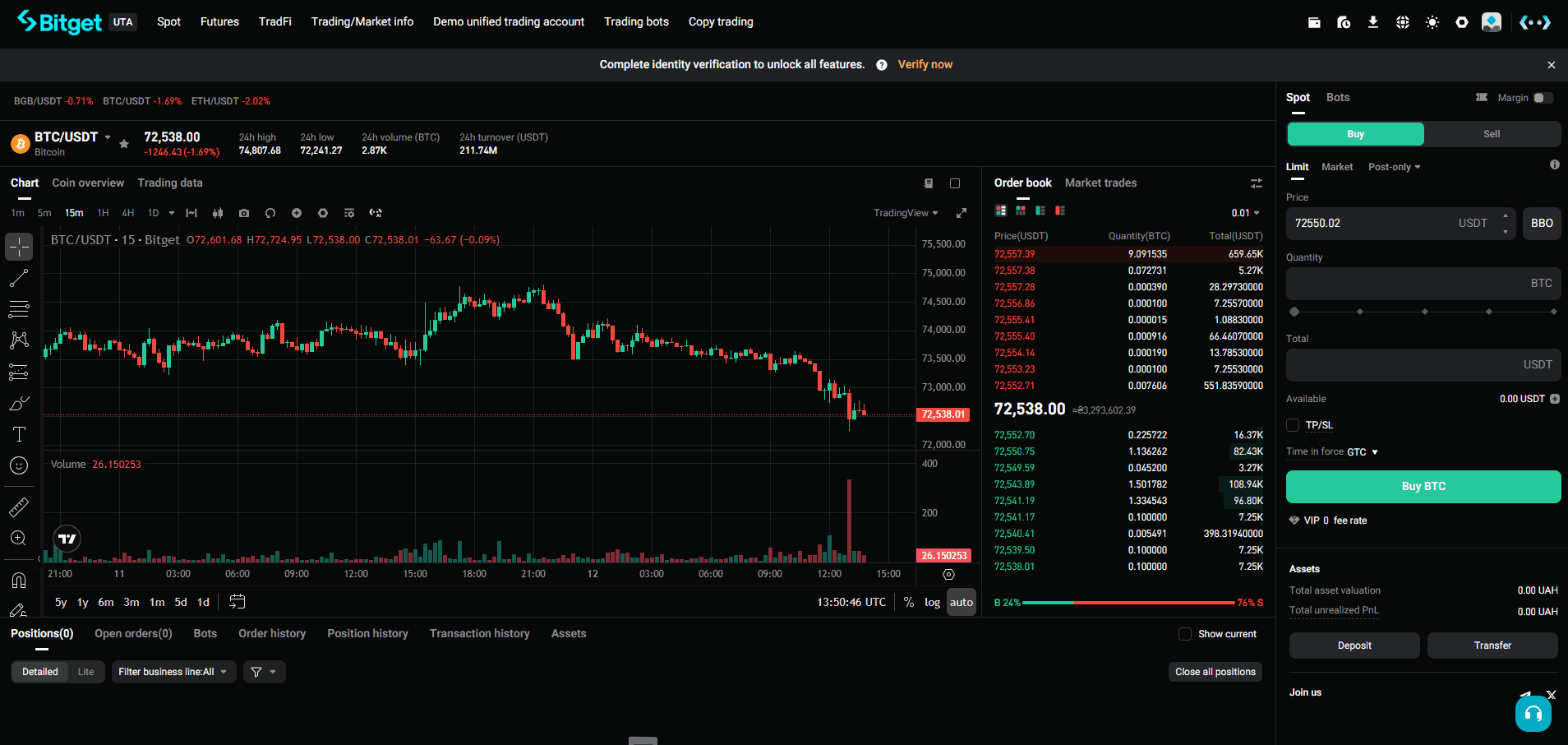
The standard trading fee is 0.1% for makers and takers. A 20% discount applies when fees are paid with the BGB token, while VIP program participants may receive additional benefits.
Margin Trading
Margin trading allows users to increase the size of a position using funds borrowed from the exchange. This makes it possible to execute trades worth more than their own capital and to trade both rising and falling cryptocurrency prices.
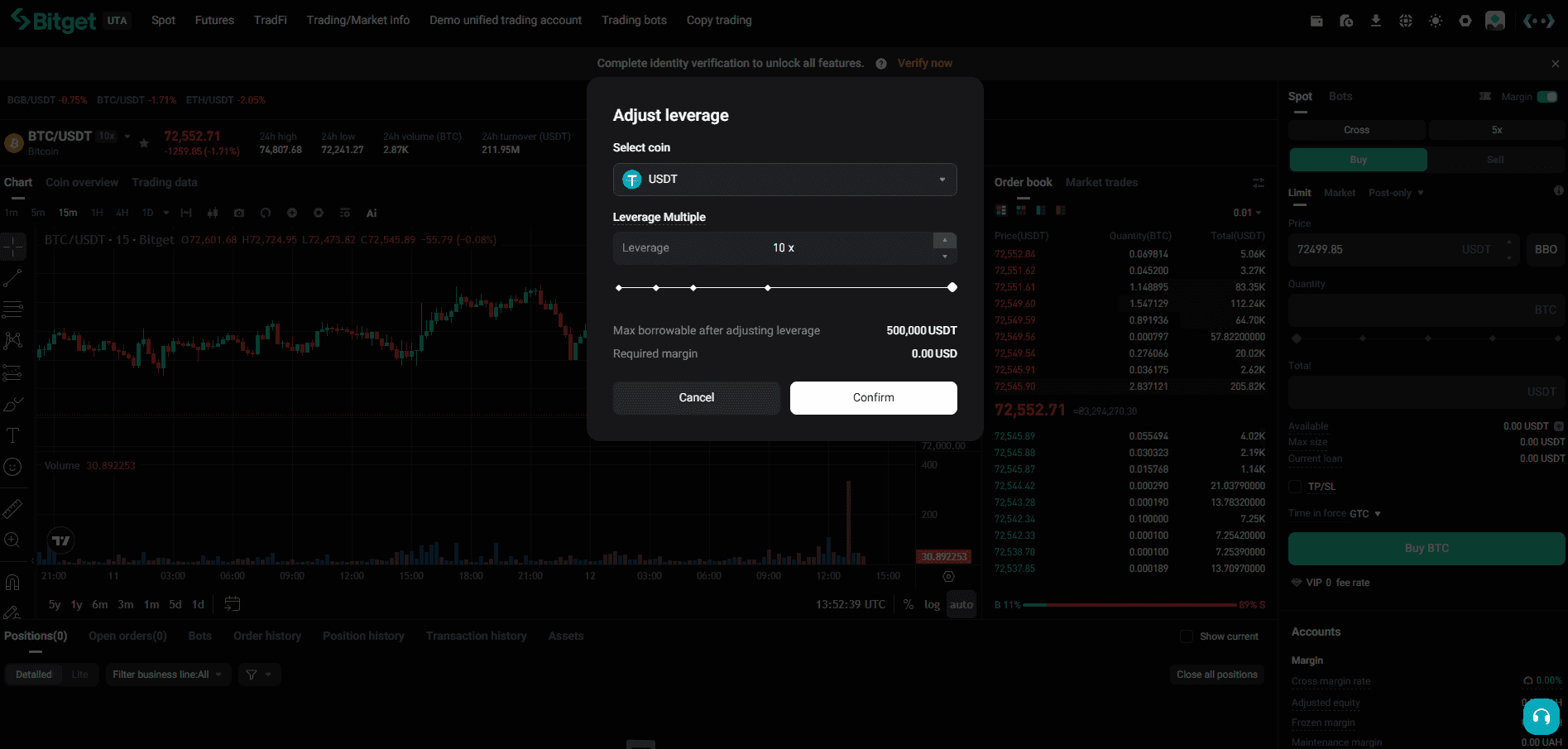
Bitget supports two main margin modes:
- Cross Margin — all available collateral is used to support multiple positions.
- Isolated Margin — collateral is allocated separately, making it possible to limit the risk of a specific position.
Interest is charged for the use of borrowed funds, with the rate depending on the cryptocurrency, lending terms, and user status.
Margin trading is intended for experienced traders because leverage increases not only potential profits but also losses. Positions may be forcibly liquidated if collateral is insufficient.
Futures Trading
Futures trading is one of Bitget's main areas of business. The platform allows users to open long (Long) and short (Short) cryptocurrency positions without purchasing the underlying asset.
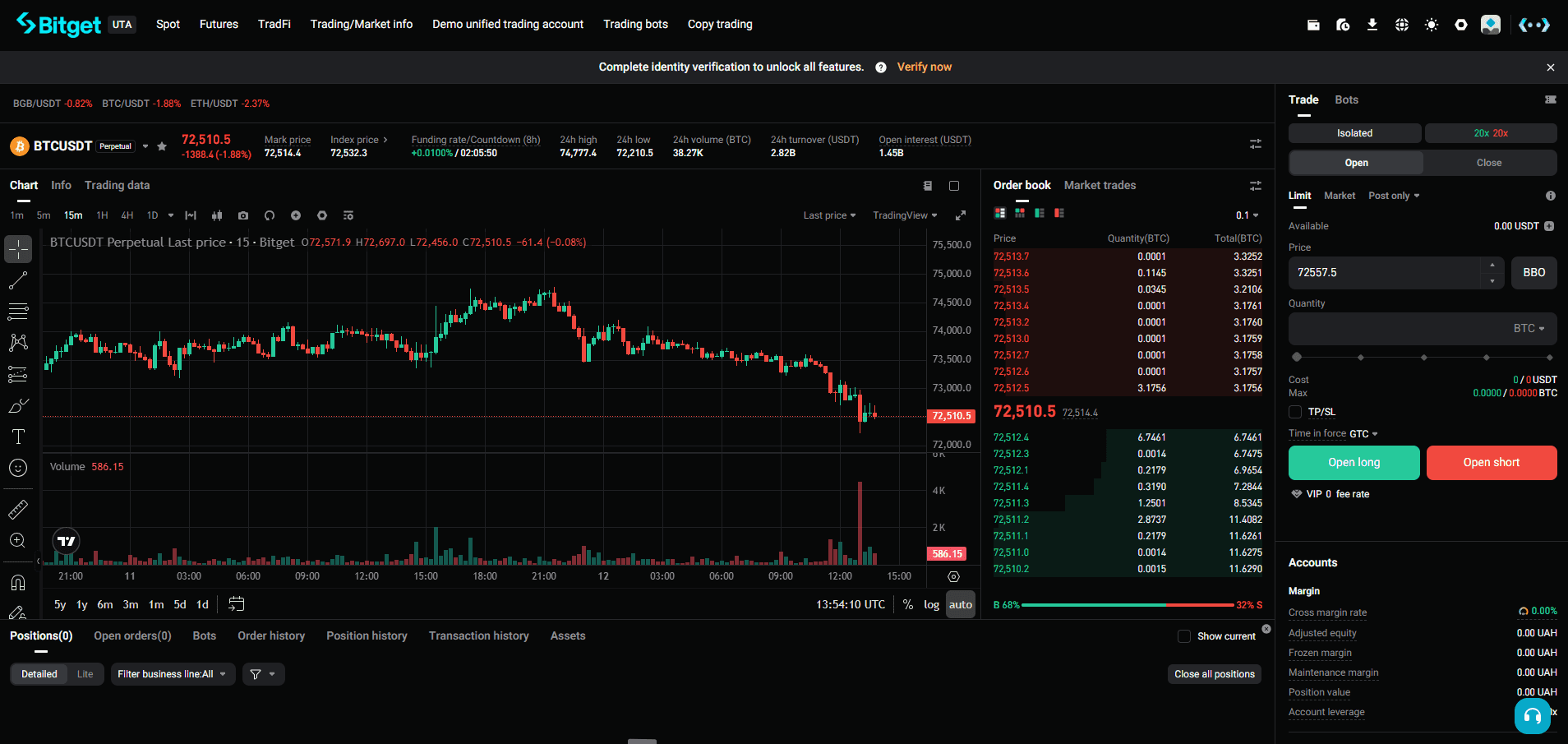
The exchange offers several categories of contracts:
- USDT-M Futures — futures settled and collateralized in USDT.
- USDC-M Futures — contracts using USDC.
- Coin-M Futures — contracts collateralized with cryptocurrencies such as BTC or ETH.
Perpetual contracts, various margin modes, leverage, conditional orders, and position management tools are available. Maximum leverage depends on the selected instrument.
Standard futures trading fees are 0.02% for makers and 0.06% for takers. Periodic funding payments are also taken into account when trading perpetual contracts.
TradFi
Bitget TradFi is a traditional financial instrument trading service that was officially launched for a broad audience in January 2026. The service provides access to various markets directly through the cryptocurrency exchange's infrastructure.
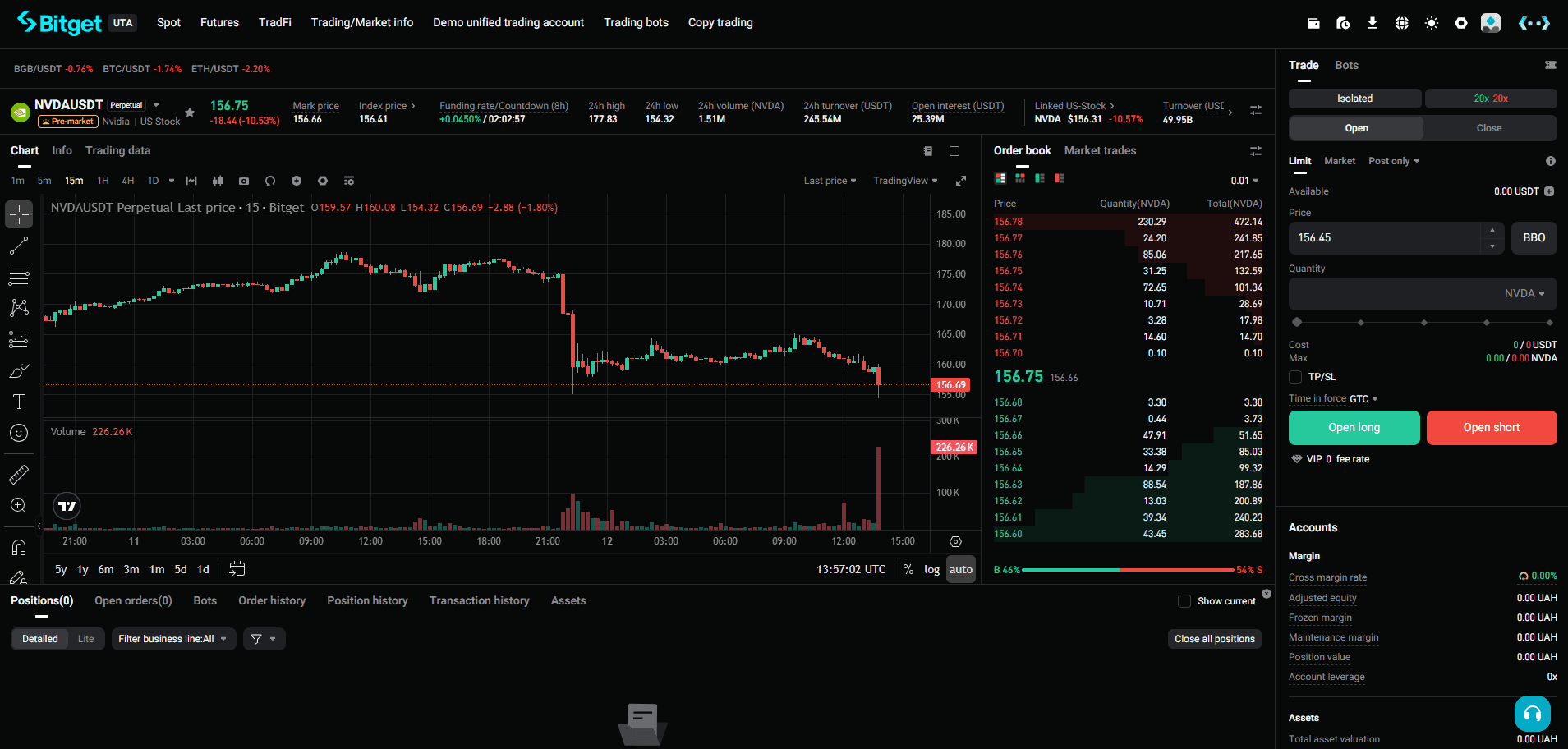
The main instrument categories are:
- Forex — currency pairs, including major pairs and selected exotic instruments.
- Precious metals — gold, silver, and other metals.
- Stock indices — contracts based on changes in the value of leading stock market indices.
- Commodities — oil, natural gas, and agricultural products.
Trading is conducted primarily through CFDs, using USDT for collateral and settlement. This allows users to speculate on changes in asset values without physically purchasing them.
Unlike the cryptocurrency market, TradFi follows the trading hours of the relevant financial venues. Separate conditions also apply to spreads, fees, leverage, and position rollover.
Demo Trading
Bitget provides a free demo account that allows users to practice trading without risking real funds. Users receive a virtual balance that they can use to open positions, test strategies, and become familiar with the exchange's trading instruments.
Demo trading is available in two main markets:
- Cryptocurrency futures — USDT-M, USDC-M, and Coin-M contracts are supported. Users can open long and short positions, apply leverage, and place market and limit orders.
- TradFi (CFD) — allows users to practice trading currency pairs, precious metals, and other traditional assets. The CFD demo account includes a virtual balance and the ability to test various trading strategies.
To start demo futures trading, simply sign in to a Bitget account and select Futures → Demo Trading. For CFDs, the corresponding trading account must first be activated, after which users can go to the TradFi section and select demo mode.
Quotes in demo mode reflect real market conditions, but trade execution may differ from trading on a live account. Virtual funds cannot be withdrawn or transferred to the main balance. The CFD demo account remains active for 30 days and can then be reactivated.
Onchain Trading
Bitget Onchain provides access to decentralized market tokens directly through the exchange interface. The service combines the capabilities of a centralized platform with blockchain network trading tools.
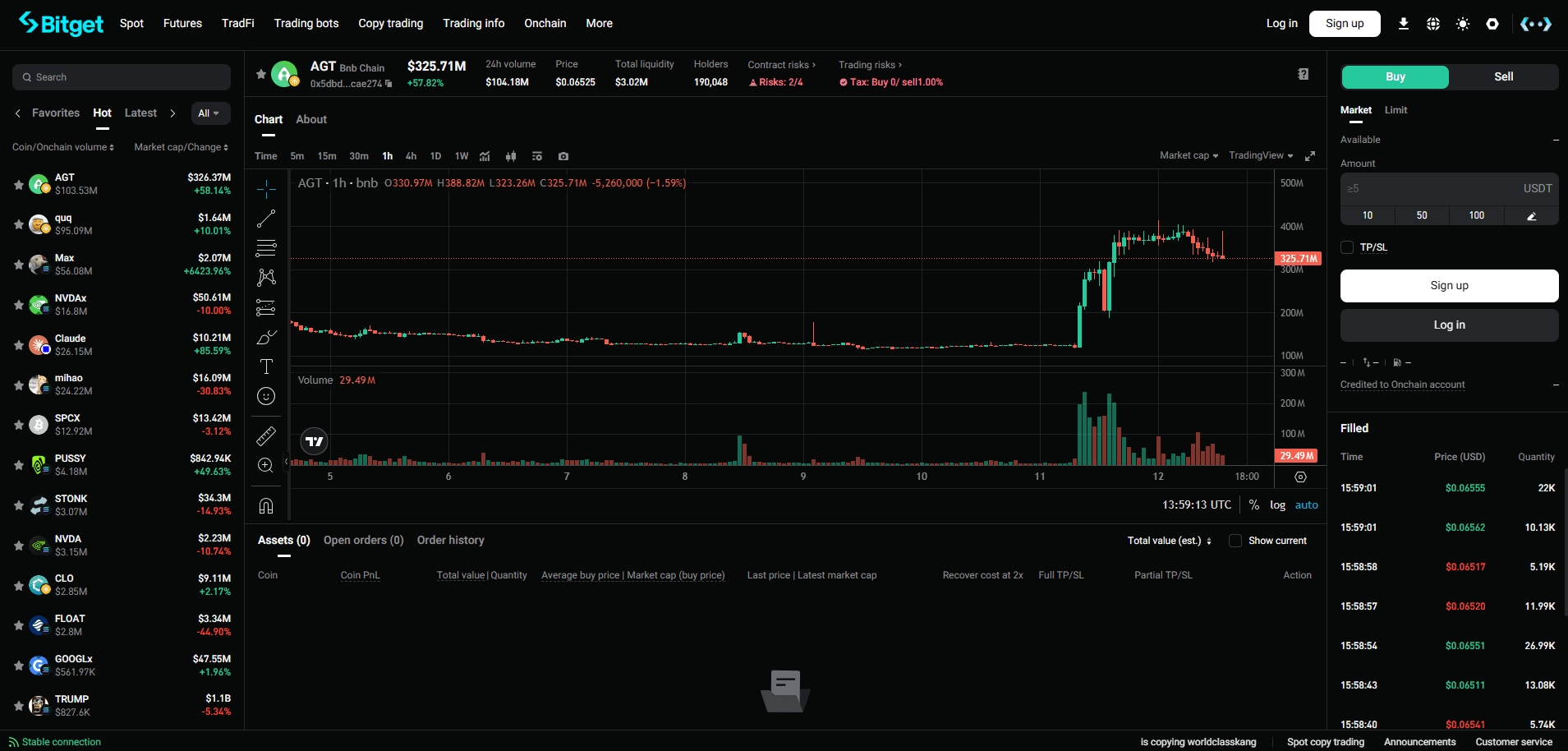
Users can search for and buy tokens from various networks, including Ethereum, Solana, BNB Chain, and Base, without having to connect third-party Web3 wallets themselves. Supported assets, including USDT and USDC, are used for trading.
The service also provides information about token liquidity, holders, smart contracts, and market activity.
Cryptocurrency Conversion
Bitget Convert is a service for quickly exchanging digital assets without using a full trading terminal.
The user selects the cryptocurrency to exchange, enters the required amount, and receives a preliminary conversion rate. After the transaction is confirmed, the purchased assets are credited to the spot balance.
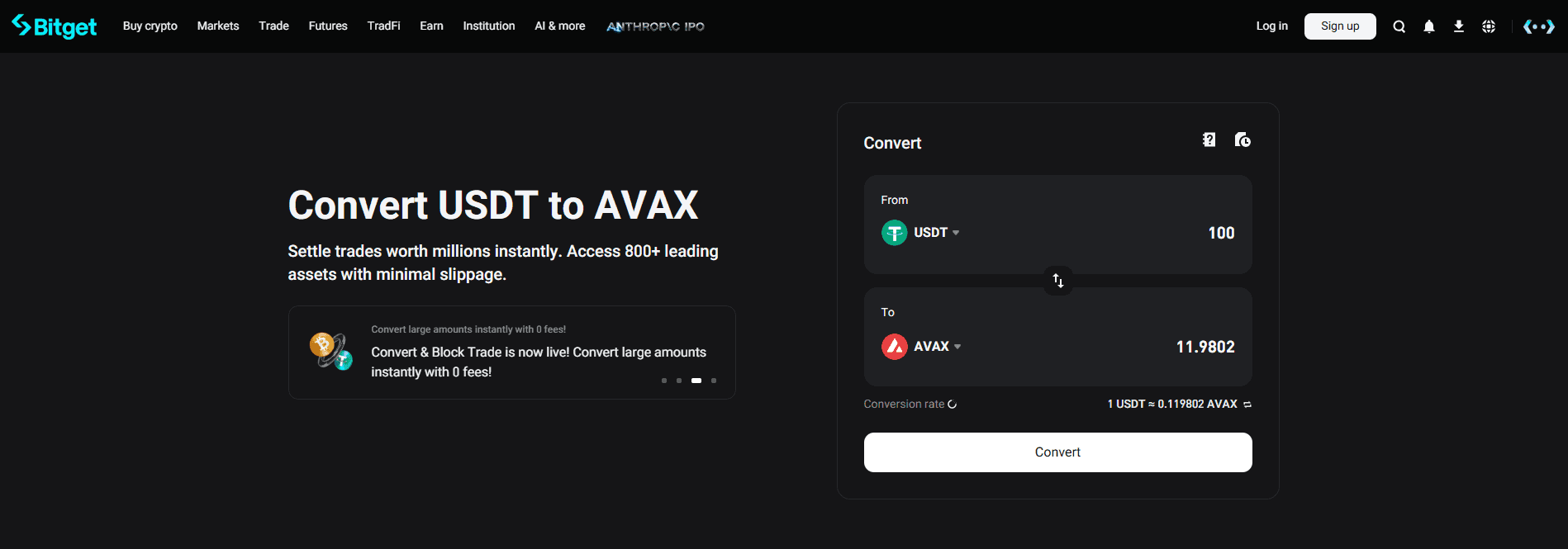
Bitget does not charge a separate trading fee for conversion, although the offered rate may differ from the current market price.
Buying Cryptocurrency and P2P Trading
Bitget provides several ways to purchase digital assets with fiat money. Depending on the country, users can pay for purchases with Visa and Mastercard bank cards, bank transfers, or third-party payment services.
To make a purchase, users must select the fiat currency, cryptocurrency, and payment method. The final cost depends on the payment provider, exchange rate, and applicable fees.
An alternative is P2P trading, which allows users to buy and sell cryptocurrencies directly among themselves.
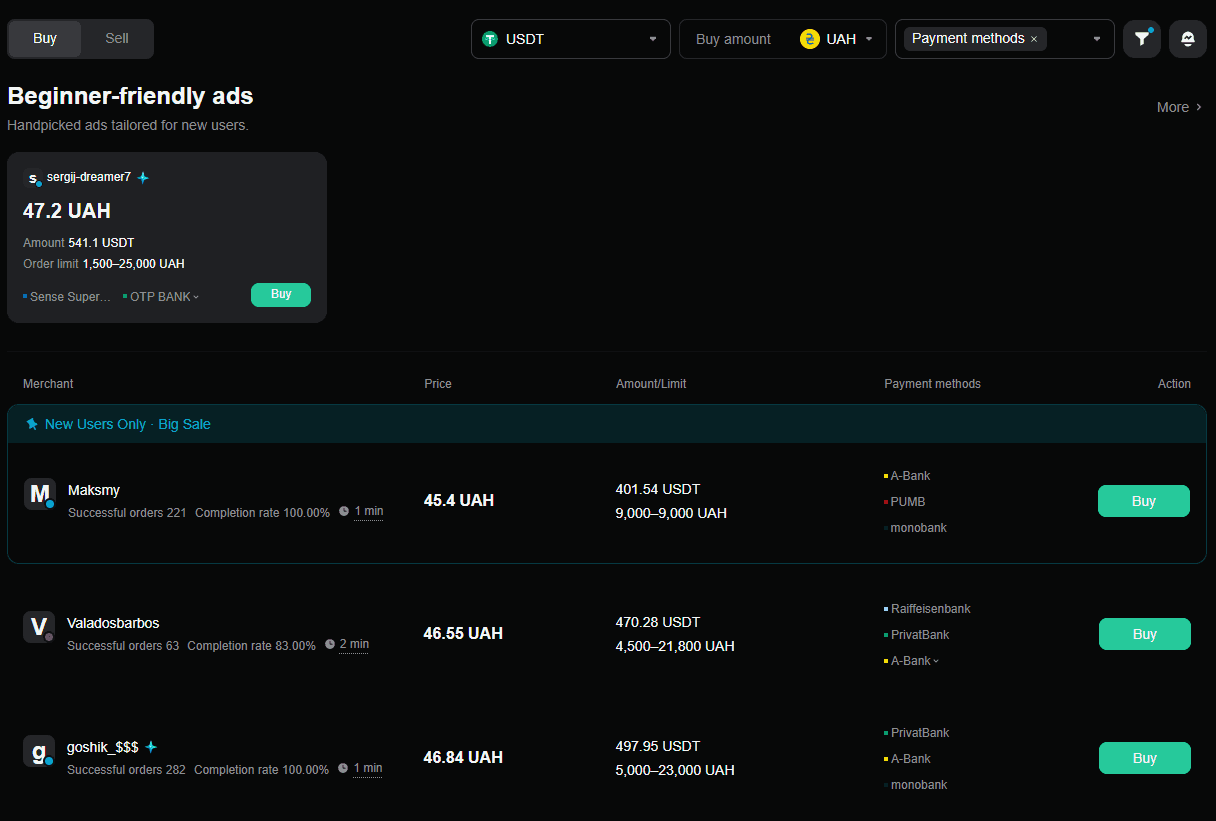
On the P2P marketplace, traders choose listings based on the rate, limits, and payment methods. To protect transactions, Bitget uses an escrow mechanism: the seller's cryptocurrency is locked until fulfillment of the transaction terms is confirmed.
Bitget does not charge a separate fee for standard P2P transactions, although fees from the payment systems used may apply.
Despite the escrow mechanism, users should check the reputation of counterparties and confirm that payment has actually been received before releasing the cryptocurrency.
OTC Trading
Bitget offers over-the-counter trading (Over-the-Counter, OTC) for large cryptocurrency transactions without direct execution through the public order book.
The main advantage of OTC trading is the ability to agree on the price and transaction volume in advance, reducing slippage and the impact of a large order on the market.
These transactions are primarily intended for professional traders, institutional investors, and clients with substantial capital. Currency availability, minimum volumes, verification requirements, and settlement terms depend on the specific service.
Trading Bots
Bitget offers automated trading tools that allow users to implement strategies without constantly placing orders manually.
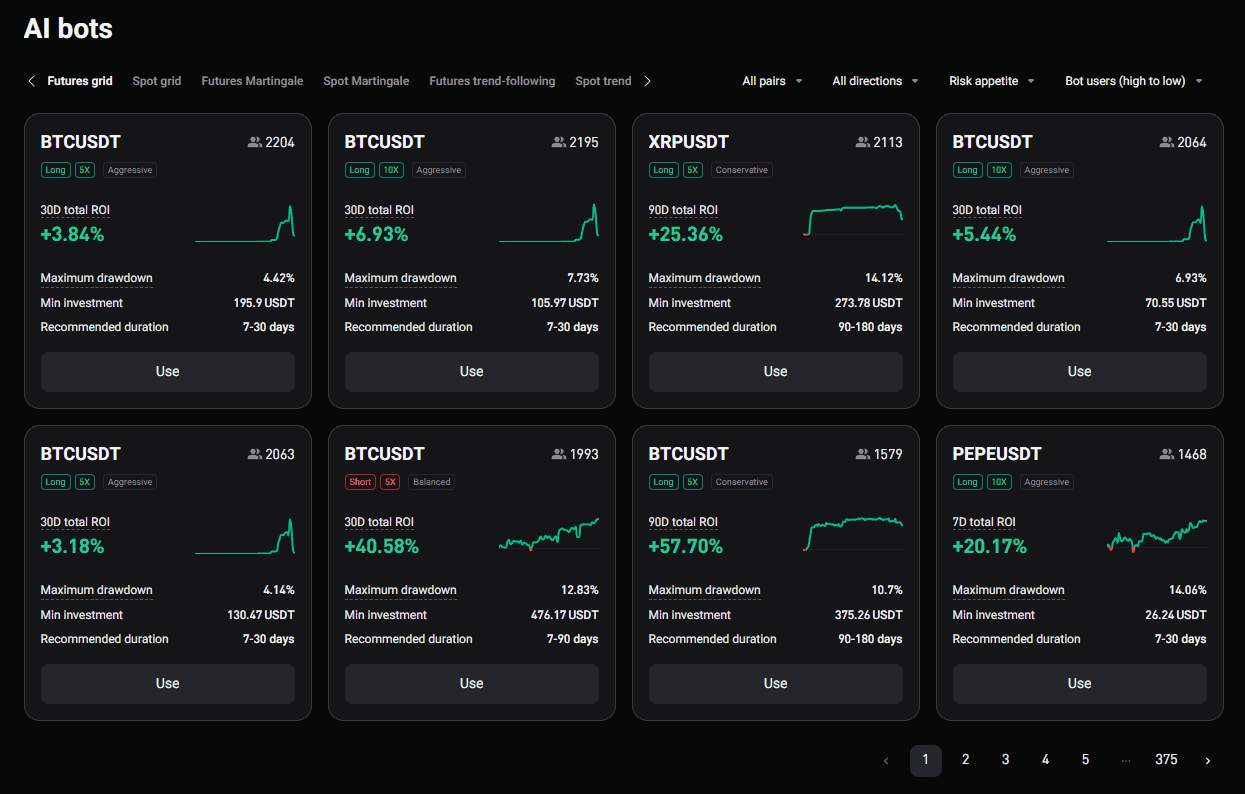
The main types of trading bots include:
- Spot Grid — automated buying and selling of cryptocurrencies within a specified price range.
- Futures Grid — grid trading in futures with the option to use leverage.
- Martingale — a strategy that increases the position when the price moves unfavorably.
- Auto-Invest — recurring cryptocurrency purchases according to a set schedule.
- Trend Following — trading based on signals from technical indicators.
- Smart Portfolio — automatic rebalancing of a cryptocurrency portfolio.
Users can set strategy parameters themselves or choose preset configurations offered by the platform.
Most standard bots do not require a separate usage fee, but regular trading fees still apply.
Automation simplifies strategy execution but does not guarantee profits. Risks are particularly high when using leverage and Martingale strategies.
Copy Trading
Copy trading is one of Bitget's best-known features, allowing users to automatically replicate the trades of other traders.
The platform offers strategy copying on spot and futures markets, as well as for selected CFD instruments where this feature is available.
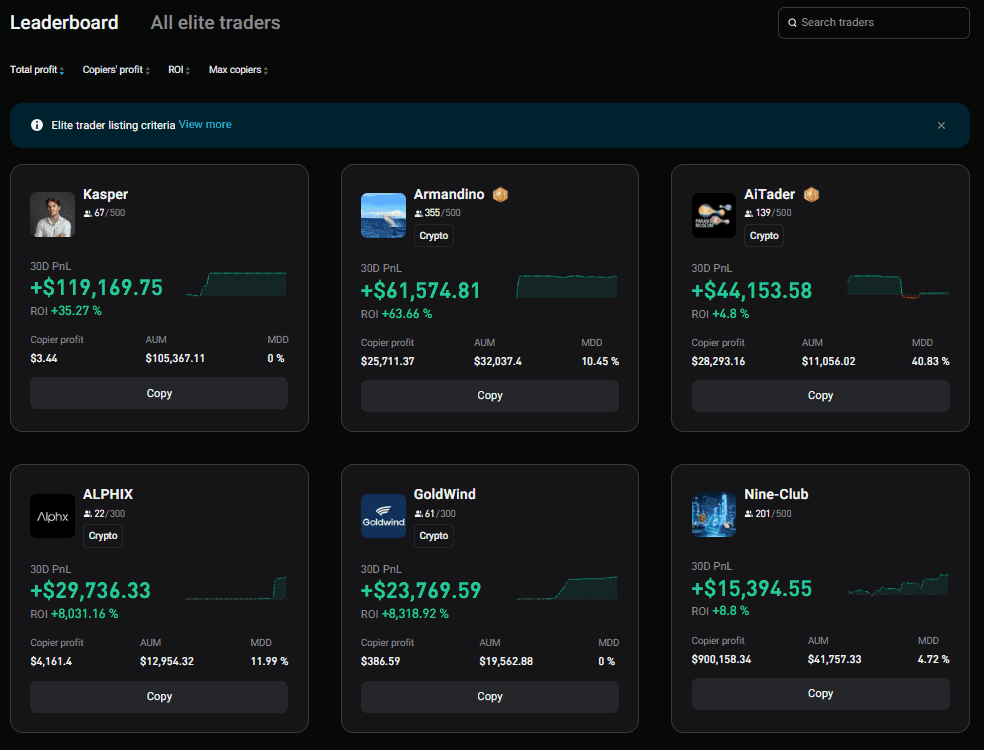
Users can select a lead trader based on statistics including returns, drawdown, trading history, and number of followers.
Before connecting a strategy, users can configure the investment amount, copying rules, and risk limits. The system then automatically opens and closes the corresponding positions.
Copying may incur standard trading fees and compensation for the lead trader in the form of a share of the profits earned.
Copy trading allows users to participate in the market without independently analyzing every trade, but it does not eliminate losses. Followers' results may also differ from the selected trader's statistics because of slippage, execution delays, and copy settings.
AI Tools
Bitget is developing artificial intelligence tools for market analysis, trading process automation, and strategy management.
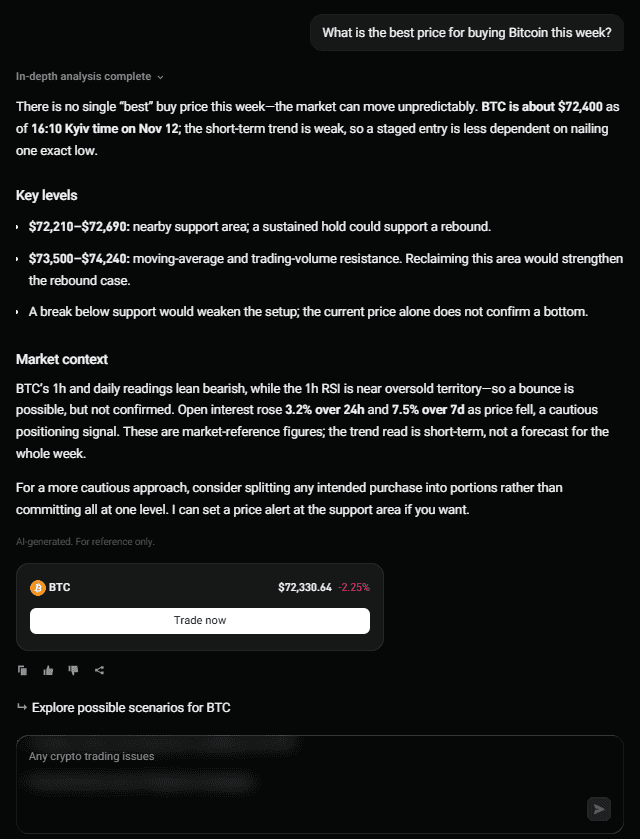
One of the main solutions is GetAgent — an intelligent assistant integrated into the trading platform. It allows users to analyze market data, identify trading opportunities, examine positions, and configure notifications using natural-language queries.
For automatic strategy execution, Bitget offers a separate tool GetClaw. It can execute trading commands and monitor specified conditions through a dedicated subaccount isolated from the user's main balance.
API
Bitget provides an API for connecting third-party applications, algorithmic systems, and professional trading terminals.
Through the API, users can obtain market quotes, order book and balance information, place orders, manage positions, and automate trading operations.
REST API and WebSocket are supported for retrieving data and interacting with the trading infrastructure.
Users can create API keys with different permissions and apply additional security measures, including access restrictions by IP addresses.
The API is aimed at algorithmic traders, trading bot developers, market makers, and institutional clients. Available features and request limits depend on the account type and service level.
Bitget Earn
Bitget Earn is a suite of investment products that allow users to potentially earn returns on deposited cryptocurrencies.
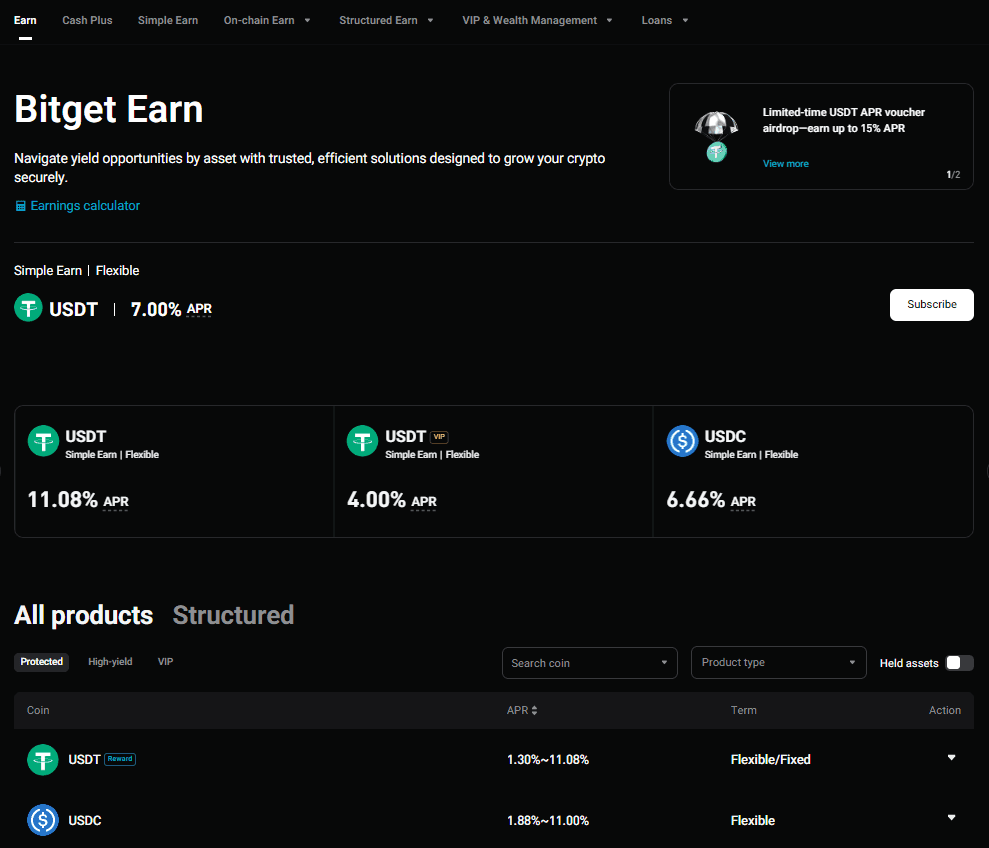
The platform offers several ways to use digital assets:
- Simple Earn Flexible — depositing cryptocurrencies with flexible withdrawal options.
- Simple Earn Fixed — fixed-term products.
- On-chain Earn — earning rewards through supported blockchain mechanisms.
- Shark Fin — structured products whose returns depend on market behavior.
- Dual Investment — investment products settled in one of two cryptocurrencies depending on the market price.
Returns, investment periods, minimum amounts, and early withdrawal conditions depend on the selected product.
Launchhub
Bitget Launchhub combines services for participating in new cryptocurrency projects, token distributions, and trading assets before their full market launch.
Launchhub includes:
- LaunchX — participation in the initial token distribution of new blockchain projects, including presales and airdrops.
- Launchpool — earning rewards in new tokens by depositing supported cryptocurrencies into dedicated pools.
- PoolX — participation in token deposit programs with different reward terms.
- Pre-Market — trading selected tokens before standard spot trading begins.
To participate in some programs, users must meet KYC requirements, hold certain assets in their account, or allocate funds for a set period.
Cryptocurrency card
New users are offered Bitget Wallet Card, which is issued through the separate Bitget Wallet app. The card is intended for paying for goods and services using crypto assets and, in supported regions, can be used with Apple Pay or Google Pay.
The availability of virtual and physical cards, fees, and service terms depends on the country of residence and the selected program.
VIP program and promotions
Bitget offers a multi-tier VIP program for active traders and users with substantial assets.
VIP status may be granted based on trading volume over the past 30 days, the amount of assets in the account, or holdings of the token BGB.
Depending on their tier, participants receive reduced trading fees, higher withdrawal limits, improved lending terms, and additional professional trading features. Large clients also receive expanded API capabilities, subaccounts, and personalized service.
Separate programs are available for institutional clients and market makers.
In addition, Bitget regularly runs promotions for new and existing users. These include welcome tasks, trading competitions, reward programs, CandyBomb campaigns, and bonuses for meeting certain conditions.
Rewards may be provided as tokens, trading bonuses, or fee coupons. Not all bonuses can be withdrawn as regular funds; their use is governed by the rules of the specific promotion.
Commissions
Bitget offers competitive trading fees on the spot and futures markets, along with a discount system for active users. Costs depend on the instrument type, VIP status, use of the BGB token, and the selected trading mode. In addition to standard fees, traders must consider funding for perpetual futures, spreads and swaps when trading CFDs, as well as withdrawal costs.
Spot trading fees
The standard fee charged by Bitget for spot trading is 0.1% for both makers and takers. The fee is charged when an order is executed, so when cryptocurrency is bought and subsequently sold, each transaction is charged separately.
Users can reduce trading costs through the VIP program or by paying fees with the BGB token. The latter provides an additional discount of 20%, reducing the standard rate to 0.08%.
Spot-market fees on Bitget by VIP level
VIP level | Trading volume over 30 days (USDT) | Maker | Taker | Maker / taker with BGB |
|---|---|---|---|---|
VIP0 | From 0 | 0.1% | 0.1% | 0.08% / 0.08% |
VIP1 | From 500 000 | 0.08% | 0.08% | 0.064% / 0.064% |
VIP2 | From 2 million | 0.065% | 0.07% | 0.052% / 0.056% |
VIP3 | From 8 million | 0.05% | 0.06% | 0.04% / 0.048% |
VIP4 | From 30 million | 0.04% | 0.05% | 0.032% / 0.04% |
VIP5 | From 50 million | 0.03% | 0.04% | 0.024% / 0.032% |
VIP6 | From 75 million | 0.02% | 0.035% | 0.016% / 0.028% |
VIP7 | From 100 million | 0% | 0.03% | 0% / 0.024% |
To obtain VIP status, meeting the trading-volume requirements is not mandatory. Bitget also considers the daily balance, the average amount of assets over 30 days, and holdings of the token BGB. It is sufficient to meet one of the specified conditions for the relevant level.
For example, when buying cryptocurrency for $1000, the standard fee is $1 and $0.80 when using BGB. For VIP3 users, a similar trade will cost $0.50 when the order is executed as a maker, or $0.60 as a taker, excluding the discount provided by BGB.
Overall, spot-market fees on Bitget are competitive, especially for users with high trading volume. Let us compare them with the standard rates of other major crypto exchanges.
Futures trading fees
Bitget uses a tiered fee system for cryptocurrency futures trading. The fee depends on the user's VIP status and whether the order adds liquidity to the order book (maker) or is filled against existing orders (taker).
For base-level VIP0 users, the fee is 0.036% for makers and 0.1% for takers. Reduced rates are available to active traders.
Futures-market fees on Bitget by VIP level
VIP level | Trading volume over 30 days (USDT) | Maker | Taker |
|---|---|---|---|
VIP0 | From 0 | 0.036% | 0.1% |
VIP1 | From 5 million | 0.035% | 0.1% |
VIP2 | From 10 million | 0.033% | 0.073% |
VIP3 | From 20 million | 0.014% | 0.0375% |
VIP4 | From 50 million | 0.012% | 0.035% |
VIP5 | From 100 million | 0.01% | 0.03% |
VIP6 | From 300 million | 0.008% | 0.03% |
VIP7 | From 1 billion | 0% | 0.02% |
These fees apply to USDT-M, USDC-M, and Coin-M contracts. The amount of assets in the account and the BGB token balance may also be considered when determining eligibility for a higher VIP level.
The fee is calculated on the notional value of the position, not the posted margin. For example, when opening a position worth $10 000, a VIP0 user will pay $3.60 as a maker or $10 as a taker at the rates shown in the table. The fee is charged again when the position is closed.
When trading perpetual futures, traders must also account for Funding Rate — periodic payments between holders of long and short positions. This is not a fee charged by Bitget: when the funding rate is positive, long position holders pay short position holders, and when it is negative, the reverse applies.
Overall, Bitget offers substantial discounts on futures trading for VIP clients. The most favorable terms are available to traders with high turnover, while base-level users should consider the full cost of opening and closing positions.
Compared with most major crypto exchanges, Bitget futures-market fees are quite high, especially for takers. More favorable terms are available to members of the VIP program, but substantial discounts require high trading volume or a large asset balance.
Fees for TradFi
For Bitget TradFi, trading costs depend on the selected CFD account mode. The exchange offers several pricing models: ECN, Pro, Zero Commission and Standard+.
In the ECN and Pro modes, per-lot trading fees apply, while in the Zero Commission and Standard+ modes, there is no separate fee because trading costs are included in the spread.
For ECN and Pro, the following base fees apply:
Instrument | VIP2 and below | VIP3 and above |
|---|---|---|
Forex | $6 per lot | $5.40 per lot |
Precious metals | $6 per lot | $5.40 per lot |
Commodities | $3 per lot | $2.70 per lot |
Oil | $3 per lot | $2.70 per lot |
Index JP225 | $0.10 per lot | $0.09 per lot |
Index HK50 | $1.50 per lot | $1.35 per lot |
Other contracts | $3 per lot | $2.70 per lot |
The specified commissions are charged once when a position is opened. For example, for a trade of 1 lot of EUR/USD a user with standard VIP status will pay $6 in commission. The market spread is also applied.
In Zero Commission mode, no separate commission is charged for opening a position, but the spread includes a standard markup. The same principle applies to Standard+, although the markup depends on the partner channel's terms.
When CFD positions are carried over to the next trading day, charges may apply in the form of swaps (Swap). Their amount depends on the instrument, position direction, and holding period. On certain days, swaps are charged three times to account for weekends.
Deposit and withdrawal fees
Bitget does not charge a fee for cryptocurrency deposits. The user only pays the blockchain network fee when sending funds from an external wallet or another exchange.
Cryptocurrency withdrawal fees depend on the selected asset, network, and current blockchain congestion. For example, the cost of withdrawing USDT may vary significantly between the Ethereum (ERC-20) and TRON (TRC-20) networks.
Separate terms apply to fiat currency transactions. For example, according to the published bank rates for individuals:
Currency | Transfer method | Deposit | Withdrawal |
|---|---|---|---|
EUR | SEPA / SEPA Instant | Free | €1 |
USD | SWIFT | Free | $30 |
BRL | Pix | Free | 2.6 BRL |
PLN | ZEN.com | 0.95% | 0.5% |
The listed rates are for reference and may vary depending on the payment partner, country of residence, and applicable restrictions. Intermediary banks may charge additional fees.
When purchasing cryptocurrency with Visa and Mastercard bank cards, costs depend on the payment provider and the terms of the specific transaction. Before confirming the purchase, the user sees the final exchange rate, fee, and amount of cryptocurrency to be received.
For P2P trading, Bitget does not set a standard transaction fee, although the payment system or bank may charge fees. The service Bitget Convert also allows cryptocurrencies to be exchanged without a separate fee, but the difference between the buy and sell rates is included in the quoted price.
Deposit and Withdrawal
Bitget offers a wide range of deposit and withdrawal methods, including cryptocurrency transfers, bank payments, purchases of digital assets using cards, and P2P trading. The exchange supports various fiat currencies and local payment systems, making it accessible to users from many countries. However, the available payment methods, fees, and processing times depend on the user's region of residence.
To use the main payment functions, users must complete identity verification (KYC). Most cryptocurrency transactions are processed quickly, while bank transfers may take several business days.
Cryptocurrency deposits
Bitget allows users to deposit cryptocurrencies from external wallets and other exchanges. Supported assets include Bitcoin, Ethereum, USDT, USDC, Solana, and many other digital assets.
To deposit cryptocurrency on Bitget, you must:
- Log in to your account and go to the Deposit section.
- Select a cryptocurrency, such as BTC, ETH or USDT.
- Specify the blockchain network. For USDT the available networks may include Ethereum (ERC-20), TRON (TRC-20) and other networks.
- Select the account to which funds will be credited, such as Spot or Funding.
- Copy the deposit wallet address or use the QR code.
- Send the cryptocurrency from an external wallet and wait for transaction confirmation.
It is important to select the correct transfer network. For example, if the selected USDT deposit address is on the TRC-20 network, funds must not be sent via ERC-20. A network mismatch may result in the permanent loss of cryptocurrency. Some assets also require a Memo or Tag.
Bitget does not charge a fee for cryptocurrency deposits. The user only pays the fee charged by the sending network or external platform.
The crediting time depends on the blockchain and the number of required confirmations. In most cases, a transfer takes from a few minutes to an hour, although network congestion may cause delays. The transaction status can be checked using the transaction identifier TxID.
Fiat deposits
Bitget supports several fiat deposit methods, including bank transfers, payment cards, and local payment services.
Main deposit methods
- Bank transfers. Users in supported countries can deposit funds in EUR via SEPA or SEPA Instant, in USD via SWIFT, in BRL via Pix, and in other currencies through local banking channels.
- Bank cards. Purchase cryptocurrency using Visa and Mastercard. The user specifies an amount in fiat currency and then receives the selected cryptocurrency in their Bitget account.
- Third-party payment services. Depending on the region, additional providers may be available for purchasing cryptocurrency and processing bank payments.
- P2P trading. Purchase cryptocurrency directly from other users using bank transfers, electronic wallets, and local payment systems.
For a direct bank deposit, go to Buy Crypto → Bank Deposit, select the currency and payment method, enter the amount, and follow the payment instructions.
For a bank transfer, the account holder's name must match the name provided during Bitget verification. Some methods require users to create a deposit request in advance and transfer the exact specified amount.
Examples of supported bank transfers
Currency | Deposit method | Fee |
|---|---|---|
EUR | SEPA / SEPA Instant | 0 EUR |
USD | SWIFT | 0 USD |
BRL | Pix | 0 BRL |
PLN | ZEN.com | 0.95% |
CZK | ZEN.com | 1.10% |
AUD | ZEN.com | 1.10% |
The listed rates apply to standard terms for individuals. Banks and payment intermediaries may charge additional fees.
Crediting time depends on the transfer method. For example, transactions via SEPA usually take 1–3 business days, while USD transfers via SWIFT take up to two business days after the required checks have been completed. Some local payment systems process transfers much faster.
When purchasing cryptocurrency with a bank card, the user immediately sees the final exchange rate and the amount of digital assets that will be credited to the account. This transaction differs from a regular fiat deposit because the user purchases cryptocurrency directly when making the payment.
Also worth noting is Bitget P2P, which supports more than 100 payment methods. The user selects a seller's listing, transfers the money, and receives the cryptocurrency after the payment is confirmed. To protect the transaction, Bitget temporarily locks the seller's assets through an escrow mechanism.
The commission charged by Bitget for standard P2P trades is zero, but the exchange rate is set by market participants, and payment systems may charge their own fees.
Cryptocurrency withdrawals
Bitget allows users to withdraw cryptocurrencies to external wallets and other exchanges. To do so, users must complete KYC and configure the transaction confirmation methods provided by the system, including two-factor authentication.
To withdraw cryptocurrency, you must:
- Go to Assets → Withdraw.
- Select a cryptocurrency to withdraw, such as BTC, ETH or USDT.
- Select the transfer type On-Chain Withdrawal.
- Enter the recipient's wallet address.
- Select the blockchain network and specify the amount.
- Check the fee and the final amount to be received.
- Confirm the transaction via email, SMS or an authenticator app.
Bitget supports withdrawals of many cryptocurrencies through multiple networks. For USDT the available networks may include Ethereum (ERC-20), TRON (TRC-20), BNB Smart Chain and other supported blockchains.
The withdrawal fee depends on the cryptocurrency and selected network. Its exact amount is displayed before the transaction is confirmed. Users are advised to compare the available networks because the cost of transferring the same asset may vary significantly.
Most requests are processed within a few minutes, after which users must wait for blockchain confirmations. Delays may occur during high network load, maintenance, or additional security checks.
For transfers between accounts on Bitget, an internal transfer function (Internal Transfer) is also available. Such transactions are usually processed without a blockchain fee.
Fiat withdrawals
Bitget supports fiat currency withdrawals to bank accounts through available regional payment channels. If the funds are held in cryptocurrency, they must first be exchanged for a supported fiat currency.
Main withdrawal options
- SEPA / SEPA Instant — withdrawals in EUR to bank accounts in supported European countries.
- SWIFT — bank transfers in USD for users in permitted jurisdictions.
- Pix — withdrawals in BRL to bank accounts in Brazil.
- ZEN.com — transfers in PLN and several other supported currencies.
- Local bank transfers — for selected countries, including Vietnam and South Africa.
- P2P trading — selling cryptocurrency to other users and receiving payment in a bank account or electronic wallet.
For a standard bank withdrawal, go to Assets → Withdraw → Fiat, select the currency and transfer method, and enter the bank details. After confirming the request, its status can be tracked in the transaction history.
The recipient's bank account must belong to the holder of a verified account on Bitget. Third-party accounts are not permitted.
Fiat withdrawal fees
Currency | Withdrawal method | Fee |
|---|---|---|
EUR | SEPA / SEPA Instant | 1 EUR |
USD | SWIFT | 30 USD |
BRL | Pix | 2.60 BRL |
PLN | ZEN.com | 0.50% |
CZK | ZEN.com | 0.50% |
AUD | ZEN.com | 0.50% |
Rates may vary depending on the payment provider and user category. Intermediary banks may also deduct additional fees.
Withdrawal speed depends on the selected method. For example, transfers via SEPA usually take 1–2 business days, while USD via SWIFT takes up to two business days. Processing times may increase if bank details must be verified or additional identification is required.
An alternative to bank withdrawals is P2P trading. The user sells cryptocurrency to another participant, who transfers the money directly to the agreed bank account or electronic wallet.
This method is especially useful in countries where direct fiat transfers through Bitget are restricted. However, for P2P transactions, you must carefully verify the counterparty and confirm that the money has actually arrived before transferring the cryptocurrency. A payment screenshot is not sufficient proof of payment.
Limits
Bitget sets withdrawal limits based on verification status and the user's VIP level. Full access to deposits, trading, and withdrawals requires mandatory identity verification.
The following daily cryptocurrency withdrawal limits apply to verified users:
VIP level | Withdrawal limit over 24 hours |
|---|---|
VIP0 | 3 000 000 USDT |
VIP1 | 4 000 000 USDT |
VIP2 | 6 000 000 USDT |
VIP3 | 8 000 000 USDT |
VIP4 | 10 000 000 USDT |
VIP5 | 12 000 000 USDT |
VIP6 | 15 000 000 USDT |
VIP7 | 20 000 000 USDT |
Thus, even users at the standard VIP0 level have access to a cryptocurrency withdrawal limit equivalent to up to 3 million USDT per 24 hours. Limits are significantly higher for professional traders and large investors.
Markets and Products
Bitget offers one of the broadest ranges of trading instruments among major crypto exchanges. In addition to spot and futures trading, users can access margin trading, copy trading, automated strategies, investment products, and on-chain trading. With the expansion of its TradFi offering, the exchange also provides access to traditional financial markets, including Forex, precious metals, stock indices, and stocks.
A distinctive feature of Bitget is its aim to bring crypto and traditional assets together within a single ecosystem. This makes the platform attractive not only to crypto traders but also to investors seeking to diversify their portfolios.
Main markets and services of Bitget
Let's examine the main markets and products available on Bitget:
Category | Products and services | Description |
|---|---|---|
Spot trading | Spot Trading | Buying and selling cryptocurrencies, including BTC, ETH, SOL and altcoins. Market, limit, and conditional orders. |
Margin trading | Cross Margin, Isolated Margin | Trading cryptocurrencies using borrowed funds. Long and short positions are available. |
Futures | USDT-M Futures | Perpetual futures contracts collateralized and settled in USDT. |
Futures | USDC-M Futures | Futures collateralized and settled in USDC. |
Futures | Coin-M Futures | Cryptocurrency futures collateralized and settled in the underlying cryptocurrencies. |
TradFi | Forex, metals, indices, commodities | CFDs on traditional financial instruments using USDT for collateral and settlement. |
Tokenized assets | Spot Stocks, rTokens, Ondo | Trading tokenized shares of U.S. companies, ETFs and instruments linked to precious metals. |
Equity derivatives | Stock Futures, Stock+ Options | Perpetual contracts on stocks and ETFs, options on U.S. securities, including multi-leg options strategies. |
On-chain trading | Bitget Onchain | Buying and selling tokens from the Ethereum, Solana, BNB Chain, Base, and other blockchain networks directly through the exchange interface. |
Copy trading | Spot, Futures, CFD Copy Trading | Automatically copying other traders' trades in supported markets. |
Automated trading | Spot Grid, Futures Grid, Martingale, Auto-Invest | Trading bots for grid strategies, automated investing, and other algorithms. |
Conversion and OTC | Bitget Convert, OTC | Quick cryptocurrency conversion at the quoted rate and execution of large over-the-counter trades. |
P2P trading | Bitget P2P | Buying and selling cryptocurrencies between users through bank transfers and local payment systems. |
Investment products | Simple Earn, On-chain Earn | Flexible and fixed-term products for earning returns by depositing cryptocurrencies. |
Structured products | Dual Investment, Shark Fin | Investment instruments with returns that depend on market conditions. |
Cryptocurrency lending | Crypto Loans | Obtaining loans secured by cryptocurrency assets. |
New tokens | LaunchX, Launchpool, PoolX, Pre-Market | Participation in new token distributions, reward programs, and pre-market trading. |
Web3 | Bitget Wallet | A non-custodial cryptocurrency wallet supporting DeFi, NFT, DApps, and token swaps. |
Payment services | Bitget Wallet Card | Payment for goods and services using cryptocurrency assets in supported countries. |
Tools for professionals | API, VIP, Institutional Services | Algorithmic trading, external system integration, and customized terms for large clients and market makers. |
Artificial intelligence | GetAgent, GetClaw | Market analysis, identification of trading opportunities, and automation of specific trading operations. |
Particularly noteworthy is the development of traditional financial markets on Bitget. In 2026, the exchange significantly expanded its range of instruments by adding trading in CFDs, tokenized stocks, and ETFs, as well as derivative contracts on equity instruments.
In July 2026, Bitget announced the launch of more than 2800 options contracts on U.S. stocks and ETFs. Multi-leg options strategies, including Vertical Spreads, Straddle, Strangle, and Collar, were introduced later. Thus, the exchange's range is no longer limited to cryptocurrency derivatives.
Supported cryptocurrencies
Bitget supports hundreds of digital assets, including the largest cryptocurrencies by market capitalization, popular altcoins, stablecoins, DeFi tokens, and new blockchain projects.
On Bitget, approximately 860 digital assets and more than 900 trading pairs are available. This list also includes some tokenized financial instruments.
For comparison, here are the numbers of assets and trading pairs available on several major crypto exchanges.
Bitget offers a wide selection of assets across various categories:
- Largest cryptocurrencies: Bitcoin (BTC), Ethereum (ETH), Solana (SOL), XRP, BNB, Cardano (ADA), Dogecoin (DOGE).
- Stablecoins: Tether (USDT), USD Coin (USDC) and other supported fiat-pegged assets.
- DeFi tokens: Uniswap (UNI), Aave (AAVE), Chainlink (LINK), Hyperliquid (HYPE).
- Blockchain infrastructure: Avalanche (AVAX), Polkadot (DOT), Arbitrum (ARB), Optimism (OP), Sui (SUI).
- Memecoins: Shiba Inu (SHIB), Pepe (PEPE), Bonk (BONK) and other speculative assets.
- Exchange token: Bitget Token (BGB), used to receive trading fee discounts and participate in selected platform programs.
The exchange regularly adds new projects, including tokens from the artificial intelligence, Web3, GameFi, and decentralized finance sectors. However, the availability of specific assets depends on listing status, liquidity, and regional restrictions.
In addition to the centralized spot market, Bitget Onchain allows users to trade tokens that have not yet received a full exchange listing. This gives users access to early-stage crypto projects, although such assets typically have greater volatility and fraud risk.
Bitget also supports numerous blockchain networks, including Ethereum, TRON, BNB Smart Chain, Solana, Arbitrum, Optimism, Base, and Avalanche. Some tokens can be transferred over multiple networks, allowing users to choose the most convenient and cost-effective transaction method.
Trading Platforms
Bitget offers a wide range of trading platforms for beginners and professional traders. Users can access a web terminal, mobile apps for iOS and Android, desktop clients for Windows and macOS, as well as integrations with TradingView and MetaTrader 5. For algorithmic trading, an API is available, enabling users to connect third-party programs and develop their own trading bots.
The platforms from Bitget combine technical analysis tools, order and position management, copy trading, and automated strategies. This allows users to choose the most convenient way to trade based on their objectives and experience.
Web platform
The web terminal from Bitget runs directly in a browser and does not require additional software installation. It provides access to spot, margin, and futures trading, as well as TradFi markets, on-chain tokens, and investment services.
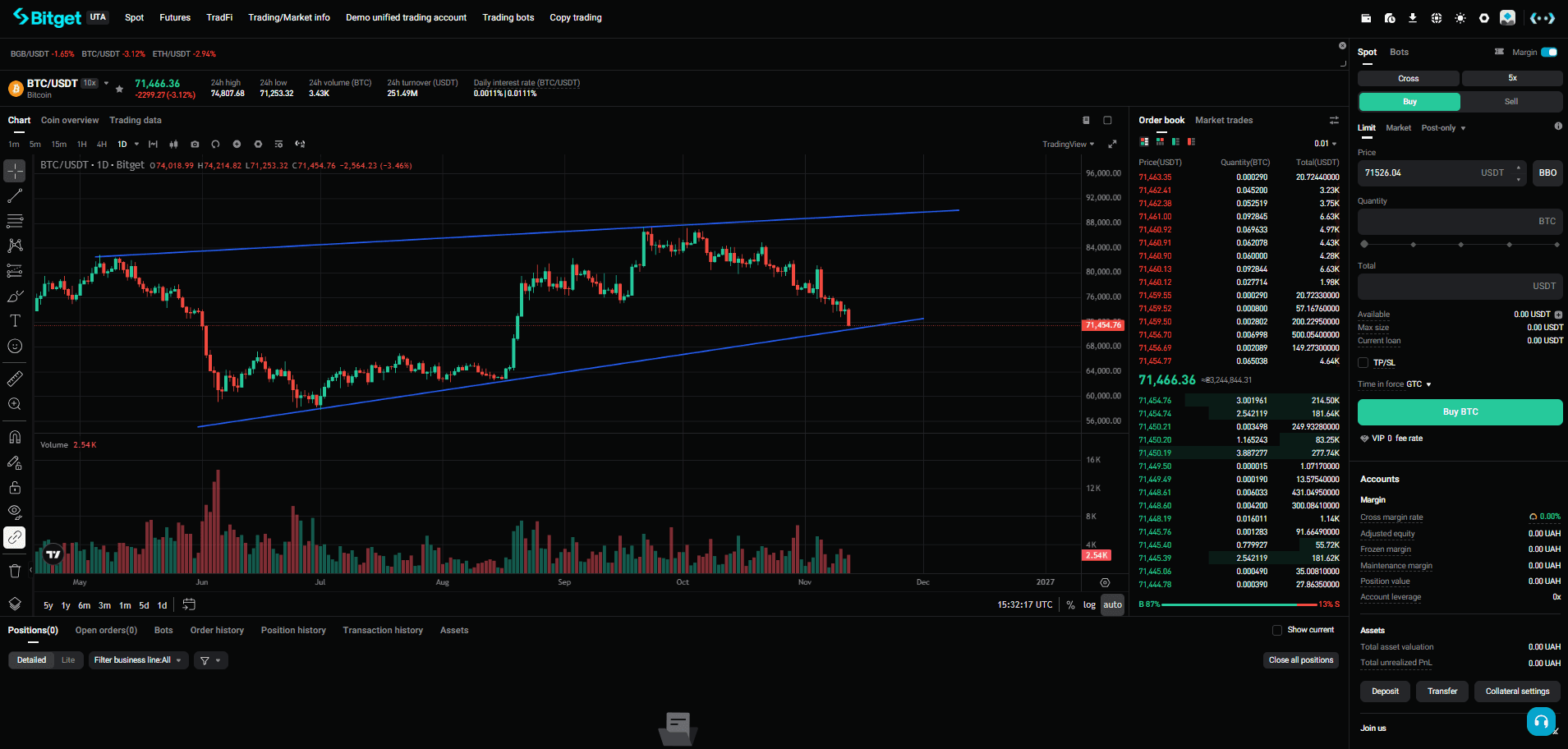
The interface includes price charts, an order book, trade history, an order entry panel, and information on open positions. Users can switch between trading pairs, track their balance, and manage multiple instruments.
Key features of the web platform from Bitget
- Charts from TradingView. Built-in technical analysis tools with indicators, drawing objects, multiple time frames, and display settings.
- Various order types. Support for market, limit, and conditional orders, Stop Loss, Take Profit, OCO, Trailing Stop, Iceberg, and TWAP for the relevant markets.
- Futures trading. Management of leverage, margin modes, and long and short positions, as well as monitoring liquidation risks.
- Copy trading and trading bots. The ability to select lead traders, track strategy performance, and launch automated trading.
- CFD trading. Access to Forex, metals, commodities, and stock indices through a separate trading interface.
- Asset management. Transfers between accounts, transaction history, deposits, and withdrawals.
The integration with TradingView deserves particular attention. Users can apply chart analysis tools, plot support and resistance levels, use technical indicators, and save their own settings.
Mobile apps
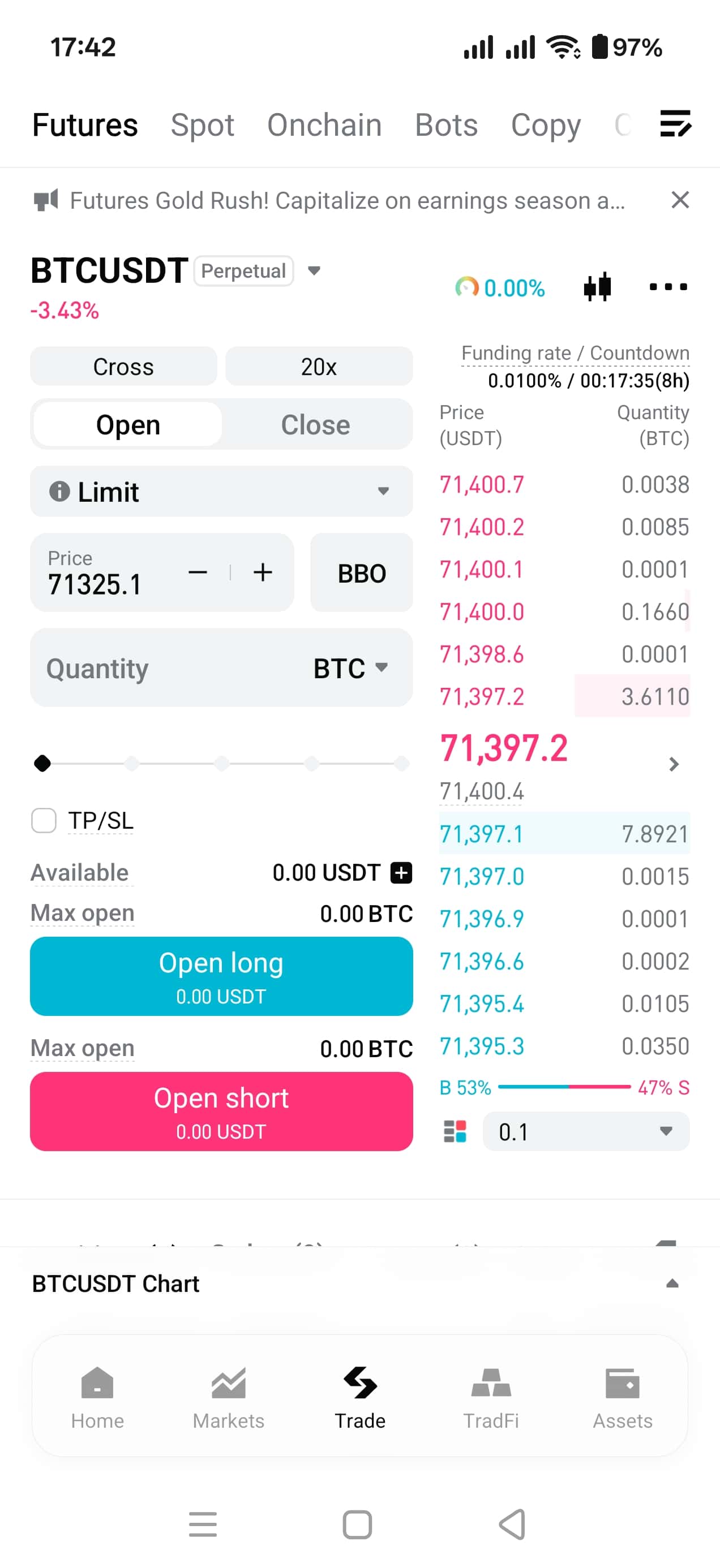
Bitget offers mobile apps for Android and iOS, allowing users to manage nearly all aspects of their trading account from a smartphone. The app can be downloaded through the App Store, Google Play, Huawei AppGallery, or the exchange's official website.
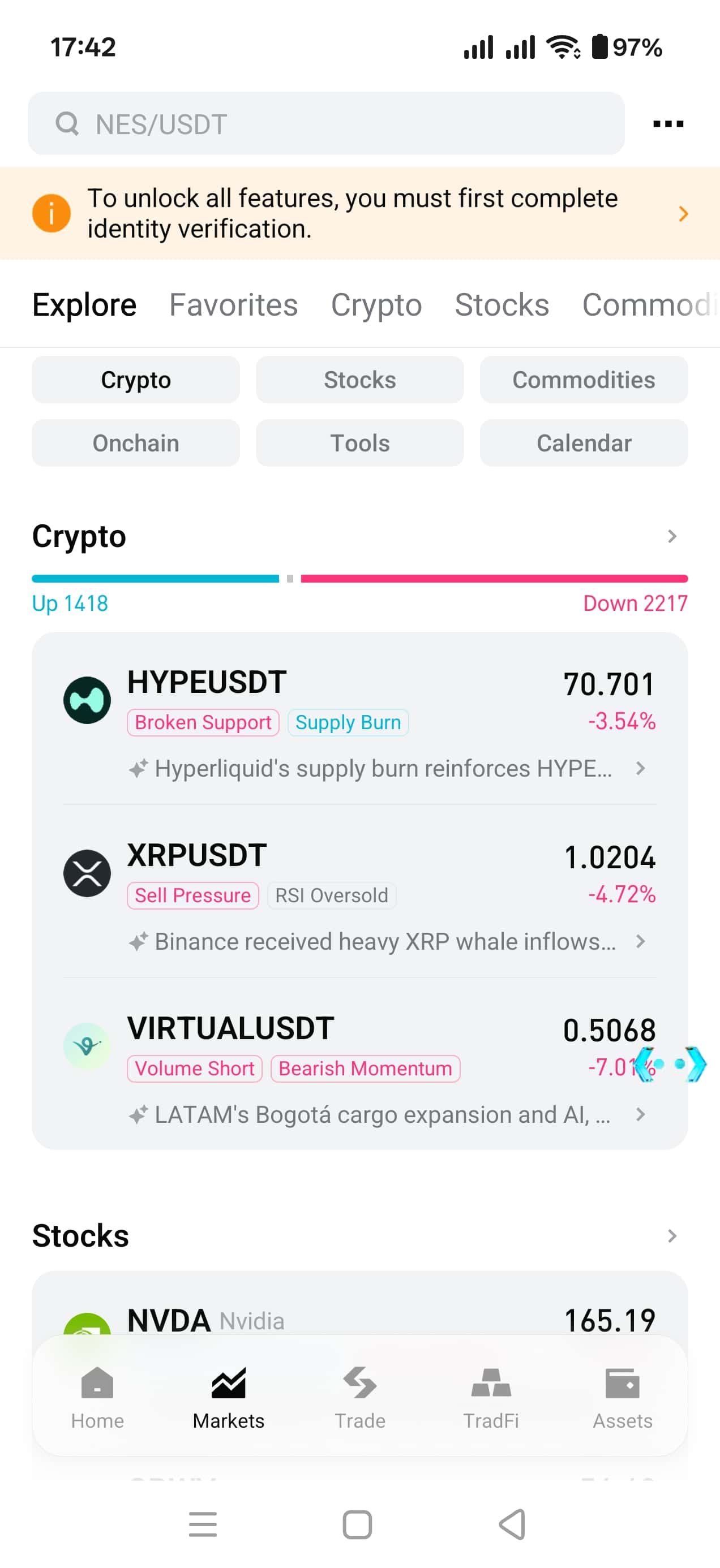
The mobile version provides access to the main trading and investment services:
- Spot, margin, and futures trading.
- Viewing charts, quotes, the order book, and trade history.
- Placing market, limit, and conditional orders.
- Managing open positions, Stop Loss, and Take Profit.
- Copy trading, trading bots, and investment products from Bitget Earn.
- Buying cryptocurrency, P2P trading, deposits, and withdrawals.
- Receiving notifications about price changes and the status of trading operations.
Account protection includes two-factor authentication, access using Passkey, and additional transaction confirmation methods. Biometric authentication support depends on the device and security settings.
The mobile app features convenient navigation and allows users to respond quickly to market changes. However, its chart analysis capabilities are more limited than those of the web version: the full set of drawing tools and advanced chart settings from TradingView is primarily available in the browser.
For users who need a separate non-custodial wallet, the company also offers Bitget Wallet. This is a standalone app for storing cryptocurrencies and interacting with DeFi protocols and Web3 services. It should be distinguished from the main trading app from Bitget.
Desktop app
Bitget offers separate desktop apps for Windows and macOS. They can be installed from the exchange's official download page and used to access trading services without having to keep the website open in a browser.
The desktop client provides access to the main features of Bitget, including cryptocurrency trading, order management, chart viewing, and balance monitoring. It is primarily intended for users who prefer to work on a computer.
For experienced traders, an additional advantage is the ability to use the exchange with professional analytical tools and external trading programs.
MetaTrader 5
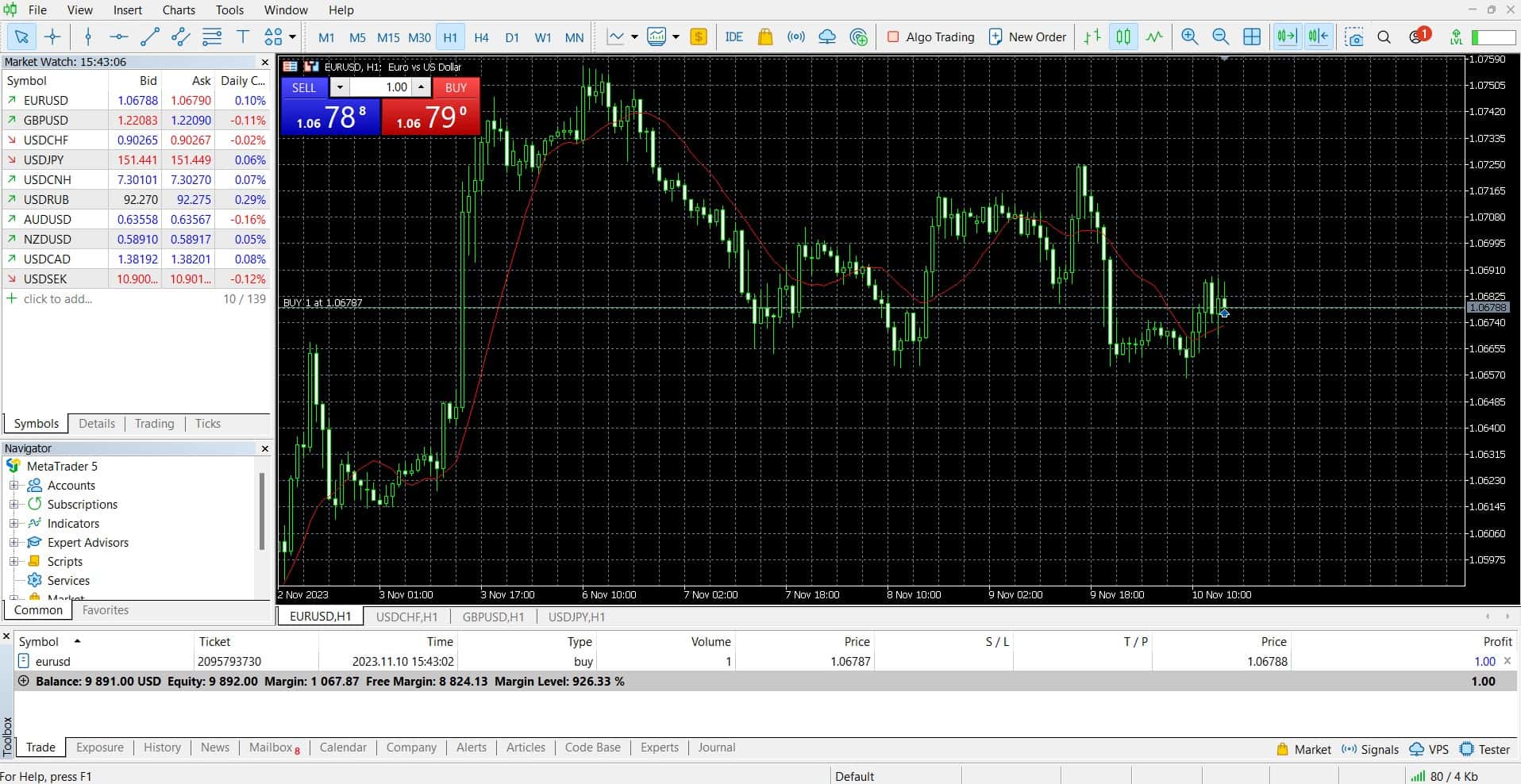
MetaTrader 5 (MT5) is available to Bitget clients for trading CFDs on traditional financial instruments, including currency pairs, precious metals, commodities, and stock indices.
MT5 provides professional tools:
- Advanced charts and technical indicators.
- Various types of market and pending orders.
- The ability to hedge positions.
- Automated trading using Expert Advisors.
- Development of custom indicators and strategies in MQL5.
- Testing trading algorithms on historical data.
To connect to MT5, you must activate a CFD account on Bitget and obtain separate login credentials, including an account number, password and trading server address. The CFD account is funded by transferring USDT from the main Bitget balance.
It is important to note that MetaTrader 5 is intended for the CFD segment of Bitget, rather than full trading in all of the exchange's spot cryptocurrency pairs.
The availability of MT5 makes Bitget more attractive to traders accustomed to traditional Forex platforms and using automated strategies.
TradingView
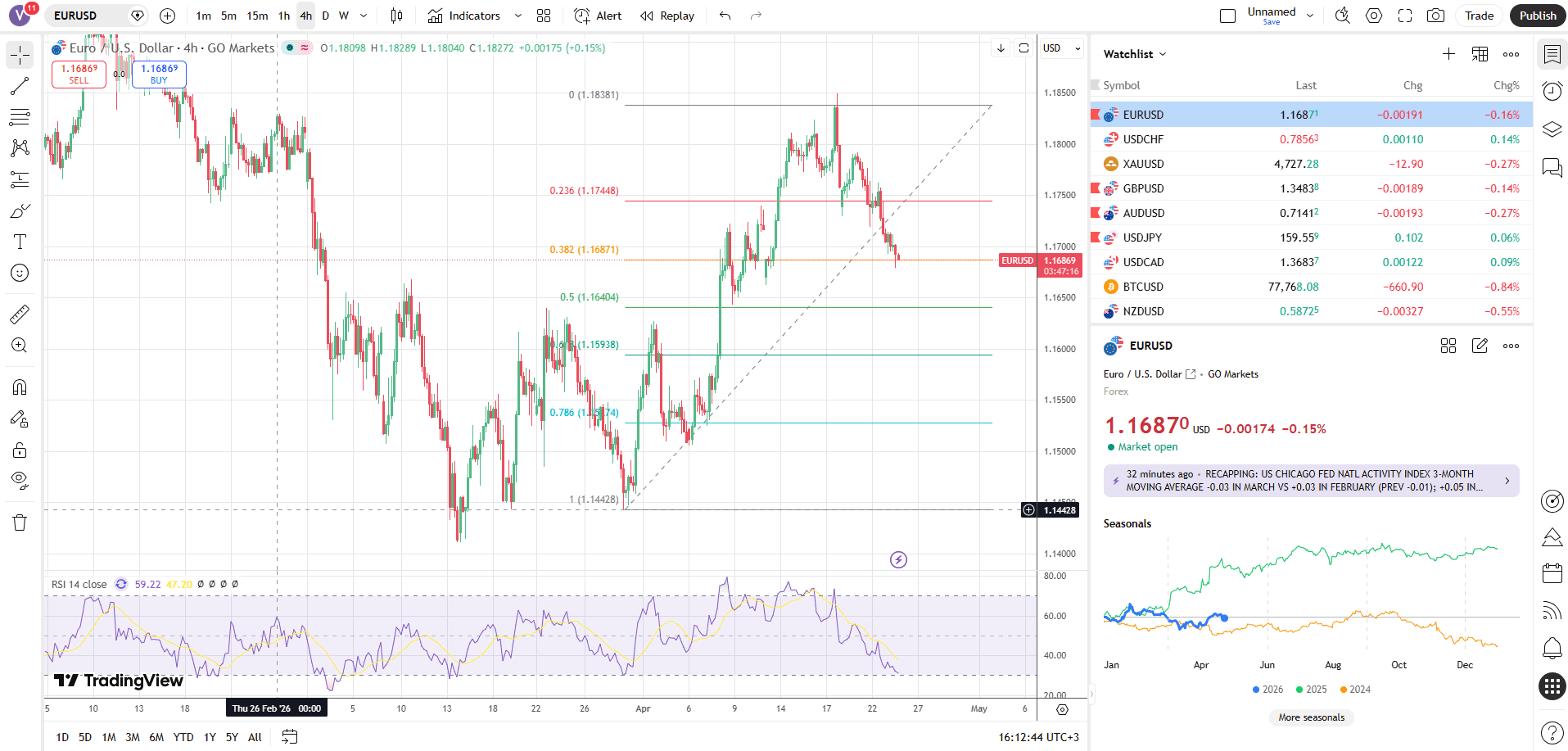
Bitget supports integration with TradingView — a popular platform for technical analysis and trading. Users can connect their Bitget trading account and place trades directly from TradingView charts using technical indicators, charting tools and various order types.
The platform also supports automated trading based on signals from TradingView through the TV-Hub integration. Traders can create strategies in Pine Script, configure trading alerts and automate trade execution for supported futures.
The integration is particularly useful for active and algorithmic traders who need advanced analysis and automation tools. Connecting Bitget is free, although some TradingView features require a paid subscription.
API and external platforms
Bitget provides an advanced API infrastructure for algorithmic trading, connecting third-party trading terminals and integrating custom software solutions.
The exchange supports two main interfaces:
- REST API — retrieving market data and account information, and managing orders, positions and other trading operations.
- WebSocket API — transmitting real-time data, including quotes, order book changes, trades and account status updates.
The API enables users to create trading bots, automate strategy execution, monitor multiple instruments and develop custom analytics systems.
Users can create API keys with different permissions, including read-only access or permission to execute trades. Account protection includes restrictions based on IP addresses. Bitget recommends granting keys only the necessary permissions and not sharing them with third parties.
Institutional clients and participants in the VIP program have access to additional low-latency connectivity options.
Analytics
Bitget offers an advanced suite of analytical tools for studying the cryptocurrency market and making trading decisions. Users have access to professional charts, futures market statistics, on-chain data, analytical research and artificial intelligence tools. The exchange places particular emphasis on automating analysis and identifying trading opportunities.
Market data and technical analysis
Bitget provides detailed information on quotes, trading volumes, liquidity and digital asset price movements. The trading terminal integrates TradingView charts, allowing technical analysis to be conducted directly on the platform.
Key analytical tools:
- Technical indicators — Moving Average, RSI, MACD, Bollinger Bands and other trend analysis tools.
- Chart analysis — trend lines, support and resistance levels, channels and Fibonacci tools.
- Order book — information on buy and sell order volumes for assessing liquidity.
- Trade history — data on completed transactions and trading activity.
- Market statistics — price changes over 24 hours, trading volume, and high and low quotes.
Users can customize charts, switch between time frames and track multiple trading instruments. TradingView integration is available for more in-depth analysis.
Futures market analytics
For derivatives trading, Bitget provides additional metrics for assessing market participant activity, trader sentiment and potential risks.
Available data includes:
- Open Interest — the volume of open futures contracts, which helps assess capital inflows into the market.
- Funding Rate — the funding rate for perpetual contracts, reflecting the balance of demand for long and short positions.
- Long/Short Ratio — the ratio of market participants' long positions to short positions.
- Liquidation Data — statistics on forcibly closed positions.
- Trading Volume — trading volumes used to assess activity and confirm price movements.
These metrics are available through analytical tools and Bitget API. They are particularly useful for experienced traders using leverage and short-term strategies.
Bitget Research and market reviews
The platform operates an analytical division, Bitget Research, which publishes cryptocurrency industry research and reviews of market trends.
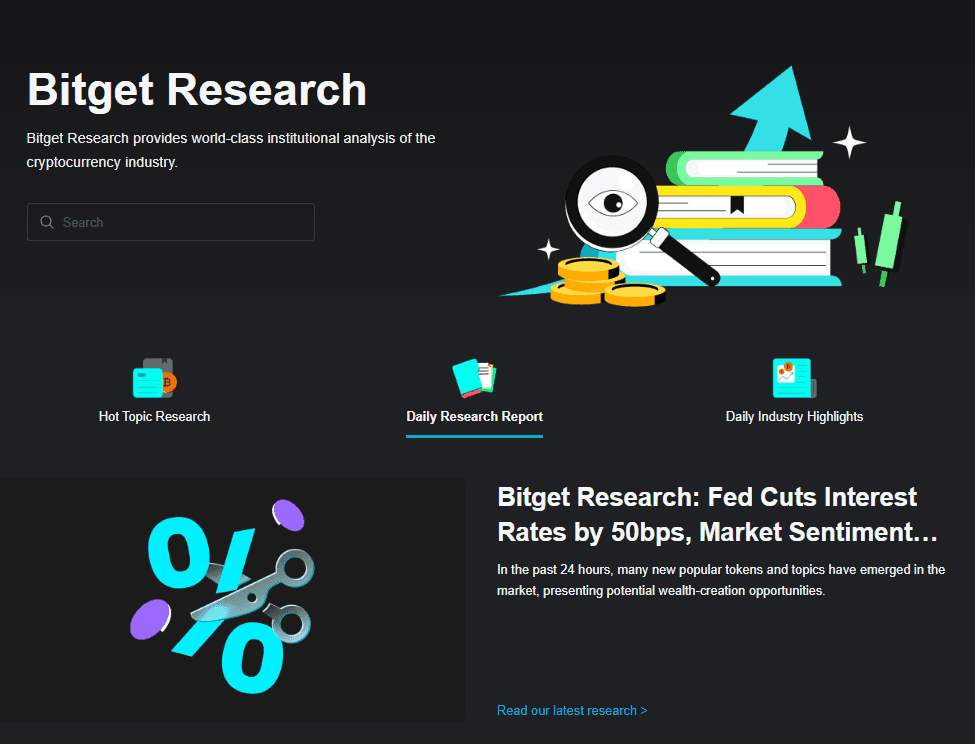
The main areas of analysis include:
- Reviews of Bitcoin, Ethereum and other cryptocurrencies.
- Research on promising blockchain projects and new tokens.
- Analysis of macroeconomic factors affecting the cryptocurrency market.
- Reviews of the DeFi, Web3, Layer 2 and tokenized asset sectors.
- Analysis of market sentiment and investment trends.
Additional materials are published in Bitget Academy, where market news, trading strategy analyses and commentary on major economic events are available.
The materials help users understand market conditions, but they are the exchange's own research and do not replace independent analysis.
On-chain analytics
Bitget is developing blockchain data analysis tools that allow users to study cryptocurrency wallet activity and assess the prospects of new tokens.
In the Bitget Onchain section, users can view information about liquidity, market capitalization, token holders and smart contract characteristics.
Tools are also available for finding promising assets based on trading activity and on-chain metrics. This is particularly useful for traders working with new tokens on Ethereum, Solana, BNB Chain and other blockchains.
However, on-chain data does not guarantee a project's reliability and requires an independent risk assessment.
Copy trading analytics
Bitget provides detailed statistics on traders whose trades can be copied automatically. Before connecting to a strategy, users can review the trader's trading history and assess the selected participant's results.
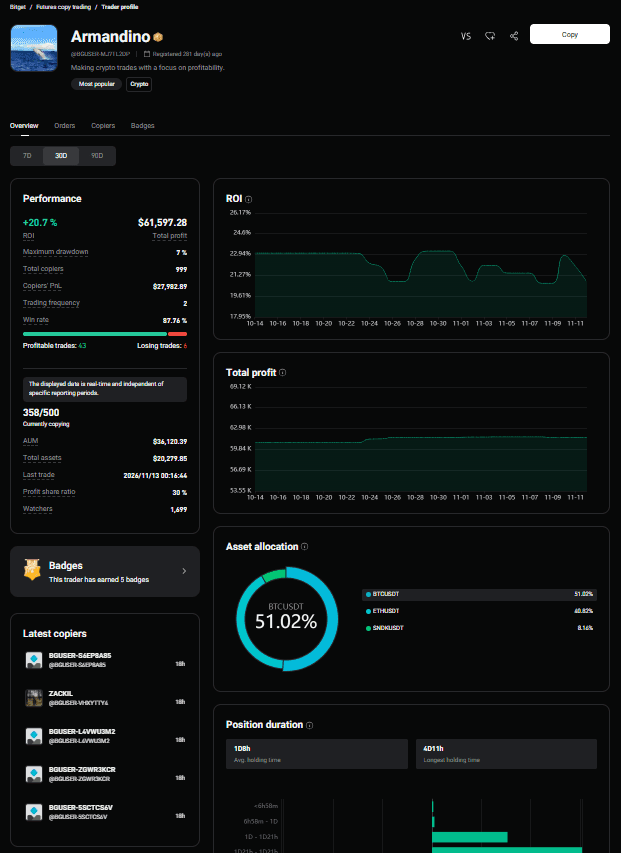
The following metrics are available for analysis:
- ROI — the trading strategy's return over the selected period.
- Win Rate — the percentage of profitable trades.
- Maximum Drawdown — the maximum historical drawdown.
- PnL — trading profit or loss.
- AUM — the amount of subscribers' funds allocated for copying.
- Trade history — information on trading activity and open and closed positions.
Users can compare results across different periods, study return charts and choose traders according to their risk tolerance.
This system increases copy trading transparency, although historical results do not guarantee future profits.
Artificial intelligence analytics
One of the most interesting analytical tools offered by Bitget is GetAgent — an AI assistant for researching markets and finding trading opportunities.
In September 2026, the company introduced GetAgent 2.0, expanding its capabilities to cryptocurrencies, stocks, CFDs and on-chain markets.
The service allows users to:
- Analyze market trends, technical indicators and trading volumes.
- Search for assets using specified criteria.
- Assess potential entry points, Stop Loss and Take Profit levels.
- Track economic events and market news.
- Analyze the risks of open positions and trading history.
- Configure alerts for when specified market conditions are met.
The main advantage of GetAgent is the ability to obtain analytical information through natural-language queries. For example, a user can ask it to analyze Bitcoin, compare the performance of gold and the dollar, or find cryptocurrencies with elevated trading volume.
Education
Bitget offers an advanced educational ecosystem designed for beginners and experienced traders. Users have access to educational articles, video tutorials, step-by-step instructions, interactive courses and demo trading. The exchange also runs educational programs with rewards and develops initiatives for studying blockchain and Web3.
Bitget Academy
Bitget Academy — the exchange's main education center, containing thousands of articles and guides on cryptocurrencies, blockchain and trading.
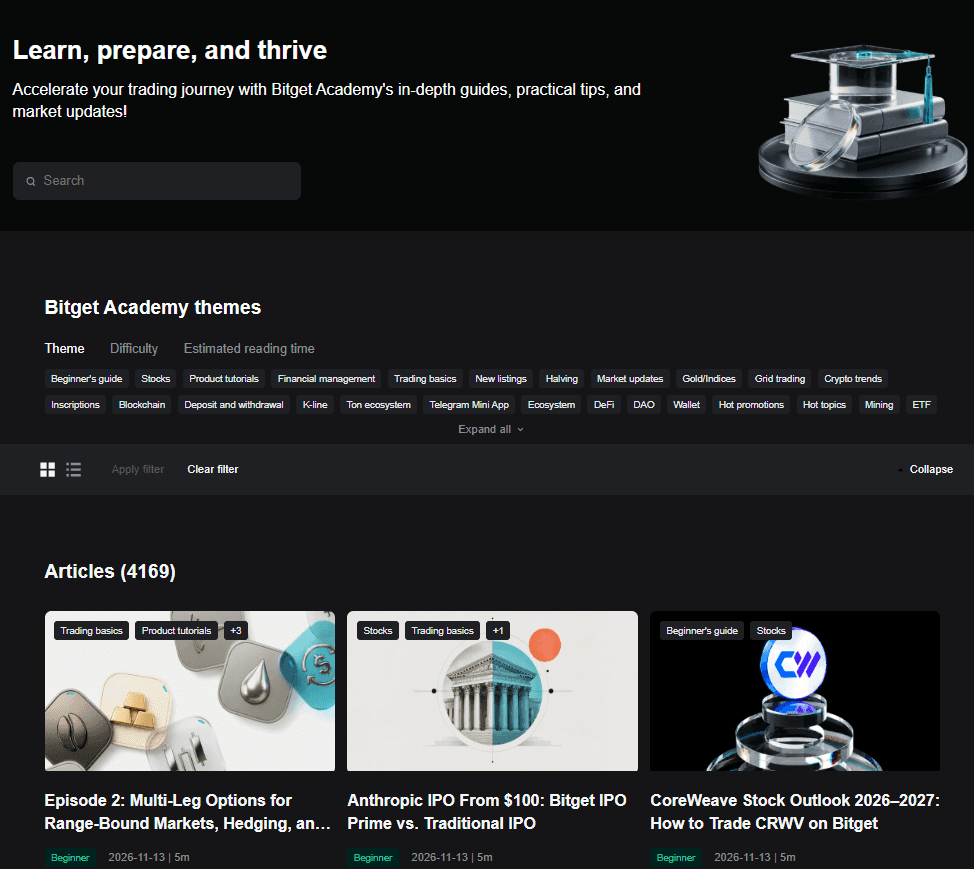
The materials cover a wide range of topics:
- Cryptocurrency basics — Bitcoin, Ethereum, blockchain, digital wallets and secure asset storage.
- Trading basics — spot trades, order types, trading fees and money management.
- Futures and margin trading — leverage, collateral, liquidation and risk management.
- Technical analysis — trading indicators, chart patterns, candlestick analysis and trading strategies.
- Automated trading — copy trading, grid bots, Auto-Invest and other strategies.
- Web3 and DeFi — decentralized finance, NFT, tokenization and new blockchain technologies.
- TradFi — the foreign exchange market, precious metals, stock indices, stocks and CFDs.
Articles can be filtered by topic, difficulty level and estimated reading time. This allows beginners to learn trading gradually, while experienced traders can study specific tools and strategies.
The Academy is regularly updated with new materials, including research on crypto projects, instructions for using Bitget services and financial market reviews.
Video tutorials and guides
In addition to written materials, Bitget offers a library of educational videos covering the use of the trading platform and the main instruments of the cryptocurrency market.
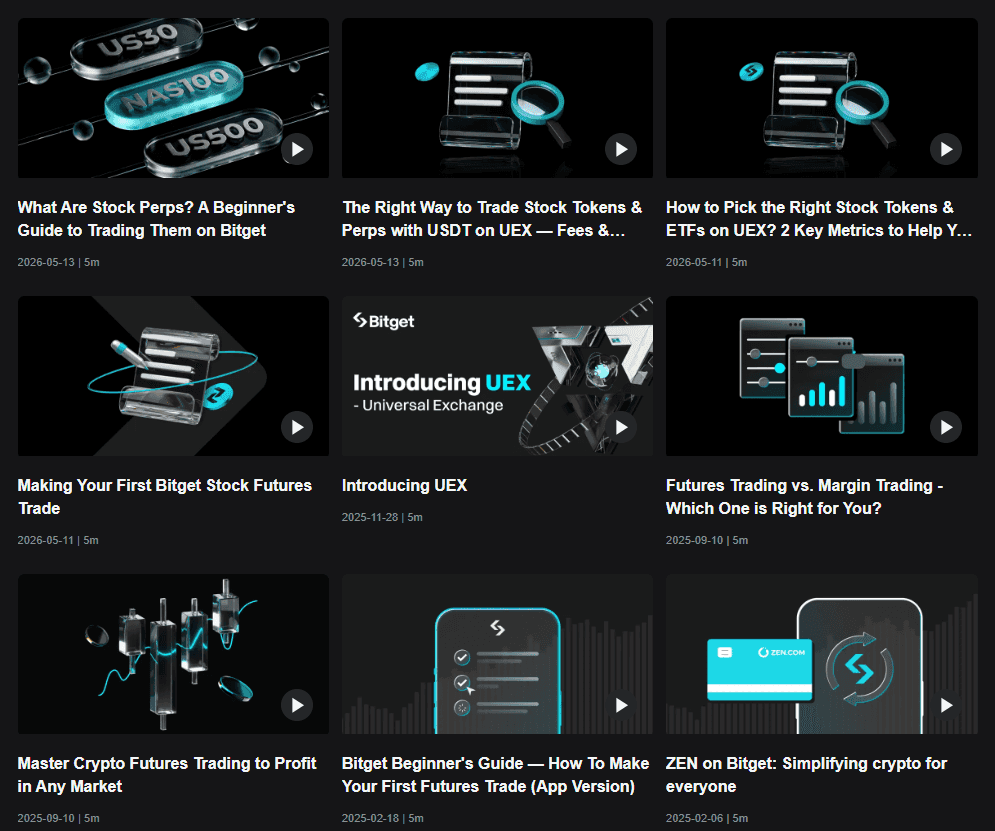
Video tutorials help explain practical matters:
- Registering and setting up a Bitget account.
- Buying and selling cryptocurrencies.
- Opening initial futures positions.
- Differences between margin and futures trading.
- Using leverage and trading orders.
- Risk management and fraud protection.
Most videos are short, making them convenient for quickly learning about individual platform features.
Additional step-by-step instructions are available in the Bitget help center. They contain descriptions of operations, interface screenshots and answers to frequently asked questions.
Learn2Earn and interactive learning
Bitget offers the Learn2Earn program, which combines learning with the opportunity to earn rewards.
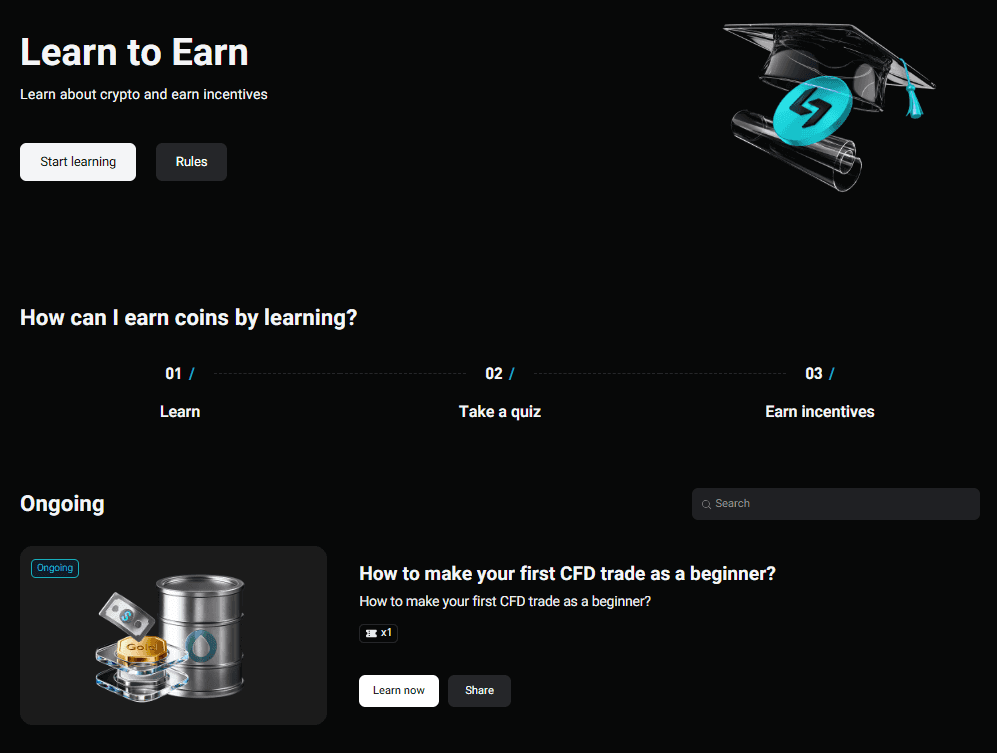
The process consists of three stages:
- The user studies educational material about a cryptocurrency, technology or trading instrument.
- The user takes a short test that assesses the knowledge acquired.
- If the answers are correct, the user receives the reward specified in the program terms.
Rewards may be provided as cryptocurrencies, bonuses or special coupons. Task availability and reward amounts depend on the specific campaign.
The TradFi 101 program, dedicated to traditional financial markets, deserves particular attention. It includes educational modules on financial fundamentals, stocks, commodities, market mechanisms, macroeconomics and risk management.
The interactive format helps users consolidate their knowledge and increases engagement with learning. However, rewards are subject to promotional terms and are not guaranteed for all participants.
Practical learning with a demo account
Bitget allows users to apply what they have learned through free demo trading. Users can open virtual positions, test trading strategies and explore terminal features without risking real funds.
Demo mode is available for cryptocurrency futures and CFD instruments on TradFi.
During practice, users can:
- Open long and short positions.
- Use leverage and various order types.
- Set Stop Loss and Take Profit.
- Track changes in profit and loss.
- Test strategies and learn about liquidation mechanisms.
To begin, users only need to log in to their account and select the appropriate demo mode. Virtual funds are provided by the platform and cannot be withdrawn.
Demo trading is particularly useful for beginners because it helps them learn the interface and basic risk management principles before moving on to real trades. However, virtual trading results may differ from real results because of slippage, liquidity and other market factors.
Blockchain4Youth
Bitget also develops the international educational initiative Blockchain4Youth, aimed at improving literacy in blockchain and Web3.
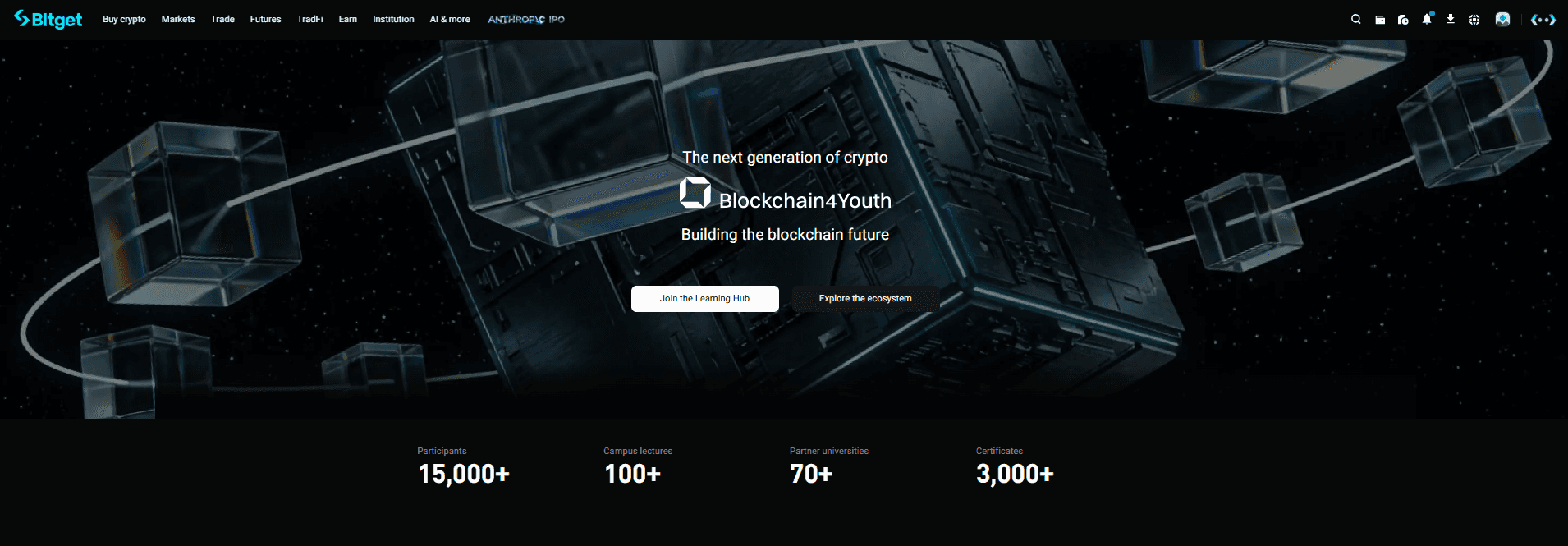
The program includes the Blockchain4Youth Learning Hub — a structured educational course comprising several thematic modules:
- Fundamentals of blockchain, cryptocurrencies and Web3.
- NFT, tokenization and artificial intelligence.
- Centralized and decentralized finance.
- Fundamentals of trading and investing.
- Practical introduction to cryptocurrency infrastructure.
After successfully completing the program, participants may receive a Bitget certificate. The initiative also includes educational events, partnerships with universities and professional workshops.
Unlike Bitget Academy, which mainly features individual articles and guides, Blockchain4Youth offers a more structured format for studying blockchain technology.
Customer Support
Bitget provides 24-hour technical support through online chat, email and a ticketing system. The exchange has a multilingual support service, an extensive knowledge base and self-service troubleshooting tools. However, service quality varies: standard issues are generally resolved fairly quickly, while complex situations involving account restrictions, withdrawals and security checks may take longer to review.
Support contact channels
Bitget offers several ways to obtain assistance:
- Online chat 24/7. The main channel for contacting support, available through the official website and mobile app. Users can describe the problem, use automated suggestions and contact an agent to resolve an unusual issue.
- Email. The address support@bitget.com is intended for inquiries about accounts, trading, security and payments. This method is convenient for describing a problem in detail and sending the necessary documents.
- Ticketing system. It allows users to create requests, attach files and track the progress of a case. Its status is available in the Support Ticket section. Notifications of new replies are sent by email, but correspondence must be continued directly in the ticketing system.
- Social media. Bitget maintains an official support account @BitgetSupport on X. It can provide general information, but issues requiring identity verification or account access should be resolved through official channels.
- VIP support. Clients with high VIP status receive priority service and access to a personal manager.
There is also a help center operated by Bitget, containing instructions on registration, verification, deposits, withdrawals and the use of trading tools. Automated services are available for common problems, such as restoring 2FA and checking uncredited deposits.
Response time
Bitget states that support is available 24 hours a day, seven days a week. Online chat allows users to submit a request promptly, but the actual time required to connect with an agent depends on service demand and the complexity of the issue.
For standard requests related to account settings, trading operations and platform use, responses may arrive fairly quickly. If additional checks are required, the request is forwarded to specialized staff, which increases the waiting time.
For certain categories of requests, Bitget publishes estimated time frames. For example, appeals concerning P2P trades are generally reviewed within 36 hours, although complex cases may take longer.
However, the exchange does not publish universal guaranteed response and resolution times for all requests.
User reviews indicate mixed experiences with support. On Trustpilot, there are complaints about lengthy case reviews, repetitive responses and the lack of specific resolution time frames. Such complaints are particularly common in connection with account access restrictions and withdrawals.
It should be noted that reviews on independent platforms are not representative statistics on support performance, as users with negative experiences may be more likely to leave them.
Support expertise
The support service of Bitget covers a wide range of issues, from restoring account access to resolving payment disputes and investigating suspicious transactions.
For standard issues, users have access to detailed instructions and automated tools. For example, resetting two-factor authentication, checking deposit status or changing security settings can often be completed without lengthy interaction with an agent.
In more complex situations, support may involve specialists in payments, security and regulatory compliance. To resolve P2P disputes, there is a separate appeals procedure in which staff check payment documents and communicate with the parties to the transaction.
However, the effectiveness of resolving unusual problems raises concerns. Reviews include complaints about scripted responses, insufficiently detailed explanations for account restrictions and the need to contact support repeatedly about the same issue.
Conclusion
Bitget is a major international crypto exchange with a wide range of trading instruments and a well-developed ecosystem of services. The platform stands out for its functional trading terminals, diverse investment products, high-quality analytics, and educational materials. However, its relatively high futures fees, uneven regulation, and past security issues remain important factors to consider when choosing an exchange.
Bitget is suitable for both beginners and experienced traders, but it is especially attractive for active cryptocurrency trading. Beginners will appreciate the simple registration process, demo account, and copy trading, while professionals will value the wide range of derivatives, trading bots, API access, and technical analysis tools. The exchange will also appeal to users who want to combine cryptocurrency trading with investment products and traditional financial markets.
FAQ
What is Bitget?
Bitget is an international cryptocurrency exchange founded in 2018. The platform offers spot and futures trading, copy trading, trading bots, investment products, and access to traditional financial markets through TradFi. The exchange is suitable for both beginners and experienced traders.
Is it safe to use Bitget?
Bitget uses two-factor authentication, cold storage for cryptocurrencies, a Proof of Reserves system, and a user protection fund worth at least $300 million. However, in September 2026, the exchange suffered a major hack, with losses of about $388 million. The company announced that it was covering the losses and restoring its services. Therefore, Bitget cannot be considered completely safe, especially for the long-term storage of large amounts.
How does Bitget work?
Bitget acts as an intermediary between cryptocurrency buyers and sellers, facilitating the execution of trading orders. Users can buy digital assets on the spot market, trade leveraged futures, copy other traders' trades, and use investment services. The exchange earns revenue primarily from trading fees and additional financial services.
How to use Bitget?
To get started, you need to register on the official website of Bitget, complete identity verification, and fund your account. You can then buy cryptocurrencies, trade on the spot or futures market, use copy trading, and access other services. Beginners are advised to start with spot trading or a demo account.
How to open an account on Bitget?
Go to the website of Bitget and click “Sign Up.” Enter your email address or phone number, create a password, and confirm your registration using the code you receive. Then complete the mandatory identity verification process (KYC), providing a document proving your identity and completing a facial verification check. Registration is free.
How to make a deposit on Bitget?
In your account, open the Deposit section, select a cryptocurrency and the appropriate blockchain network. Copy the wallet address and send funds from an external platform. Bitget does not charge fees for cryptocurrency deposits. Bank transfers, cryptocurrency purchases by card, and P2P trading are also available in supported countries.
How to trade on Bitget?
Go to the Trade section, select the spot or futures market and the desired trading pair, such as BTC/USDT. Then select the order type and amount and confirm the trade. For futures, you can also configure leverage, Stop Loss, and Take Profit. Beginners are advised to avoid high leverage.
How to sell cryptocurrency on Bitget?
Open the spot trading section and select the desired cryptocurrency and trading pair, such as BTC/USDT. Enter the amount of the asset, choose a market or limit order, and click “Sell.” To receive fiat money in a bank account, you can use P2P trading or a fiat withdrawal service available in your region.
How to withdraw money from Bitget?
To withdraw cryptocurrency, go to Assets → Withdraw, select the coin, and enter the recipient's address, network, and amount. Check the fee and confirm the transaction. To receive fiat money, you can use bank transfers in supported countries or sell cryptocurrency through P2P. Withdrawal methods, fees, and limits depend on the region and account status.
How to delete an account on Bitget?
To delete your account on Bitget, first close all trading positions, complete any active transactions, and withdraw the remaining funds. Then go to your profile settings, select My Profile → Close Account, and confirm the deletion. The request is processed within 24 hours. Deletion is irreversible, and re-registration using the same details is not possible for 30 days.