Coinbase Review 2026
Coinbase is suitable for beginners, active traders, and long-term investors who value reliability, convenience, and a wide range of trading tools.
- Coinbase is trusted. Tested via live trading.
- Coinbase №12 in the crypto exchanges list
Highlights of Coinbase

Coinbase is one of the largest U.S. cryptocurrency exchanges, founded in 2012 by Brian Armstrong and Fred Ehrsam. The platform allows users to buy, sell, exchange, and store cryptocurrencies. Coinbase became widely known for its user-friendly interface, ease of use, and focus on security. In 2021, the company went public on the Nasdaq stock exchange, becoming one of the first publicly traded companies in the crypto industry.
Today, Coinbase serves beginner investors, professional traders, and institutional clients. The exchange offers a wide selection of digital assets, active trading tools, and additional cryptocurrency services.
Advantages and disadvantages of Coinbase
Pros
- A high level of regulation and public financial reporting.
- A user-friendly platform for beginners and experienced traders.
- A wide selection of cryptocurrencies, derivatives, and investment services.
- Advanced trading tools on Coinbase Advanced and integration with TradingView.
- A sophisticated security system and cold storage of assets.
Cons
- High trading fees, especially in the standard interface.
- A history of major fines and regulatory claims.
- Potential delays when resolving complex issues through support.
Coinbase reviews

Coinbase
What traders talk about
No reviews yet.
Leave a review of your experience:
Coinbase Exchange Overview
- Foundation Year
- 2012
- Official Website
- https://www.coinbase.com
- Regulated in Countries
United States, Luxembourg, Ireland, United Kingdom, Cyprus, Canada, Singapore, Australia, Bermuda, India, Brazil
More Details- Trading Assets
- Cryptocurrency
- Futures
- Options
- Fees (Maker/Taker)
- Spot
- 0.25% / 0.5%
- Futures
- 0.015% / 0.035%
- Max Leverage
- —
- Email Support




Coinbase is a U.S. cryptocurrency company founded in 2012 by Brian Armstrong and Fred Ehrsam. The project was initially created as a service for buying and selling bitcoin, but over time it developed into a digital asset platform aimed at retail users, professional traders, and institutional investors.
The main business of Coinbase is providing services for buying, selling, exchanging, and storing cryptocurrencies. The company develops trading platforms for different categories of clients and offers staking and digital asset custody services for large investors. In addition to its exchange business, Coinbase creates payment solutions and developer tools that enable cryptocurrency transactions to be integrated into applications and services.
Coinbase Review Summary
Reliability and Regulation
Coinbase demonstrates a high level of reliability thanks to regulation in leading jurisdictions, public reporting, and a sophisticated asset protection system. The exchange deserves a high rating despite certain regulatory and operational risks.
Advantages
- Licences and regulation in several jurisdictions.
- A publicly traded company with transparent reporting.
- Cold storage of assets and multi-layered protection.
Disadvantages
- A history of major regulatory fines.
- Customer data leak in 2025.
- Limited insurance coverage for cryptocurrency assets.
The rating of Coinbase is based on a comprehensive analysis of the exchange's reliability and security, trading conditions, commissions, available instruments, platform usability, and customer service quality. When assigning ratings, we follow our own evaluation methodology, which enables objective comparisons of cryptocurrency exchanges based on key criteria.
Continue reading the review to learn more about the features of Coinbase, its advantages and disadvantages, and whether this exchange suits your needs.
Reliability and Regulation
Coinbase is one of the world's best-known and most regulated cryptocurrency exchanges. The company has operated since 2012, is registered in the United States, and since April 2021 has been listed on the Nasdaq stock exchange under the ticker COIN. Its public status requires Coinbase to regularly disclose financial statements and undergo independent audits, increasing the transparency of its business.
The exchange holds licenses and registrations in several major jurisdictions, including the United States, the European Union, the United Kingdom, Canada, and Singapore. At the same time, Coinbase has repeatedly faced regulatory claims, and its security system is not completely protected against cyber threats and fraud.
Licensing and jurisdiction
| Legal Entity | Regulator |
|---|---|


Coinbase operates through a group of legal entities belonging to Coinbase Global, Inc. Each division serves specific markets and operates under local law. Unlike exchanges registered exclusively in offshore jurisdictions, Coinbase has obtained authorization to operate from several reputable financial regulators.
In the United States, the main operator is Coinbase, Inc. The company is registered with FinCEN as a Money Services Business (MSB), holds money transmitter licenses in most states, and has a BitLicense license from the New York State Department of Financial Services (NYDFS). Institutional cryptocurrency custody is also provided through Coinbase Custody Trust Company, LLC, which is regulated by NYDFS.
In June 2025, Coinbase received authorization under the European regulation MiCA through its Luxembourg-based company Coinbase Luxembourg S.A. This enabled it to provide regulated cryptocurrency services to clients in the European Economic Area.
In April 2026, Coinbase also received preliminary conditional approval from the U.S. regulator OCC to establish Coinbase National Trust Company. The new entity is expected to focus primarily on digital asset custody and related services. However, this approval alone is not final authorization to begin banking operations.
Regulatory risks
Despite its extensive licensing framework, Coinbase has a history of disputes with financial regulators.
In June 2023, the U.S. Securities and Exchange Commission (SEC) filed a lawsuit against Coinbase, accusing the company of operating as an unregistered securities exchange, broker, and clearing agency, as well as committing violations related to staking. On 27 February 2025, the SEC announced the dismissal of the case. The proceedings ended without a judicial finding of liability on the part of Coinbase regarding the allegations, but the SEC separately emphasized that the decision to dismiss the case was not based on an assessment of their merits.
In addition to its dispute with SEC, the company faced other sanctions:
- 2023 — United States. NYDFS fined Coinbase in the amount of $50 million for deficiencies in its customer verification and anti-money laundering procedures. The company also agreed to invest another $50 million in improving its compliance system.
- 2024 — United Kingdom. FCA fined CB Payments Limited in the amount of £3.5 million for repeatedly breaching restrictions on serving high-risk customers.
- 2025 — Ireland. The Central Bank of Ireland imposed a fine of €21.46 million on Coinbase Europe Limited for violations of transaction monitoring and anti-money laundering requirements.
- 2026 — Ireland. On 22 October, the regulator announced an agreed fine of €3.25 million on Coinbase Ireland Limited for breaches of requirements concerning the safeguarding of client funds and oversight of outsourcing in 2020–2025. The regulator found that the dedicated account for safeguarding client funds had been underfunded for an extended period. The sanction is subject to approval by the High Court of Ireland.
The latest proceeding is particularly important when assessing the exchange's reliability because it directly concerns mechanisms for protecting client funds. According to Coinbase, the violations did not result in financial losses for clients or restrict their access to funds.
Overall, the regulatory risks of Coinbase stem less from a lack of licenses than from the complexity of complying with the requirements of different countries. The company is under continuous supervision, but legislative changes, new inspections, and regulatory orders may lead to restrictions on certain services, additional customer checks, and revised service terms.
Security of funds
Coinbase uses a multi-layered system to protect cryptocurrency assets, including cold storage, cryptographic key-protection mechanisms, transaction controls, and user account security tools.
Cryptocurrency storage
Most client digital assets are held in cold wallets isolated from a constant internet connection. According to the annual report of Coinbase for the 2025 reporting year, the company seeks to keep the share of assets in hot wallets at no more than 2%. Cryptographic mechanisms and multi-party transaction approval procedures are used to protect private keys.
Asset segregation
Coinbase states that it holds client assets at a ratio of 1:1 and does not use them for lending or other transactions without the owners' consent. Client funds are accounted for separately from the company's corporate assets. However, the specific custody arrangement and legal guarantees depend on the service used and the applicable user agreement.
Account protection
Users have access to two-factor authentication (2FA), hardware security keys, and additional transaction confirmation tools. The Coinbase Vault feature provides enhanced withdrawal controls, including confirmation by multiple authorized individuals.
Asset insurance
Coinbase has corporate insurance coverage for certain cases of digital asset theft, including those involving cyber incidents. However, the insurance covers only some potential losses and does not cover an ordinary personal account breach caused by compromised user credentials.
Cryptocurrencies held on Coinbase are not protected by the U.S. bank deposit insurance system FDIC or the fund SIPC. However, U.S. dollar cash balances, held as deposits with partner banks, may be covered by FDIC insurance up to $250 000 per depositor, subject to the applicable conditions. This protection applies if the bank fails, not Coinbase itself, and does not cover every method of holding cash.
Security incidents
In May 2025, Coinbase reported a major client data breach. Attackers bribed certain customer support employees and gained access to some users' personal information, which they then used for fraudulent attacks. Passwords and private keys were not compromised in the incident, but some clients suffered losses due to social engineering. Coinbase announced compensation for those affected and stronger security measures.
Account Opening
Opening an account with Coinbase is straightforward and requires no special knowledge. Registration is free, the interface is intuitive, and creating an account takes only a few minutes. Mandatory verification is usually completed quickly, although additional document checks may increase the waiting time.
Registration
You can register with Coinbase through the official website coinbase.com or the mobile application for Android and iOS.
Step-by-step registration guide
- Go to the Coinbase website and click Sign up (Registration).
- Choose how to create your account: using an email address or a Google or Apple account.
- When registering by email, enter your email address, enter the confirmation code you receive, and create a password.
- Enter your first and last name exactly as they appear on your identity document.
- Enter your mobile phone number and confirm it using the SMS code.
- Specify your country of residence, citizenship, and other personal information requested by the platform.
- Confirm that you are of legal age, review the terms of service, and complete registration.
After creating an account, it is advisable to set up two-factor authentication (2FA), preferably through an authenticator app or hardware security key.
Verification
To make full use of Coinbase, you must complete identity verification in accordance with KYC and AML requirements. The exchange verifies users' personal information to prevent fraud, money laundering, and other illegal activities.
The following documents and information may be required for verification:
- Identity document. A passport, national ID card, or driver's license. The list of accepted documents depends on the country.
- Proof of residential address. A bank statement, utility bill, or another document showing the user's address, if such verification is required.
- Selfie or video verification. A facial photo or short video recording to confirm that the document belongs to the user.
- Additional information. Information about tax residency, a tax identification number, or other information required by local law.
Procedure for completing verification:
- Sign in to your Coinbase account and open the identity verification section.
- Select your country and document type.
- Take clear photos of the document and upload them through the website or mobile app.
- Complete a facial verification using the camera if required.
- Provide additional information if requested by the exchange.
- Submit the information for review and wait for the result.
Automated verification usually takes a few minutes, although a notification about the review status may arrive within 24 hours. In some cases, verification takes longer because additional documents must be provided.
For citizens of certain countries, Coinbase has additional proof-of-residence requirements. Customers from some European countries and the United Kingdom may also need to provide their tax residency and tax identification number.
After successful verification, the user gains access to transactions permitted in their jurisdiction. Buying cryptocurrency with fiat money may also require linking a bank card or another supported payment method.
Account Types
Coinbase offers a wide range of trading modes and additional services that meet the needs of almost every category of user. Simple cryptocurrency purchases are suitable for beginners, Coinbase Advanced for active traders, and Coinbase Wealth for major investors. Staking, onchain transactions, and self-custody features make the platform a versatile solution for trading and investing.
Buying and Selling Cryptocurrency
Coinbase's standard mode is intended primarily for beginners and investors who need a simple way to use cryptocurrencies without complex trading tools.
The web platform or mobile app can be used to buy, sell, and exchange digital assets, track portfolio value, and set up recurring purchases (Recurring Buy). To complete a transaction, simply select a cryptocurrency, specify the amount, and confirm the trade.
Before confirmation, Coinbase displays the total transaction cost, including applicable fees and the spread. This format is convenient for one-time purchases and long-term investments, but frequent trading may be more expensive than with Coinbase Advanced.
Coinbase Advanced
Coinbase Advanced is a professional trading interface that replaced Coinbase Pro. It is designed for active traders who need advanced market analysis tools and more precise control over order execution.
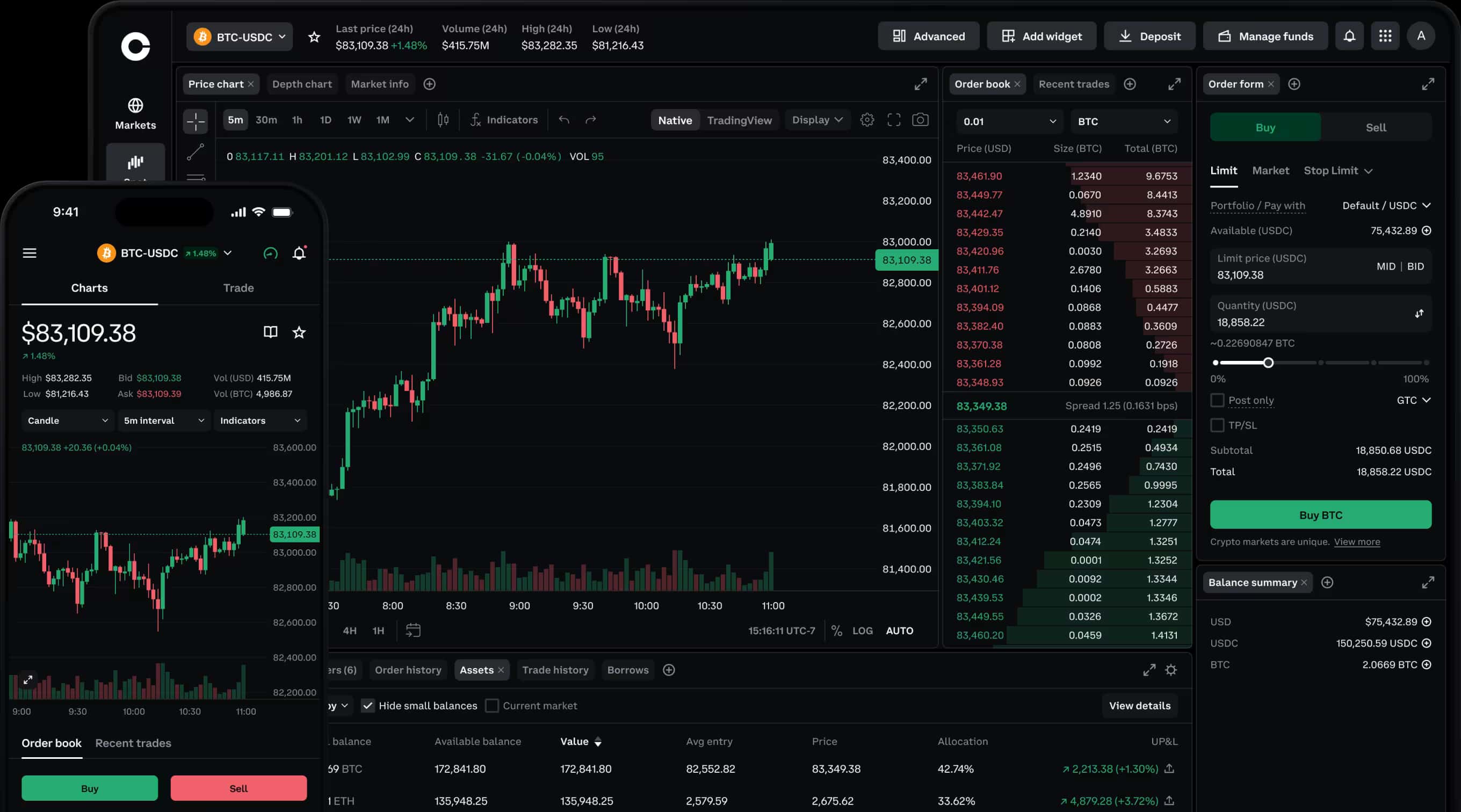
The platform provides TradingView charts with technical indicators, an order book, market depth information, and various order types, including limit, stop-limit, and combined orders. An API is also available for automated trading.
Coinbase Advanced uses a Maker/Taker fee model: the fee depends on the type of order execution, trading volume over the last 30 days, and other pricing-tier conditions. Derivatives trading is supported in eligible jurisdictions.
Coinbase Earn
Coinbase Earn brings together tools for earning rewards on cryptocurrency assets. The service is aimed at users who want to use their cryptocurrencies not only for trading but also to generate additional income.
Key features include:
- Staking. Earn rewards for participating in blockchain networks, including Ethereum, Solana, Cardano, and other supported cryptocurrencies.
- USDC Rewards. Earn rewards for holding the USDC stablecoin on Coinbase in eligible regions.
- Lending. The ability to lend USDC through integrated DeFi protocols, including Morpho, if the product is available to the user.
The yield depends on the specific asset, market conditions, and applicable Coinbase fees. With staking, withdrawals may require waiting for assets to be unlocked, while participation in DeFi lending carries smart-contract and loss-of-funds risks.
Coinbase One
Coinbase One is a paid subscription that provides additional benefits when using the exchange. It may appeal to users who trade regularly, participate in staking, or need enhanced support.
The subscription includes three pricing tiers:
Plan | Cost in the US | Fee-free simple trading volume |
|---|---|---|
Basic | $4.99/month | Up to $500/month |
Preferred | $29.99/month | Up to $10 000/month |
Premium | $299.99/month | No volume limit |
In addition to exemption from standard trading fees within the specified limits, subscribers may receive increased staking rewards, additional benefits for holding USDC, account protection against certain cases of unauthorized access, and special partner offers.
The Preferred and Premium tiers also provide priority support and rebates on some Coinbase Advanced trading fees when the program conditions are met.
The absence of a trading fee does not mean trades are completely free. In Coinbase's standard mode, the spread still applies, while Coinbase One benefits do not automatically cover all order types and derivatives.
The listed prices apply to the US market. Subscription costs, available benefits, and restrictions may vary by country.
Coinbase Wallet and Onchain
Coinbase Wallet is a separate cryptocurrency wallet for holding assets independently (self-custody). Its features are also available through the Base app, which expands access to decentralized services.
Unlike a standard exchange account, a self-custody wallet allows the user to control cryptographic keys and manage assets directly on the blockchain. It supports various networks, including Ethereum, Base, Solana, and Bitcoin, as well as interaction with decentralized applications.
The wallet can be used to store and transfer cryptocurrencies, exchange tokens through a DEX, interact with DeFi protocols, and use other onchain services.
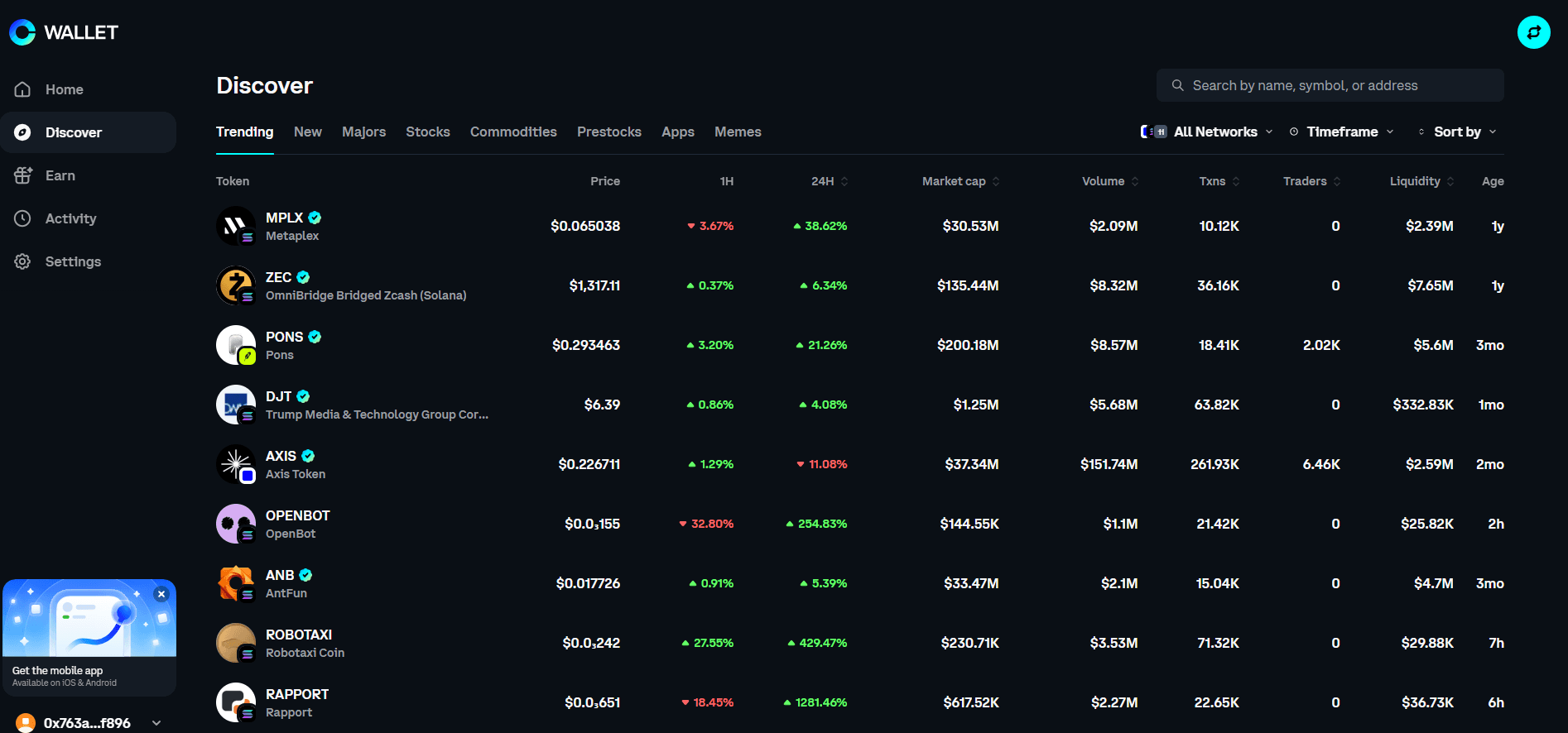
In addition to the separate wallet, Coinbase is developing onchain trading directly within the exchange's main app. It provides access to tokens on decentralized exchanges without requiring them to be listed on Coinbase's centralized platform.
However, these assets do not undergo Coinbase's standard listing procedure. Users must independently consider the risks of fraudulent tokens, low liquidity, slippage, and smart-contract vulnerabilities. Protecting access keys is also particularly important with self-custody.
Coinbase Wealth
Coinbase Wealth is a specialized platform for high-net-worth private investors, family offices (Family Offices), and professional wealth managers.
The service provides access to Coinbase Prime infrastructure, combining institutional cryptocurrency custody, trading and financial tools, advanced reporting, and personalized service.
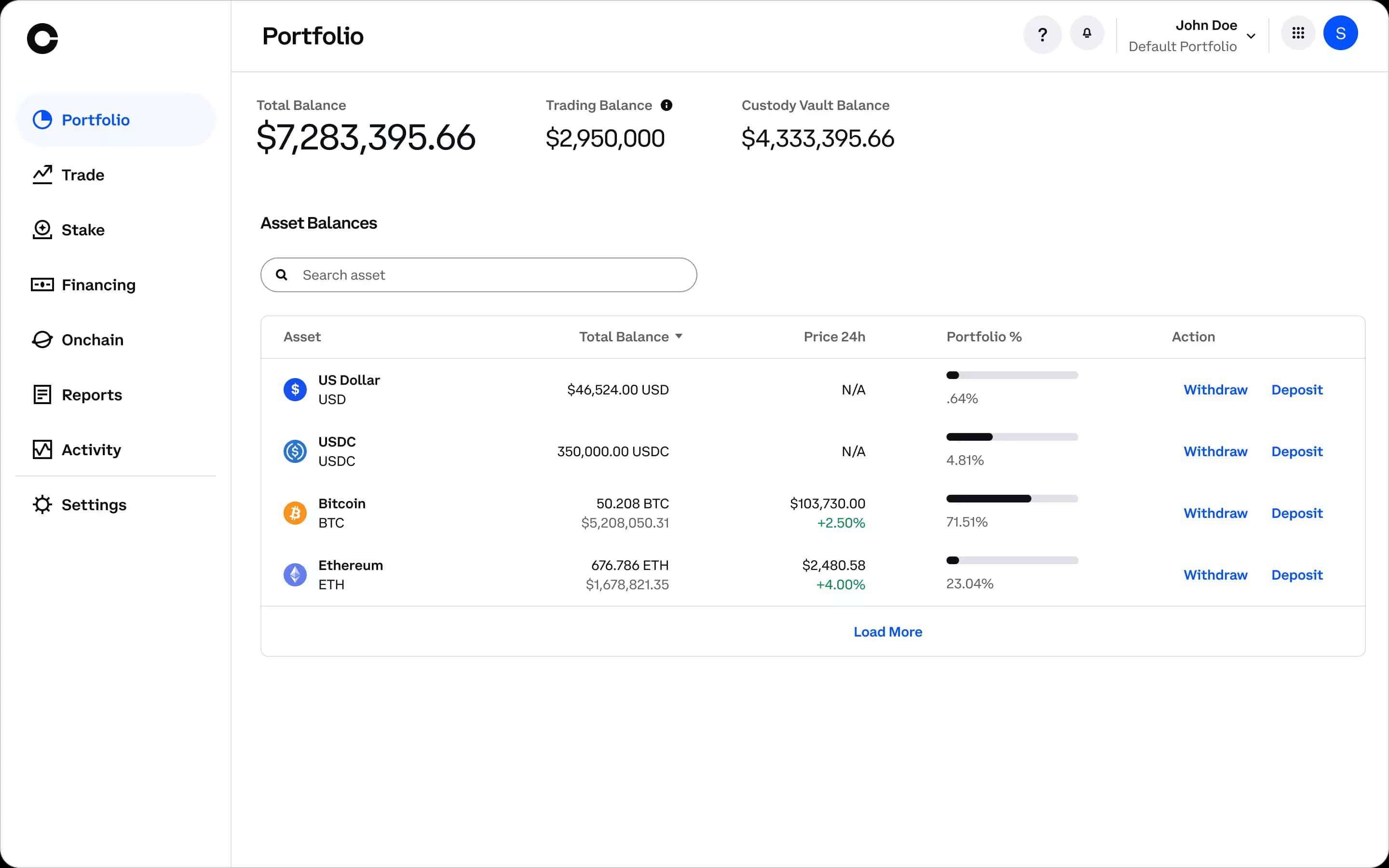
Clients have access to trading using multiple liquidity sources, algorithmic execution of large orders, staking, lending products, and cryptocurrency portfolio management tools. Support from personal managers and institutional trading specialists is also available.
Coinbase Credit and Debit Cards
Coinbase offers payment cards that allow fiat funds or cryptocurrency assets to be used for everyday purchases. Card terms and availability depend on the country of residence.
Coinbase Card is a Visa debit card. It allows users to pay for purchases and withdraw cash from their available balance. When cryptocurrency is used, Coinbase automatically converts it into the local payment currency.
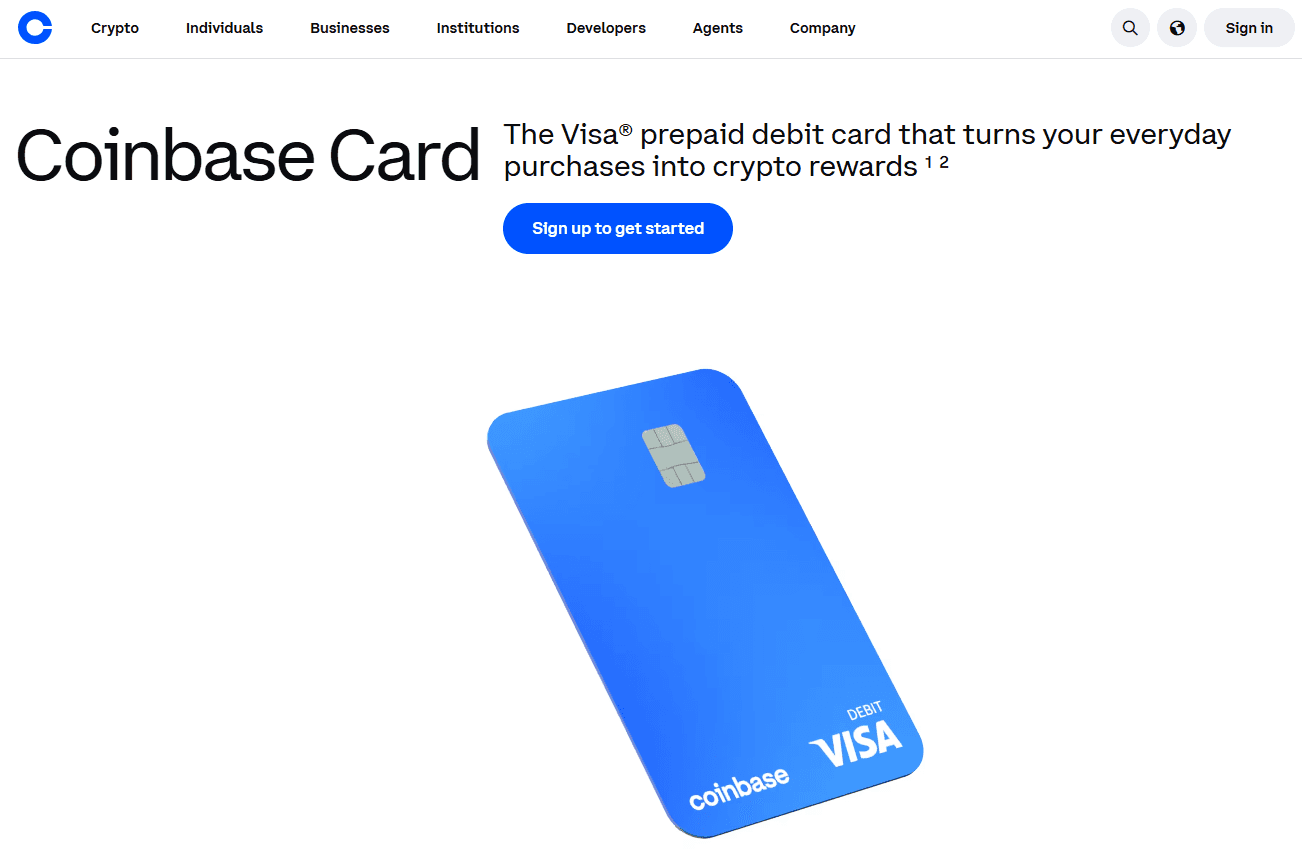
The card is available to eligible customers in the US, the United Kingdom, and certain European countries. Cryptocurrency rewards for purchases are available in some regions. A spread may apply when assets are converted, while selling cryptocurrency to make a payment may create tax liabilities.
Coinbase One Card is an American Express credit card. It is intended for eligible Coinbase One users in the US. Its main benefit is the ability to earn up to 4% cashback in Bitcoin on eligible purchases. The reward rate depends, among other factors, on the amount of assets held on Coinbase.
Applying for the credit card requires meeting creditworthiness requirements and having an eligible Coinbase One subscription. The credit limit and interest rate are set individually.
Commissions
Coinbase fees are generally above the market average, especially when buying cryptocurrency through the standard interface and trading in small volumes. Coinbase Advanced offers more favorable terms and discounts for active traders, but its base rates in many regions are less competitive than those of rivals. Deposit and withdrawal fees appear fairly reasonable, especially when bank transfers are used.
Spot Trading Fees
Coinbase uses two fee models: a standard model for simple cryptocurrency purchases and sales, and a Maker/Taker model for Coinbase Advanced.
In Coinbase's standard interface, the fee is calculated individually and depends on the transaction amount, payment method, region, and market conditions. A spread is also included in the quote. Simple limit orders incur a 1% execution fee, and an additional Coinbase fee of up to 1.875% may also apply.
In Coinbase Advanced, fees are determined by order type and trading activity. A maker adds liquidity to the order book, while a taker executes a trade against an existing order.
Base Coinbase Advanced rates vary by region:
- US: 0.5% for makers and 0.9% for takers.
- EU and United Kingdom: 0.25% for makers and 0.5% for takers.
- Brazil, India, and certain other international markets: 0.09% for makers and 0.1% for takers.
Fees decrease as trading volume over the last 30 days increases or USDC balance requirements are met. At high VIP tiers, rates may be as low as 0% for makers and 0.02% for takers.
Below is a comparison of Coinbase Advanced's base spot trading fees for European users with the terms offered by other major cryptocurrency exchanges.
Compared with most competitors, Coinbase remains a relatively expensive exchange for spot trading, especially for beginner traders with low trading volumes. However, active users can significantly reduce costs through VIP pricing, while Coinbase One members receive additional fee benefits within the terms of their subscription.
VIP-Tier Fees
Coinbase Advanced offers a tiered trading fee system that allows active traders to reduce costs as their trading volume increases. In addition to the Intro and Advanced base tiers, eight VIP tiers provide further benefits.
The pricing tier is determined using the criterion most favorable to the user: spot trading volume over the last 30 days, eligible futures trading volume, or USDC balance. Meeting just one of the conditions is sufficient to receive the discount.
Coinbase Advanced fees by tier (European pricing schedule):
Level | Spot trading volume over 30 days | Futures trading volume over 30 days | Balance in USDC | Maker (spot) | Taker (spot) |
|---|---|---|---|---|---|
Intro | $0 | $0 | $0 | 0.25% | 0.50% |
Advanced 1 | $10 thousand | $100 thousand | $500 thousand | 0.20% | 0.40% |
Advanced 2 | $50 thousand | $500 thousand | $1 million | 0.15% | 0.30% |
Advanced 3 | $250 thousand | $2.5 million | $5 million | 0.10% | 0.20% |
VIP 1 | $1 million | $10 million | $10 million | 0.06% | 0.16% |
VIP 2 | $5 million | $25 million | $15 million | 0.03% | 0.12% |
VIP 3 | $20 million | $100 million | — | 0.02% | 0.10% |
VIP 4 | $50 million | $250 million | — | 0.01% | 0.08% |
VIP 5 | $100 million | $500 million | — | 0% | 0.06% |
VIP 6 | $200 million | $1 billion | — | 0% | 0.04% |
VIP 7 | $500 million | $2.5 billion | — | 0% | 0.03% |
VIP 8 | $1 billion | $5 billion | — | 0% | 0.02% |
The fee tier is updated automatically when trading volume or asset balance changes. In addition, members of the VIP program can receive personal support, higher withdrawal limits, and access to special offers.
Futures fees
Coinbase offers dated and perpetual futures through the standard interface and Coinbase Advanced. Fees depend on the trading mode, region, and contract type.
In the standard interface, the fee for international perpetual futures is 0.25% per side of the trade. In Coinbase Advanced, a more favorable Maker/Taker fee structure applies, with discounts based on trading volume. There is no single global fee schedule: rates depend on the jurisdiction and the VIP level. Separate fees for regulated futures also apply in Europe and the U.S.
As of October 1, 2026, international perpetual futures trading on Coinbase has been migrated to the infrastructure of Deribit, which is part of the Coinbase group. Users continue to trade through Coinbase Advanced, but gain access to pooled liquidity and a new order execution system.
Below, the fees of Coinbase are compared with those of other crypto exchanges.
In addition to trading fees, the Funding Rate—periodic payments under perpetual contracts—as well as potential liquidation fees must be taken into account. When leverage is used, fees are calculated based on the full value of the position.
Deposit and withdrawal fees
Coinbase supports deposits and withdrawals in fiat currencies and cryptocurrencies. Fees depend on the transfer method, currency, region, and the product used on Coinbase.
Fiat transfer fees
Bank transfers are generally the most cost-effective way to deposit and withdraw funds. In some regions, they are available without a fee charged by Coinbase, while instant card transactions and international transfers may incur additional costs.
Transfer method | Deposit | Withdrawal |
|---|---|---|
SEPA (EUR, retail Coinbase in the EEA) | Free | Free |
ACH (USD, Coinbase Exchange) | Free | Free |
Wire (USD, Coinbase Exchange) | $10 | $25 |
SWIFT (USD, Coinbase Exchange) | $25 | $25 |
Faster Payments (GBP, Coinbase Exchange) | Free | Depends on the withdrawal method |
Bank cards | Depends on the region and transaction | Depends on the region and transaction |
PayPal | Depends on the region and transaction | Depends on the region and transaction |
Transfers via SEPA usually take 1–3 business days. Instant withdrawals to supported bank cards are faster but may incur an additional fee. The fee is shown before the transaction is confirmed.
Cryptocurrency transfer fees
Deposits in supported cryptocurrencies incur no separate fee from Coinbase. However, a blockchain network fee may be charged when sending funds from an external wallet.
When withdrawing cryptocurrencies, Coinbase calculates the network fee based on current blockchain congestion and the estimated cost of processing the transaction. Some assets are also subject to special fees:
- USDT: withdrawal processing fee of 0.01% of the amount, up to 20 USDT, plus the network fee.
- Bitcoin Lightning Network: fee of 0.2% of the transfer amount.
- Internal transfers on Coinbase: are free when sent between exchange users’ main balances.
The exact fee is shown before the withdrawal is confirmed. Some cryptocurrencies support multiple networks, allowing users to choose a more economical transfer method.
Deposit and Withdrawal
Coinbase offers convenient deposit and withdrawal methods, including cryptocurrency transfers, bank payments, and cards. Free bank transactions and fast transfers are available in major regions. However, the choice of payment methods depends heavily on the country, while additional checks and temporary restrictions may delay withdrawals. Overall, the terms are good, but they are less versatile than those of some major competitors.
Cryptocurrency deposits
Coinbase allows users to deposit cryptocurrencies from external wallets and other exchanges. Supported assets include Bitcoin, Ethereum, USDC, Solana, and many other digital assets. Transfers over multiple blockchain networks are available for some tokens.
To deposit cryptocurrency with Coinbase:
- Log in to your account and open the Receive crypto section (“Receive cryptocurrency”).
- Select the cryptocurrency you want to transfer.
- Specify the transfer network if the asset supports multiple blockchains.
- Copy the deposit wallet address or scan the QR code.
- Send the cryptocurrency from an external wallet to the provided address.
- Wait for the required number of blockchain confirmations.
Some cryptocurrencies also require a Memo or Destination Tag. This information must be provided with the address, or the funds may not be credited to the account.
Coinbase does not charge a separate fee for standard cryptocurrency deposits. The sender pays the network fee or the fee charged by the other exchange from which the transfer is made.
The time it takes for funds to arrive depends on the network. Transfers via Solana and some Layer 2 networks are usually completed within minutes, whereas transactions on Bitcoin and Ethereum may take longer.
Particular attention should be paid to network selection. For example, USDC can be transferred via Ethereum, Base, Solana, and other supported blockchains. If tokens are sent over a network that Coinbase does not support for deposits, the funds may be lost.
Fiat deposits
Coinbase supports fiat balance deposits via bank transfers and certain electronic payment methods. Users can also buy cryptocurrency directly with a bank card without first depositing money into their account.
Main deposit methods for Coinbase:
Method | Region | Processing time |
|---|---|---|
ACH | United States | 1–5 business days |
Wire Transfer | United States | 1–3 business days |
SEPA | European Economic Area | 1–3 business days |
Faster Payments | United Kingdom | Up to 1–3 business days |
Easy Bank Transfer | United Kingdom and selected EU countries | From a few minutes to 3 days |
Interac e-Transfer | Canada | Usually up to 5 minutes |
Pix | Brazil | Usually instant, sometimes up to 30 minutes |
Visa/Mastercard bank cards | Supported countries | Usually instant |
Bank cards cannot be used to fund a fiat balance in every region. In some cases, they are available only for purchasing cryptocurrency directly.
To deposit via bank transfer, open the Deposit cash section, then select the currency and a suitable payment method. Coinbase will display the bank details or prompt you to authorize the transfer through your banking app.
In Europe, the most common transfers are SEPA in euros. They are processed free of charge by Coinbase, and the funds usually arrive within 1–3 business days. Faster Payments and Easy Bank Transfer are available in the United Kingdom, while in the United States, ACH and wire transfers are available.
Buying cryptocurrency with a bank card is usually almost instant but may incur higher fees than a bank transfer.
Important: funds deposited via a bank account may become available for trading before they are available for withdrawal. Coinbase sometimes temporarily blocks transfers of purchased cryptocurrency to external wallets until the bank payment is fully settled.
Cryptocurrency withdrawals
Cryptocurrency can be withdrawn from Coinbase to an external wallet, another cryptocurrency exchange, or another user’s address. Transfers over various blockchain networks are supported, as are free internal transfers between users of Coinbase.
Steps for withdrawing cryptocurrency:
- Open the Send crypto section (“Send cryptocurrency”).
- Select the asset to withdraw and enter the amount.
- Enter the recipient’s address or scan the QR code.
- Select the appropriate blockchain network.
- Check the address, transfer amount, and fee.
- Confirm the transaction and complete two-factor authentication if required.
When transferring to an external wallet, Coinbase charges a network fee whose amount depends on the blockchain and its current congestion. The exact amount is shown before the transaction is confirmed.
Internal transfers between Coinbase users are free and almost instantaneous. Transfers can be sent using the recipient's email address, phone number, or username.
Withdrawals to an external address require blockchain confirmations. Most standard transactions are completed within a few minutes, although processing may take longer during network congestion or additional checks.
For EU customers, legislation governing cryptoasset transfers may require verification of ownership of an external wallet or additional information about the recipient.
Cryptocurrency transfers are irreversible. Before sending funds, users should therefore verify that the address is correct and that the selected network is compatible with the recipient's wallet.
Fiat Withdrawals
Coinbase allows users to withdraw fiat funds to bank accounts, supported debit cards, and through certain electronic payment services.
To withdraw cryptocurrency assets as conventional money, they must first be sold for a supported fiat currency, such as USD, EUR, or GBP. After the sale, the funds are credited to the corresponding Coinbase cash balance, from which they can be withdrawn using an available method.
To withdraw fiat funds:
- If necessary, sell the cryptocurrency through the Sell section.
- Go to the Cash section and select Withdraw cash.
- Enter the withdrawal amount.
- Select a linked bank account, card, or another available payment method.
- Review the fee and estimated time for receiving the money.
- Confirm the transaction.
Main withdrawal options:
- SEPA: euro withdrawals to a bank account in Europe, usually within 1–3 business days.
- ACH: US dollar withdrawals to a US bank account, usually within 1–5 business days.
- Faster Payments: British pound withdrawals to a UK bank account.
- Instant Cashout: expedited withdrawals to supported Visa and Mastercard cards in the US, UK, and EU.
- PayPal: available for withdrawals in certain countries, including the US and selected European markets.
Instant withdrawals usually take about 30 minutes, but in some cases processing may take up to 24 hours. Bank transfers take longer but are often less expensive.
Coinbase generally does not charge a fee for SEPA transfers. Additional fees may apply to instant transfers, bank cards, and international payments, and these are displayed before the withdrawal is confirmed.
Markets and Products
Coinbase offers a wide selection of markets and financial services — from simple cryptocurrency purchases to professional derivatives trading, stock investing, and access to decentralized applications. Following the acquisition of Deribit and the expansion of its product range, the exchange has become a comprehensive multi-asset platform for retail and institutional investors.
Main Coinbase Markets and Services
Below are the main trading markets and additional features available on Coinbase.
Category | Products and Services | Description |
|---|---|---|
Spot Trading | Coinbase, Coinbase Advanced | Buy, sell, and exchange more than 400 cryptocurrencies. Advanced charts, an order book, limit and stop orders, and an API for automated trading. |
Margin Trading | Spot Margin | Spot market trading using borrowed funds. Available to eligible customers in selected jurisdictions and subject to additional requirements. |
Futures | Coinbase Advanced, Coinbase Derivatives | Expiring and perpetual futures on BTC, ETH, and other cryptocurrencies. Regulated contracts in the US and Europe, plus international perpetual futures through Deribit infrastructure. |
Options | Deribit by Coinbase | Cryptocurrency Call and Put options on BTC, ETH, SOL, XRP, AVAX, and HYPE. Various strike prices and expiration dates. Available to eligible customers in supported jurisdictions. |
Stock Derivatives | Stock Perpetual Futures | Perpetual contracts on shares of Apple, NVIDIA, Tesla, Microsoft, and other companies, as well as the SPY and QQQ ETFs. Available to certain categories of international customers. |
Stocks and ETFs | Coinbase Stocks | Buy and sell shares in US companies and exchange-traded funds. The service is available through a separate brokerage account in the US; supported stocks can be traded in the UK. |
Prediction Markets | Coinbase Predictions | Contracts on the outcomes of sporting, economic, and other events through the regulated Kalshi platform. Available to eligible US users. |
Onchain Trading | Coinbase DEX, Base App | Access to tokens on decentralized exchanges, including assets on the Base and Solana networks. Use of DeFi applications and self-custody of cryptocurrency. |
Staking and Rewards | Coinbase Earn | Staking of ETH, SOL, ADA, and other supported assets. Rewards for holding USDC and additional investment opportunities. |
Crypto Lending | Coinbase Borrow, Morpho | Obtain USDC loans secured by cryptocurrency and deposit USDC into DeFi lending protocols. Availability depends on the country. |
New Token Sales | Coinbase Token Sales | Participation in initial cryptocurrency sales before listing. Purchase tokens with USDC through selected offerings. |
Paid Subscription | Coinbase One | Subscription plans with discounted trading fees, additional rewards, and enhanced support. |
Institutional Services | Coinbase Prime, Coinbase Wealth | OTC trading, asset custody, financing, staking, and management of large cryptocurrency portfolios. |
Payment Services | Coinbase Card, Coinbase One Card | Debit and credit cards for payments and earning cryptocurrency rewards. Available in selected countries. |
Coinbase covers virtually all major areas of cryptocurrency trading and investing. The exchange is also actively developing traditional financial products, gradually bringing cryptocurrencies, stocks, and derivatives together on one platform.
Supported Cryptocurrencies
Coinbase offers a broad selection of digital assets, including major cryptocurrencies, stablecoins, DeFi tokens, and assets from emerging blockchain projects. The exchange also tracks the market prices of thousands of other tokens, although not all of them can be bought or sold on the centralized platform.
Coinbase supports many popular blockchains, including Bitcoin, Ethereum, Solana, Base, Arbitrum, Optimism, Polygon, and Avalanche. Deposits and withdrawals for some cryptocurrencies are available through multiple networks, allowing users to choose between transaction speed and network fees.
A separate feature worth highlighting is onchain trading. Through integrations with decentralized exchanges, Coinbase provides access to significantly more tokens than its conventional spot market. However, these assets do not necessarily undergo Coinbase's standard listing review and may involve higher risks.
For institutional investors, Coinbase Prime offers more than 275 tradable assets and custody for over 470 digital assets across 52 blockchain networks.
Trading Platforms
Coinbase offers convenient and functional trading platforms for beginners and experienced traders. Coinbase Advanced provides professional charts, advanced orders, and analysis tools, while the mobile apps offer comprehensive trade management. TradingView integration and a well-developed API expand automation capabilities. The only notable limitation is the absence of a dedicated desktop terminal.
Web Platform
The Coinbase web platform is accessible through a browser on the official website, coinbase.com. The interface is designed for ease of use: users can buy and sell cryptocurrencies, monitor their portfolio, review transaction history, and manage funds.
Experienced traders can use Coinbase Advanced — a professional trading interface with advanced analytical capabilities.
Main Coinbase Advanced tools:
- TradingView charts. More than 100 technical indicators, including RSI, MACD, EMA, moving averages and Bollinger Bands, as well as drawing tools and various chart types.
- Order book. Real-time display of buy and sell orders, market depth and trade history.
- Advanced orders. Market, limit, stop-limit and combined orders for risk management.
- Customizable interface. The layout of trading panels can be changed, allowing users to organize the workspace to suit their needs.
- Spot and futures trading. Access to various markets, including derivatives, depending on the user's region.
Switching between standard Coinbase and Coinbase Advanced is done directly in the account. There is no need to create a separate account or pay for a subscription.
Mobile apps
Coinbase offers a mobile app for Android and iOS, which combines standard trading and Coinbase Advanced.
Through the app, users can buy and sell cryptocurrencies, track prices, manage their portfolio, deposit funds and withdraw funds. Price change notifications and security tools, including biometric authentication, are also available.
In Coinbase Advanced mode, the mobile app provides access to advanced charts, the order book, trade history and various order types. This allows users to monitor positions and execute trades without a computer.
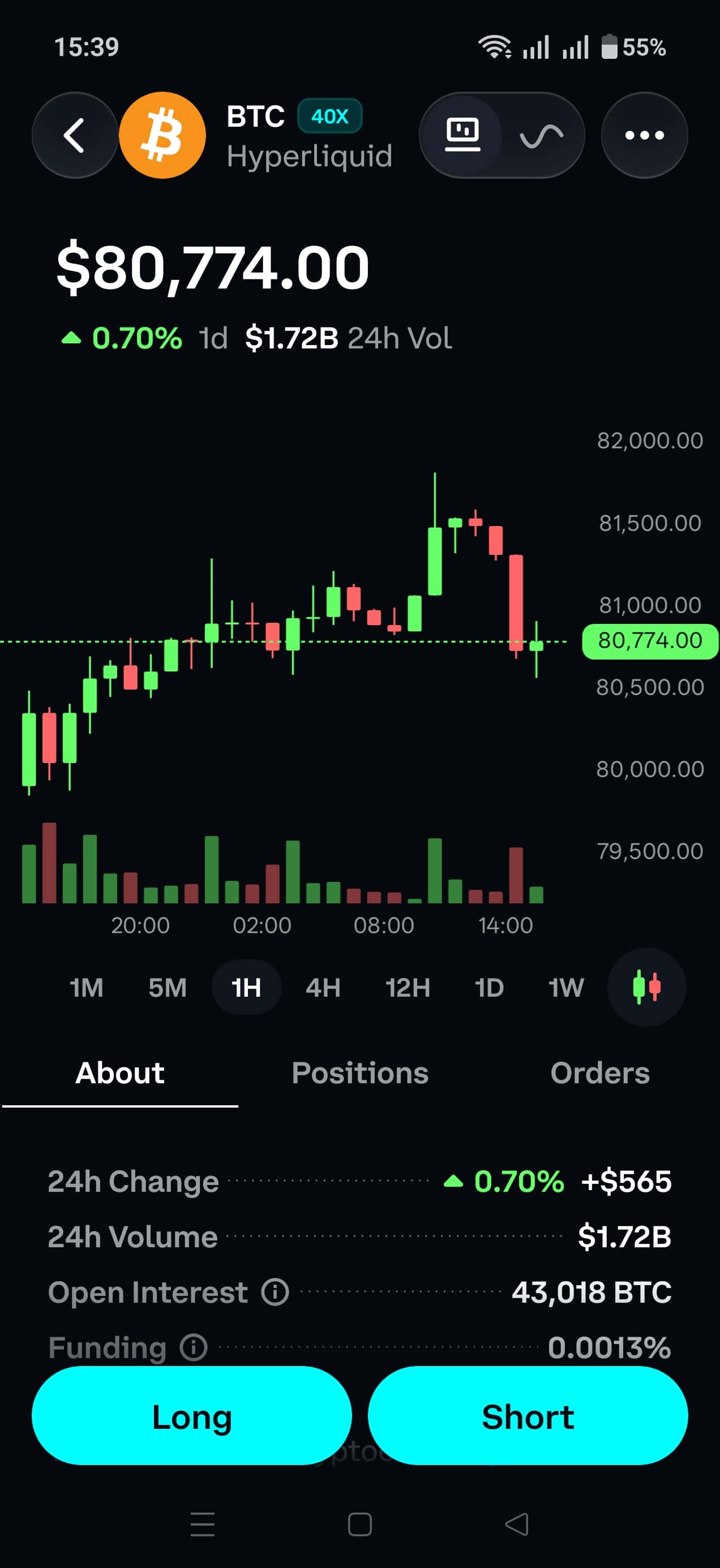
Separately, Coinbase develops Base App (formerly Coinbase Wallet) — an app for independently storing cryptocurrencies and interacting with decentralized services. It lets users manage their own wallet, swap tokens and interact with DeFi protocols and other on-chain applications. Unlike the main app from Coinbase, Base App uses a self-custody model.
API and external platforms
Coinbase provides robust API infrastructure for automated trading, obtaining market data and connecting third-party services.
Key features of Coinbase Advanced API include placing and canceling orders, obtaining information on balances, trading pairs, fees and transaction history. Through the REST API, trading operations can be managed, while WebSocket streams quotes, order book data and order updates in real time.
The exchange supports integration with popular external platforms:
Platform | Features |
|---|---|
Direct connection to Coinbase Advanced, technical analysis, and spot and futures trading from charts | |
Automated strategies, DCA bots, grid bots and trading signals | |
Trading bots, strategy automation and trade management | |
Algorithmic trading, signals and strategy automation | |
Trading terminal, order management and portfolio management | |
Creation of automated trading strategies based on predefined rules |
Integration with TradingView is especially useful for traders who prefer to analyze the market and execute trades in a single interface. Users can connect Coinbase Advanced directly to TradingView and trade supported instruments without constantly switching between platforms.
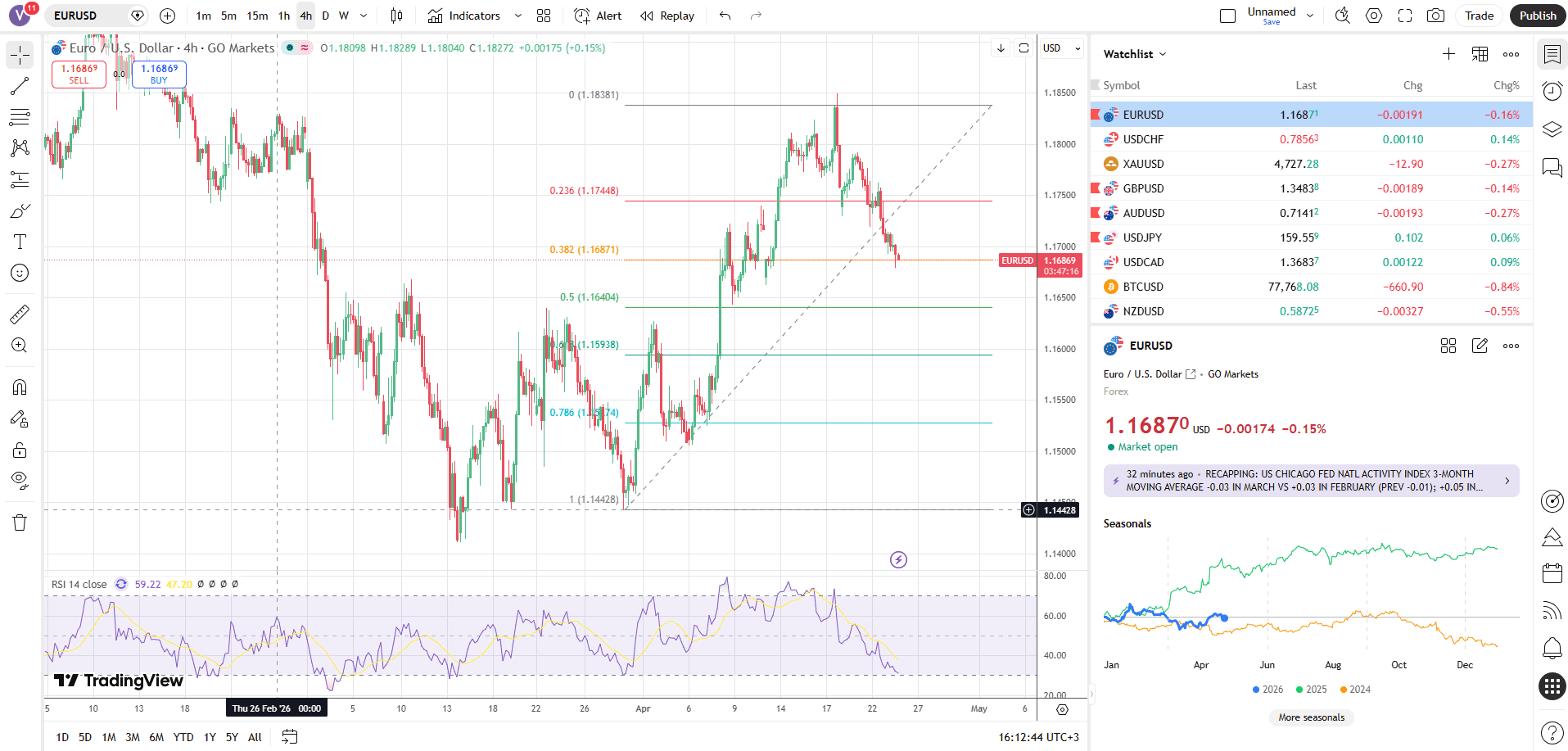
For professional and institutional clients, Coinbase also offers dedicated API interfaces, including FIX and high-performance channels for receiving market data. Following the integration of international derivatives with Deribit, a specialized API gateway based on JSON-RPC is used for the relevant products.
When connecting trading bots, it is recommended to limit the permissions granted to API keys to only the required operations and use allowlists for IP addresses.
Analytics
Coinbase offers advanced analytics infrastructure, combining professional charts from TradingView, technical indicators, market statistics and research from Coinbase Research. Regular reviews, expert forecasts and institutional-grade analytics help provide a deeper assessment of market trends.
Market statistics and monitoring
In the Explore section, Coinbase provides market data for thousands of cryptocurrencies, including assets unavailable for trading on the exchange itself.
For each cryptocurrency, users can view its current price, price movements, market capitalization, daily trading volume, circulating supply and all-time high price.
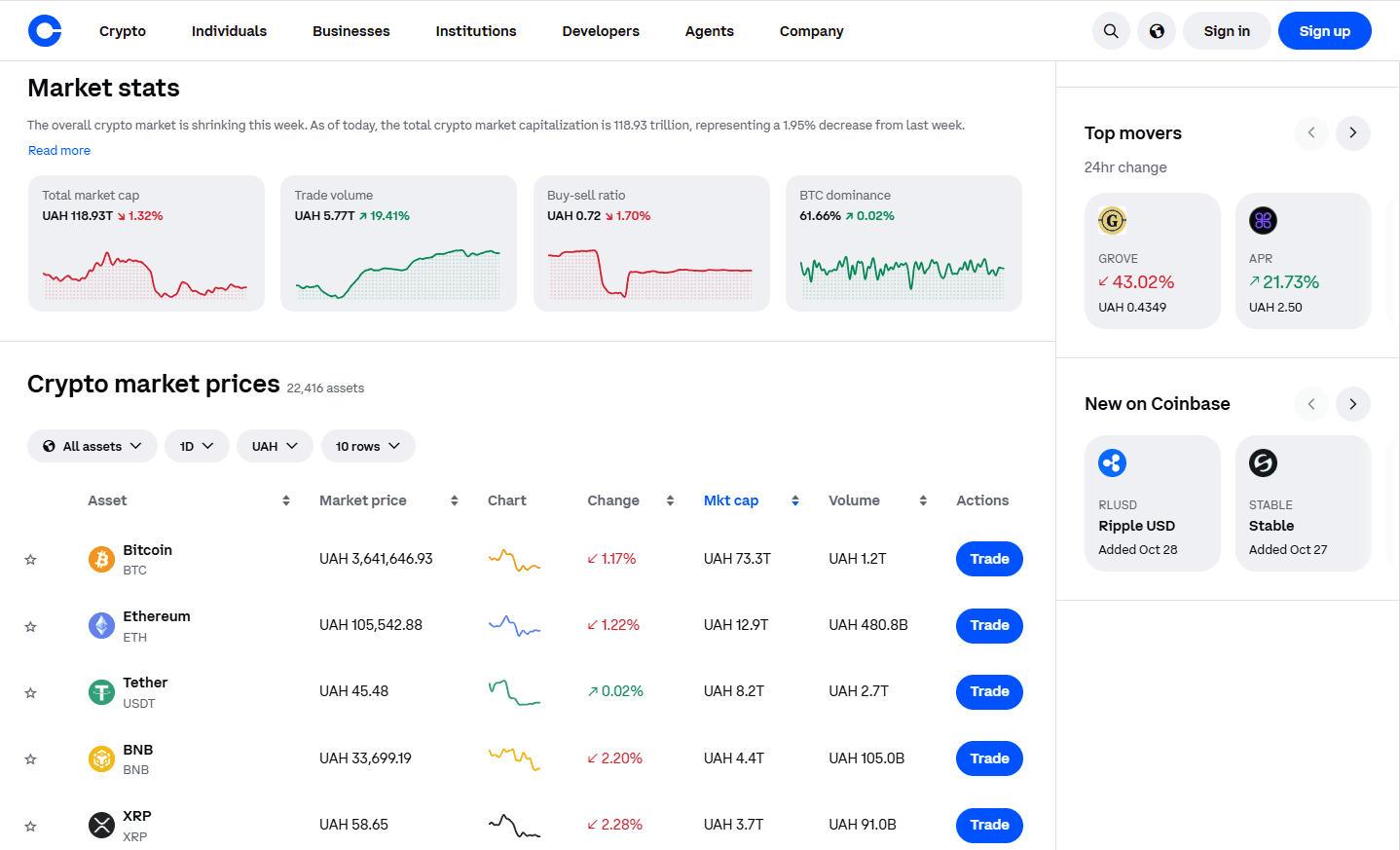
Overall crypto market metrics are also available: total market capitalization, trading volume over the past 24 hours, Bitcoin dominance and the ratio of buys to sells.
To find trading opportunities, users can access rankings of the top gainers and losers, sorting by market capitalization and a list of recently added cryptocurrencies.
Users can add assets of interest to a watchlist (Watchlist) and set alerts for when a certain price is reached. This allows them to monitor the market without constantly viewing charts.
Technical analysis
In Coinbase Advanced, professional charts from TradingView are integrated, allowing users to conduct their own technical analysis directly in the trading terminal.
Main analytical tools:
- 104 technical indicators, including RSI, MACD, moving averages, EMA and Bollinger Bands.
- Interactive charts with various timeframes and candlestick and line price displays.
- Drawing tools for plotting trend lines and support and resistance levels.
- Order book and market depth chart for analyzing liquidity, supply and demand.
- Real-time trade history for monitoring the trading activity of market participants.
Traders can combine indicators, save chart settings and track changes in market liquidity. All the main tools in Coinbase Advanced are available without a paid subscription.
Research from Coinbase Research
One of the main advantages of Coinbase is its in-house analytics division Coinbase Research, which publishes research on the cryptocurrency market.
Analysts examine the impact of macroeconomics, monetary policy, institutional investment and changes in liquidity on the value of digital assets.
Key analytical publications from Coinbase:
Publication | Content | Frequency |
|---|---|---|
Weekly Market Commentary | Events of the week, macroeconomic factors, capital flows and market outlook | Weekly |
Monthly Outlook | Medium-term forecasts, market scenarios and risk analysis | Monthly, according to the publication schedule |
Crypto Market Positioning | Participant positioning, spot and futures market data, liquidity | Monthly |
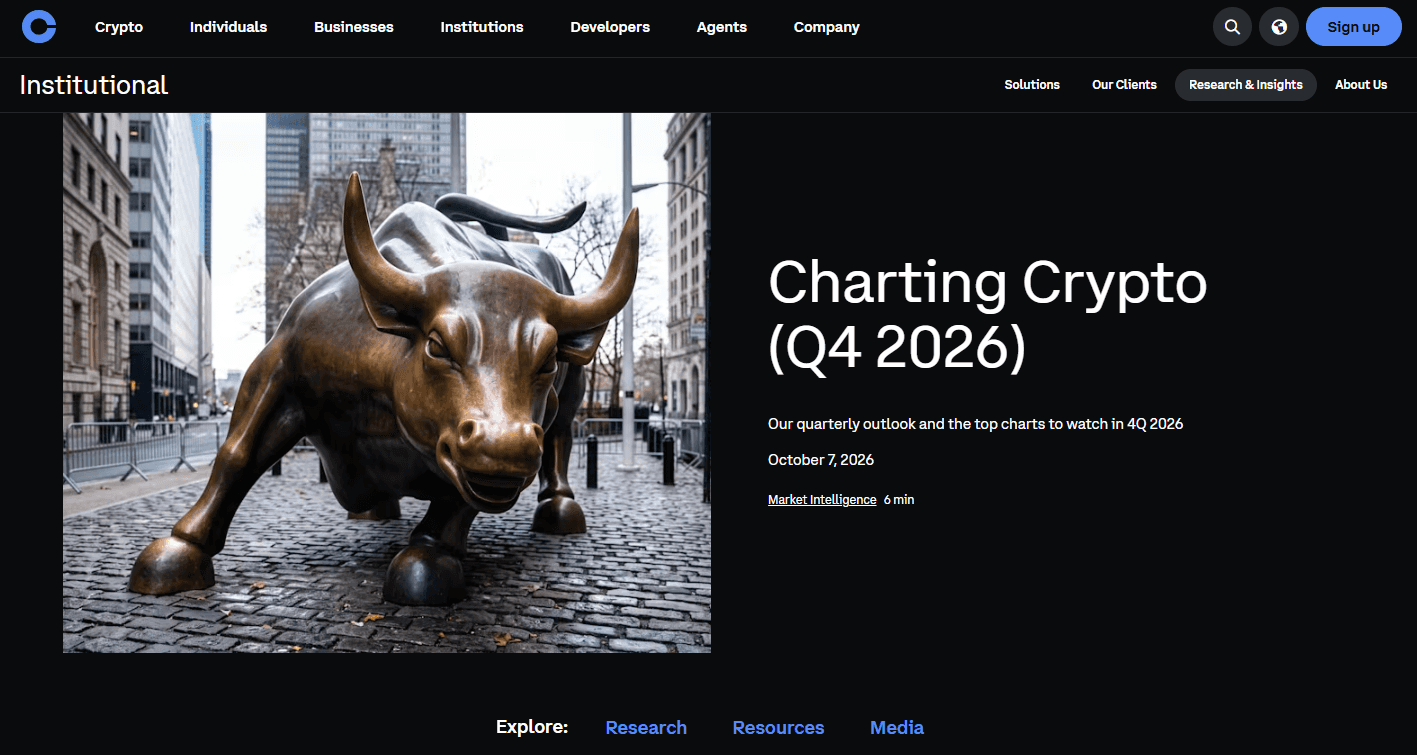
Charting Crypto | Quarterly market review with charts, indicators and key trends | Quarterly |
Market Intelligence | In-depth research on blockchain projects and individual segments of the crypto market | As available |
Tokenomics Review | Analysis of cryptocurrency tokenomics, issuance, distribution and economic mechanisms | Periodically |
Most research is accompanied by charts, statistical data and commentary from professional analysts.
The materials are available in the Coinbase Institutional section. Meanwhile, institutional clients and subscribers to Coinbase One in the United States receive exclusive early access to research seven days before its public release.
Investment portfolio analytics
Coinbase is also developing tools for evaluating investment performance. The Portfolio Performance feature allows users to analyze changes in asset values and track investment performance.
Users can access data on portfolio composition, average purchase price, realized and unrealized profit, overall returns and changes in capital over a selected period.
Education
Coinbase offers a high-quality and diverse educational resource library, including articles, video tutorials, practical guides, and materials for advanced traders. The educational content covers cryptocurrencies, trading strategies, technical analysis, and risk management. The materials are available free of charge and are well structured.
Coinbase Learn: cryptocurrency basics
Coinbase Learn is the exchange's main educational portal, designed for users of all experience levels.
The Crypto Basics section contains introductory materials explaining how digital assets and blockchain technologies work. The articles are written in accessible language and include examples that help readers understand complex concepts without specialist knowledge.
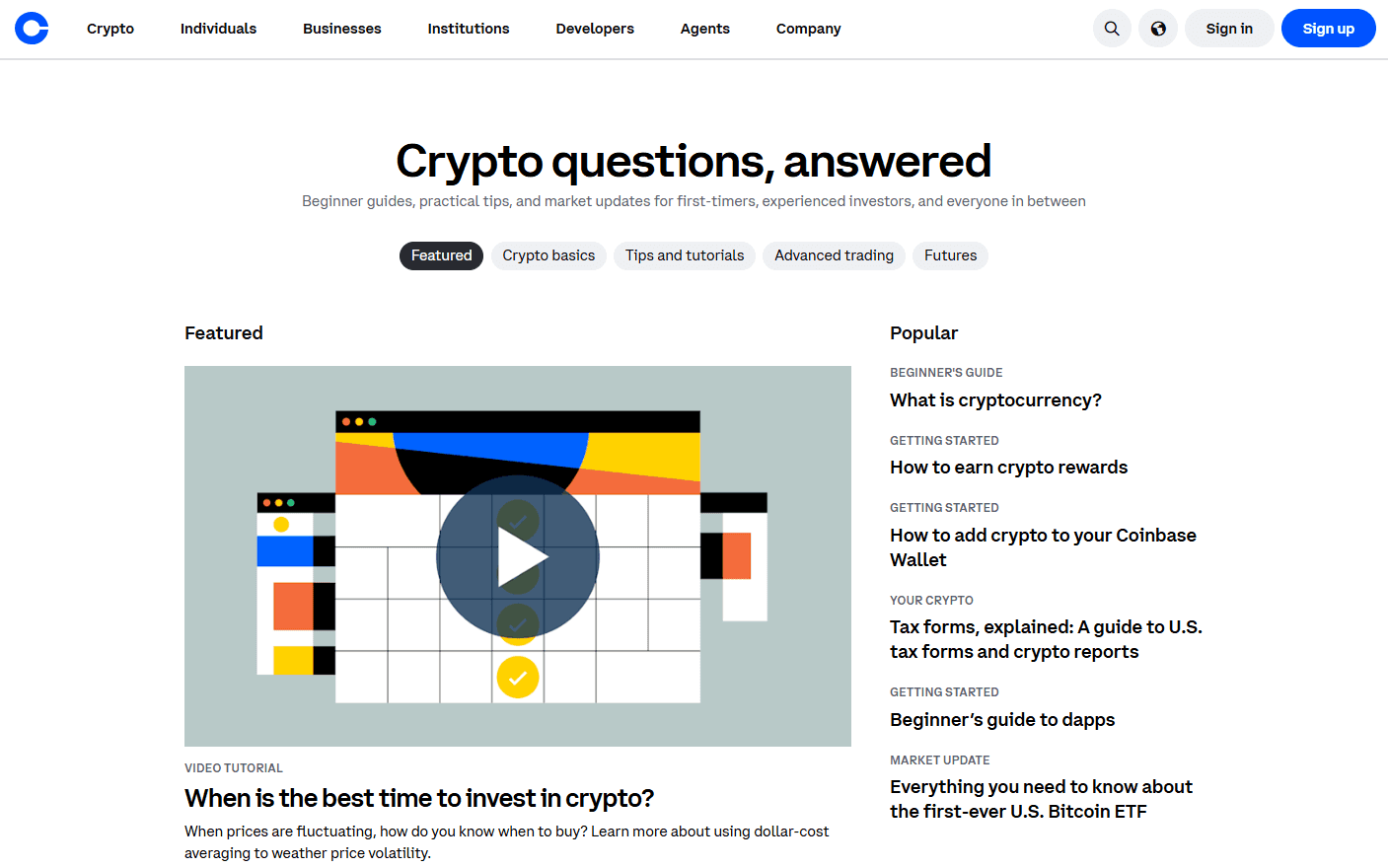
The main learning topics are:
- Cryptocurrencies and blockchain. How Bitcoin, Ethereum, stablecoins, mining, and consensus mechanisms work.
- Investing. The basics of spot trading, dollar-cost averaging (DCA), volatility, and market cycles.
- Decentralized finance. Staking, DeFi protocols, smart contracts, and decentralized exchanges.
- Security. Cryptocurrency storage, private key protection, scam detection, and risk management.
Also available is the Crypto Glossary, a reference guide to cryptocurrency terms that explains key concepts. It is useful for beginners who are just becoming familiar with professional terminology.
Trading education
For users who want to master active trading, Coinbase offers the Advanced Trading section.
The materials cover trading orders, chart analysis, liquidity assessment, and the professional tools available in Coinbase Advanced.
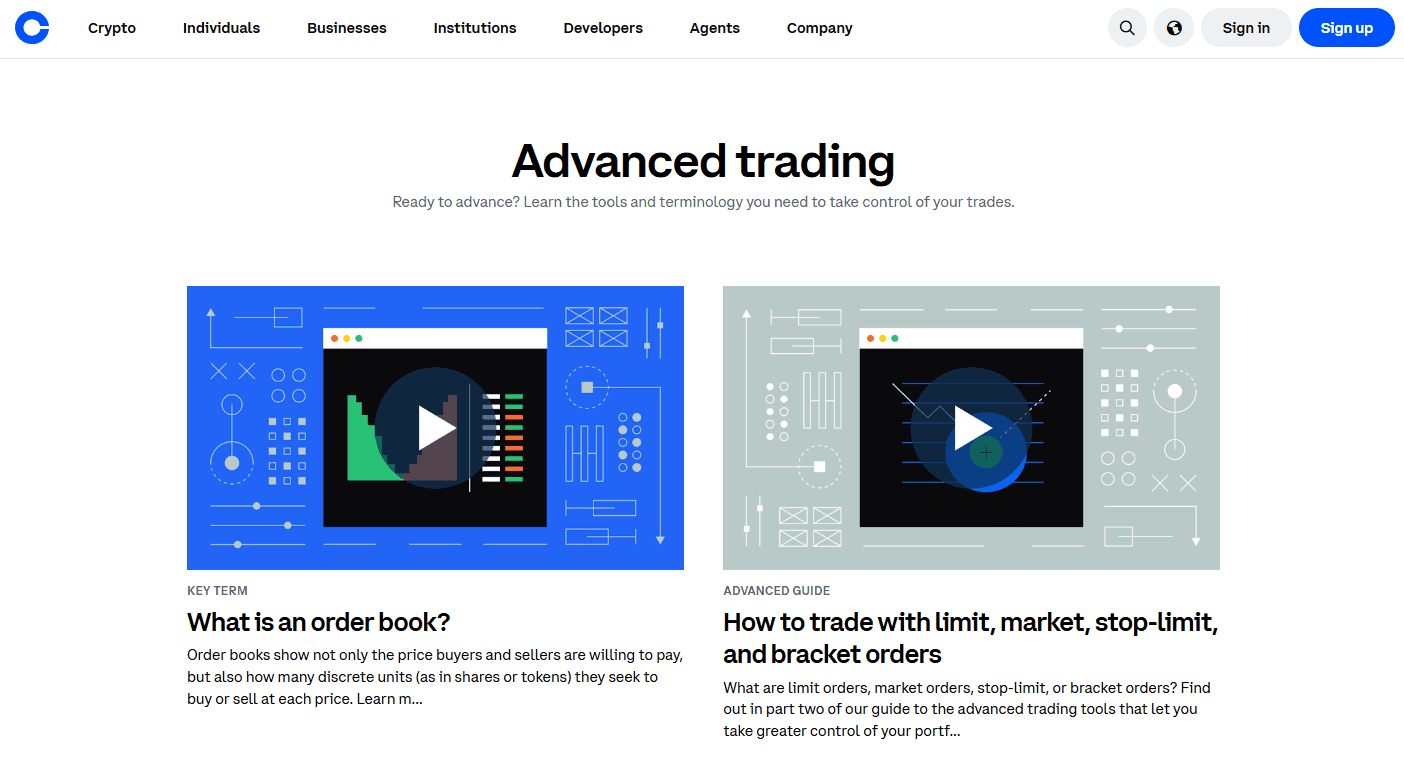
The educational content covers the following areas:
- Market, limit, stop-limit, and combination orders.
- Reading candlestick charts and using technical indicators.
- Analyzing the order book, liquidity, and market depth.
- Automated trading, trading bots, and algorithmic strategies.
- Arbitrage, margin trading, and risk management.
Coinbase also offers a series of video tutorials on Coinbase Advanced. They show how to use professional charts, analyze market depth, and manage open orders.
The combination of theoretical materials and practical instructions for using the platform is particularly useful. Users can study a specific tool and then apply what they have learned in the trading interface.
Futures trading education
At Coinbase, there is a dedicated educational section on futures, developed with the involvement of Coinbase Derivatives.
The materials explain how futures contracts work, how to open and close positions, how margin is used, and the main trading strategies.
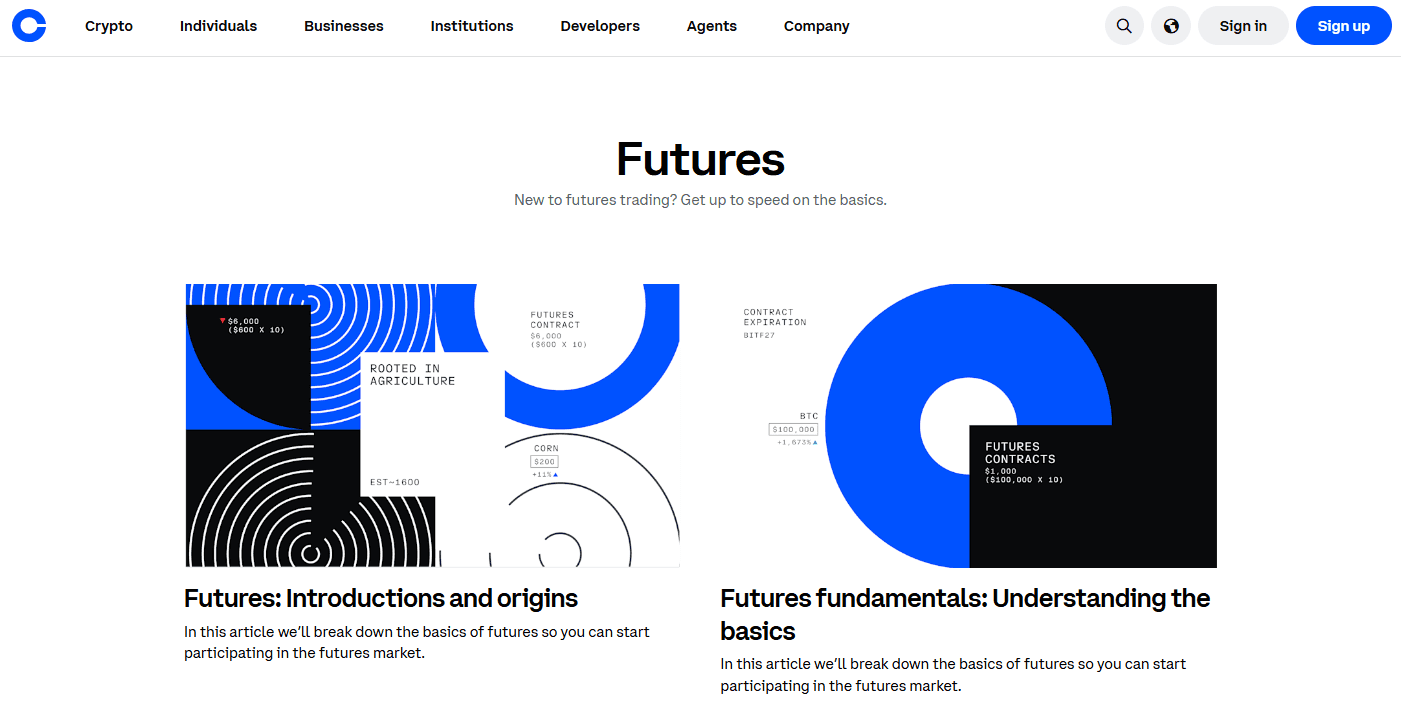
Particular attention is paid to the differences between long and short positions, speculative trading, and risk hedging. Separate articles examine volatility, leverage, and potential losses when trading derivatives.
Practical guides and security
The Tips and Tutorials section contains step-by-step instructions on using cryptocurrencies and related services.
Users can learn how to create a cryptocurrency wallet, send and receive digital assets, use decentralized applications, or interact with NFT.
Security materials are given a dedicated place. Coinbase explains how to protect an account, use two-factor authentication, store recovery phrases, and identify fraudulent transactions.
Additional instructions are available in the Coinbase Help Center. They cover registration, verification, account setup, payment methods, and troubleshooting common technical issues.
Customer Support
Coinbase offers a wide range of contact channels, including 24-hour live chat, phone support, and priority service for Coinbase One subscribers. Common issues are usually resolved fairly quickly, and the staff have the necessary expertise.
Support contact channels
You can contact Coinbase in several ways:
- Live chat. The main support channel is the Coinbase Help Center. Users first interact with a virtual assistant, which offers instructions and solutions to common problems. If necessary, they can request a connection to a live agent.
- Phone support. Coinbase allows users to contact an agent by phone or request a callback. In the United States, Canada, the United Kingdom, and some other regions, service is available 24 hours a day. Some countries have restrictions on operating hours and language availability.
- Electronic requests. Users can submit a request through the help center concerning account access, verification, transfers, or other operations. Responses and request updates may be sent by email.
- Social media. Coinbase maintains official contact channels on X and other social networks. They are suitable for general questions and checking the status of a request, but confidential data should only be shared through secure support channels.
- Coinbase One. Preferred subscribers receive 24-hour priority support, while Premium members have access to the Concierge service with personal assistance.
There is also an official complaint procedure. If a regular request does not resolve the problem, the user can submit a formal complaint that includes the request number and supporting documents.
Support is available in several languages, including English, German, French, Spanish, and Portuguese. However, the availability of a specific language depends on the region and contact channel.
Response time
Coinbase uses an automated request-processing system, so initial information on common issues can be obtained almost instantly. The virtual assistant helps users find the relevant instructions, check possible causes of an error, or begin the access recovery process.
When contacting a live agent, the wait time depends on support workload, region, and the complexity of the issue. Coinbase does not publish a single guaranteed response time for all retail customers.
According to user reviews, service speed varies considerably. Some customers report that problems are resolved quickly via chat and phone, while others report long waits for an agent and the need to make repeated requests.
Complex cases involving identity verification, account restrictions, suspicious transactions, or frozen funds may take several days or longer to review. Resolving them often requires the involvement of specialized departments.
Subscribers to Coinbase One Preferred and Premium have the advantage of priority request processing. However, even personal assistance does not guarantee an immediate resolution of issues requiring additional checks.
Support expertise
Coinbase has specialized teams to handle issues related to trading operations, payments, security, and regulatory compliance.
Support staff help restore account access, resolve verification errors, check the status of bank and cryptocurrency transfers, clarify restrictions, and resolve technical platform issues.
Support is most effective with standard requests, for which ready-made instructions and automated procedures are available. Users can reset their password, set up two-factor authentication, or check a transaction's status through the help center.
The situation is less clear with more complex issues. Reviews include complaints about scripted responses, requests being repeatedly transferred between specialists, and insufficiently detailed explanations for why funds were frozen. This is particularly true in cases requiring review by the security or compliance department.
An advantage of Coinbase is the ability to escalate requests and the availability of personal assistance for certain customer categories. However, the quality of resolutions for nonstandard problems remains less consistent than the handling of routine requests.
Conclusion
Coinbase is one of the leading U.S. crypto exchanges and has grown over the years into a large-scale platform for trading and investing in digital assets. The company places considerable emphasis on regulation, security, and developing its ecosystem. In terms of its overall capabilities, Coinbase holds a strong position in the global cryptocurrency market.
The exchange is suitable for both novice investors who value simplicity and convenience and experienced traders who need professional trading tools. Coinbase is also of interest to long-term investors and major market participants. Overall, it is a versatile cryptocurrency platform offering a high level of reliability and extensive capabilities for different categories of users.
FAQ
What is Coinbase?
Coinbase is an American crypto exchange founded in 2012. The platform allows users to buy, sell, exchange, and store cryptocurrencies. Coinbase offers both a simple interface for beginner investors and the professional trading tools of Coinbase Advanced.
Is Coinbase safe?
Coinbase is considered one of the most reliable crypto exchanges due to regulation in several jurisdictions, public financial reporting, and the cold storage of most customer assets. However, the company has faced regulatory sanctions and data breaches. Cryptocurrency funds are not protected by government deposit insurance, so risks cannot be eliminated entirely.
How does Coinbase work?
Coinbase acts as an intermediary between cryptocurrency buyers and sellers, facilitating trade execution and the storage of digital assets. Users can buy cryptocurrency with fiat money, trade on spot and futures markets, transfer funds, and earn staking rewards. The exchange charges fees for transactions.
How to use Coinbase?
To get started, users need to register with Coinbase, verify their identity, and fund their account. They can then buy and sell cryptocurrencies through the standard interface or use Coinbase Advanced for professional trading. It is advisable to set up two-factor authentication immediately to protect the account.
How to open an account with Coinbase?
Go to the official website of Coinbase or install the mobile app. Click Sign up, enter an email address, create a password, and confirm the contact details. Then provide personal information and complete the mandatory identity verification process (KYC) by uploading an identity document and, if necessary, additional documents. Registration is free.
How to make a deposit on Coinbase?
You can fund Coinbase with a cryptocurrency transfer from an external wallet or with fiat funds through an available payment method. For a cryptocurrency deposit, select Receive crypto, specify the asset and network, and then send the funds to the provided address. To deposit fiat funds, use Deposit cash and select a bank transfer or another available payment method. Supported methods depend on the country of residence.
How to trade on Coinbase?
To buy cryptocurrency, select Buy, specify the asset, amount, and payment method, then review the terms and confirm the trade. For professional trading, go to Coinbase Advanced, select a trading pair and an order type: market, limit, or stop-limit. Futures trading is also available in supported jurisdictions.
How to sell cryptocurrency on Coinbase?
Open the Sell section, select the cryptocurrency, and specify the amount to sell. Then select the currency or balance to which the funds should be credited, review the fee, and confirm the transaction. Once the trade is executed, the money will be credited to the relevant balance, from which it can be withdrawn using an available method or used for subsequent purchases.
How to withdraw money from Coinbase?
To withdraw fiat funds, first sell the cryptocurrency, then open Withdraw Cash, specify the amount, and select a bank account, card, or another available payment method. To withdraw cryptocurrency, use Send crypto and enter the recipient's address, network, and amount. Be sure to check the details and fees before confirming. Withdrawal methods and processing times depend on the region.
How to delete an account on Coinbase?
To close an account, users must withdraw all funds, complete pending transactions, and cancel any active Coinbase One subscription. They should then go to the account closure page in the Coinbase settings, select Close account, and confirm the action using two-factor authentication. Closure is irreversible, although Coinbase may continue to retain certain personal data in accordance with the law.